
BuddhistCatholicContemplativeEvangelicalGeneral ChristianHinduJewishLatter-day SaintMuslimNew VisionsProgressive Christian
Beliefs
- Buddhist
- Catholic
- Contemplative
- Evangelical
- General Christian
- Hindu
- Jewish
- Latter-day Saint
- More Voices
- Muslim
- New Visions
- Pagan
- Progressive Christian
Topics
- Religion News
- Food and Religion
- Sports and Religion
- Religious Art
- Religious Music and Entertainment
- Religious Events
- History and Religion
- Style and Religion
- Politics and Religion
- Women in Religion
- Recreation Outdoors and Religion
- Business Finance and Religion
- Careers Workplace and Religion
- Education and Religion
- Family Parenting and Religion
- Health Fitness and Religion
- Home and Religion
- Relationships and Religion
- Technology and Religion
- Travel and Religion
Columnists
- Buddhist Columnists
- Business Finance and Religion Columnists
- Careers Workplace and Religion Columnists
- Catholic Columnists
- Contemplative Columnists
- Education and Religion Columnists
- Evangelists Columnists
- Family Parenting and Religion Columnists
- General Christian Columnists
- Health Fitness and Religion Columnists
- Hindu Columnists
- History and Religion Columnists
- Home and Religion Columnists
- Jewish Columnists
- More Voices Columnists
- Latter Day Columnists
- Muslim Columnists
- New Visions Columnists
- Nonreligious Columnists
- Pagan Columnists
- Politics and Religion Columnists
- Progressive Columnists
- Recreation Outdoors and Religion Columnists
- Relationships and Religion Columnists
- Religion News Columnists
- Religious Art Columnists
- Religious Events Columnists
- Religious Music and Entertainment Columnists
- Sports and Religion Columnists
- Style and Religion Columnists
- Technology and Religion Columnists
- Travel and Religion Columnists
- Women in Religion Columnists
Resource Library
- 2026 Calendar
- Library of World Religions
- The 100 Most Holy Places on Earth
- Patheos Answers
- Podcasts
- Videos
- Faith Leaders Database
- Anglican Episcopalian
- Bahai
- Baptist
- Buddhism
- Christianity
- Confucianism
- Eastern Orthodoxy
- Hinduism
- Holiness and Pentecostal
- ISKCON
- Islam
- Judaism
- Lutheran
- Methodist
- The Church of Jesus Christ of Latter-day Saints
- New Age
- Paganism
- Presbytarian and Reformed
- Protestantism
- Religion Behind the Scenes
- Roman Catholic
- Scientology
- Shia Islam
- Sikhism
- Sufism
- Sunni Islam
- Taoism
- Zen
- See all religions
Research Tools
 Ad-Free & Subscriber Log-In Subscription Support
Ad-Free & Subscriber Log-In Subscription Support
Follow Patheos 

- Trending:
- Forgiveness
- |
- Marriage
- |
- Consciousness
- |
- Death Penalty
- |
- Election
- |
- Halloween

- Home
- Religious Music and Entertainment
- Subsidarity Is Not Libertarianism
Subsidarity Is Not Libertarianism
Last updated on: August 9, 2017 at 7:16 pm by Chase Padusniak
Subsidarity Is Not Libertarianism 2017-08-09T19:16:13-04:00 Chase Padusniak
Patheos Explore the world's faith through different perspectives on religion and spirituality! Patheos has the views of the prevalent religions and spiritualities of the world.
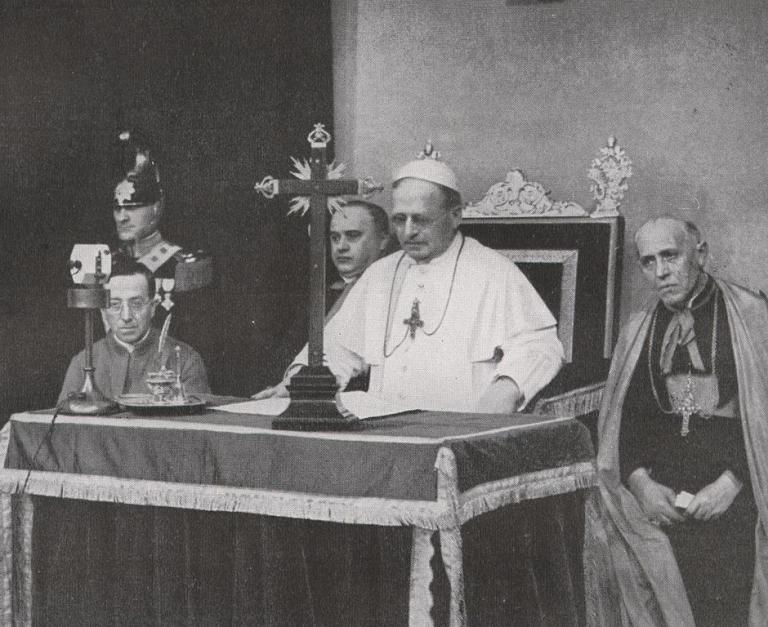
Pope Pius XI at the opening of Vatican Radio on February 12, 1931. Public Domain.
Subsidiarity is a word that gets thrown around a good deal in Catholic circles. Typically, it’s associated with distributism, and most always with Catholic Social Teaching on the whole. Its emphasis on what some would call “federalism” (to me this colors the concept with Americanism so stark that it becomes unrecognizable) is, however, often perverted such that it no longer makes sense within its great theoretical context (e.g. its association with solidarity). In the United States, many “followers of Catholic Social Teaching,” many “distributists” are effectively libertarians.
I am not a distributist (though the idea has my sympathies; it seems to lack, however, the theoretical heft of Marx’s analysis of capitalism. Its solutions are decent ones, but it underestimates the intractable nature of capitalist economic structures). But, as an admirer of Dorothy Day, as a member of the American Solidarity Party (may my friends on the Catholic Left have mercy on me), and, well, merely as a Catholic, clarifying this definition holds a special significance. And so, with my meager, graduate-student, blogger’s powers, I shall try.
First, we’ll need a general definition of subsidiarity. The Catechism has this to say:
The teaching of the Church has elaborated the principle of subsidiarity, according to which “a community of a higher order should not interfere in the internal life of a community of a lower order, depriving the latter of its functions, but rather should support it in case of need and help to co-ordinate its activity with the activities of the rest of society, always with a view to the common good.”
This division of powers, so to speak, seems, to the American ear, to mean federalism as it is spoken about in the U.S. Here, for example, is the Acton Institute on subsidiarity:
Monsignor Higgins, by contrast, fails to even mention the relationship between federal, state, and local governments. Any extended discussion of the principle of subsidiarity which neglects to consider the respective roles of the state and federal governments in the American system is radically flawed. As our founding fathers made clear in The Federalist Papers, the U.S. Constitution was designed to leave many issues of great importance in the hands of the states. The federal government was to do only those things which the individual states could not effectively do for themselves. The subsidiarity principle was at work in the foundation of our nation. But from the New Deal era onwards, there has been a steady growth in federal power at the expense of the states. This has sparked a renewed interest in the Tenth Amendment, which reserves all powers not delegated to the federal government to the states.
This amounts to an equation of (a specific understanding of) American-style federalism with subsidiarity. This is prima facie misguided for a couple reasons. For one, the term “subsidiarity” entered our “social teaching” (it did not quite have the name yet) through Friedrich Emmanuel Freiherr von Ketteler, Bishop of Mainz. In context, he was carving out a space for Catholic liberty in the midst of persecution during the German Kulturkampf (not to mention his dalliance with certain forms of socialism). This moment in history was not about “levels of governance,” but represented a time of fierce Protestant aggression against German Catholics:
Kulturkampf, (German: “culture struggle”), the bitter struggle (c. 1871–87) on the part of the German chancellor Otto von Bismarck to subject the Roman Catholic church to state controls. The term came into use in 1873, when the scientist and Prussian liberal statesman Rudolf Virchow declared that the battle with the Roman Catholics was assuming “the character of a great struggle in the interest of humanity.”
Bismarck, a staunch Protestant, never fully trusted the loyalty of the Roman Catholics within his newly created German Empire and became concerned by the Vatican Council’s proclamation of 1870 concerning papal infallibility. The Roman Catholics, who were represented politically by the Centre Party, distrusted the predominance of Protestant Prussia within the empire and often opposed Bismarck’s policies.
The conflict began in July 1871, when Bismarck, supported by the liberals, abolished the Roman Catholic bureau in the Prussian Ministry of Culture (i.e., ministry of education and ecclesiastical affairs) and in November forbade priests from voicing political opinions from the pulpit. In March 1872 all religious schools became subject to state inspection; in June all religious teachers were excluded from state schools, and the Jesuit order was dissolved in Germany; and in December diplomatic relations with the Vatican were severed. In 1873 the May Laws, promulgated by the Prussian minister of culture, Adalbert Falk, placed strict state controls over religious training and even over ecclesiastical appointments within the church. The climax of the struggle came in 1875, when civil marriage was made obligatory throughout Germany. Dioceses that failed to comply with state regulations were cut off from state aid, and noncompliant clergy were exiled.
The principle, however, became something of a buzzword at a more fully-ecclesial level via Pius XI’s Quadragesimo Anno:
The supreme authority of the State ought, therefore, to let subordinate groups handle matters and concerns of lesser importance, which would otherwise dissipate its efforts greatly. Thereby the State will more freely, powerfully, and effectively do all those things that belong to it alone because it alone can do them: directing, watching, urging, restraining, as occasion requires and necessity demands. Therefore, those in power should be sure that the more perfectly a graduated order is kept among the various associations, in observance of the principle of “subsidiary function,” the stronger social authority and effectiveness will be the happier and more prosperous the condition of the State.
First and foremost, the State and every good citizen ought to look to and strive toward this end: that the conflict between the hostile classes be abolished and harmonious cooperation of the Industries and Professions be encouraged and promoted
The social policy of the State, therefore, must devote itself to the re-establishment of the Industries and Professions. In actual fact, human society now, for the reason that it is founded on classes with divergent aims and hence opposed to one another and therefore inclined to enmity and strife, continues to be in a violent condition and is unstable and uncertain.
Labor, as Our Predecessor explained well in his Encyclical, is not a mere commodity. On the contrary, the worker’s human dignity in it must be recognized. It therefore cannot be bought and sold like a commodity. Nevertheless, as the situation now stands, hiring and offering for hire in the so-called labor market separate men into two divisions, as into battle lines, and the contest between these divisions turns the labor market itself almost into a battlefield where, face to face, the opposing lines struggle bitterly. Everyone understands that this grave evil which is plunging all human society to destruction must be remedied as soon as possible.
Previous Post

August 8, 2017
Catholic Modesty Fetishism
Next Post

August 22, 2017 For Those Considering Leaving the Church
Browse Our Archives
Select a Category Academia Culture Politics Reviews Theology Uncategorized
Select a Month October 2026 September 2026 August 2026 July 2026 June 2026 May 2026 April 2026 March 2026 February 2026 January 2026 December 2025 November 2025 October 2025 September 2025 August 2025 July 2025 June 2025 May 2025 April 2025 March 2025 February 2025 January 2025 December 2024 November 2024 October 2024 September 2024 August 2024 July 2024 June 2024 May 2024 April 2024 March 2024 February 2024 January 2024 December 2023 November 2023 October 2023 September 2023 August 2023 July 2023 June 2023 May 2023 April 2023 March 2023 February 2023 January 2023 November 2022 October 2022 September 2022 August 2022 July 2022 June 2022 May 2022 April 2022 March 2022 February 2022 July 2021 December 2020 November 2020 July 2020 May 2020 April 2020 February 2020 January 2020 December 2019 November 2019 October 2019 August 2019 July 2019 April 2019 March 2019 December 2018 August 2018 July 2018 June 2018 May 2018 April 2018 March 2018 January 2018 December 2017 November 2017 September 2017 August 2017 July 2017 June 2017 May 2017 April 2017 March 2017 February 2017 January 2017 December 2016 November 2016 October 2016 September 2016 August 2016 July 2016 June 2016 May 2016 April 2016 March 2016 February 2016
Follow Us!
TAKE THE
Religious Wisdom Quiz
What city was known as the City of David?
Select your answer to see how you score.
Bethlehem Jerusalem Jericho Nazareth
Related posts from Jappers and Janglers


Apostasy, Scandal, and a Road Well-Trod
TRENDING AT PATHEOS Religious Music and Entertainment

The Iron Gates and the Lion of the...
Yesterday, I didn't finish my report about, well, yesterday. So I'll...

Dolly Parton’s Last Song Wins Dove Award with...
Bluegrass band The Grascals, speaking on the red carpet at the 57th...

The Image: On the Horror of Capitalism and...
The Image Then went the Pharisees, and took counsel how they might...

We are approaching the date of our new American national holiday: October...

Letters on Living the Faith by C.S. Lewis
Most of us met C.S. Lewis as a public intellectual. Mere Christianity....

When Halloween Unmasks Married Hearts
Written by Dr. David K. Ewen from Eternal Truth Bible College Behind...
view all Religious Music and Entertainment blogs
Ad-Free & Subscriber Log-In Subscription Support
- About Us
- 2026 Calendar
- Videos
- Podcasts
- Library of World Religions
- Faith In Media Tracker
- Advertise With Us
- Write for Us
- Privacy Policy
- Terms of Service
- Do Not Sell My Data
- Contact Us
- Radiant Digital
- Manage Newsletter Subscriptions
- Unsubscribe From Notifications
- Sitemap
Copyright 2008-2026, Patheos. All rights reserved.
Subscription Support Ad-Free & Subscriber Log-In
Follow Patheos