
BuddhistCatholicContemplativeEvangelicalGeneral ChristianHinduJewishLatter-day SaintMuslimNew VisionsProgressive Christian
Beliefs
- Buddhist
- Catholic
- Contemplative
- Evangelical
- General Christian
- Hindu
- Jewish
- Latter-day Saint
- More Voices
- Muslim
- New Visions
- Pagan
- Progressive Christian
Topics
- Religion News
- Food and Religion
- Sports and Religion
- Religious Art
- Religious Music and Entertainment
- Religious Events
- History and Religion
- Style and Religion
- Politics and Religion
- Women in Religion
- Recreation Outdoors and Religion
- Business Finance and Religion
- Careers Workplace and Religion
- Education and Religion
- Family Parenting and Religion
- Health Fitness and Religion
- Home and Religion
- Relationships and Religion
- Technology and Religion
- Travel and Religion
Columnists
- Buddhist Columnists
- Business Finance and Religion Columnists
- Careers Workplace and Religion Columnists
- Catholic Columnists
- Contemplative Columnists
- Education and Religion Columnists
- Evangelists Columnists
- Family Parenting and Religion Columnists
- General Christian Columnists
- Health Fitness and Religion Columnists
- Hindu Columnists
- History and Religion Columnists
- Home and Religion Columnists
- Jewish Columnists
- More Voices Columnists
- Latter Day Columnists
- Muslim Columnists
- New Visions Columnists
- Nonreligious Columnists
- Pagan Columnists
- Politics and Religion Columnists
- Progressive Columnists
- Recreation Outdoors and Religion Columnists
- Relationships and Religion Columnists
- Religion News Columnists
- Religious Art Columnists
- Religious Events Columnists
- Religious Music and Entertainment Columnists
- Sports and Religion Columnists
- Style and Religion Columnists
- Technology and Religion Columnists
- Travel and Religion Columnists
- Women in Religion Columnists
Resource Library
- 2026 Calendar
- Library of World Religions
- The 100 Most Holy Places on Earth
- Patheos Answers
- Podcasts
- Videos
- Faith Leaders Database
- Anglican Episcopalian
- Bahai
- Baptist
- Buddhism
- Christianity
- Confucianism
- Eastern Orthodoxy
- Hinduism
- Holiness and Pentecostal
- ISKCON
- Islam
- Judaism
- Lutheran
- Methodist
- The Church of Jesus Christ of Latter-day Saints
- New Age
- Paganism
- Presbytarian and Reformed
- Protestantism
- Religion Behind the Scenes
- Roman Catholic
- Scientology
- Shia Islam
- Sikhism
- Sufism
- Sunni Islam
- Taoism
- Zen
- See all religions
Research Tools
 Ad-Free & Subscriber Log-In Subscription Support
Ad-Free & Subscriber Log-In Subscription Support
Follow Patheos 

- Trending:
- Forgiveness
- |
- Marriage
- |
- Consciousness
- |
- Death Penalty
- |
- Election
- |
- Halloween

- Home
- Religious Music and Entertainment
- What Is Religious Art?
What Is Religious Art?
Last updated on: August 25, 2017 at 11:08 am by Chase Padusniak
What Is Religious Art? 2017-08-25T11:08:45-04:00 Chase Padusniak
Patheos Explore the world's faith through different perspectives on religion and spirituality! Patheos has the views of the prevalent religions and spiritualities of the world.
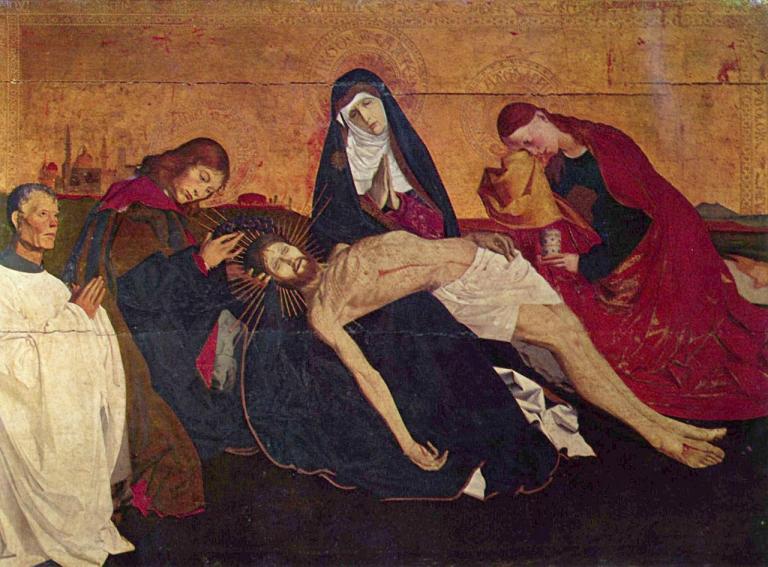
The Pietà of Villeneuve-lès-Avignon (1455) by Enguerrand Quarton. Public Domain.
On the one hand, this might seem a sort of silly question. Who cares what counts as religious art? When one sees a giant depiction of Jesus Christ, it’s safe to assume one is dealing with it. Other forms might present some complexities, maybe even a few outliers, but, on the whole, what you see is what you get.
I am not, however, just interested in discussing visual art. What makes for a religious book? Poem? Film? One could go on and on. The question has all the more immediacy because there’s a tendency these days to decry all forms of Modern art as useless, godless, and ugly. Among Catholics, there’s a noticeable desire to turn to older forms—typically Renaissance and Early Modern ones in the aftermath of much post-Vatican II church building. While these impulses do not always go together, it is certainly not uncommon to hear one degraded while a sort of return is countenanced. What if social conditions today could be appropriated for religious purposes as well?
To assume they cannot is, I think, a sort of mistake. For one, to do so elides the distinction between popular and other forms of art within the premodern and Early Modern worlds. There was plenty of bawdy stuff; it wasn’t all pristine religiosity. Additionally, to do so simply misunderstands how it is that religious art can function within a society such as our own, one not predominantly populated by, well, religious people (N.B. given that this is a Catholic blog, my examples here will concentrate on Catholicism, though I imagine the basic concepts could be applied to most other religious groups).
There are, in practice, two sorts of religious art. First and foremost there is that put up in churches within an explicitly religious context, whether visual or textual. This would include stained glass, the mime plays sometimes put on during medieval sermons, and even the vestments of the clergy. These are not my focus today, since their function is explicitly didactic and laudatory; they necessarily communicate to a limited community (this is, in part, why just putting them outside the church does not work as a means of “popularizing” religious art).
People make other sorts, however. Think of the Lord of the Rings books—implicitly religious without any “overt” Christian symbolism. Think, perhaps a bit more offensively, about Francis Bacon’s Head VI, which, while itself not by a religious artist, plays with the existence of a religious tradition to achieve its effect. What about Andy Warhol’s The Last Supper? As these examples show, art can appropriate religious imagery for other purposes or mask its religious didacticism by popular ways. This, as we will see, may be the key to understanding (and publicizing) religious art today.

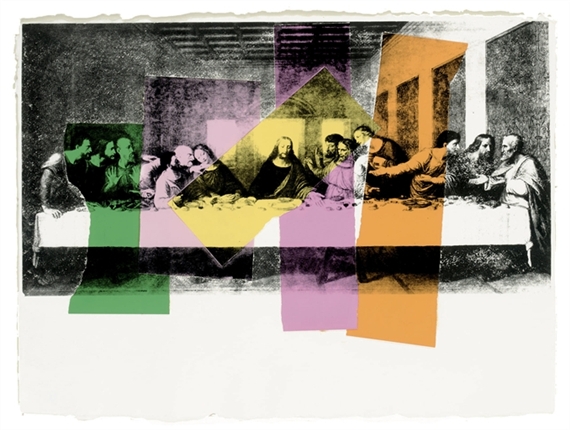
To my mind, both of these sorts of such art are necessary in today’s world. Purely didactic or laudatory religious art is directed at a cohesive community, a set of individuals gathered for a specific, religious reason. It works in churches. There is nothing wrong with it (at all) and, it, of course, can successfully convince people to become religious within certain contexts. But this is not its primary function—to truly understand the intricacies of iconography, or to know the stories of the life of Christ from stained glass—these require oral or textual edification. The tropes used are rooted in existing traditions with which the average viewer or reader is unfamiliar. In short, in spite of its beauty, it often elicits confusion.
Linking past to present, I see this everyday as a grad student working in the field of medieval literature. There are certain poets, for example, who were wildly popular (by the standards of the time anyway) in their own day, but whose work now meets a more-or-less universal “meh.” Part of this has to do with changing conceptions of poetry, but part of it is merely that the implied audience was different for the earlier writer. John Lydgate serves as a good example. He was a Benedictine monk who likely knew Chaucer. In the 15th century, he became fairly famous, working for some of the most important patrons of the day and producing a massive output of some 145,000+ lines of poetry. His popularity endured for some time, with many seeing him as second only to Chaucer in the canon of early English literature. Eventually his fame tapered off; he never got it back. Why? Because, unlike Chaucer, who characteristically developed a deeply ironic sense, worked in a variety of forms, obsessively thought in terms of narrative, and who (in some important ways) broke with medieval poetic sense, Lydgate is the archetypal medieval writer who loves amplificatio, occupatio, and the like. His poems are long, sometimes with dozens of lines making the same point over and over again in different words as a means of celebrating or amplifying that idea’s importance. A brief example:
Beholde, o man! lyft up thyn eye and see
What mortall peyne I suffre for thi trespace.
With pietous voys I crye and sey to the:
Beholde my woundes, behold my blody face,
Beholde the rebukes that do me so manace,
Beholde my enemyes that do me so despice,
And how that I, to reforme the to grace,
Was like a lambe offred in sacryfice.And geyn thi pryde behold my gret mekenesse;
Geyn thyn envie behold my charité;
Geyn thi leccherye behold my chast clennesse;
Geyn thi covetyse behold my poverté.
Atweene too thevys nayled to a tree,
Rayled with reed blood, they lyst me so desguyse,
Behold, O man! all this I did for the,
Meke as a lambe offred in sacryfice.Behold my love, and gyf me thyn ageyn;
Behold, I deyde thy raunsom for to paye.
Se howe myn herte is open brode and pleyn,
Thy gostly enemyes onely to affraye.
An hardere batayle no man myght assaye,
Of all tryumphes the grettest hye empryse.
Wher-for, O man! no lenger to dismaye,
I gaf for the my blood in sacryfice.Turne home ageyn, thy synne do forsake.
Behold and se yf ought be left behynde,
How I to mercy am redy the to take.
Gyf me thyn herte and be no more unkynde;
Thy love and myn, togedyr do hem bynde,
And late hem never departe in any wyse.
Whan thou were lost, thy sowle ageyn to fynde,
My blod I offred for the in sacryfice.Emprente thes thynges in thyn inward thought,
And grave hem depe in thy remembraunce;
Thynke on hem, and forgete hem nowght.
Al this I suffred to do the allegeaunce,
And with my seyntes to yeve the suffisaunce,
In the hevenly court for the I do devyse
A place eternall, a place of all plesaunce;
For which my blood I gaf in sacryfice.
Previous Post

August 22, 2017
For Those Considering Leaving the Church
Next Post
September 5, 2017 A Meditation on the “Our Father”
Browse Our Archives
Select a Category Academia Culture Politics Reviews Theology Uncategorized
Select a Month October 2026 September 2026 August 2026 July 2026 June 2026 May 2026 April 2026 March 2026 February 2026 January 2026 December 2025 November 2025 October 2025 September 2025 August 2025 July 2025 June 2025 May 2025 April 2025 March 2025 February 2025 January 2025 December 2024 November 2024 October 2024 September 2024 August 2024 July 2024 June 2024 May 2024 April 2024 March 2024 February 2024 January 2024 December 2023 November 2023 October 2023 September 2023 August 2023 July 2023 June 2023 May 2023 April 2023 March 2023 February 2023 January 2023 November 2022 October 2022 September 2022 August 2022 July 2022 June 2022 May 2022 April 2022 March 2022 February 2022 July 2021 December 2020 November 2020 July 2020 May 2020 April 2020 February 2020 January 2020 December 2019 November 2019 October 2019 August 2019 July 2019 April 2019 March 2019 December 2018 August 2018 July 2018 June 2018 May 2018 April 2018 March 2018 January 2018 December 2017 November 2017 September 2017 August 2017 July 2017 June 2017 May 2017 April 2017 March 2017 February 2017 January 2017 December 2016 November 2016 October 2016 September 2016 August 2016 July 2016 June 2016 May 2016 April 2016 March 2016 February 2016
Follow Us!
TAKE THE
Religious Wisdom Quiz
Where was Jesus praying the night before He was crucified?
Select your answer to see how you score.
The Garden of Gethsemane Galilee Antioch Tarsus
Related posts from Jappers and Janglers


TRENDING AT PATHEOS Religious Music and Entertainment

Letters on Living the Faith by C.S. Lewis
Most of us met C.S. Lewis as a public intellectual. Mere Christianity....

When Halloween Unmasks Married Hearts
Written by Dr. David K. Ewen from Eternal Truth Bible College Behind...

Aristotle. He’s been called the father of logic, the father of the...

Methodist Central Hall and Westminster Abbey
Situated on the same square is Methodist Central Hall and Westminster Abbey. ...

57th Dove Awards Honor Dolly Parton, Crown New...
On gospel music’s biggest night, the 57th annual GMA Dove Awards honored...

The First Eucharistic Controversy: Christ’s Real Presence
For Catholics, the Eucharist is the source and summit of the Christian...
view all Religious Music and Entertainment blogs
Ad-Free & Subscriber Log-In Subscription Support
- About Us
- 2026 Calendar
- Videos
- Podcasts
- Library of World Religions
- Faith In Media Tracker
- Advertise With Us
- Write for Us
- Privacy Policy
- Terms of Service
- Do Not Sell My Data
- Contact Us
- Radiant Digital
- Manage Newsletter Subscriptions
- Unsubscribe From Notifications
- Sitemap
Copyright 2008-2026, Patheos. All rights reserved.
Subscription Support Ad-Free & Subscriber Log-In
Follow Patheos