
BuddhistCatholicContemplativeEvangelicalGeneral ChristianHinduJewishLatter-day SaintMuslimNew VisionsProgressive Christian
Beliefs
- Buddhist
- Catholic
- Contemplative
- Evangelical
- General Christian
- Hindu
- Jewish
- Latter-day Saint
- More Voices
- Muslim
- New Visions
- Pagan
- Progressive Christian
Topics
- Religion News
- Food and Religion
- Sports and Religion
- Religious Art
- Religious Music and Entertainment
- Religious Events
- History and Religion
- Style and Religion
- Politics and Religion
- Women in Religion
- Recreation Outdoors and Religion
- Business Finance and Religion
- Careers Workplace and Religion
- Education and Religion
- Family Parenting and Religion
- Health Fitness and Religion
- Home and Religion
- Relationships and Religion
- Technology and Religion
- Travel and Religion
Columnists
- Buddhist Columnists
- Business Finance and Religion Columnists
- Careers Workplace and Religion Columnists
- Catholic Columnists
- Contemplative Columnists
- Education and Religion Columnists
- Evangelists Columnists
- Family Parenting and Religion Columnists
- General Christian Columnists
- Health Fitness and Religion Columnists
- Hindu Columnists
- History and Religion Columnists
- Home and Religion Columnists
- Jewish Columnists
- More Voices Columnists
- Latter Day Columnists
- Muslim Columnists
- New Visions Columnists
- Nonreligious Columnists
- Pagan Columnists
- Politics and Religion Columnists
- Progressive Columnists
- Recreation Outdoors and Religion Columnists
- Relationships and Religion Columnists
- Religion News Columnists
- Religious Art Columnists
- Religious Events Columnists
- Religious Music and Entertainment Columnists
- Sports and Religion Columnists
- Style and Religion Columnists
- Technology and Religion Columnists
- Travel and Religion Columnists
- Women in Religion Columnists
Resource Library
- 2026 Calendar
- Library of World Religions
- The 100 Most Holy Places on Earth
- Patheos Answers
- Podcasts
- Videos
- Faith Leaders Database
- Anglican Episcopalian
- Bahai
- Baptist
- Buddhism
- Christianity
- Confucianism
- Eastern Orthodoxy
- Hinduism
- Holiness and Pentecostal
- ISKCON
- Islam
- Judaism
- Lutheran
- Methodist
- The Church of Jesus Christ of Latter-day Saints
- New Age
- Paganism
- Presbytarian and Reformed
- Protestantism
- Religion Behind the Scenes
- Roman Catholic
- Scientology
- Shia Islam
- Sikhism
- Sufism
- Sunni Islam
- Taoism
- Zen
- See all religions
Research Tools
 Ad-Free & Subscriber Log-In Subscription Support
Ad-Free & Subscriber Log-In Subscription Support
Follow Patheos 

- Trending:
- Forgiveness
- |
- Marriage
- |
- Consciousness
- |
- Death Penalty
- |
- Election
- |
- Halloween

- Home
- Religious Music and Entertainment
- Depressive Catholicism
Depressive Catholicism
Last updated on: July 31, 2017 at 9:46 pm by Chase Padusniak
Depressive Catholicism 2017-07-31T21:46:30-04:00 Chase Padusniak
Patheos Explore the world's faith through different perspectives on religion and spirituality! Patheos has the views of the prevalent religions and spiritualities of the world.
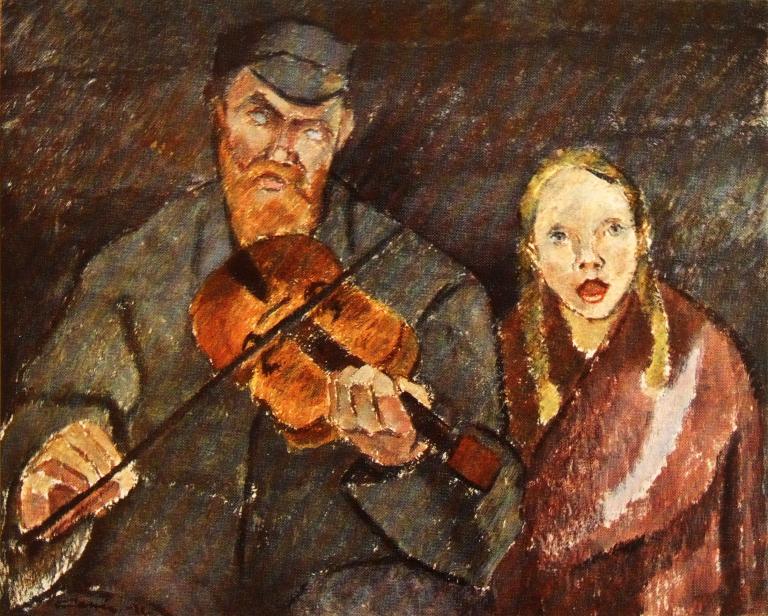
Blind Musician (1922) by Alvar Cawén. Creative Commons License.
It would be wrong of me to identify as “depressed.” For one, I’ve never been diagnosed. Frankly, unless things were to get impossibly bad, I’m resistant to the idea of what I see as medicalizing a variable and temporary condition (I wouldn’t describe my “depressiveness” as clinical). In my eyes, and in the eyes of many theorists and poets before me, anxiety as many experience it is a particularly modern quality. This isn’t to say that no one felt sad before 1500; rather, for those of us who believe social conditions shape how we think, it’s difficult not to note the emphasis on alienation, lingering depressiveness, and general angst in the reportage and literature of the past 300 years. The Romantic poets decried their exteriority to their age; Marx told us of mothers, sweating before power looms, drugging their children to keep them calm, docile. It seems only to be getting worse as modernity beats on.
Marx holds capitalism responsible for much of our busy alienation (getting and spending, fetishizing everything we buy, etc.). Kierkegaard, less delicately—and certainly more indulgently—put his feelings about contemporary community this way:
I have just now come from a party where I was its life and soul; witticisms streamed from my lips, everyone laughed and admired me, but I went away — yes, the dash should be as long as the radius of the earth’s orbit ——————————— and wanted to shoot myself.
Freud, Camus, Lacan, Sartre—all have had their say. Directors such as Ingmar Bergman, Rainer Werner Fassbinder, and Woody Allen have represented, over and over again, the pain of everyday life. These disparate minds—myself included—might be said to agree on one thing: that this comment (from the Amazon-page comments to an edition of Kierkegaard’s journals) is tragically wrong:
The overpowering sense of guilt that Kierkegaard evidently felt and concluded was the lot of Everyman is better explained by Freud and those who followed him (in the chronological sense, I mean, not as disciples). What we know about brain chemistry, though meagre, is a better explanation of the states Kierkegaard thought were God’s entry point into our souls.
Brain-chemistry-based depression is real. But many of us experience a burden of anxiety that fluctuates environmentally or socially. It’s a feeling of alienation perhaps intrinsic to the human condition, but exacerbated by capital and its effects (the breakdown of the family, the collapse of most other “organic” forms of community, etc.). You might think of it as the shadow of the joyful nihilism (rightly understood) of Qoheleth in Ecclesiastes.
That said, I’m not writing this to complain—verbalization may be important, but not here, not now (and definitely not from me, considering how long I can go on). In fact, I’d say that this “burden” can be very productive. It often leads people to see the world a certain way, to disengage, to not take things too seriously. At its most dangerous, the sense of removal can make one prideful. At its most beneficial, it affords one the necessary space to treat others with disinterested love, with insights derived from (insofar as this is possible) an objective, or at least third-person, perspective.
I’m writing about this, to go a step further, because it has heavily shaped my Catholicism. I was reminded of this by a few, briefly-spoken words in Ingmar Bergman’s The Seventh Seal (a lovely film, but definitely a favorite among—well—depressives): “what will become of those of us who want to believe, but cannot?” Or, as it is put slightly later: “Why does He [God] live on in me in a humiliating way, despite my wanting to evict Him from my heart?”
This is how I feel many days. I look out on a Catholic world seemingly filled with joy, happy to post about the newest happenings in the Church, the smallest squabbles, dedicated to the tiniest of contrivances, when I can barely get up or write anything (of course, I do not know their hearts). What I can write is often too alien to public desire and taste to be worth putting down, or, if anxiety (God forbid) becomes resentment, my thoughts ought be held back for lack of decorum (some days I want to stand on a hill and scream “don’t you all realize one day you will die? There’s only so much time! Your concerns are trivial!”). But such things don’t make for good blog numbers, and, more often than not, are said to ease one’s own pain, rather than genuinely convert anyone (this would seem to be the difference between a charlatan and a prophet).
In this sense, a communal faith is made something deeply (and at times badly) individual. My actual “belief” is rarely questioned—God is the only concept that keeps the bottom of my universe from falling out—and yet there is a sense in which that belief is as much the desire to believe as it is the fullness and joy others seem to mean when they utter the word “God.”
But there is another side to this story too. The tradition testifies to my spirit. This heartens me. The mystics especially seem always on the brink of the void: Pseudo-Dionysius, Eriugena, Meister Eckhart, Julian of Norwich, St. John of the Cross, Angelus Silesius, Simone Weil, Dorothy Day, and Mother Theresa, among many others. Even when they preach and practice love, it always seems to come from this place of desolation, the state Simone Weil might call “affliction.” Hence Mother Theresa’s decades-long dark night in Calcutta; hence Julian’s deathbed visions of divine suffering and love. These lines from Silesius encapsulate the point:
The Cross on Golgotha
Thou lookest to in vain,
Unless within thine heart
It be set up again.
In this sense, I feel my faith deep inside of me, embedded in all my doubts—the void I fear and the God I worship seem not so difficult. As one might put it, the problem of the mystics is that there are only two infinities: God and nothingness—the trouble is telling the difference if there is one at all. There’s lots of complex theology attempting to work out that problem (Eckhart is good on this point), but that needn’t worry us here. The point is that my “depressiveness” (again, I dare not call it “depression”) weighs like a yoked boulder, even as it strikes me as the greatest blessing I have ever received.
Perhaps this post, unlike what I try to do with most of my work here, is a bit formless (like the void that can haunt). Perhaps its purpose is a bit opaque. But, if only one reader has been helped to see inside my mind, if only one person will act with patience and charity the next time he or she encounters someone struggling, if only one of you looks with kindness upon the problems of another who seems caught between faith and doubt, love and pain, then this will have been worth it. At minimum, these thoughts ease my conscience—though that is by far not enough.
Previous Post
July 12, 2017
What Is Love?
Next Post
August 1, 2017 Dying Before You Die
Browse Our Archives
Select a Category Academia Culture Politics Reviews Theology Uncategorized
Select a Month October 2026 September 2026 August 2026 July 2026 June 2026 May 2026 April 2026 March 2026 February 2026 January 2026 December 2025 November 2025 October 2025 September 2025 August 2025 July 2025 June 2025 May 2025 April 2025 March 2025 February 2025 January 2025 December 2024 November 2024 October 2024 September 2024 August 2024 July 2024 June 2024 May 2024 April 2024 March 2024 February 2024 January 2024 December 2023 November 2023 October 2023 September 2023 August 2023 July 2023 June 2023 May 2023 April 2023 March 2023 February 2023 January 2023 November 2022 October 2022 September 2022 August 2022 July 2022 June 2022 May 2022 April 2022 March 2022 February 2022 July 2021 December 2020 November 2020 July 2020 May 2020 April 2020 February 2020 January 2020 December 2019 November 2019 October 2019 August 2019 July 2019 April 2019 March 2019 December 2018 August 2018 July 2018 June 2018 May 2018 April 2018 March 2018 January 2018 December 2017 November 2017 September 2017 August 2017 July 2017 June 2017 May 2017 April 2017 March 2017 February 2017 January 2017 December 2016 November 2016 October 2016 September 2016 August 2016 July 2016 June 2016 May 2016 April 2016 March 2016 February 2016
Follow Us!
TAKE THE
Religious Wisdom Quiz
What did God tell Isaiah to do for three years as a sign against Egypt and Cush?
Select your answer to see how you score.
Walk barefoot and naked Drink only water Sleep outside Eat bread only
Related posts from Jappers and Janglers




Shimmering Opacity in a Country Church
TRENDING AT PATHEOS Religious Music and Entertainment

57th Dove Awards Honor Dolly Parton, Crown New...
On gospel music’s biggest night, the 57th annual GMA Dove Awards honored...

The First Eucharistic Controversy: Christ’s Real Presence
For Catholics, the Eucharist is the source and summit of the Christian...

What a Stop Sign Can Teach Us About...
How to Make a Decision When You Can't Hear God Main point:...

Archdiocese Hosts Military Marriage Retreat in Germany
RASTATT, Germany — The transient military lifestyle, with its frequent deployments and...

Nearly every morning, I make the drive to Detroit with my high-school-age...

The Real AI Story Is Adoption Without Trust
Artificial intelligence has crossed a political threshold. It is no longer a...
view all Religious Music and Entertainment blogs
Ad-Free & Subscriber Log-In Subscription Support
- About Us
- 2026 Calendar
- Videos
- Podcasts
- Library of World Religions
- Faith In Media Tracker
- Advertise With Us
- Write for Us
- Privacy Policy
- Terms of Service
- Do Not Sell My Data
- Contact Us
- Radiant Digital
- Manage Newsletter Subscriptions
- Unsubscribe From Notifications
- Sitemap
Copyright 2008-2026, Patheos. All rights reserved.
Subscription Support Ad-Free & Subscriber Log-In
Follow Patheos