
BuddhistCatholicContemplativeEvangelicalGeneral ChristianHinduJewishLatter-day SaintMuslimNew VisionsProgressive Christian
Beliefs
- Buddhist
- Catholic
- Contemplative
- Evangelical
- General Christian
- Hindu
- Jewish
- Latter-day Saint
- More Voices
- Muslim
- New Visions
- Pagan
- Progressive Christian
Topics
- Religion News
- Food and Religion
- Sports and Religion
- Religious Art
- Religious Music and Entertainment
- Religious Events
- History and Religion
- Style and Religion
- Politics and Religion
- Women in Religion
- Recreation Outdoors and Religion
- Business Finance and Religion
- Careers Workplace and Religion
- Education and Religion
- Family Parenting and Religion
- Health Fitness and Religion
- Home and Religion
- Relationships and Religion
- Technology and Religion
- Travel and Religion
Columnists
- Buddhist Columnists
- Business Finance and Religion Columnists
- Careers Workplace and Religion Columnists
- Catholic Columnists
- Contemplative Columnists
- Education and Religion Columnists
- Evangelists Columnists
- Family Parenting and Religion Columnists
- General Christian Columnists
- Health Fitness and Religion Columnists
- Hindu Columnists
- History and Religion Columnists
- Home and Religion Columnists
- Jewish Columnists
- More Voices Columnists
- Latter Day Columnists
- Muslim Columnists
- New Visions Columnists
- Nonreligious Columnists
- Pagan Columnists
- Politics and Religion Columnists
- Progressive Columnists
- Recreation Outdoors and Religion Columnists
- Relationships and Religion Columnists
- Religion News Columnists
- Religious Art Columnists
- Religious Events Columnists
- Religious Music and Entertainment Columnists
- Sports and Religion Columnists
- Style and Religion Columnists
- Technology and Religion Columnists
- Travel and Religion Columnists
- Women in Religion Columnists
Resource Library
- 2026 Calendar
- Library of World Religions
- The 100 Most Holy Places on Earth
- Patheos Answers
- Podcasts
- Videos
- Faith Leaders Database
- Anglican Episcopalian
- Bahai
- Baptist
- Buddhism
- Christianity
- Confucianism
- Eastern Orthodoxy
- Hinduism
- Holiness and Pentecostal
- ISKCON
- Islam
- Judaism
- Lutheran
- Methodist
- The Church of Jesus Christ of Latter-day Saints
- New Age
- Paganism
- Presbytarian and Reformed
- Protestantism
- Religion Behind the Scenes
- Roman Catholic
- Scientology
- Shia Islam
- Sikhism
- Sufism
- Sunni Islam
- Taoism
- Zen
- See all religions
Research Tools
 Ad-Free & Subscriber Log-In Subscription Support
Ad-Free & Subscriber Log-In Subscription Support
Follow Patheos 

- Trending:
- Forgiveness
- |
- Marriage
- |
- Consciousness
- |
- Death Penalty
- |
- Election
- |
- Halloween

- Home
- Religious Music and Entertainment
- Christianity, Conspiracy Theory, Evil
Christianity, Conspiracy Theory, Evil
Last updated on: June 25, 2017 at 1:33 am by Chase Padusniak
Christianity, Conspiracy Theory, Evil 2017-06-25T01:33:10-04:00 Chase Padusniak
Patheos Explore the world's faith through different perspectives on religion and spirituality! Patheos has the views of the prevalent religions and spiritualities of the world.
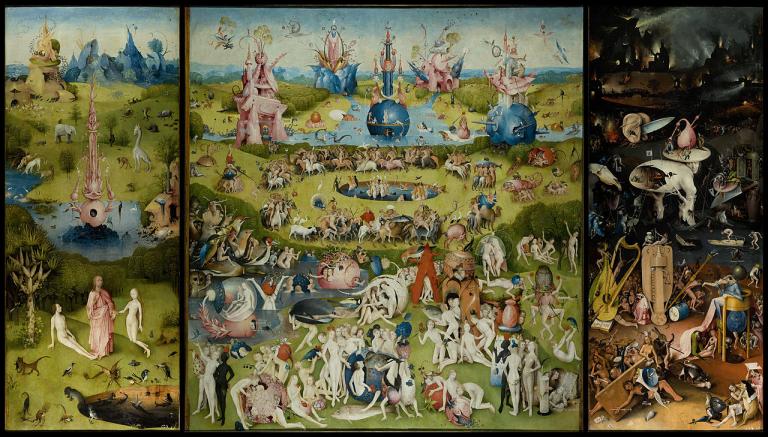
The Garden of Earthly Delights (c.1495-1505) by Hieronymus Bosch. Public Domain.
Alex Jones believes that chemicals in the water are turning the frogs gay. If you don’t know about Jones, he’s a political commentator and conspiracy theorist known for his website, InfoWars. Known, perhaps, because the (chem)trail doesn’t end with homosexual amphibians: the Sandy Hook Shooting was a hoax, the government was behind the Oklahoma City Bombing, and 9/11 was, in fact, an inside job. He is best known, at this point however, for his affiliation with the Alt-Right and Donald Trump. Jones is a Christian, and this got me thinking: what is the relationship between American Christians and conspiracy theories anyway?
First thing’s first: Alex Jones, Donald Trump, and the Alt-Right are three different things, though, many have argued, closely-related in a variety of ways. What interests me here is how all three, in certain senses, invoke conspiracies to explain various problems. To take one example, all of them think the mainstream media is lying in some way. As they say: fake news!
The Donald tends merely to dismiss: outlets lie for his opponents, because, well, they are outlets for his opponents. Alex Jones, meanwhile, tends to advocate more shadowy explanations: Soros money, the New World Order—things of that nature (I just call Soros and the New World Order a symptom of, and another name for, capitalism respectively. But that’s just me). The Alt-Right, as a fairly-amorphous movement, would seem to fit somewhere in between (depending on the member, the theory, and a multitude of other factors).
Keeping in mind that here I will be treating three separate people as if they were one, I would like to pose a question: why do Christians turn to these theories to explain away—often very real—evils (I, for example, do think the mainstream media is biased and that its “fact-checking” is often merely interpretation; I also think corporations as well as other wealthy groups and people influence our societies and politics to the detriment of our communities)? Why not turn to other explanations (did somebody say Marx?)?
The answer, to me, seems to lie in how we understand evil. Conspiracy theories posit that real horrors (mass shootings, behind-the-scenes control of politics, etc.) have concrete causes. Often hidden causes, yes, but ultimately identifiable, often personal or institutional ones. Merriam-Webster, for example, defines the term thus:
[A] theory that explains an event or set of circumstances as the result of a secret plot by usually powerful conspirators.
Both “plot” and “conspirators” imply agency. Whether George Soros or organized super-national cabals, the deciding factor in these theories is an identifiable, human cause, something that can be located and pointed to—evil with a face.
This strikes me because of the Right’s general denial of structural issues, like, for example, structural racism, which implies (to speak generally) that most people are not subjectively racist—i.e. they don’t in a personal sense think their group is intrinsically superior to others—but that conditions in America make for objective racism. The word “objective” here might seem strange; at first glance, it might seem to mean that racism is some sort of indisputable and empirical scientific fact. But its usage here is philosophical. It finds its roots in Marx, and before him, in Hegel.
Without attempting to explain the philosophy of one of history’s notoriously most-confusing thinkers, I will merely say that “objectivity” here refers to what is socially true (in other words, it is not a question of empirical verification, but of how people relate to one another). The Stanford Encyclopedia of Philosophy might be helpful here:
Hegel […] had no problem in considering an objective outer world beyond any particular subjective mind. But this objective world itself had to be understood as conceptually informed: it was objectified spirit. Thus in contrast to Berkeleian subjective idealism it became common to talk of Hegel as incorporating the objective idealism of views, especially common among German historians, in which social life and thought were understood in terms of the conceptual or spiritual structures that informed them.
Okay, maybe that doesn’t help (see how hard explaining Hegel is? And to think I have to teach this stuff someday…). To clarify: human beings have their own wills, passions, desires, and so on, but these are informed by the context in which they live (the time period, their country of origin, their social class—yes, Hegel does talk about class—their gender, etc.). Their own particular subjectivity then informs these “objective” (because exterior and socially-formed) structures. To be very reductive, this is a form of notorious “Hegelian dialectics.”
Structural racism, then, is thought to have complex causes. It is not simply the idea that individuals are racists, but rather that our society and politics, under the weight of our history, still manifest certain forms of racism (certain police shootings are often seen as an example of this. It’s not that individual cops are bigots; it’s that non-black Americans, for a variety of historical and cultural reasons, have an unconscious fear of black people, especially in certain circumstances). Whether you agree or disagree, the point is that the form of structural racism is nebulous. Its causes are manifold and, to some extent, hidden; its remedy is equally complex and open to debate because its origins are shadowy. In other words and on this view, racism (of a structural sort) does not have a “face.”
The Right (by and large) does not accept that structural racism exists, and this is the case all the more with the Alt-Right., etc.). Because it cannot be traced to a philosophical idea [e.g. some thinker deciding society should be constructed such that non-white people would be structurally marginalized (in reality, of course, such thinkers did and do exist, but, as far as I can tell, many people on the Right would not say their influence remains in meaningful ways)], and because they don’t believe themselves to be racists, many on the Right deny that such a concept can have any meaning. What it requires is a physical face—a cabal, or something more mundane, like Richard Weaver’s pinning most modern ills on William of Ockham’s Nominalism).
To view the world this way is to ensure that evil has a visage; it is to see evil as something (typically) chosen. Evil must be locatable not in a complex array of phenomena, but in specific individuals or institutions. Structural racism is merely an idea without referent while the mainstream news media is a group of people working (willfully) to undermine American (and often, on this view, Christian) values. For those who agree that such racism exists, however, evil is, in a sense, nebulous. It is a force that takes hold of people unwittingly (i.e. they believe they are choosing the good). No one “chooses evil”; rather, evil enters into us and slowly we give ourselves over to it. We receive it and cultivate it, but we do not, as such, choose it.
Previous Post
June 13, 2017
A Byzantine Morning Prayer
Next Post
June 26, 2017 If the Church Condemns Socialism, She Condemns Modern Conservatism
Browse Our Archives
Select a Category Academia Culture Politics Reviews Theology Uncategorized
Select a Month October 2026 September 2026 August 2026 July 2026 June 2026 May 2026 April 2026 March 2026 February 2026 January 2026 December 2025 November 2025 October 2025 September 2025 August 2025 July 2025 June 2025 May 2025 April 2025 March 2025 February 2025 January 2025 December 2024 November 2024 October 2024 September 2024 August 2024 July 2024 June 2024 May 2024 April 2024 March 2024 February 2024 January 2024 December 2023 November 2023 October 2023 September 2023 August 2023 July 2023 June 2023 May 2023 April 2023 March 2023 February 2023 January 2023 November 2022 October 2022 September 2022 August 2022 July 2022 June 2022 May 2022 April 2022 March 2022 February 2022 July 2021 December 2020 November 2020 July 2020 May 2020 April 2020 February 2020 January 2020 December 2019 November 2019 October 2019 August 2019 July 2019 April 2019 March 2019 December 2018 August 2018 July 2018 June 2018 May 2018 April 2018 March 2018 January 2018 December 2017 November 2017 September 2017 August 2017 July 2017 June 2017 May 2017 April 2017 March 2017 February 2017 January 2017 December 2016 November 2016 October 2016 September 2016 August 2016 July 2016 June 2016 May 2016 April 2016 March 2016 February 2016
Follow Us!
TAKE THE
Religious Wisdom Quiz
What covered the sky during Jesus’ crucifixion?
Select your answer to see how you score.
Darkness Rain Fire Clouds
Related posts from Jappers and Janglers

Apostasy, Scandal, and a Road Well-Trod


Liberalism, or Rule by Technicality

Christ Forgives Debts, so Should We
TRENDING AT PATHEOS Religious Music and Entertainment

Letters on Living the Faith by C.S. Lewis
Most of us met C.S. Lewis as a public intellectual. Mere Christianity....

When Halloween Unmasks Married Hearts
Written by Dr. David K. Ewen from Eternal Truth Bible College Behind...

Aristotle. He’s been called the father of logic, the father of the...

Methodist Central Hall and Westminster Abbey
Situated on the same square is Methodist Central Hall and Westminster Abbey. ...

57th Dove Awards Honor Dolly Parton, Crown New...
On gospel music’s biggest night, the 57th annual GMA Dove Awards honored...

The First Eucharistic Controversy: Christ’s Real Presence
For Catholics, the Eucharist is the source and summit of the Christian...
view all Religious Music and Entertainment blogs
Ad-Free & Subscriber Log-In Subscription Support
- About Us
- 2026 Calendar
- Videos
- Podcasts
- Library of World Religions
- Faith In Media Tracker
- Advertise With Us
- Write for Us
- Privacy Policy
- Terms of Service
- Do Not Sell My Data
- Contact Us
- Radiant Digital
- Manage Newsletter Subscriptions
- Unsubscribe From Notifications
- Sitemap
Copyright 2008-2026, Patheos. All rights reserved.
Subscription Support Ad-Free & Subscriber Log-In
Follow Patheos