
BuddhistCatholicContemplativeEvangelicalGeneral ChristianHinduJewishLatter-day SaintMuslimNew VisionsProgressive Christian
Beliefs
- Buddhist
- Catholic
- Contemplative
- Evangelical
- General Christian
- Hindu
- Jewish
- Latter-day Saint
- More Voices
- Muslim
- New Visions
- Pagan
- Progressive Christian
Topics
- Religion News
- Food and Religion
- Sports and Religion
- Religious Art
- Religious Music and Entertainment
- Religious Events
- History and Religion
- Style and Religion
- Politics and Religion
- Women in Religion
- Recreation Outdoors and Religion
- Business Finance and Religion
- Careers Workplace and Religion
- Education and Religion
- Family Parenting and Religion
- Health Fitness and Religion
- Home and Religion
- Relationships and Religion
- Technology and Religion
- Travel and Religion
Columnists
- Buddhist Columnists
- Business Finance and Religion Columnists
- Careers Workplace and Religion Columnists
- Catholic Columnists
- Contemplative Columnists
- Education and Religion Columnists
- Evangelists Columnists
- Family Parenting and Religion Columnists
- General Christian Columnists
- Health Fitness and Religion Columnists
- Hindu Columnists
- History and Religion Columnists
- Home and Religion Columnists
- Jewish Columnists
- More Voices Columnists
- Latter Day Columnists
- Muslim Columnists
- New Visions Columnists
- Nonreligious Columnists
- Pagan Columnists
- Politics and Religion Columnists
- Progressive Columnists
- Recreation Outdoors and Religion Columnists
- Relationships and Religion Columnists
- Religion News Columnists
- Religious Art Columnists
- Religious Events Columnists
- Religious Music and Entertainment Columnists
- Sports and Religion Columnists
- Style and Religion Columnists
- Technology and Religion Columnists
- Travel and Religion Columnists
- Women in Religion Columnists
Resource Library
- 2026 Calendar
- Library of World Religions
- The 100 Most Holy Places on Earth
- Patheos Answers
- Podcasts
- Videos
- Faith Leaders Database
- Anglican Episcopalian
- Bahai
- Baptist
- Buddhism
- Christianity
- Confucianism
- Eastern Orthodoxy
- Hinduism
- Holiness and Pentecostal
- ISKCON
- Islam
- Judaism
- Lutheran
- Methodist
- The Church of Jesus Christ of Latter-day Saints
- New Age
- Paganism
- Presbytarian and Reformed
- Protestantism
- Religion Behind the Scenes
- Roman Catholic
- Scientology
- Shia Islam
- Sikhism
- Sufism
- Sunni Islam
- Taoism
- Zen
- See all religions
Research Tools
 Ad-Free & Subscriber Log-In Subscription Support
Ad-Free & Subscriber Log-In Subscription Support
Follow Patheos 

- Trending:
- Forgiveness
- |
- Marriage
- |
- Consciousness
- |
- Death Penalty
- |
- Election
- |
- Halloween

- Home
- Religious Music and Entertainment
- The Thing about First Things
The Thing about First Things
Last updated on: May 9, 2017 at 8:19 pm by Chase Padusniak
The Thing about First Things 2017-05-09T20:19:41-04:00 Chase Padusniak
Patheos Explore the world's faith through different perspectives on religion and spirituality! Patheos has the views of the prevalent religions and spiritualities of the world.
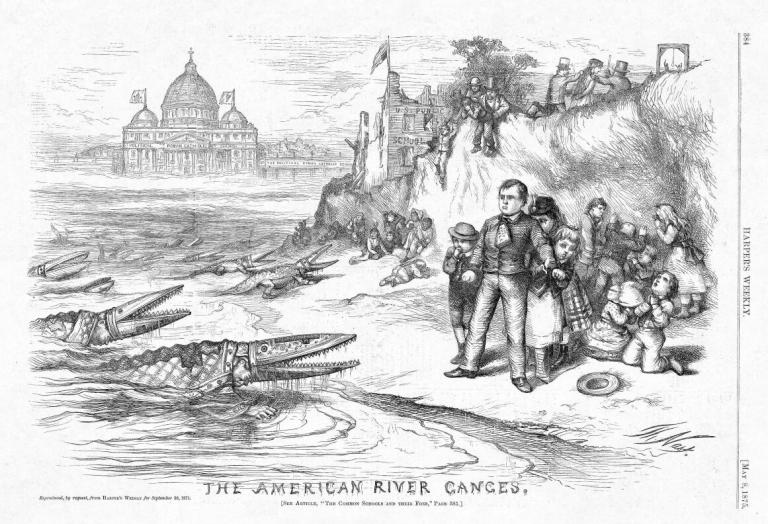
“The American River Ganges,” an 1875 anti-Catholic cartoon by Thomas Nash from Harper’s Weekly magazine. Source: Wikimedia, Creative Commons License.
During my senior year of college, I took over our campus’s right-leaning paper, The Fenwick Review. Notorious for its polemics, its deft ability to put the student body at odds, my tenure as co-editor marked something of a shift. We made the thing glossy in contrast to its previous news-ink soaked state. We brought on student artists to design the cover and punctuate the articles with wannabe medieval grotesques. Poetry, short stories, and cartoons began to appear.
Why? I felt my conservatism challenged, at least the conservatism I had known. First Things seems, to me, to be undergoing a similar transformation though on a more significant scale.
When I first began reading First Things, the journal was unabashedly neoconservative in orientation, or, at minimum, pluralistic. Founded by Richard John Neuhaus in 1990, it carried forth the good pater’s mission with hopeful, religious gusto. Such a direction remains enshrined on its website:
First Things is published by the Institute on Religion and Public Life, an interreligious, nonpartisan research and educational 501(c)(3) organization. The Institute was founded in 1990 by Richard John Neuhaus and his colleagues to confront the ideology of secularism, which insists that the public square must be “naked,” and that faith has no place in shaping the public conversation or in shaping public policy.
The Institute’s mission is to articulate a governing consensus that supports:
[A] religiously pluralistic society capable of cooperating to defend human dignity from conception to natural death.
[A] democratically, constitutionally ordered form of government supported by a religiously and morally serious culture.
[E]conomic freedom that encourages a culture of personal and communal responsibility.
[G]enuine patriotism and loyalty to the Western tradition that provide a basis for responsible global citizenship.
The Institute’s flagship program, First Things magazine, is the leading intellectual journal of its kind in the United States. In addition to publishing ten issues of First Things each year, the Institute hosts educational programs that promote religiously informed analysis of culture, society, theology, and politics.
Here the magazine concerns me more than the institute as a whole. Regardless, I have no few memories of reading pieces by current editor R.R. Reno, firmly-entrenched within the Neuhaus-tradition: balance the budget, fight within democracy for a godly public square, etc.
And yet, something is afoot. Reno’s last two pieces “Goodbye, Left and Right” and “Twenty-First-Century Conservatism” show circumspection a-brewin’. A bit from the latter article:
In recent years, I have been struggling with the intuition that the political and social assumptions I’ve held for many years aren’t so much wrong as inadequate […]
As a teen I read George Orwell and Aleksandr Solzhenitsyn, not Leo XIII. My first years of theological study focused on Karl Barth, whose outlook was profoundly influenced by his recognition that Christianity had to be defended against spiritual conquest by German nationalism. Although I started on the left, over time I came to see that progressivism, even the moderate progressivism of American liberalism, invariably seeks to increase the power of the state. The cultural wars of my lifetime—the war on racism, the war on sexual inequality, and the war on poverty—fell into the same pattern. The state needs to be empowered to make the world anew […]
I was finishing graduate school when Richard John Neuhaus launched First Things. His outlook seemed right. Again, I wasn’t thinking in Leo XIII’s terms in those days. But I can now see that Neuhaus recognized that our society needed the renewal of the moral authority of traditional institutions, especially marriage and Church, in order to restore the Leonine [referring to Pope Leo XIII] balance. In the face of progressive attempts to displace family and Church with politically orchestrated cultural change, we needed to defend limited government and a free economy in order to restrain this tendency. This would restore the Leonine balance […]
That analysis was not so much wrong as shortsighted. We failed to see that judicial usurpation is a symptom of something much more powerful. The real peril of our time does not rest in the fact that the state has become so powerful that it can “find” new rights and force us to acknowledge them. Instead, the danger comes from what Hittinger calls the “revolutions from below.” By this evocative term he means the multifaceted cultural, economic, and technological forces that encourage us to believe we don’t need any of the necessary societies. Or if we do need them, it’s only because they play a useful role in providing ever-greater utility to individuals. On such a view—and it’s now the dominant view in the West—society does not exist to sustain marriage, political community, and religion. Its purpose is plenary liberation (“negative anthropology”) and economic growth. The mutually reinforcing empires of desire and utility displace the three societies.
Although it may seem as if I have quoted the entire piece, it trods on for quite a bit longer, even defending Reno’s fidelity to the tradition of Neuhaus. Clearly, R.R. and I have our disagreements, those forces from below he cites in Hittinger might just as easily be called “symptoms of capitalism” or “outgrowths of an unjust social structure,” but that’s neither here nor there. The point is simple enough: something is indeed afoot.
The staff and regular contributors at First Things only reinforce this (by now somewhat trite) hunch. Matthew Schmitz and Matthew Walther especially come to mind. The former, as far as I know, got his start with more-traditionally First Things-esque activities: debating Mark Joseph Stern on same-sex marriage, for example But more recently he has written a fairly-positive piece about the Tradinistas, not to mention a glowing account of the Young Pope.
Walther is, at least in terms of written content, a newer name at the magazine. He delights in the sensuousness of language—witness his newest review at First Things. Originally writing for more straightforwardly-conservative magazines like National Review, the bulk of his work has appeared in The Washington Free Beacon (itself a conservative paper). And yet, his pieces reflect rather well how I once heard him characterized: the god of Catholic gonzo. Hot takes on Girls, abortion, and Star Wars trail in his writerly wake. Now an editor at the Free Beacon, I think it’s safe to say that, if he is the Tom Wolfe of Catholicism, something of his cultural attitude, if not his affects, is appearing over at First Things.
The magazine is a metonym. The growing pains, the jerks and rustlings of American Catholicism are projected onto its pages, a reality to which even Rusty Reno must admit. But why is that at all interesting?
Previous Post

May 8, 2017
Pope Francis Revisited
Next Post

May 10, 2017 How to Avoid Cafeteria Catholicism and Champagne Socialism
Browse Our Archives
Select a Category Academia Culture Politics Reviews Theology Uncategorized
Select a Month October 2026 September 2026 August 2026 July 2026 June 2026 May 2026 April 2026 March 2026 February 2026 January 2026 December 2025 November 2025 October 2025 September 2025 August 2025 July 2025 June 2025 May 2025 April 2025 March 2025 February 2025 January 2025 December 2024 November 2024 October 2024 September 2024 August 2024 July 2024 June 2024 May 2024 April 2024 March 2024 February 2024 January 2024 December 2023 November 2023 October 2023 September 2023 August 2023 July 2023 June 2023 May 2023 April 2023 March 2023 February 2023 January 2023 November 2022 October 2022 September 2022 August 2022 July 2022 June 2022 May 2022 April 2022 March 2022 February 2022 July 2021 December 2020 November 2020 July 2020 May 2020 April 2020 February 2020 January 2020 December 2019 November 2019 October 2019 August 2019 July 2019 April 2019 March 2019 December 2018 August 2018 July 2018 June 2018 May 2018 April 2018 March 2018 January 2018 December 2017 November 2017 September 2017 August 2017 July 2017 June 2017 May 2017 April 2017 March 2017 February 2017 January 2017 December 2016 November 2016 October 2016 September 2016 August 2016 July 2016 June 2016 May 2016 April 2016 March 2016 February 2016
Follow Us!
TAKE THE
Religious Wisdom Quiz
Where did David hide from Saul for many years?
Select your answer to see how you score.
Philistine camp Jerusalem The wilderness Jericho
Related posts from Jappers and Janglers



The Big Circus at Mummy Mountain
The Trip That Broke 1000 Hearts
TRENDING AT PATHEOS Religious Music and Entertainment

The Iron Gates and the Lion of the...
Yesterday, I didn't finish my report about, well, yesterday. So I'll...

Dolly Parton’s Last Song Wins Dove Award with...
Bluegrass band The Grascals, speaking on the red carpet at the 57th...

The Image: On the Horror of Capitalism and...
The Image Then went the Pharisees, and took counsel how they might...

We are approaching the date of our new American national holiday: October...

Letters on Living the Faith by C.S. Lewis
Most of us met C.S. Lewis as a public intellectual. Mere Christianity....

When Halloween Unmasks Married Hearts
Written by Dr. David K. Ewen from Eternal Truth Bible College Behind...
view all Religious Music and Entertainment blogs
Ad-Free & Subscriber Log-In Subscription Support
- About Us
- 2026 Calendar
- Videos
- Podcasts
- Library of World Religions
- Faith In Media Tracker
- Advertise With Us
- Write for Us
- Privacy Policy
- Terms of Service
- Do Not Sell My Data
- Contact Us
- Radiant Digital
- Manage Newsletter Subscriptions
- Unsubscribe From Notifications
- Sitemap
Copyright 2008-2026, Patheos. All rights reserved.
Subscription Support Ad-Free & Subscriber Log-In
Follow Patheos