
BuddhistCatholicContemplativeEvangelicalGeneral ChristianHinduJewishLatter-day SaintMuslimNew VisionsProgressive Christian
Beliefs
- Buddhist
- Catholic
- Contemplative
- Evangelical
- General Christian
- Hindu
- Jewish
- Latter-day Saint
- More Voices
- Muslim
- New Visions
- Pagan
- Progressive Christian
Topics
- Religion News
- Food and Religion
- Sports and Religion
- Religious Art
- Religious Music and Entertainment
- Religious Events
- History and Religion
- Style and Religion
- Politics and Religion
- Women in Religion
- Recreation Outdoors and Religion
- Business Finance and Religion
- Careers Workplace and Religion
- Education and Religion
- Family Parenting and Religion
- Health Fitness and Religion
- Home and Religion
- Relationships and Religion
- Technology and Religion
- Travel and Religion
Columnists
- Buddhist Columnists
- Business Finance and Religion Columnists
- Careers Workplace and Religion Columnists
- Catholic Columnists
- Contemplative Columnists
- Education and Religion Columnists
- Evangelists Columnists
- Family Parenting and Religion Columnists
- General Christian Columnists
- Health Fitness and Religion Columnists
- Hindu Columnists
- History and Religion Columnists
- Home and Religion Columnists
- Jewish Columnists
- More Voices Columnists
- Latter Day Columnists
- Muslim Columnists
- New Visions Columnists
- Nonreligious Columnists
- Pagan Columnists
- Politics and Religion Columnists
- Progressive Columnists
- Recreation Outdoors and Religion Columnists
- Relationships and Religion Columnists
- Religion News Columnists
- Religious Art Columnists
- Religious Events Columnists
- Religious Music and Entertainment Columnists
- Sports and Religion Columnists
- Style and Religion Columnists
- Technology and Religion Columnists
- Travel and Religion Columnists
- Women in Religion Columnists
Resource Library
- 2026 Calendar
- Library of World Religions
- The 100 Most Holy Places on Earth
- Patheos Answers
- Podcasts
- Videos
- Faith Leaders Database
- Anglican Episcopalian
- Bahai
- Baptist
- Buddhism
- Christianity
- Confucianism
- Eastern Orthodoxy
- Hinduism
- Holiness and Pentecostal
- ISKCON
- Islam
- Judaism
- Lutheran
- Methodist
- The Church of Jesus Christ of Latter-day Saints
- New Age
- Paganism
- Presbytarian and Reformed
- Protestantism
- Religion Behind the Scenes
- Roman Catholic
- Scientology
- Shia Islam
- Sikhism
- Sufism
- Sunni Islam
- Taoism
- Zen
- See all religions
Research Tools
 Ad-Free & Subscriber Log-In Subscription Support
Ad-Free & Subscriber Log-In Subscription Support
Follow Patheos 

- Trending:
- Forgiveness
- |
- Marriage
- |
- Consciousness
- |
- Death Penalty
- |
- Election
- |
- Halloween

- Home
- Religious Music and Entertainment
- Pope Francis Revisited
Pope Francis Revisited
Last updated on: May 11, 2017 at 12:24 pm by Chase Padusniak
Pope Francis Revisited 2017-05-11T12:24:16-04:00 Chase Padusniak
Patheos Explore the world's faith through different perspectives on religion and spirituality! Patheos has the views of the prevalent religions and spiritualities of the world.
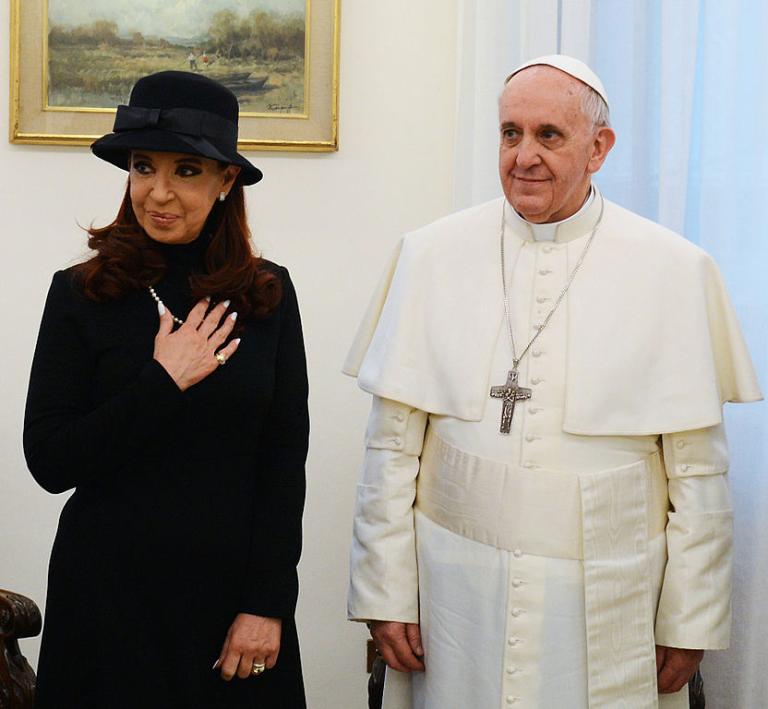
Pope Francis with Cristina Fernández de Kirchner, noted Personist, and then president of Argentina, on March 18, 2013. Source: Wikimedia, Creative Commons License.
It’s not uncommon for me to see the pope addressed on social media: Facebook conversations, Twitter repartee (less so), and all manner of other places, including in my own Messenger inbox. Some people earnestly seek clarification; others discern the demonic (or some such) at work behind the bright eyes of an 80-year-old Jesuit. Regardless, it seems what is most needed is clarification, something undertaken long ago, but seemingly (and understandably) forgotten.
These days many a Catholic applies that approach so hated as nothing more than academic gobbledygook—the hermeneutics of suspicion—to the pope as if a deviant (and deeply Fruedian) unconscious were at work within the pontiff’s head. But most of their questions—really most of their assumptions—were addressed way back when the pope was first elected and in the months and years thereafter. Newsweek, the Atlantic, PRI, the Washington Post, and the New Yorker all have published pieces on the pope’s past and what that past might mean for the present and the future. Therein lie the keys to understanding his attacks on unfettered capitalism, his denouncements of “rigidity,” and most everything else that raises American eyebrows.
In order to understand the pope, in order to clarify what he means to mean, we must revisit Pope Francis as an Argentine Jesuit and product of mid-century Latin America.
The Supreme Pontiff grew up in a fairly-lower-class, immigrant neighborhood in Buenos Aires; his initial experience of Catholicism was colored by his grandmother—Nonna Rosa—whose folksy love of novenas and processions left a deep imprint on young Jorge. His theological studies were initially opposed by his mother, who wanted him to study something more practical (and likely also more lucrative). Such formed the background of his entry into the Jesuits.
His boyhood was colored (especially due to his involvement in Catholic Action, an organization his beloved grandmother had supported in Italy) by Peronism, which was considered to have an affinity with Catholicism. A sort of “Third Way” approach, it combined authoritarian tendencies, a robust welfare state, and nationalism. The Encyclopædia Britannica traces the movement thus:
The Peronist movement arose as the personal following of Col. Juan Perón. In 1943, after participating in a successful military coup, Perón became Argentina’s minister of labour, a position through which he enacted various social measures to help the country’s growing class of urban industrial workers. Gaining the admiration of the masses, Perón called for the state to take a leading role in the economy to ensure cooperation between businesses and labour. In 1946 he was elected to the presidency with the strong support of the workers and their labour unions; he also gained the support of many lower-middle-class citizens and of the country’s industrialists. After Perón was overthrown and exiled in 1955 by the military, the leaderless Peronist movement was weakened by factional conflicts, since it was composed of many divergent elements, from left-wing trade unionists to right-wing authoritarian nationalists. Nonetheless, the movement remained the main civilian contender for power in Argentina.
Pope Francis became a Jesuit novice in 1958, in other words just after the downfall of Peronist supremacy. Combined with his early involvement in Catholic Action and the continuing influence of the ideology (something that is still the case today), it seems to have exerted a good deal of force on his worldview. As stated above, the movement fractured into Left- and Right-wing varieties, which soon, within Catholic circles, aligned with similar ideological developments after Vatican II. In other words, the political break within Peronism and the theological complexities in the aftermath of the Second Vatican Council must be attended to if Pope Francis is to be understood.
At 36, he became Jesuit Provincial for Argentina and Uruguay. The moment was filled with divisiveness. On the one hand, the advent of Liberation Theology; on the other, the emergence of Argentina’ Dirty War, during which 10,000 people were killed, and many others “disappeared.” Jorge Bergoglio was brought in as provincial specifically to replace Ricardo O’Farrell, a generally Left-leaning Jesuit. The future pope, in short, was seen as a conservative.
And rule as a conservative he did. Paul Valley, writing in the Atlantic, puts it well:
As polarization grew between an atheist, anti-Church Left and a right wing that claimed to be acting in defense of the Church and its values, Bergoglio found that it was impossible to hold to a middle way. He cracked down on Liberation Theology inside the Jesuits. Progressives within the order accused him of de-facto collusion with the worldview of the Right, if not with its tactics. Looking back he admitted, in his first interview as pope: “I had to deal with difficult situations, and I made my decisions abruptly and by myself. My authoritarian and quick manner of making decisions led me to have serious problems and to be accused of being ultra-conservative.”
A titanic struggle for the soul of Catholicism ensued. Bergoglio had strong support within the Jesuits when he became provincial superior in 1973. But by the time he ended his leadership role as rector of Buenos Aires’s Jesuit seminary in 1986, those who loathed him had begun to outnumber those who loved him. By 1990, his support within the order had been eroded by his authoritarian style and his incorrigible inability, in the words of the Jesuit, Father Frank Brennan, “to let go the reins of office once a [Jesuit] provincial of a different hue was in the saddle.” Another senior Jesuit told me: “He drove people really crazy with his insistence that only he knew the right way to do things. Finally the other Jesuits said: ‘Enough.’”
By the time he was sent into exile, according to one senior Jesuit in Rome, around two-thirds of Argentina’s Jesuits had lost patience with him. In his first interview after becoming pope, Francis attributed this dynamic to his own “style of government as a Jesuit at the beginning. … I found myself provincial when I was still very young. I was only 36 years old. That was crazy.” As a young priest in powerful leadership positions, Bergoglio did not have the maturity he needed to cope with the competing pressures of Jesuit factions, the Vatican, and a ruthless military dictatorship.
The pope has since lamented that he did not do enough during Argentina’s Dirty War. He cast aside two priests who took theology to the slums; they were kidnapped and tortured not long after he took away their faculties to say Mass. He hid some books for an old mentor and sometime radical, Ester Ballestrino. She helped to found “Las Madres de la Plaza de Mayo,” a group for the mothers of those who had been “disappeared.” They would march with the pictures of their children. One day she herself simply disappeared, dropped, still alive after being drugged, into the Atlantic Ocean. To this day, if his 2010 testimony on the matter is to be believed, his lack of action causes him immense pain.
Feeling the sting of failure and the imprudence of his youth, he was exiled, first to Germany and then to the distant, inland city of Córdoba. In the former, he fell in love with a painting of Mary, Untier of Knots, specifically related to the Blessed Mother’s intercession in the failing marriage of a noble couple. In the latter, he was not allowed to say Mass in the Jesuit Church, and so he spent much time doing two things: hearing confessions and walking. This seems to have transformed him. Again, from the Atlantic:
In Cordoba, Bergoglio turned inward. His main public spiritual engagement was hearing confessions. He spent a lot of time looking out the window and walking the streets, from the Jesuit residence to the church along a road that passed through many different areas of the city. People from all walks of life—academics, students, lawyers, and ordinary folk—visited the church for the penitential sacrament. He found his interactions with the poor particularly moving.
“Cordoba was, for Bergoglio, a place of humility and humiliation,” said Father Guillermo Marco, who was later Bergoglio’s right-hand man on public affairs in the diocese of Buenos Aires. There seems to have been more to this than learning from experience. Francis later admitted to having made “hundreds of errors” in his time as leader of Argentina’s Jesuits. Cordoba was, he revealed in his first interview as pope, “a time of great interior crisis.”
Previous Post

April 4, 2017
Responsio ad Herr Journalist Polemikerque Rod Dreher Louisianae
Next Post
May 9, 2017 The Thing about First Things
Browse Our Archives
Select a Category Academia Culture Politics Reviews Theology Uncategorized
Select a Month October 2026 September 2026 August 2026 July 2026 June 2026 May 2026 April 2026 March 2026 February 2026 January 2026 December 2025 November 2025 October 2025 September 2025 August 2025 July 2025 June 2025 May 2025 April 2025 March 2025 February 2025 January 2025 December 2024 November 2024 October 2024 September 2024 August 2024 July 2024 June 2024 May 2024 April 2024 March 2024 February 2024 January 2024 December 2023 November 2023 October 2023 September 2023 August 2023 July 2023 June 2023 May 2023 April 2023 March 2023 February 2023 January 2023 November 2022 October 2022 September 2022 August 2022 July 2022 June 2022 May 2022 April 2022 March 2022 February 2022 July 2021 December 2020 November 2020 July 2020 May 2020 April 2020 February 2020 January 2020 December 2019 November 2019 October 2019 August 2019 July 2019 April 2019 March 2019 December 2018 August 2018 July 2018 June 2018 May 2018 April 2018 March 2018 January 2018 December 2017 November 2017 September 2017 August 2017 July 2017 June 2017 May 2017 April 2017 March 2017 February 2017 January 2017 December 2016 November 2016 October 2016 September 2016 August 2016 July 2016 June 2016 May 2016 April 2016 March 2016 February 2016
Follow Us!
TAKE THE
Religious Wisdom Quiz
Which Psalm is often read at funerals: "Even though I walk through the valley..."?
Select your answer to see how you score.
Psalm 51 Psalm 137 Psalm 90 Psalm 23
Related posts from Jappers and Janglers
The Exorcist: If Evil's Real, Then What?



TRENDING AT PATHEOS Religious Music and Entertainment

Letters on Living the Faith by C.S. Lewis
Most of us met C.S. Lewis as a public intellectual. Mere Christianity....

When Halloween Unmasks Married Hearts
Written by Dr. David K. Ewen from Eternal Truth Bible College Behind...

Aristotle. He’s been called the father of logic, the father of the...

Methodist Central Hall and Westminster Abbey
Situated on the same square is Methodist Central Hall and Westminster Abbey. ...

57th Dove Awards Honor Dolly Parton, Crown New...
On gospel music’s biggest night, the 57th annual GMA Dove Awards honored...

The First Eucharistic Controversy: Christ’s Real Presence
For Catholics, the Eucharist is the source and summit of the Christian...
view all Religious Music and Entertainment blogs
Ad-Free & Subscriber Log-In Subscription Support
- About Us
- 2026 Calendar
- Videos
- Podcasts
- Library of World Religions
- Faith In Media Tracker
- Advertise With Us
- Write for Us
- Privacy Policy
- Terms of Service
- Do Not Sell My Data
- Contact Us
- Radiant Digital
- Manage Newsletter Subscriptions
- Unsubscribe From Notifications
- Sitemap
Copyright 2008-2026, Patheos. All rights reserved.
Subscription Support Ad-Free & Subscriber Log-In
Follow Patheos