
BuddhistCatholicContemplativeEvangelicalGeneral ChristianHinduJewishLatter-day SaintMuslimNew VisionsProgressive Christian
Beliefs
- Buddhist
- Catholic
- Contemplative
- Evangelical
- General Christian
- Hindu
- Jewish
- Latter-day Saint
- More Voices
- Muslim
- New Visions
- Pagan
- Progressive Christian
Topics
- Religion News
- Food and Religion
- Sports and Religion
- Religious Art
- Religious Music and Entertainment
- Religious Events
- History and Religion
- Style and Religion
- Politics and Religion
- Women in Religion
- Recreation Outdoors and Religion
- Business Finance and Religion
- Careers Workplace and Religion
- Education and Religion
- Family Parenting and Religion
- Health Fitness and Religion
- Home and Religion
- Relationships and Religion
- Technology and Religion
- Travel and Religion
Columnists
- Buddhist Columnists
- Business Finance and Religion Columnists
- Careers Workplace and Religion Columnists
- Catholic Columnists
- Contemplative Columnists
- Education and Religion Columnists
- Evangelists Columnists
- Family Parenting and Religion Columnists
- General Christian Columnists
- Health Fitness and Religion Columnists
- Hindu Columnists
- History and Religion Columnists
- Home and Religion Columnists
- Jewish Columnists
- More Voices Columnists
- Latter Day Columnists
- Muslim Columnists
- New Visions Columnists
- Nonreligious Columnists
- Pagan Columnists
- Politics and Religion Columnists
- Progressive Columnists
- Recreation Outdoors and Religion Columnists
- Relationships and Religion Columnists
- Religion News Columnists
- Religious Art Columnists
- Religious Events Columnists
- Religious Music and Entertainment Columnists
- Sports and Religion Columnists
- Style and Religion Columnists
- Technology and Religion Columnists
- Travel and Religion Columnists
- Women in Religion Columnists
Resource Library
- 2026 Calendar
- Library of World Religions
- The 100 Most Holy Places on Earth
- Patheos Answers
- Podcasts
- Videos
- Faith Leaders Database
- Anglican Episcopalian
- Bahai
- Baptist
- Buddhism
- Christianity
- Confucianism
- Eastern Orthodoxy
- Hinduism
- Holiness and Pentecostal
- ISKCON
- Islam
- Judaism
- Lutheran
- Methodist
- The Church of Jesus Christ of Latter-day Saints
- New Age
- Paganism
- Presbytarian and Reformed
- Protestantism
- Religion Behind the Scenes
- Roman Catholic
- Scientology
- Shia Islam
- Sikhism
- Sufism
- Sunni Islam
- Taoism
- Zen
- See all religions
Research Tools
 Ad-Free & Subscriber Log-In Subscription Support
Ad-Free & Subscriber Log-In Subscription Support
Follow Patheos 

- Trending:
- Forgiveness
- |
- Marriage
- |
- Consciousness
- |
- Death Penalty
- |
- Election
- |
- Halloween

- Home
- Religious Music and Entertainment
- Be as Job
Be as Job
Last updated on: June 26, 2017 at 12:43 am by Chase Padusniak
Be as Job 2017-06-26T00:43:10-04:00 Chase Padusniak
Patheos Explore the world's faith through different perspectives on religion and spirituality! Patheos has the views of the prevalent religions and spiritualities of the world.
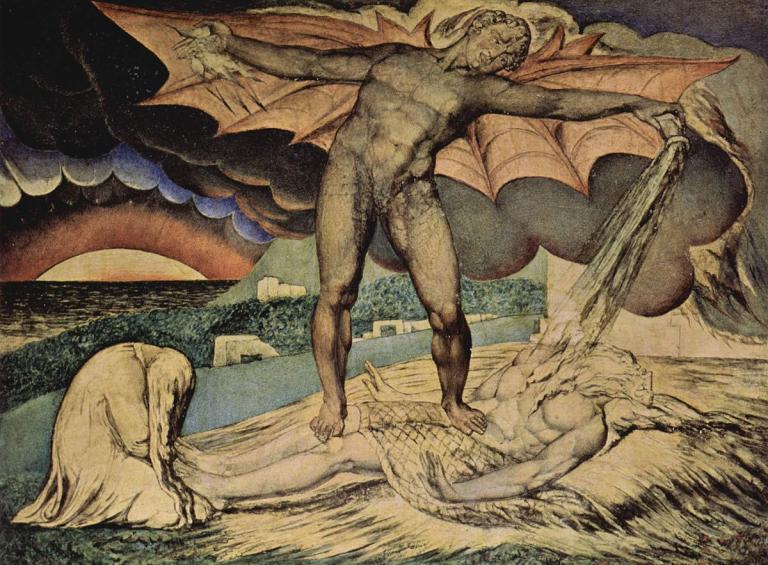
The Examination of Hiob: Satan Pours on the Plagues of Hiob, William Blake, 1826-1827. Source: Wikimedia, Creative Commons License.
Job confounds. A book in which God allows “the satan” to overwhelm a righteous man, purely to prove that Job’s righteousness and fear of God come not from God’s blessings, but instead are rooted in a respect for the creator. The premise thus seems simple enough: love God at all times; let not material and spiritual health and prosperity dictate whether or not you worship the Lord your god. After his servants are murdered, his livestock stolen, that is, his livelihood carried away and slaughtered:
Then Job arose and tore his cloak and cut off his hair. He fell to the ground and worshiped.
He said,
Naked I came forth from my mother’s womb,
and naked shall I go back there.
The LORD gave and the LORD has taken away;
blessed be the name of the LORD!”
In all this Job did not sin, nor did he charge God with wrong.
(1:20-22)
God allow “the satan” to further curse Job. This time with boils. And it is here that the story becomes interesting. It is not just that Job refuses to curse the name of the Lord; it is not just that he endures patiently. Rather, he refuses consolation. His wife scolds him; his friends attempt to make sense of the disaster, and Job, against all of what we might call common sense, refuses to budge:
He took a potsherd to scrape himself, as he sat among the ashes. Then his wife said to him, “Are you still holding to your innocence? Curse God and die!” But he said to her, “You speak as foolish women do. We accept good things from God; should we not accept evil?” Through all this, Job did not sin in what he said.
Now when three of Job’s friends heard of all the misfortune that had come upon him, they set out each one from his own place: Eliphaz from Teman, Bildad from Shuh, and Zophar from Naamath. They met and journeyed together to give him sympathy and comfort. But when, at a distance, they lifted up their eyes and did not recognize him, they began to weep aloud; they tore their cloaks and threw dust into the air over their heads. Then they sat down upon the ground with him seven days and seven nights, but none of them spoke a word to him; for they saw how great was his suffering. (2:8:13)
For many, many chapters the books drags on. Job’s friends oscillate between offering consolation and offering diagnoses. He must have done something wrong to deserve such horrors; he cannot be blameless, for who is blameless? Job, however, refuses to budge. He is, if afflicted, honest. For a time, he sounds not unlike Qoheleth of Ecclesiastes, devoted to how meaningless all seems in the face of overwhelming suffering. God himself eventually thunders forth from the sky; He scolds Job. How dare a mere man castigate the creator! How dare one with knowledge of so little pretend that his paltry existence can comprehend truth!
At first, Job complains; he talks back, so to speak. But, by the end, all is restored to him, though only after he confesses:
I know that you can do all things,
and that no purpose of yours can be hindered.
“Who is this who obscures counsel with ignorance?”
I have spoken but did not understand;
things too marvelous for me, which I did not know.
“Listen, and I will speak;
I will question you, and you tell me the answers.”
By hearsay I had heard of you,
but now my eye has seen you.
Therefore I disown what I have said,
and repent in dust and ashes.
(42:2-6)
This passage seems straightforward enough: repent and love. No human being can know all things, can expect anything, such is pride, a projection of mere humanity onto the Lord of Heaven, the God who will eventually become man. All of this is, of course, true enough, but it is best read against the Lord’s final speech to Job:
Adorn yourself with grandeur and majesty,
and clothe yourself with glory and splendor.
Let loose the fury of your wrath;
look at everyone who is proud and bring them down.
Look at everyone who is proud, and humble them.
Tear down the wicked in their place,
bury them in the dust together;
in the hidden world imprison them.
Then will I too praise you,
for your own right hand can save you.
Look at Behemoth, whom I made along with you,
who feeds on grass like an ox.
See the strength in his loins,
the power in the sinews of his belly.
He carries his tail like a cedar;
the sinews of his thighs are like cables.
His bones are like tubes of bronze;
his limbs are like iron rods.
[…]
Can you lead Leviathan about with a hook,
or tie down his tongue with a rope?
Can you put a ring into his nose,
or pierce through his cheek with a gaff?
Will he then plead with you, time after time,
or address you with tender words?
Will he make a covenant with you
that you may have him as a slave forever?
Can you play with him, as with a bird?
Can you tie him up for your little girls?
Will the traders bargain for him?
Will the merchants divide him up?
Can you fill his hide with barbs,
or his head with fish spears?
Once you but lay a hand upon him,
no need to recall any other conflict!
Whoever might vainly hope to do so
need only see him to be overthrown.
No one is fierce enough to arouse him;
who then dares stand before me?
Whoever has assailed me, I will pay back—
Everything under the heavens is mine.
I need hardly mention his limbs,
his strength, and the fitness of his equipment.
Who can strip off his outer garment,
or penetrate his double armor?
Who can force open the doors of his face,
close to his terrible teeth?
(40:10-18, 25-32; 41:1-6)
On the one hand, this reads like divine gobbledygook: I made the world full of things you can’t control. That’s that; shut up. But to my eyes, and in my own experience, this misses the point. What God tells Job to forsake is control, is the belief not only that he is the center of the universe, but more concretely that he, as a single human being in a wide world filled with horrors—worst of all other human beings—can exert his will over others.
Is this not the case? Is this not what it means to be human? If a loved one makes a bad decision, I may try to stop him or her, but I cannot ultimately make the decision for them. If I beg a friend to forgive me, I may do all in my power, but what can I really do to soften his hardened heart? Live with my guilt? Pray for compassion?
Yes, that is it: prayer. Job, in my eyes, is a lesson in prayer, fundamentally a critique not merely of pride, but of power itself. The world is as it is, filled with suffering. We try to do what is right; we make mistakes, and cannot guarantee any outcome. Every breeze, every harsh rain, every other human being—these are completely out of our control as individuals, radical, though mundane, reminders of our utter powerlessness in the face of an existence filled with others who feel themselves as in control as we do (that is, they feel themselves powerful, yet constrained by the same fact of total powerlessness).
What is left but to pray? What is left but to keep silent before the majesty of being? All we can do is let go. Fight as we must (as we cannot help but do as human beings), but always with the knowledge that control is not ours—power is not ours. Job is the truth of Christ’s words about the lilies of the field; Job is our ultimate consolation in the form of consolation’s own death.
Previous Post

May 16, 2017
Don’t Let Mike Pence Speak at Notre Dame
Next Post

May 18, 2017 Anarchism and Catholicism: An Introduction
Browse Our Archives
Select a Category Academia Culture Politics Reviews Theology Uncategorized
Select a Month October 2026 September 2026 August 2026 July 2026 June 2026 May 2026 April 2026 March 2026 February 2026 January 2026 December 2025 November 2025 October 2025 September 2025 August 2025 July 2025 June 2025 May 2025 April 2025 March 2025 February 2025 January 2025 December 2024 November 2024 October 2024 September 2024 August 2024 July 2024 June 2024 May 2024 April 2024 March 2024 February 2024 January 2024 December 2023 November 2023 October 2023 September 2023 August 2023 July 2023 June 2023 May 2023 April 2023 March 2023 February 2023 January 2023 November 2022 October 2022 September 2022 August 2022 July 2022 June 2022 May 2022 April 2022 March 2022 February 2022 July 2021 December 2020 November 2020 July 2020 May 2020 April 2020 February 2020 January 2020 December 2019 November 2019 October 2019 August 2019 July 2019 April 2019 March 2019 December 2018 August 2018 July 2018 June 2018 May 2018 April 2018 March 2018 January 2018 December 2017 November 2017 September 2017 August 2017 July 2017 June 2017 May 2017 April 2017 March 2017 February 2017 January 2017 December 2016 November 2016 October 2016 September 2016 August 2016 July 2016 June 2016 May 2016 April 2016 March 2016 February 2016
Follow Us!
TAKE THE
Religious Wisdom Quiz
Who was Noah's father?
Select your answer to see how you score.
Abel Enoch Seth Lamech
Related posts from Jappers and Janglers

American Movie: The Beauty of the Chuds

Which is the Original Bible? Is it the...
Who Founded the Catholic Church?
TRENDING AT PATHEOS Religious Music and Entertainment

The Dangers of Gradual Accommodation (Winking at Sin)
Recently, the “law of gradualness” resurfaced during the opening of a weeklong,...

The Iron Gates and the Lion of the...
Yesterday, I didn't finish my report about, well, yesterday. So I'll...

Dolly Parton’s Last Song Wins Dove Award with...
Bluegrass band The Grascals, speaking on the red carpet at the 57th...

The Image: On the Horror of Capitalism and...
The Image Then went the Pharisees, and took counsel how they might...

We are approaching the date of our new American national holiday: October...

Letters on Living the Faith by C.S. Lewis
Most of us met C.S. Lewis as a public intellectual. Mere Christianity....
view all Religious Music and Entertainment blogs
Ad-Free & Subscriber Log-In Subscription Support
- About Us
- 2026 Calendar
- Videos
- Podcasts
- Library of World Religions
- Faith In Media Tracker
- Advertise With Us
- Write for Us
- Privacy Policy
- Terms of Service
- Do Not Sell My Data
- Contact Us
- Radiant Digital
- Manage Newsletter Subscriptions
- Unsubscribe From Notifications
- Sitemap
Copyright 2008-2026, Patheos. All rights reserved.
Subscription Support Ad-Free & Subscriber Log-In
Follow Patheos