
BuddhistCatholicContemplativeEvangelicalGeneral ChristianHinduJewishLatter-day SaintMuslimNew VisionsProgressive Christian
Beliefs
- Buddhist
- Catholic
- Contemplative
- Evangelical
- General Christian
- Hindu
- Jewish
- Latter-day Saint
- More Voices
- Muslim
- New Visions
- Pagan
- Progressive Christian
Topics
- Religion News
- Food and Religion
- Sports and Religion
- Religious Art
- Religious Music and Entertainment
- Religious Events
- History and Religion
- Style and Religion
- Politics and Religion
- Women in Religion
- Recreation Outdoors and Religion
- Business Finance and Religion
- Careers Workplace and Religion
- Education and Religion
- Family Parenting and Religion
- Health Fitness and Religion
- Home and Religion
- Relationships and Religion
- Technology and Religion
- Travel and Religion
Columnists
- Buddhist Columnists
- Business Finance and Religion Columnists
- Careers Workplace and Religion Columnists
- Catholic Columnists
- Contemplative Columnists
- Education and Religion Columnists
- Evangelists Columnists
- Family Parenting and Religion Columnists
- General Christian Columnists
- Health Fitness and Religion Columnists
- Hindu Columnists
- History and Religion Columnists
- Home and Religion Columnists
- Jewish Columnists
- More Voices Columnists
- Latter Day Columnists
- Muslim Columnists
- New Visions Columnists
- Nonreligious Columnists
- Pagan Columnists
- Politics and Religion Columnists
- Progressive Columnists
- Recreation Outdoors and Religion Columnists
- Relationships and Religion Columnists
- Religion News Columnists
- Religious Art Columnists
- Religious Events Columnists
- Religious Music and Entertainment Columnists
- Sports and Religion Columnists
- Style and Religion Columnists
- Technology and Religion Columnists
- Travel and Religion Columnists
- Women in Religion Columnists
Resource Library
- 2026 Calendar
- Library of World Religions
- The 100 Most Holy Places on Earth
- Patheos Answers
- Podcasts
- Videos
- Faith Leaders Database
- Anglican Episcopalian
- Bahai
- Baptist
- Buddhism
- Christianity
- Confucianism
- Eastern Orthodoxy
- Hinduism
- Holiness and Pentecostal
- ISKCON
- Islam
- Judaism
- Lutheran
- Methodist
- The Church of Jesus Christ of Latter-day Saints
- New Age
- Paganism
- Presbytarian and Reformed
- Protestantism
- Religion Behind the Scenes
- Roman Catholic
- Scientology
- Shia Islam
- Sikhism
- Sufism
- Sunni Islam
- Taoism
- Zen
- See all religions
Research Tools
 Ad-Free & Subscriber Log-In Subscription Support
Ad-Free & Subscriber Log-In Subscription Support
Follow Patheos 

- Trending:
- Forgiveness
- |
- Marriage
- |
- Consciousness
- |
- Death Penalty
- |
- Election
- |
- Halloween

- Home
- Religious Music and Entertainment
- Our Daily Bread
Our Daily Bread
Last updated on: February 25, 2017 at 9:52 pm by Chase Padusniak
Our Daily Bread 2017-02-25T21:52:18-04:00 Chase Padusniak
Patheos Explore the world's faith through different perspectives on religion and spirituality! Patheos has the views of the prevalent religions and spiritualities of the world.
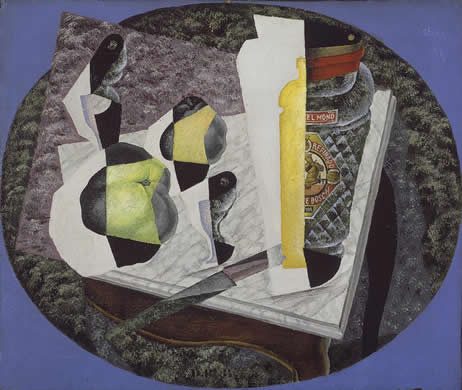
Still Life with Bread Knife (1915) by Diego Rivera. Source: Flickr, Attribution Required.
Not the Eucharist.
I recall being in third grade, given an assignment to visualize the “Our Father;” particularly, we were told to write individual lines from the prayer on construction paper, weaved ‘round with depictions of their content. “Our Father, who art in heaven” might have yielded a smiling, bearded man looking down from on high, a sun inhabiting the corner of the paper, probably smiling too.
I liked that assignment because it made a familiar prayer weird. Not coming from a religious household, but exposed to religion at school, I had learned to rattle off the prayers that began and ended every day: “Hail Mary, full of grace, the Lord is with Saint Michael, Archangel, defend us in battle, in earth as it is in heaven…”
These were, to my 9-year-old brain, dead words, up there with the Pledge of Allegiance. We preferred “You’re a Grand Old Flag.” You could stomp along to that.
This temptation is lifelong. Prayers of repetition hold so much power, but equally as much temptation—temptation to deaden the words, to summon them up and spew them out, to give the sayings of Jesus Christ all the power of vocabulary words for a 5th-grade spelling test.
Perhaps with the “Our Father” it is strongest. It’s a Scriptural prayer, shared across traditions, liturgical communities, and languages. It’s one of the few outward signs that unite Catholics and Protestants, Orthodox and non-denoms. More repetition, more pregnant with power, more likely to be desiccated.
In one sense, this is how “Our daily bread” becomes stale. But the words themselves also suggest a lesson here. As with anything Scriptural (really anything textual), words suggest huge numbers of associations. “Our daily bread” could easily be sustenance, health, daily contentment, even the Eucharist.
For me, recently, they’ve come to signify something simpler, yet something weirder, something that has infused some energy into my regrettably-bad prayer life: simplicity.
As has been noted over the millennia, bread and wine are basic food items; thus the Eucharist takes these forms in part because Jesus Christ is to nourish us at all times, even in the normalcy of daily life. Hence the Latin: “Panem nostrum quotidianum da nobis hodie.” “Quotidianum” gives us the fancy academic “quotidian” meaning “daily,” but more importantly “mundane” or “usual.”
We think of these words in relation to God’s sanctification of us through His feeding us with His body. Fair enough. But what if the words suggest that that sanctification is itself simplicity, innocence, even naïveté. Two passages come to mind:
People were bringing even infants to him that he might touch them, and when the disciples saw this, they rebuked them. Jesus, however, called the children to himself and said, “Let the children come to me and do not prevent them; for the kingdom of God belongs to such as these. Amen, I say to you, whoever does not accept the kingdom of God like a child will not enter it. (Luke 18:15-17)
Therefore I tell you, do not worry about your life, what you will eat [or drink], or about your body, what you will wear. Is not life more than food and the body more than clothing? Look at the birds in the sky; they do not sow or reap, they gather nothing into barns, yet your heavenly Father feeds them. Are not you more important than they? Can any of you by worrying add a single moment to your life-span? Why are you anxious about clothes? Learn from the way the wild flowers grow. They do not work or spin. But I tell you that not even Solomon in all his splendor was clothed like one of them. If God so clothes the grass of the field, which grows today and is thrown into the oven tomorrow, will he not much more provide for you, O you of little faith? So do not worry and say, “What are we to eat?” or “What are we to drink?” or “What are we to wear?” All these things the pagans seek. Your heavenly Father knows that you need them all. But seek first the kingdom [of God] and his righteousness, and all these things will be given you besides. Do not worry about tomorrow; tomorrow will take care of itself. Sufficient for a day is its own evil. (Matthew 6:25-34)
The former appears right between the Parable of the Pharisee and the Publican (or Tax Collector) and Jesus’ encounter with the rich official, who asks what he must do to get into heaven (give away his possessions and follow Christ). The latter comes at the end of a chapter filled with teachings on almsgiving, fasting, and prayer, not to mention the relaying of the “Our Father” itself.
Our daily bread suggests not just what God grants us in material goods, but the way we are to relate to the world, that we might treat all people honestly, with simplicity and good cheer. To eat one’s daily bread is to depend on God and therefore to move in Him, to trust in Him, not to worry and fret, to impose one’s own shallow will on the world, but to accept that all will be as it will in the Lord, that, as Julian of Norwich wrote “all shall be well, all shall be well, and all manner of thing shall be well.” “Our daily bread” is a relationship to God and our fellow man.
How impossible! And yet how necessary. How easy it is to speak and not listen, to complain, rather than look within. I stand guilty of this day in and day out, of reciting my prayers (when I remember to or feel moved to!) without passion or concentration, with only the heart of a nine-year-old student. I receive one sort of daily bread, and yet spurn its content in daily life. What arrogance!
And yet, the Lord has granted me some small illumination in the light of my sins, His doing and not mine, an inkling that the “Our Father” might be made weird again. After all, “weird” comes to us from the Old English “wyrd,” meaning “fate” or “destiny.” God is weird; God makes the quotidian weird again.
Previous Post
February 22, 2017
Empty Traditionalism
Next Post
February 26, 2017 Being Forgiven
Browse Our Archives
Select a Category Academia Culture Politics Reviews Theology Uncategorized
Select a Month October 2026 September 2026 August 2026 July 2026 June 2026 May 2026 April 2026 March 2026 February 2026 January 2026 December 2025 November 2025 October 2025 September 2025 August 2025 July 2025 June 2025 May 2025 April 2025 March 2025 February 2025 January 2025 December 2024 November 2024 October 2024 September 2024 August 2024 July 2024 June 2024 May 2024 April 2024 March 2024 February 2024 January 2024 December 2023 November 2023 October 2023 September 2023 August 2023 July 2023 June 2023 May 2023 April 2023 March 2023 February 2023 January 2023 November 2022 October 2022 September 2022 August 2022 July 2022 June 2022 May 2022 April 2022 March 2022 February 2022 July 2021 December 2020 November 2020 July 2020 May 2020 April 2020 February 2020 January 2020 December 2019 November 2019 October 2019 August 2019 July 2019 April 2019 March 2019 December 2018 August 2018 July 2018 June 2018 May 2018 April 2018 March 2018 January 2018 December 2017 November 2017 September 2017 August 2017 July 2017 June 2017 May 2017 April 2017 March 2017 February 2017 January 2017 December 2016 November 2016 October 2016 September 2016 August 2016 July 2016 June 2016 May 2016 April 2016 March 2016 February 2016
Follow Us!
TAKE THE
Religious Wisdom Quiz
Which relative of Saul cursed and threw stones at David during Absalom's rebellion?
Select your answer to see how you score.
Jonathan Ish-bosheth Mephibosheth Shimei
Related posts from Jappers and Janglers

American Movie: The Beauty of the Chuds

Which is the Original Bible? Is it the...
Who Founded the Catholic Church?

TRENDING AT PATHEOS Religious Music and Entertainment

57th Dove Awards Honor Dolly Parton, Crown New...
On gospel music’s biggest night, the 57th annual GMA Dove Awards honored...

The First Eucharistic Controversy: Christ’s Real Presence
For Catholics, the Eucharist is the source and summit of the Christian...

What a Stop Sign Can Teach Us About...
How to Make a Decision When You Can't Hear God Main point:...

Archdiocese Hosts Military Marriage Retreat in Germany
RASTATT, Germany — The transient military lifestyle, with its frequent deployments and...

Nearly every morning, I make the drive to Detroit with my high-school-age...

The Real AI Story Is Adoption Without Trust
Artificial intelligence has crossed a political threshold. It is no longer a...
view all Religious Music and Entertainment blogs
Ad-Free & Subscriber Log-In Subscription Support
- About Us
- 2026 Calendar
- Videos
- Podcasts
- Library of World Religions
- Faith In Media Tracker
- Advertise With Us
- Write for Us
- Privacy Policy
- Terms of Service
- Do Not Sell My Data
- Contact Us
- Radiant Digital
- Manage Newsletter Subscriptions
- Unsubscribe From Notifications
- Sitemap
Copyright 2008-2026, Patheos. All rights reserved.
Subscription Support Ad-Free & Subscriber Log-In
Follow Patheos