
BuddhistCatholicContemplativeEvangelicalGeneral ChristianHinduJewishLatter-day SaintMuslimNew VisionsProgressive Christian
Beliefs
- Buddhist
- Catholic
- Contemplative
- Evangelical
- General Christian
- Hindu
- Jewish
- Latter-day Saint
- More Voices
- Muslim
- New Visions
- Pagan
- Progressive Christian
Topics
- Religion News
- Food and Religion
- Sports and Religion
- Religious Art
- Religious Music and Entertainment
- Religious Events
- History and Religion
- Style and Religion
- Politics and Religion
- Women in Religion
- Recreation Outdoors and Religion
- Business Finance and Religion
- Careers Workplace and Religion
- Education and Religion
- Family Parenting and Religion
- Health Fitness and Religion
- Home and Religion
- Relationships and Religion
- Technology and Religion
- Travel and Religion
Columnists
- Buddhist Columnists
- Business Finance and Religion Columnists
- Careers Workplace and Religion Columnists
- Catholic Columnists
- Contemplative Columnists
- Education and Religion Columnists
- Evangelists Columnists
- Family Parenting and Religion Columnists
- General Christian Columnists
- Health Fitness and Religion Columnists
- Hindu Columnists
- History and Religion Columnists
- Home and Religion Columnists
- Jewish Columnists
- More Voices Columnists
- Latter Day Columnists
- Muslim Columnists
- New Visions Columnists
- Nonreligious Columnists
- Pagan Columnists
- Politics and Religion Columnists
- Progressive Columnists
- Recreation Outdoors and Religion Columnists
- Relationships and Religion Columnists
- Religion News Columnists
- Religious Art Columnists
- Religious Events Columnists
- Religious Music and Entertainment Columnists
- Sports and Religion Columnists
- Style and Religion Columnists
- Technology and Religion Columnists
- Travel and Religion Columnists
- Women in Religion Columnists
Resource Library
- 2026 Calendar
- Library of World Religions
- The 100 Most Holy Places on Earth
- Patheos Answers
- Podcasts
- Videos
- Faith Leaders Database
- Anglican Episcopalian
- Bahai
- Baptist
- Buddhism
- Christianity
- Confucianism
- Eastern Orthodoxy
- Hinduism
- Holiness and Pentecostal
- ISKCON
- Islam
- Judaism
- Lutheran
- Methodist
- The Church of Jesus Christ of Latter-day Saints
- New Age
- Paganism
- Presbytarian and Reformed
- Protestantism
- Religion Behind the Scenes
- Roman Catholic
- Scientology
- Shia Islam
- Sikhism
- Sufism
- Sunni Islam
- Taoism
- Zen
- See all religions
Research Tools
 Ad-Free & Subscriber Log-In Subscription Support
Ad-Free & Subscriber Log-In Subscription Support
Follow Patheos 

- Trending:
- Forgiveness
- |
- Marriage
- |
- Consciousness
- |
- Death Penalty
- |
- Election
- |
- Halloween

- Home
- Religious Music and Entertainment
- Empty Traditionalism
Empty Traditionalism
Last updated on: February 22, 2017 at 5:30 pm by Chase Padusniak
Empty Traditionalism 2017-02-22T17:30:14-04:00 Chase Padusniak
Patheos Explore the world's faith through different perspectives on religion and spirituality! Patheos has the views of the prevalent religions and spiritualities of the world.
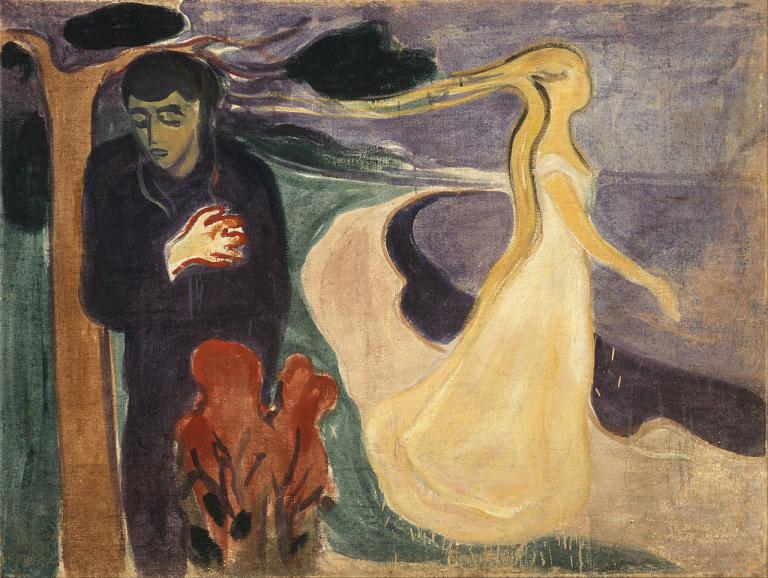
“Separation” (1896) by Edvard Munch. Source: Wikimedia, Creative Commons License.
Whoever is versed in the jargon does not have to say what he thinks, does not even have to think it properly. The jargon takes over this task. – Theodor Adorno
This is not a hit job.
A hit job would be un-critical defamation of “Traditionalist” philosophy, a takedown with no advice, the always-stale, but ever-present, “gotcha” of so much theoretical talk. I’ve done things like that before, and I repent—this is something different.
This is (obliquely) an attempt to deal with the legacy of Traditionalism in my own life but it is also an analysis of a common form of Traditionalism, a specifically shallow sort with which religions (specifically Catholicism) must reckon, if they hope to remain socially vital (we might also say politically salient). It’s worth writing about not because “Traditionalists” are dominant in the Church, but because their deep commitment to the Church, to faith, is a crucial starting point for religious revitalization.
Empty Traditionalism refuses history as a process. The work of understanding how we got here and where we’re going is reduced to a series of reified terms. I’ll begin with an exemplary one with cultural-political salience:
“Cultural Marxism.” Like all of these terms, this one is so pregnant with ideas, associations, and suggestions that it is essentially empty of content. So much is crammed into its shell that it stands merely as a signal for the validation of previously-held belief. Take this explanation:
Cultural Marxism is a branch of western Marxism, different from the Marxism-Leninism of the old Soviet Union. It is commonly known as “multiculturalism” or, less formally, Political Correctness. From its beginning, the promoters of cultural Marxism have known they could be more effective if they concealed the Marxist nature of their work, hence the use of terms such as “multiculturalism.”
Cultural Marxism began not in the 1960s but in 1919, immediately after World War I. Marxist theory had predicted that in the event of a big European war, the working class all over Europe would rise up to overthrow capitalism and create communism. But when war came in 1914, that did not happen. When it finally did happen in Russia in 1917, workers in other European countries did not support it. What had gone wrong?
Independently, two Marxist theorists, Antonio Gramsci in Italy and Georg Lukacs in Hungary, came to the same answer: Western culture and the Christian religion had so blinded the working class to its true, Marxist class interest that Communism was impossible in the West until both could be destroyed. In 1919, Lukacs asked, “Who will save us from Western civilization?” That same year, when he became Deputy Commissar for Culture in the short-lived Bolshevik Bela Kun government in Hungary, one of Lukacs’s first acts was to introduce sex education into Hungary’s public schools. He knew that if he could destroy the West’s traditional sexual morals, he would have taken a giant step toward destroying Western culture itself […]
Fatefully for America, when Hitler came to power in Germany in 1933, the Frankfurt School fled – – and reestablished itself in New York City. There, it shifted its focus from destroying traditional Western culture in Germany to destroying it in the United States. To do so, it invented “Critical Theory.” What is the theory? To criticize every traditional institution, starting with the family, brutally and unremittingly, in order to bring them down. It wrote a series of “studies in prejudice,” which said that anyone who believes in traditional Western culture is prejudiced, a “racist” or “sexist” of “fascist” – – and is also mentally ill.
Most importantly, the Frankfurt School crossed Marx with Freud, taking from psychology the technique of psychological conditioning. Today, when the cultural Marxists want to do something like “normalize” homosexuality, they do not argue the point philosophically. They just beam television show after television show into every American home where the only normal-seeming white male is a homosexual (the Frankfurt School’s key people spent the war years in Hollywood).
Here, “Cultural Marxism,” is figured as everything that certain sorts of conservatives oppose: diversity, multiculturalism, etc. without any real attempt to differentiate ideas, practices, and historical contingencies from one another. It is true that many a Western Marxist was an atheist, but that proves nothing. Adorno, Benjamin, Horkheimer, Marcuse—these are all different human beings with different agendas. They are a school insofar as they fused Freud and Marx, sure, but the existence of critique does not immediately mean a philosophy of complete liberation from all cultural institutions of a “traditional bent.” Alasdair MacIntyre is helpful here:
In so doing he [Raymond Geuss, a philosopher] continues and extends some of the enquiries of the Frankfurt School, more especially of Adorno. Three aspects of those enquiries should be kept in mind. They were and are an attempt to free us from the limitations and distortions of the bourgeois cultural and social order inherited from the Enlightenment, so that we may understand the inadequacies of concepts and presuppositions that are taken for granted by and so imprison most of our contemporaries. They posed and pose the painful question of how, if and when we have arrived at such an understanding, we are to live out our everyday lives within a discredited social and cultural order. And their focus was and is on the concrete and the particular, so that generalizations and abstractions, unavoidable as they are, should not obscure the realities that they are designed to disclose. Geuss’s enquiries in all three respects resemble Adorno’s.
I remind you, dear reader, that MacIntyre is deeply traditional in his commitments; he is, after all, a pre-eminent figure in the revival of Aristotelian virtue ethics—and a devout Catholic to boot. Notice that he speaks of “bourgeois cultural and social order inherited from the Enlightenment.” What Empty Traditionalism does is take the term “Cultural Marxism” and cue a concerned Christian’s fear: “Marxism” (generally seen to be bad in the American conservative-traditional mind) and cultural critique (the implication being cultural institutions of ours like marriage) are both brought to mind and much is assumed before any dialogue is attempted with the Frankfurt School as such. MacIntyre, however, is much more careful: he recognizes that Adorno, et al. can be allies in a revitalization of philosophy, precisely because they force us to think historically about the manifestation (and failure) of Enlightenment institutions. Is not the Traditionalist an enemy of these institutions?
To Adorno my inclination is to respond by quoting Dr. Johnson’s friend, Oliver Edwards, who said that he too had tried to be a philosopher, but “cheerfulness was always breaking in”, perhaps a philistine, but also an appropriate response. What grounds then are there for cheerfulness in any social order such as our own about which some of Adorno’s central claims still hold true? Those grounds derive surely from the continuing resistance to deprivations, frustrations, and evils that informs so many everyday lives in so many parts of the world, as well as much of the best thinking about those deprivations, frustrations, and evils, including Adorno’s and Geuss’s. To be good, to live rightly, and to think rightly, it may be said in reply to Adorno, is to be engaged in struggle and a perfected life is one perfected in key part in and through conflicts. […]
That Geuss, like Williams and like Adorno, always provokes us into further questioning is of course a virtue of his essays, not a fault. And that the questions thus provoked are exactly the right questions for us here and now to ask makes it a great and unusual virtue. Geuss has put us in his debt with these essays. They should be required reading for graduate students in — and most of all for those who remain inside — ethics.
More praise! The central point here is that Empty Traditionalism refuses to take seriously the diverse possibilities of history; historical processes are made into concrete slabs to be approved or obliterated: “Cultural Marxism? Delete. The Frankfurt School? Delete.” In reality, these ideas themselves must be seen in context. Adorno and co. were responding to the secular, liberal regimes under which they lived (and which later became further deformed under Nazism). Their insights are thus part of a process, a critical movement interested in divorcing “Western Civilization” (perhaps we might say “Europe”) from the blasé secularism and personal atomism of Enlightenment philosophy. The later appropriation (or misappropriation) of their ideas (and again we must think historically about why their ideas were so appropriated) is not itself a strike against the thinkers themselves. Do we repudiate Augustine because of Luther and Calvin? Is Aquinas merely a paganizer? Must the baby go with the bathwater?
Previous Post

February 16, 2017
The Sensuous Catholic Body
Next Post

February 25, 2017 Our Daily Bread
Browse Our Archives
Select a Category Academia Culture Politics Reviews Theology Uncategorized
Select a Month October 2026 September 2026 August 2026 July 2026 June 2026 May 2026 April 2026 March 2026 February 2026 January 2026 December 2025 November 2025 October 2025 September 2025 August 2025 July 2025 June 2025 May 2025 April 2025 March 2025 February 2025 January 2025 December 2024 November 2024 October 2024 September 2024 August 2024 July 2024 June 2024 May 2024 April 2024 March 2024 February 2024 January 2024 December 2023 November 2023 October 2023 September 2023 August 2023 July 2023 June 2023 May 2023 April 2023 March 2023 February 2023 January 2023 November 2022 October 2022 September 2022 August 2022 July 2022 June 2022 May 2022 April 2022 March 2022 February 2022 July 2021 December 2020 November 2020 July 2020 May 2020 April 2020 February 2020 January 2020 December 2019 November 2019 October 2019 August 2019 July 2019 April 2019 March 2019 December 2018 August 2018 July 2018 June 2018 May 2018 April 2018 March 2018 January 2018 December 2017 November 2017 September 2017 August 2017 July 2017 June 2017 May 2017 April 2017 March 2017 February 2017 January 2017 December 2016 November 2016 October 2016 September 2016 August 2016 July 2016 June 2016 May 2016 April 2016 March 2016 February 2016
Follow Us!
TAKE THE
Religious Wisdom Quiz
Who was Jesus’ mother?
Select your answer to see how you score.
Ruth Sarah Esther Mary
Related posts from Jappers and Janglers


Who Founded the Catholic Church?
TRENDING AT PATHEOS Religious Music and Entertainment

Letters on Living the Faith by C.S. Lewis
Most of us met C.S. Lewis as a public intellectual. Mere Christianity....

When Halloween Unmasks Married Hearts
Written by Dr. David K. Ewen from Eternal Truth Bible College Behind...

Aristotle. He’s been called the father of logic, the father of the...

Methodist Central Hall and Westminster Abbey
Situated on the same square is Methodist Central Hall and Westminster Abbey. ...

57th Dove Awards Honor Dolly Parton, Crown New...
On gospel music’s biggest night, the 57th annual GMA Dove Awards honored...

The First Eucharistic Controversy: Christ’s Real Presence
For Catholics, the Eucharist is the source and summit of the Christian...
view all Religious Music and Entertainment blogs
Ad-Free & Subscriber Log-In Subscription Support
- About Us
- 2026 Calendar
- Videos
- Podcasts
- Library of World Religions
- Faith In Media Tracker
- Advertise With Us
- Write for Us
- Privacy Policy
- Terms of Service
- Do Not Sell My Data
- Contact Us
- Radiant Digital
- Manage Newsletter Subscriptions
- Unsubscribe From Notifications
- Sitemap
Copyright 2008-2026, Patheos. All rights reserved.
Subscription Support Ad-Free & Subscriber Log-In
Follow Patheos