
BuddhistCatholicContemplativeEvangelicalGeneral ChristianHinduJewishLatter-day SaintMuslimNew VisionsProgressive Christian
Beliefs
- Buddhist
- Catholic
- Contemplative
- Evangelical
- General Christian
- Hindu
- Jewish
- Latter-day Saint
- More Voices
- Muslim
- New Visions
- Pagan
- Progressive Christian
Topics
- Religion News
- Food and Religion
- Sports and Religion
- Religious Art
- Religious Music and Entertainment
- Religious Events
- History and Religion
- Style and Religion
- Politics and Religion
- Women in Religion
- Recreation Outdoors and Religion
- Business Finance and Religion
- Careers Workplace and Religion
- Education and Religion
- Family Parenting and Religion
- Health Fitness and Religion
- Home and Religion
- Relationships and Religion
- Technology and Religion
- Travel and Religion
Columnists
- Buddhist Columnists
- Business Finance and Religion Columnists
- Careers Workplace and Religion Columnists
- Catholic Columnists
- Contemplative Columnists
- Education and Religion Columnists
- Evangelists Columnists
- Family Parenting and Religion Columnists
- General Christian Columnists
- Health Fitness and Religion Columnists
- Hindu Columnists
- History and Religion Columnists
- Home and Religion Columnists
- Jewish Columnists
- More Voices Columnists
- Latter Day Columnists
- Muslim Columnists
- New Visions Columnists
- Nonreligious Columnists
- Pagan Columnists
- Politics and Religion Columnists
- Progressive Columnists
- Recreation Outdoors and Religion Columnists
- Relationships and Religion Columnists
- Religion News Columnists
- Religious Art Columnists
- Religious Events Columnists
- Religious Music and Entertainment Columnists
- Sports and Religion Columnists
- Style and Religion Columnists
- Technology and Religion Columnists
- Travel and Religion Columnists
- Women in Religion Columnists
Resource Library
- 2026 Calendar
- Library of World Religions
- The 100 Most Holy Places on Earth
- Patheos Answers
- Podcasts
- Videos
- Faith Leaders Database
- Anglican Episcopalian
- Bahai
- Baptist
- Buddhism
- Christianity
- Confucianism
- Eastern Orthodoxy
- Hinduism
- Holiness and Pentecostal
- ISKCON
- Islam
- Judaism
- Lutheran
- Methodist
- The Church of Jesus Christ of Latter-day Saints
- New Age
- Paganism
- Presbytarian and Reformed
- Protestantism
- Religion Behind the Scenes
- Roman Catholic
- Scientology
- Shia Islam
- Sikhism
- Sufism
- Sunni Islam
- Taoism
- Zen
- See all religions
Research Tools
 Ad-Free & Subscriber Log-In Subscription Support
Ad-Free & Subscriber Log-In Subscription Support
Follow Patheos 

- Trending:
- Forgiveness
- |
- Marriage
- |
- Consciousness
- |
- Death Penalty
- |
- Election
- |
- Halloween

- Home
- Religious Music and Entertainment
- Scorsese’s Silence: A (No Spoilers) Review
Scorsese’s Silence: A (No Spoilers) Review
Last updated on: January 3, 2017 at 9:30 pm by Chase Padusniak
Scorsese’s Silence: A (No Spoilers) Review 2017-01-03T21:30:35-04:00 Chase Padusniak
Patheos Explore the world's faith through different perspectives on religion and spirituality! Patheos has the views of the prevalent religions and spiritualities of the world.
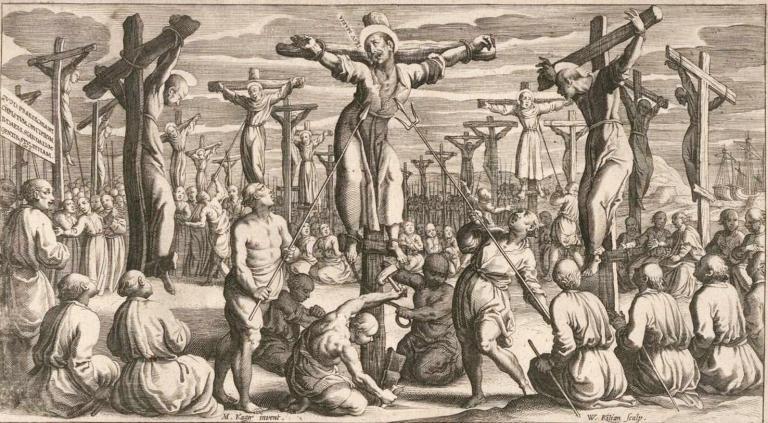
(A 1628 Depiction of the 26 Martyrs of Nagasaki. Source: Wikimedia, Creative Commons License).
Silence might be the most Catholic thing I have ever seen. To truly justify that, I’d need to spoil the film. I won’t, but I’ll say what I can, try to express its impact on me without reflecting the content of the images I saw.
I have not read Endo’s novel, though I’ve heard about it many times along my journey to the Faith. The decision of the (at minimum culturally) Catholic Martin Scorsese to direct its film version excited lots of Christians I know—what could go wrong when you combine Catholic sensibility, rich subject matter, and one of the most successful directors in the history of cinema?
Not much. Except perhaps that I found it nearly impossible to watch as a film. I’m typically swift to notice the flaws and triumphs in movies; I’ve developed (at times to my detriment) a certain objective distance from the subject matter at hand, partly because I’m currently working on a movie myself. With Silence, this was utterly impossible. I cannot imagine a Catholic watching the film and not shedding tears. I saw it projected digitally in a New York City mega-theater, hardly the perfect environment for cinematic purity, and yet I was entranced. The film tortures the viewer just the same as the Japanese tortured their island’s secret Christians. Tears abounded in the first half, but simply wouldn’t come after hours of on-screen physical and psychological erosion. By the end, exasperation seemed the only valid reaction. When the credits began rolling, my friend and I could do little but sit in silence.
The only other film I can recall putting me in a similar state is a movie I can only describe as emotionally manipulative, like an atom bomb for the psyche: Isao Takahata’s Grave of the Fireflies.
But that lacked the Catholic connection. Silence sounded a call to live, to take up my cross, so much so in fact that I found myself gripping my own crucifix necklace at moments of special temptation and grievousness. It’s that timelessness that really affected me; it’s that timelessness that begs me to put away any cinematic squabbles (and I have a few) to review the film without spoilers.
I know many people know Endo’s work well; others have an investment in locating the story historically, reminding us of the particular horrors faced by Japanese Christians. I understand that. As a youth, I was slightly obsessed with feudal Japan; the cultural issue cannot be ignored.
And yet, at the center of the film are long-lasting historical conflicts. At times, one feels as if Scorsese made the anti-Christian Japanese elites comically evil; their willingness to discriminate, equivocate, and torture (would that such torture were only physical!) without ever giving a real reason cannot help but disturb. In other words, the good guys are never ambiguous. We may not always like the missionary priests; we may not always agree with their actions, but they are clearly (though stained and broken) not the forces of darkness in the film. Morally ambiguous and sinister are two separate categories.
Parts feel like a replay of the battle between late-antique paganism and Christianity. Silence rarely shows us Japanese folk religion; instead what haunts the priests day-in and day-out is the specter of an elite philosophical system, an established, ethnocentric belief in hierarchy, nature, and obedience. We see few altars, few Shinto or Buddhist priests; instead we witness conversations—disputations if you like—between Catholics grasping at transcendence and Japanese elites defending the need to harmonize oneself with this world, this nature, alone. What is nature? What is man? Can god be a human being? For these questions, voices have gone and will go hoarse and bodies have and will bleed.
Although today such discussions are rare, their historical representation in the film has meaning for Catholics today. The torture and death of illiterate peasants reminds us of both our historical suffering as a pilgrim people and our need to be willing to continue to do so. The last thing Scorsese protects is bourgeois individualism and contemporary comfort; the film screams, echoing: eli eli lama sabachthani! The clash of philosophies points backward to past persecutions and forward to the ongoing push to envision transcendence in the world, not to succumb to the “natural” philosophies of the age, but to always remember that our world itself is enchanted with God’s grandeur, a grandeur we help manifest in our works and deeds of Christ-like, bloody, long-suffering love.
Some people will reduce the film to its context or to the question of apostasy-salvation. These are integral to Silence; no one can deny that. And yet, most of the film is not about apostasy, but torture and faith. It all takes place in Japan, but we see different sides of the island: the xenophobic, half-pagan elite and the well-meaning Christian bumpkins. The film is not simply the tale of an island divided, but of a world fractured, a testament to the trans-historical mission of evangelization and suffering, of hope and silence.
See it.
Previous Post
December 30, 2016
The Eastern Catholic Churches: A Primer
Next Post
January 4, 2017 The Decline of Liberal Protestantism: A Lesson for Catholics
Browse Our Archives
Select a Category Academia Culture Politics Reviews Theology Uncategorized
Select a Month October 2026 September 2026 August 2026 July 2026 June 2026 May 2026 April 2026 March 2026 February 2026 January 2026 December 2025 November 2025 October 2025 September 2025 August 2025 July 2025 June 2025 May 2025 April 2025 March 2025 February 2025 January 2025 December 2024 November 2024 October 2024 September 2024 August 2024 July 2024 June 2024 May 2024 April 2024 March 2024 February 2024 January 2024 December 2023 November 2023 October 2023 September 2023 August 2023 July 2023 June 2023 May 2023 April 2023 March 2023 February 2023 January 2023 November 2022 October 2022 September 2022 August 2022 July 2022 June 2022 May 2022 April 2022 March 2022 February 2022 July 2021 December 2020 November 2020 July 2020 May 2020 April 2020 February 2020 January 2020 December 2019 November 2019 October 2019 August 2019 July 2019 April 2019 March 2019 December 2018 August 2018 July 2018 June 2018 May 2018 April 2018 March 2018 January 2018 December 2017 November 2017 September 2017 August 2017 July 2017 June 2017 May 2017 April 2017 March 2017 February 2017 January 2017 December 2016 November 2016 October 2016 September 2016 August 2016 July 2016 June 2016 May 2016 April 2016 March 2016 February 2016
Follow Us!
TAKE THE
Religious Wisdom Quiz
"Let your ________ before men, that they may see your good deeds and praise your Father in heaven."
Select your answer to see how you score.
Light So Shine Face Shine Voice Be Raised Conscience Be Clear
Related posts from Jappers and Janglers

Road to Eternity: War, Endless War



TRENDING AT PATHEOS Religious Music and Entertainment

Looking at the Largest Orthodox Cathedral on Earth
There is often a considerable amount of anger and, shall we...

The Problem with False Prophets
Miller’s Station UMC| 10/18/26| Anchor Verse: Jeremiah 23: 1, 9-23 I...

Emotion in Early Christianity by Andrew Crislip
Andrew Crislip’s Emotion in Early Christianity examines an often overlooked dimension of...

16 Spiritual Touchstones for a More Grounded Life
After decades of spiritual study, here are 16 principles I try...

Catholic Evangelization: Sharing Your Faith Every Day
Welcome back to the Graceful Awakening mini-series called, “From Faith to Mission.” ...

The Pillar of the Boatmen: the Ancient Monument...
The Pillar of the Boatmen is a Romano-Gaulish sculpture that dates from...
view all Religious Music and Entertainment blogs
Ad-Free & Subscriber Log-In Subscription Support
- About Us
- 2026 Calendar
- Videos
- Podcasts
- Library of World Religions
- Faith In Media Tracker
- Advertise With Us
- Write for Us
- Privacy Policy
- Terms of Service
- Do Not Sell My Data
- Contact Us
- Radiant Digital
- Manage Newsletter Subscriptions
- Unsubscribe From Notifications
- Sitemap
Copyright 2008-2026, Patheos. All rights reserved.
Subscription Support Ad-Free & Subscriber Log-In
Follow Patheos