
BuddhistCatholicContemplativeEvangelicalGeneral ChristianHinduJewishLatter-day SaintMuslimNew VisionsProgressive Christian
Beliefs
- Buddhist
- Catholic
- Contemplative
- Evangelical
- General Christian
- Hindu
- Jewish
- Latter-day Saint
- More Voices
- Muslim
- New Visions
- Pagan
- Progressive Christian
Topics
- Religion News
- Food and Religion
- Sports and Religion
- Religious Art
- Religious Music and Entertainment
- Religious Events
- History and Religion
- Style and Religion
- Politics and Religion
- Women in Religion
- Recreation Outdoors and Religion
- Business Finance and Religion
- Careers Workplace and Religion
- Education and Religion
- Family Parenting and Religion
- Health Fitness and Religion
- Home and Religion
- Relationships and Religion
- Technology and Religion
- Travel and Religion
Columnists
- Buddhist Columnists
- Business Finance and Religion Columnists
- Careers Workplace and Religion Columnists
- Catholic Columnists
- Contemplative Columnists
- Education and Religion Columnists
- Evangelists Columnists
- Family Parenting and Religion Columnists
- General Christian Columnists
- Health Fitness and Religion Columnists
- Hindu Columnists
- History and Religion Columnists
- Home and Religion Columnists
- Jewish Columnists
- More Voices Columnists
- Latter Day Columnists
- Muslim Columnists
- New Visions Columnists
- Nonreligious Columnists
- Pagan Columnists
- Politics and Religion Columnists
- Progressive Columnists
- Recreation Outdoors and Religion Columnists
- Relationships and Religion Columnists
- Religion News Columnists
- Religious Art Columnists
- Religious Events Columnists
- Religious Music and Entertainment Columnists
- Sports and Religion Columnists
- Style and Religion Columnists
- Technology and Religion Columnists
- Travel and Religion Columnists
- Women in Religion Columnists
Resource Library
- 2026 Calendar
- Library of World Religions
- The 100 Most Holy Places on Earth
- Patheos Answers
- Podcasts
- Videos
- Faith Leaders Database
- Anglican Episcopalian
- Bahai
- Baptist
- Buddhism
- Christianity
- Confucianism
- Eastern Orthodoxy
- Hinduism
- Holiness and Pentecostal
- ISKCON
- Islam
- Judaism
- Lutheran
- Methodist
- The Church of Jesus Christ of Latter-day Saints
- New Age
- Paganism
- Presbytarian and Reformed
- Protestantism
- Religion Behind the Scenes
- Roman Catholic
- Scientology
- Shia Islam
- Sikhism
- Sufism
- Sunni Islam
- Taoism
- Zen
- See all religions
Research Tools
 Ad-Free & Subscriber Log-In Subscription Support
Ad-Free & Subscriber Log-In Subscription Support
Follow Patheos 

- Trending:
- Forgiveness
- |
- Marriage
- |
- Consciousness
- |
- Death Penalty
- |
- Election
- |
- Halloween

- Home
- Religious Music and Entertainment
- The Decline of Liberal Protestantism: A Lesson for Catholics
The Decline of Liberal Protestantism: A Lesson for Catholics
Last updated on: January 4, 2017 at 10:29 pm by Chase Padusniak
The Decline of Liberal Protestantism: A Lesson for Catholics 2017-01-04T22:29:10-04:00 Chase Padusniak
Patheos Explore the world's faith through different perspectives on religion and spirituality! Patheos has the views of the prevalent religions and spiritualities of the world.
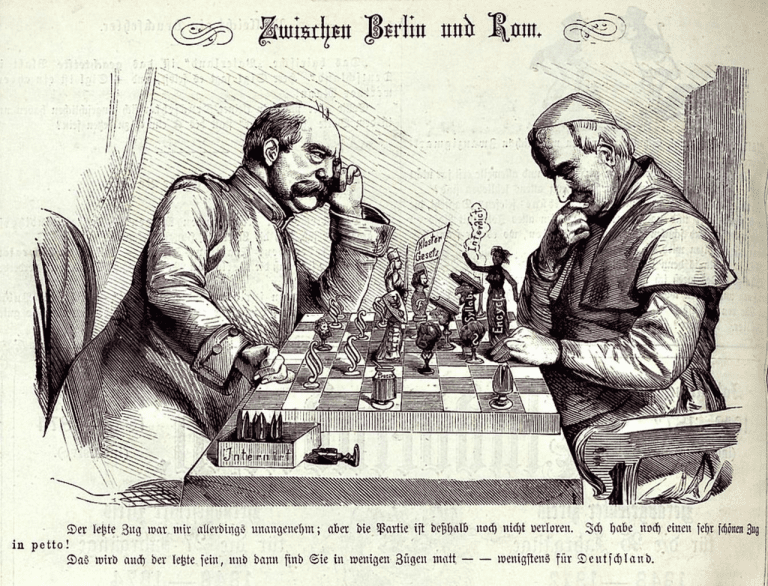
(“Zwischen Berlin und Rom.” Bismarck confronts Pope Pius IX in a caricature from the May 16, 1875 edition of “Kladderadatsch.” Source: Wikimedia, Creative Commons License).
A piece online today at the Washington Post links “liberal” theology to declines in church membership while observing the opposite trend in “conservative” congregations. In it, the author, David Millard Haskell, presents his research as overturning older theories that “getting with the times” might revivify religious life in the 21st century:
For example, we found 93 percent of clergy members and 83 percent of worshipers from growing churches agreed with the statement “Jesus rose from the dead with a real flesh-and-blood body leaving behind an empty tomb.” This compared with 67 percent of worshipers and 56 percent of clergy members from declining churches. Furthermore, all growing church clergy members and 90 percent of their worshipers agreed that “God performs miracles in answer to prayers,” compared with 80 percent of worshipers and a mere 44 percent of clergy members from declining churches.
In other words, clergy who believe in the traditional dogmas of Christian faith are likely to build more orthodox (and larger) congregations while those who reject the basics of Christianity are more likely to build smaller, less orthodox ones. Many have made similar points before, though some liberal Christians have disputed their conclusions. What this research suggests is that mitigating factors like lower birth rates and a lack of church planting are not the primary causes of decline: theological liberalism is.
The study only seems to deal with Protestant groups. Many Catholics, however, are likely to see Haskell’s work as vindication of American, conservative Catholicism, that is, for a return to a more conservative (in the American political sense) liturgy and theology. This view is not, per se, wrong, but it might move to judge too quickly. We must ask ourselves what “liberal” here really means and see how that maps onto Catholic belief and practice (I will not address the question of liturgy here, since that does not seem to have been an aspect of the research).
Liberal Protestantism does not just mean all post-Vatican II theology, bad liturgy, or women priests. The term is much older and predates the contemporary decline. Its development occurred in stages from the hermeneutical analyses of Schleiermacher through the early-20th-century works of John Oman. The key term uniting these different historical instantiations is “liberal.” “Liberal” here does not mean pro-government or pro-choice. No, it means—as I have argued before—rooted in the Enlightenment with a particular emphasis (and this is a generalization) on individualism and private experience. Liberal theology—whether pietistic or rigorously historical and critical—finds its roots in post-Enlightenment philosophies of the person, time, and society.
This distinction is important, because it implies that social justice is not the problem, concentrating on the suffering of others is not the problem, believing in the power of the Church to transform the world is not the problem. In fact, based on this definition, one could argue that the theologies and politics of “conservative” American figures like John Courtney Murray are far more “liberal” than the Leftists political theologies of Herbert McCabe and Gustavo Gutiérrez. One can have tradition-rich theology without reverting to what we term “conservative” (though actually quite liberal in the original sense) thought. To put it simply: the option for the poor is more likely to find deep resources within the Tradition than atomized theories of charity or individual freedom, both center-Right and center-Left.
The difference, then, and what “liberal” really means here is “failure to hold orthodox beliefs about Christian dogma.” Haskell says as much:
For example, because of their conservative outlook, the growing church clergy members in our study took Jesus’ command to “Go make disciples” literally. Thus, they all held the conviction it’s “very important to encourage non-Christians to become Christians,” and thus likely put effort into converting non-Christians. Conversely, because of their liberal leanings, half the clergy members at the declining churches held the opposite conviction, believing it is not desirable to convert non-Christians. Some of them felt, for instance, that peddling their religion outside of their immediate faith community is culturally insensitive.
Put simply: is your desire to transform the world rooted in a deep and rich theological tradition or is that tradition merely a veneer or justification for doing what you would otherwise do (feed the poor, clothe the homeless, etc.)? Going to a school attached to a liberal seminary, I have seen some of this. The seminarians around me are often very intelligent people, well trained in how to read the Bible, and aware of every historical contingency in its development (and these things are important!), but it is sometimes unclear exactly how Christianity relates to their desires to help God’s people. One student’s slippage during class was indicative. When speaking about what churches ought to do post-Trump (and I’m paraphrasing), he commented that he was happy to have been told that people are finding meaning in activism, seeing activism as their religion; it creates a sense of purpose and belonging in a time of marginalization. This is not the impulse to evangelize, nor is to likely to set the world on fire. Rather, it seems to put philosophical and political commitments over and above theological ones (he is, I should add, clearly a deeply-concerned and smart guy).
Fittingly, his story was followed by that of another classmate, a liberal Protestant, who praised the actions of a Catholic bishop she had seen while attending a Mass, commemorating the closing of the recent Jubilee Year. What had he done? He had used his role as bishop to commemorate those currently in prison—an effective unity of socio-political concern and traditional authority.
Such is the crux of the thing: do we do good because we feel formed in Christ or does Christ merely stand behind a tradition (one of many) that might justify our desire to act on others’ behalves? Catholics would do best—conservative and liberal in the American sense—to ask themselves this. Haskell’s research is not necessarily a vindication of American conservatism, but a cry to root ourselves deeply in Tradition, the joyous Tradition that sees the poor and the broken, that transforms the world, because of and through the God-man, Jesus Christ.
Previous Post
January 3, 2017
Scorsese’s Silence: A (No Spoilers) Review
Next Post

January 6, 2017 We Are All Trolls Now
Browse Our Archives
Select a Category Academia Culture Politics Reviews Theology Uncategorized
Select a Month October 2026 September 2026 August 2026 July 2026 June 2026 May 2026 April 2026 March 2026 February 2026 January 2026 December 2025 November 2025 October 2025 September 2025 August 2025 July 2025 June 2025 May 2025 April 2025 March 2025 February 2025 January 2025 December 2024 November 2024 October 2024 September 2024 August 2024 July 2024 June 2024 May 2024 April 2024 March 2024 February 2024 January 2024 December 2023 November 2023 October 2023 September 2023 August 2023 July 2023 June 2023 May 2023 April 2023 March 2023 February 2023 January 2023 November 2022 October 2022 September 2022 August 2022 July 2022 June 2022 May 2022 April 2022 March 2022 February 2022 July 2021 December 2020 November 2020 July 2020 May 2020 April 2020 February 2020 January 2020 December 2019 November 2019 October 2019 August 2019 July 2019 April 2019 March 2019 December 2018 August 2018 July 2018 June 2018 May 2018 April 2018 March 2018 January 2018 December 2017 November 2017 September 2017 August 2017 July 2017 June 2017 May 2017 April 2017 March 2017 February 2017 January 2017 December 2016 November 2016 October 2016 September 2016 August 2016 July 2016 June 2016 May 2016 April 2016 March 2016 February 2016
Follow Us!
TAKE THE
Religious Wisdom Quiz
What biblical figure was prepared to sacrifice his son Isaac on an altar?
Select your answer to see how you score.
Isaiah Abraham Moses Noah
Related posts from Jappers and Janglers

American Movie: The Beauty of the Chuds

500 Days of Paralyzing Anxiety
The Greatest Christmas Story Ever Told
TRENDING AT PATHEOS Religious Music and Entertainment

The Iron Gates and the Lion of the...
Yesterday, I didn't finish my report about, well, yesterday. So I'll...

Dolly Parton’s Last Song Wins Dove Award with...
Bluegrass band The Grascals, speaking on the red carpet at the 57th...

The Image: On the Horror of Capitalism and...
The Image Then went the Pharisees, and took counsel how they might...

We are approaching the date of our new American national holiday: October...

Letters on Living the Faith by C.S. Lewis
Most of us met C.S. Lewis as a public intellectual. Mere Christianity....

When Halloween Unmasks Married Hearts
Written by Dr. David K. Ewen from Eternal Truth Bible College Behind...
view all Religious Music and Entertainment blogs
Ad-Free & Subscriber Log-In Subscription Support
- About Us
- 2026 Calendar
- Videos
- Podcasts
- Library of World Religions
- Faith In Media Tracker
- Advertise With Us
- Write for Us
- Privacy Policy
- Terms of Service
- Do Not Sell My Data
- Contact Us
- Radiant Digital
- Manage Newsletter Subscriptions
- Unsubscribe From Notifications
- Sitemap
Copyright 2008-2026, Patheos. All rights reserved.
Subscription Support Ad-Free & Subscriber Log-In
Follow Patheos