
BuddhistCatholicContemplativeEvangelicalGeneral ChristianHinduJewishLatter-day SaintMuslimNew VisionsProgressive Christian
Beliefs
- Buddhist
- Catholic
- Contemplative
- Evangelical
- General Christian
- Hindu
- Jewish
- Latter-day Saint
- More Voices
- Muslim
- New Visions
- Pagan
- Progressive Christian
Topics
- Religion News
- Food and Religion
- Sports and Religion
- Religious Art
- Religious Music and Entertainment
- Religious Events
- History and Religion
- Style and Religion
- Politics and Religion
- Women in Religion
- Recreation Outdoors and Religion
- Business Finance and Religion
- Careers Workplace and Religion
- Education and Religion
- Family Parenting and Religion
- Health Fitness and Religion
- Home and Religion
- Relationships and Religion
- Technology and Religion
- Travel and Religion
Columnists
- Buddhist Columnists
- Business Finance and Religion Columnists
- Careers Workplace and Religion Columnists
- Catholic Columnists
- Contemplative Columnists
- Education and Religion Columnists
- Evangelists Columnists
- Family Parenting and Religion Columnists
- General Christian Columnists
- Health Fitness and Religion Columnists
- Hindu Columnists
- History and Religion Columnists
- Home and Religion Columnists
- Jewish Columnists
- More Voices Columnists
- Latter Day Columnists
- Muslim Columnists
- New Visions Columnists
- Nonreligious Columnists
- Pagan Columnists
- Politics and Religion Columnists
- Progressive Columnists
- Recreation Outdoors and Religion Columnists
- Relationships and Religion Columnists
- Religion News Columnists
- Religious Art Columnists
- Religious Events Columnists
- Religious Music and Entertainment Columnists
- Sports and Religion Columnists
- Style and Religion Columnists
- Technology and Religion Columnists
- Travel and Religion Columnists
- Women in Religion Columnists
Resource Library
- 2026 Calendar
- Library of World Religions
- The 100 Most Holy Places on Earth
- Patheos Answers
- Podcasts
- Videos
- Faith Leaders Database
- Anglican Episcopalian
- Bahai
- Baptist
- Buddhism
- Christianity
- Confucianism
- Eastern Orthodoxy
- Hinduism
- Holiness and Pentecostal
- ISKCON
- Islam
- Judaism
- Lutheran
- Methodist
- The Church of Jesus Christ of Latter-day Saints
- New Age
- Paganism
- Presbytarian and Reformed
- Protestantism
- Religion Behind the Scenes
- Roman Catholic
- Scientology
- Shia Islam
- Sikhism
- Sufism
- Sunni Islam
- Taoism
- Zen
- See all religions
Research Tools
 Ad-Free & Subscriber Log-In Subscription Support
Ad-Free & Subscriber Log-In Subscription Support
Follow Patheos 

- Trending:
- Forgiveness
- |
- Marriage
- |
- Consciousness
- |
- Death Penalty
- |
- Election
- |
- Halloween

- Home
- Religious Music and Entertainment
- There and Back Again: Catholicism and Orthodoxy
There and Back Again: Catholicism and Orthodoxy
Last updated on: November 21, 2016 at 1:11 pm by Guest Contributor
There and Back Again: Catholicism and Orthodoxy 2016-11-21T13:11:03-04:00 Guest Contributor
Patheos Explore the world's faith through different perspectives on religion and spirituality! Patheos has the views of the prevalent religions and spiritualities of the world.
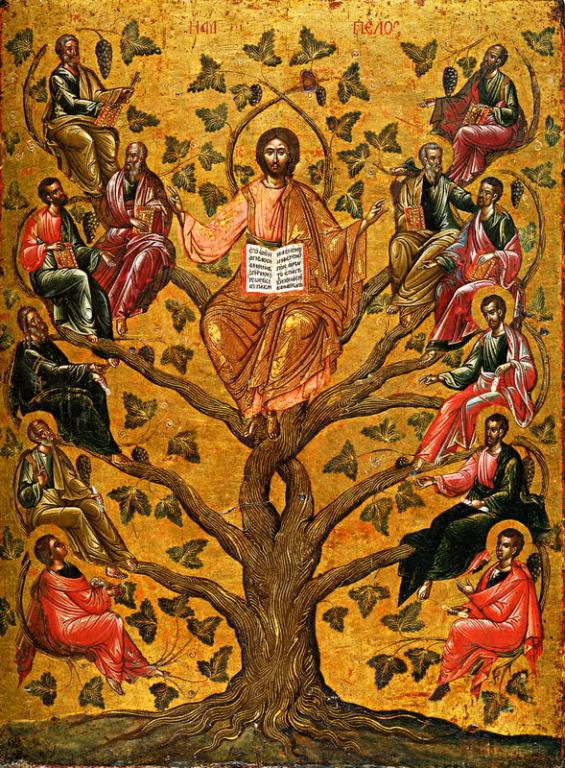
(Icon of Christ as the True Vine, 16th century. Source: Wikimedia, Creative Commons License).
The following is a guest post by a friend whose story of conversion from Roman Catholicism to Orthodoxy and back to Catholicism has taken a lot of bravery to tell. These thoughts are her own; please be respectful in reading.
I touched the outstretched crucifix, sobbing in the confessional, and received my penance. The priest’s gnarled hands formed a shroud of dark flesh around the brass figure of Christ’s tormented body. I choked out the Act of Contrition, quieted myself, and left the church.
More than a year later, I confessed again – but this time, to an Orthodox priest. It was my first confession since having left the Roman Catholic Church.
I entered the Roman Catholic Church with the rest of my family when I was eight. I left it, profoundly alone, when I was 22. God had abandoned me, I felt. He had abandoned all Roman Catholics. But I knew He existed, and I hated Him for it. I needed and wanted nothing more than the Eucharist, than reconciliation, but was mortified to receive either.
So I drank – often alone or, if not, until I blacked out. I shut myself out from communion with others. I looked at what I knew to be true – God, the Sacraments, the Church – but could see no beauty. I felt nothing other than a twisting, anxious sense of shame and loathing and need.
I read voraciously, even as I hated. But Orthodox theology, which constituted a significant portion of my reading, repeatedly and quietly said: Stop reading.
It was through the Orthodox liturgy – the sacraments, its celebration and celebrants, the entire year and community life ordered around it – that I relearned love, because I relearned beauty. The Sacraments were, I saw at last, profoundly erotic. They were not only true, they were beautiful. Moreover, their eroticism was rooted in community and body. I watched as body, community, and Sacrament coalesced. I felt suddenly that the knowledge I had wanted so desperately for so long – the knowledge of participation, not apprehension – I could attain through the pre-articulate poesy recited and developed with each Divine Liturgy.
I understood, finally, that the beginning and end of all understanding is love. The Orthodox Church held all which is most dear to the Roman Catholic Church with joy and tenderness I had never seen before, much less experienced or been able to celebrate myself. I could be in love with the Church, and I was.
My twin brother stood among his classmates in his black robes and cap during the Baccalaureate Mass. He was now the only member of the family who remained a Roman Catholic. The crucifix again loomed above me, heavy and loathsome and perpetual. I left the church with my family after Mass, nauseated, and saw my mother begin crying as if she’d lost a child.
She had indeed lost a child. She had left him behind, in the West.
The rift between my brother and the rest of my family was real and vast. We felt the wound of schism immanently, persistently. It was precisely our chosen allegiance to Orthodoxy which barred him from shared communion. The alienation was our doing. He saw the same beauty in the East that we saw, yet chose to remain behind. Why?
He usually responded to my queries in terms of duty and obedience to the Church, but the problem I discerned was this: There is no life post-Catholicism, if one takes the Church at its word. It is an all-encompassing and non-derivative explanation of the world, a thorough situation within the cosmos. All which comes after is necessarily critique, addendum, or flat and insensible negation.
The process of “conversion,” if it is to be genuine conversion, must provide and leverage some more radically comprehensive and basic principle for belief – resulting in a full refutation of the Church – or risk being reduced, in the end, to an expression of preference or history. Without this refutation, “conversion” remains mere critique and thus fundamentally Catholic. The etymology of the word belies this. “Conversion” first entered Middle English referring specifically to the “turn” of sinners to God, signifying both an affirmation (of God) and repentance (of sin). But its Latin root means to “turn around,” to redirect or be redirected in a total sense.
The problem of my own conversion to Orthodoxy was precisely that I found the idea of “conversion” absurd, since impossible. I could not refute the Roman Catholic church and had no desire to do so. I hoped to fulfill my Catholic faith, not reject it. What I saw in Orthodoxy was what I thought Catholicism ought to be. I saw the antidote to a faith poisoned by intellectualism and individualism, thwarted by poor catechesis and a body of disinterested faithful.
So I could adopt one of two explanations for my conversion. I could either characterize my conversion as an expression of mere preference – and thus “convert” without refutation – or affirm the unity of the Church, East and West, and come to understand my Orthodox faith as a celebration or fulfillment of my Roman Catholic faith.
I opted for the latter.
But having done so, I was confronted by the fact that my new allegiance to Orthodoxy forced me to argue against administration of the Sacraments to Roman Catholics – to my brother. It demanded that I affirm schism, which directly conflicted with my understanding of conversion. He was barred from our Eucharist, his Sacraments and life in the Church generally (though gently) dismissed as “less-than.” My mother’s sense that she had lost a child was well-founded.
“The Church must breathe with her two lungs,” wrote Saint Pope John Paul II in Ut unum sint.
The cry for unity is not merely a presumptuous appeal to the “truth” of submission to the Pope, nor is it the kid glove covering a grimy imperialistic hand seeking to wrest a rich, organic faith from those who would be unified under the Holy See of Rome. Emphasis on unity is an appeal to love, to the beauty of the visible and whole Church. Our present disunity is a wound, and we must minister to it.
An exhaustive study of ecclesiological and theological development will not, in the end, serve to convince a faithful member of the Body of Christ that one or other branch of the Church is correct. I have spent much time and much energy trying to discern which is the true church, and my conclusion is simply that they both are. They name and adore and embody the same beauty.
As in Ephesians 2:19-22, “Brothers and sisters: You are no longer strangers and sojourners, but you are fellow citizens with the holy ones and members of the household of God, built upon the foundation of the Apostles and prophets, with Christ Jesus himself as the capstone. Through him the whole structure is held together and grows into a temple sacred in the Lord; in him you also are being built together into a dwelling place of God in the Spirit.”
East and West are complementary, but distinct, dispositions toward the same Sacramental life in the Church. Those on both sides who would emphasize difference to the point of rupture and schism ignore the deep, abiding, and beautiful resonance between Orthodoxy and Catholicism. We need each other and are both most beautiful when unified with the other. We must build together. The Roman Catholic church is the field I must plow. Others have been given (or have chosen) Orthodoxy. Neither East nor West is wrong until it wrongs the other.
My hope in writing is to offer my mistakes and my loves to others who may share my struggle. Theological refutation is not my goal. I aim not to pronounce, but to invite. I am well aware of the delicate and contentious history at hand and ask forgiveness for what I have omitted or overlooked.
All I can do is offer you what charity I have and ask that you do the same. Loving discourse is the first step toward unity – and perhaps is itself a kind of union. To that end, I welcome any and all rebuttals or queries.
Through Christ the whole structure is held together; through Him we are being built together into a dwelling place of God. But the task of reconciliation is ours.
Please, let us begin.
This is a guest post by Sarah Albers. She may be contacted at [email protected] or on Twitter at @goingblondzo.
Previous Post
November 14, 2016
Communist Francis? Sure, Why Not?
Next Post
November 29, 2016 The Saint You Hate
Browse Our Archives
Select a Category Academia Culture Politics Reviews Theology Uncategorized
Select a Month October 2026 September 2026 August 2026 July 2026 June 2026 May 2026 April 2026 March 2026 February 2026 January 2026 December 2025 November 2025 October 2025 September 2025 August 2025 July 2025 June 2025 May 2025 April 2025 March 2025 February 2025 January 2025 December 2024 November 2024 October 2024 September 2024 August 2024 July 2024 June 2024 May 2024 April 2024 March 2024 February 2024 January 2024 December 2023 November 2023 October 2023 September 2023 August 2023 July 2023 June 2023 May 2023 April 2023 March 2023 February 2023 January 2023 November 2022 October 2022 September 2022 August 2022 July 2022 June 2022 May 2022 April 2022 March 2022 February 2022 July 2021 December 2020 November 2020 July 2020 May 2020 April 2020 February 2020 January 2020 December 2019 November 2019 October 2019 August 2019 July 2019 April 2019 March 2019 December 2018 August 2018 July 2018 June 2018 May 2018 April 2018 March 2018 January 2018 December 2017 November 2017 September 2017 August 2017 July 2017 June 2017 May 2017 April 2017 March 2017 February 2017 January 2017 December 2016 November 2016 October 2016 September 2016 August 2016 July 2016 June 2016 May 2016 April 2016 March 2016 February 2016
Follow Us!
TAKE THE
Religious Wisdom Quiz
Who was the patriarch whose faith led to the near-sacrifice of his son?
Select your answer to see how you score.
Joseph Jacob Abraham Isaac
Related posts from Jappers and Janglers

American Movie: The Beauty of the Chuds

Apostasy, Scandal, and a Road Well-Trod

Which is the Original Bible? Is it the...
TRENDING AT PATHEOS Religious Music and Entertainment

'Super Scam Me' Exposes AI Jon Bon Jovi...
Leslie Pickett believed she was in a relationship with Jon Bon Jovi....

The Brazilian Remake of Kendricks' 'Flywheel' Opens in...
“Flywheel,” the story that launched the Kendrick Brothers’ filmmaking career is getting...

The Dangers of Gradual Accommodation (Winking at Sin)
Recently, the “law of gradualness” resurfaced during the opening of a weeklong,...

The Iron Gates and the Lion of the...
Yesterday, I didn't finish my report about, well, yesterday. So I'll...

The Image: On the Horror of Capitalism and...
The Image Then went the Pharisees, and took counsel how they might...

We are approaching the date of our new American national holiday: October...
view all Religious Music and Entertainment blogs
Ad-Free & Subscriber Log-In Subscription Support
- About Us
- 2026 Calendar
- Videos
- Podcasts
- Library of World Religions
- Faith In Media Tracker
- Advertise With Us
- Write for Us
- Privacy Policy
- Terms of Service
- Do Not Sell My Data
- Contact Us
- Radiant Digital
- Manage Newsletter Subscriptions
- Unsubscribe From Notifications
- Sitemap
Copyright 2008-2026, Patheos. All rights reserved.
Subscription Support Ad-Free & Subscriber Log-In
Follow Patheos