
BuddhistCatholicContemplativeEvangelicalGeneral ChristianHinduJewishLatter-day SaintMuslimNew VisionsProgressive Christian
Beliefs
- Buddhist
- Catholic
- Contemplative
- Evangelical
- General Christian
- Hindu
- Jewish
- Latter-day Saint
- More Voices
- Muslim
- New Visions
- Pagan
- Progressive Christian
Topics
- Religion News
- Food and Religion
- Sports and Religion
- Religious Art
- Religious Music and Entertainment
- Religious Events
- History and Religion
- Style and Religion
- Politics and Religion
- Women in Religion
- Recreation Outdoors and Religion
- Business Finance and Religion
- Careers Workplace and Religion
- Education and Religion
- Family Parenting and Religion
- Health Fitness and Religion
- Home and Religion
- Relationships and Religion
- Technology and Religion
- Travel and Religion
Columnists
- Buddhist Columnists
- Business Finance and Religion Columnists
- Careers Workplace and Religion Columnists
- Catholic Columnists
- Contemplative Columnists
- Education and Religion Columnists
- Evangelists Columnists
- Family Parenting and Religion Columnists
- General Christian Columnists
- Health Fitness and Religion Columnists
- Hindu Columnists
- History and Religion Columnists
- Home and Religion Columnists
- Jewish Columnists
- More Voices Columnists
- Latter Day Columnists
- Muslim Columnists
- New Visions Columnists
- Nonreligious Columnists
- Pagan Columnists
- Politics and Religion Columnists
- Progressive Columnists
- Recreation Outdoors and Religion Columnists
- Relationships and Religion Columnists
- Religion News Columnists
- Religious Art Columnists
- Religious Events Columnists
- Religious Music and Entertainment Columnists
- Sports and Religion Columnists
- Style and Religion Columnists
- Technology and Religion Columnists
- Travel and Religion Columnists
- Women in Religion Columnists
Resource Library
- 2026 Calendar
- Library of World Religions
- The 100 Most Holy Places on Earth
- Patheos Answers
- Podcasts
- Videos
- Faith Leaders Database
- Anglican Episcopalian
- Bahai
- Baptist
- Buddhism
- Christianity
- Confucianism
- Eastern Orthodoxy
- Hinduism
- Holiness and Pentecostal
- ISKCON
- Islam
- Judaism
- Lutheran
- Methodist
- The Church of Jesus Christ of Latter-day Saints
- New Age
- Paganism
- Presbytarian and Reformed
- Protestantism
- Religion Behind the Scenes
- Roman Catholic
- Scientology
- Shia Islam
- Sikhism
- Sufism
- Sunni Islam
- Taoism
- Zen
- See all religions
Research Tools
 Ad-Free & Subscriber Log-In Subscription Support
Ad-Free & Subscriber Log-In Subscription Support
Follow Patheos 

- Trending:
- Forgiveness
- |
- Marriage
- |
- Consciousness
- |
- Death Penalty
- |
- Election
- |
- Halloween

- Home
- Religious Music and Entertainment
- Confessions of a Catholic Anarchist in Trump’s America
Confessions of a Catholic Anarchist in Trump’s America
Last updated on: November 12, 2016 at 6:24 pm by Chase Padusniak
Confessions of a Catholic Anarchist in Trump’s America 2016-11-12T18:24:16-04:00 Chase Padusniak
Patheos Explore the world's faith through different perspectives on religion and spirituality! Patheos has the views of the prevalent religions and spiritualities of the world.
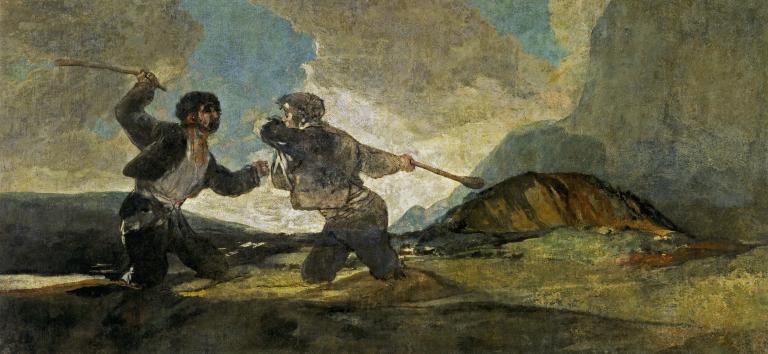
(“Duelo a garrotazos,” or “Fight with Cudgels” by Francisco de Goya y Lucientes, 1819-1823. Source: Wikimedia, Creative Commons License).
Yesterday I had six hours of class—six hours that bought me a whole day to reflect on what was a night filled with conflicting and difficult emotions. In what follows, I will attempt total honesty about myself, about my feelings throughout election night. That may sound silly: who shouldn’t attempt to be honest? But after an election like this, it’s easy to collapse inner perturbations and surprises into a simple narrative. I refuse to let myself do that.
After that, I’d like to offer some thought—preliminary and, again, honest—about the future.
Confiteor: I experienced a certain giddiness when I saw Hillary’s numbers begin to slip. I imagined Bernie, half-slunk over, grinning. The collapse of guaranteed neoliberal victory stirred a smile.
Confiteor: Throughout the night, I clung to the hope that the results would mean a revitalized commitment to justice and the poor; despair was not yet in my soul.
Confiteor: My inner Millennial was rife with cynicism, rooted in a sort of irony. For example, I promised that if Trump won, I would listen to nothing but Joy Division until the end of the work week (I am actually doing this); I also had a funny sort of vision: President-Elect Clinton takes the stage as confetti streams down. “Love Will Tear Us Apart” blares over a silent audience.
Confiteor: As time went on the seriousness of what had happened began to dawn on me, and any sense of giddiness, any trace of detached mockery began to fade.
Why did I react in this way? Well, it’s no secret that I am not a fan of Trump; I’ve written about my voting third party more than once. I also deeply disliked Clinton for a number of reasons (abortion, foreign policy, the death penalty, and her career politicking particularly come to mind). But none of that explains a sort of ashamed giddiness at watching her numbers plummet; I was not pulling for Trump.
Sam Kriss, however, correctly, I think, explains why it is that people like me had the reaction they did:
I think I’m still in shock. When the sun rose this morning it was blistered with the face of Donald Trump, bronze and smirking hideous, and all I can think about is Hillary Clinton. It’s what I know. Throughout the entire election, one slow-motion clip of a clown car ramming into a crowd of pedestrians, I’d assumed that the danger of Trump and the danger of Clinton were of two different orders. Trump was dangerous because of what he said and what he represented, the waves of fascism and violence that rippled out from the dead plopping weight of his speeches. Clinton was dangerous because of what she would actually do, because Clinton was going to win the election. I was a sucker, the kind who gets duped precisely by believing himself to be too smart for any kind of con. I thought I saw through it all, the whole stupid charade, a coronation disguised as a battlefield. I was wrong. This was exactly what Hillary Clinton wanted people like me to think; she wanted to be an inevitability. And this is why Trump won: the presidency was Clinton’s to lose, from the moment she announced her candidacy, and she lost it. She was the only person who could. People don’t like taking part in someone else’s inevitability.
A “coronation disguised as a battlefield.” That is the essence of the thing. I never thought she would lose, and so I was setting myself up to be a critic, to spend the next four years having my little cynic’s cake and eating it too. She would sweep into office: prideful, corrupt, a warmonger, pro-choice, a neoliberal, pant-suited shill. I never had to contend with the idea that I would occupy the role of Trump critic: he would fade and the real work would remain to be done. The task was to be rebuilding the pro-life movement, proudly calling out Madame President as she drone struck people of color out of existence in the name of progress.
This was the initial giddiness, the self-satisfaction that comes from telling people working-class whites feel ignored, that cynically enjoys watching pride come before the fall. Again, Kriss:
She knew that she was electoral poison, that vast swathes of the country hated her and for good reason, that she was compromised by a miserable record spotted with sleaze and criminality, that she alienated the left, inflamed the right, and appealed mostly to a small coterie of sexually repressed and pathologically centrist think-tank nerds, that her entire constituency was made of limp cardboard and backlogged semen, that her candidacy raised the serious possibility of a Republican victory when anyone else would have beaten that divided and frothing party into insignificance with one hand tied behind their back – but she ran anyway.
But this couldn’t last. As friends—people of color, Jews, Muslims, and others—came to me yesterday and said: we feel threatened; we feel dejected, forgotten—in plain-English: wronged. Some will call them “special snowflakes,” but that’s to misunderstand; that’s to call a white worker a “special snowflake” because his job went to China and his children are on meth. It’s callous.
More than callousness, though, it betrays a misapprehension of human feeling. I have Jewish friends who fear for their status here, not because they think anti-Semitism is ubiquitous, but because its return in any shape is threatening. Friends of Hispanic ancestry worry about familial deportations, about the most fundamental unit of human solidarity being torn apart. Women balk at the idea that we’ve put a man charged with sexual assault, and notoriously misogynistic in language, into the White House.
You don’t have to agree that Trump is guilty to see how this could upset people, cause them real anxiety. Further, if you’re Catholic: how else can you respond but with love, with companionship? Families torn apart—call this a consequence, but regardless of political stance it is a tragedy.
And so, I now find myself stuck, preparing to disagree with a foe I never imagined could be relevant. My own pride has damned me. Let me cry: mea culpa, mea culpa, mea maxima culpa.
That said, my hope remains—I refuse to despair, and my belief that the abyss created by this election might yet beget a renewed politics of justice and love has not been squashed.
Very clearly, I may be wrong, but it is my belief that President Trump will be little more than a mildly less-interventionist, mildly-less free trade Republican. Take, for example, his plan for his first 100 days in office. Much here might upset people, and rightly so. But how much of it is different than what any Republican nominee would have had to support to come near the White House in 2016? Attacks on climate change prevention measures and Obamacare are par for the GOP course; regulation eliminations, a pro-life Supreme Court justice, and stricter immigration policy are nothing new. It is, yes, true that his party will have control of both legislative houses, but what does that really mean? This year has seen the GOP implode, and it seems naïve to me to expect that every Republican lawmaker will become a Trump-lover overnight. Even then, the Senate retains its ability to filibuster (though if it does, it must be careful: block his way too much and risk being scapegoated as obstructions to the new American course).
In my view, the truth is that Trump’s rhetoric, the ugly sort of xenophobia he’s allowed to resurface: these are the things to worry about, the things that separate this Republican presidency from any other. These realities also hamper calls for “unity,” a nice liberal idea, but unlikely to manifest itself magically after this contentious campaign: name-calling will continue. In other words, it’s the sociology of the situation that ought to upset; the realities of American politics are likely to remain bland, partisan, and unproductive.
Previous Post

November 8, 2016
A Byzantine Prayer for Election Day
Next Post

November 14, 2016 Communist Francis? Sure, Why Not?
Browse Our Archives
Select a Category Academia Culture Politics Reviews Theology Uncategorized
Select a Month October 2026 September 2026 August 2026 July 2026 June 2026 May 2026 April 2026 March 2026 February 2026 January 2026 December 2025 November 2025 October 2025 September 2025 August 2025 July 2025 June 2025 May 2025 April 2025 March 2025 February 2025 January 2025 December 2024 November 2024 October 2024 September 2024 August 2024 July 2024 June 2024 May 2024 April 2024 March 2024 February 2024 January 2024 December 2023 November 2023 October 2023 September 2023 August 2023 July 2023 June 2023 May 2023 April 2023 March 2023 February 2023 January 2023 November 2022 October 2022 September 2022 August 2022 July 2022 June 2022 May 2022 April 2022 March 2022 February 2022 July 2021 December 2020 November 2020 July 2020 May 2020 April 2020 February 2020 January 2020 December 2019 November 2019 October 2019 August 2019 July 2019 April 2019 March 2019 December 2018 August 2018 July 2018 June 2018 May 2018 April 2018 March 2018 January 2018 December 2017 November 2017 September 2017 August 2017 July 2017 June 2017 May 2017 April 2017 March 2017 February 2017 January 2017 December 2016 November 2016 October 2016 September 2016 August 2016 July 2016 June 2016 May 2016 April 2016 March 2016 February 2016
Follow Us!
TAKE THE
Religious Wisdom Quiz
What did God use to guide the Israelites by night in the wilderness?
Select your answer to see how you score.
A cloud A pillar of fire The moon A torch
Related posts from Jappers and Janglers

Secrets & Lies in the Age of Truth...


Apostasy, Scandal, and a Road Well-Trod
TRENDING AT PATHEOS Religious Music and Entertainment

The Problem with False Prophets
Miller’s Station UMC| 10/18/26| Anchor Verse: Jeremiah 23: 1, 9-23 I...

Emotion in Early Christianity by Andrew Crislip
Andrew Crislip’s Emotion in Early Christianity examines an often overlooked dimension of...

16 Spiritual Touchstones for a More Grounded Life
After decades of spiritual study, here are 16 principles I try...

Catholic Evangelization: Sharing Your Faith Every Day
Welcome back to the Graceful Awakening mini-series called, “From Faith to Mission.” ...

The Pillar of the Boatmen: the Ancient Monument...
The Pillar of the Boatmen is a Romano-Gaulish sculpture that dates from...

In one sense walking into Westminster Abbey is like walking down the...
view all Religious Music and Entertainment blogs
Ad-Free & Subscriber Log-In Subscription Support
- About Us
- 2026 Calendar
- Videos
- Podcasts
- Library of World Religions
- Faith In Media Tracker
- Advertise With Us
- Write for Us
- Privacy Policy
- Terms of Service
- Do Not Sell My Data
- Contact Us
- Radiant Digital
- Manage Newsletter Subscriptions
- Unsubscribe From Notifications
- Sitemap
Copyright 2008-2026, Patheos. All rights reserved.
Subscription Support Ad-Free & Subscriber Log-In
Follow Patheos