
BuddhistCatholicContemplativeEvangelicalGeneral ChristianHinduJewishLatter-day SaintMuslimNew VisionsProgressive Christian
Beliefs
- Buddhist
- Catholic
- Contemplative
- Evangelical
- General Christian
- Hindu
- Jewish
- Latter-day Saint
- More Voices
- Muslim
- New Visions
- Pagan
- Progressive Christian
Topics
- Religion News
- Food and Religion
- Sports and Religion
- Religious Art
- Religious Music and Entertainment
- Religious Events
- History and Religion
- Style and Religion
- Politics and Religion
- Women in Religion
- Recreation Outdoors and Religion
- Business Finance and Religion
- Careers Workplace and Religion
- Education and Religion
- Family Parenting and Religion
- Health Fitness and Religion
- Home and Religion
- Relationships and Religion
- Technology and Religion
- Travel and Religion
Columnists
- Buddhist Columnists
- Business Finance and Religion Columnists
- Careers Workplace and Religion Columnists
- Catholic Columnists
- Contemplative Columnists
- Education and Religion Columnists
- Evangelists Columnists
- Family Parenting and Religion Columnists
- General Christian Columnists
- Health Fitness and Religion Columnists
- Hindu Columnists
- History and Religion Columnists
- Home and Religion Columnists
- Jewish Columnists
- More Voices Columnists
- Latter Day Columnists
- Muslim Columnists
- New Visions Columnists
- Nonreligious Columnists
- Pagan Columnists
- Politics and Religion Columnists
- Progressive Columnists
- Recreation Outdoors and Religion Columnists
- Relationships and Religion Columnists
- Religion News Columnists
- Religious Art Columnists
- Religious Events Columnists
- Religious Music and Entertainment Columnists
- Sports and Religion Columnists
- Style and Religion Columnists
- Technology and Religion Columnists
- Travel and Religion Columnists
- Women in Religion Columnists
Resource Library
- 2026 Calendar
- Library of World Religions
- The 100 Most Holy Places on Earth
- Patheos Answers
- Podcasts
- Videos
- Faith Leaders Database
- Anglican Episcopalian
- Bahai
- Baptist
- Buddhism
- Christianity
- Confucianism
- Eastern Orthodoxy
- Hinduism
- Holiness and Pentecostal
- ISKCON
- Islam
- Judaism
- Lutheran
- Methodist
- The Church of Jesus Christ of Latter-day Saints
- New Age
- Paganism
- Presbytarian and Reformed
- Protestantism
- Religion Behind the Scenes
- Roman Catholic
- Scientology
- Shia Islam
- Sikhism
- Sufism
- Sunni Islam
- Taoism
- Zen
- See all religions
Research Tools
 Ad-Free & Subscriber Log-In Subscription Support
Ad-Free & Subscriber Log-In Subscription Support
Follow Patheos 

- Trending:
- Forgiveness
- |
- Marriage
- |
- Consciousness
- |
- Death Penalty
- |
- Election
- |
- Halloween

- Home
- Religious Music and Entertainment
- When Your Enemies Are Christians
When Your Enemies Are Christians
Last updated on: August 17, 2016 at 9:26 pm by Chase Padusniak
When Your Enemies Are Christians 2016-08-17T21:26:43-04:00 Chase Padusniak
Patheos Explore the world's faith through different perspectives on religion and spirituality! Patheos has the views of the prevalent religions and spiritualities of the world.
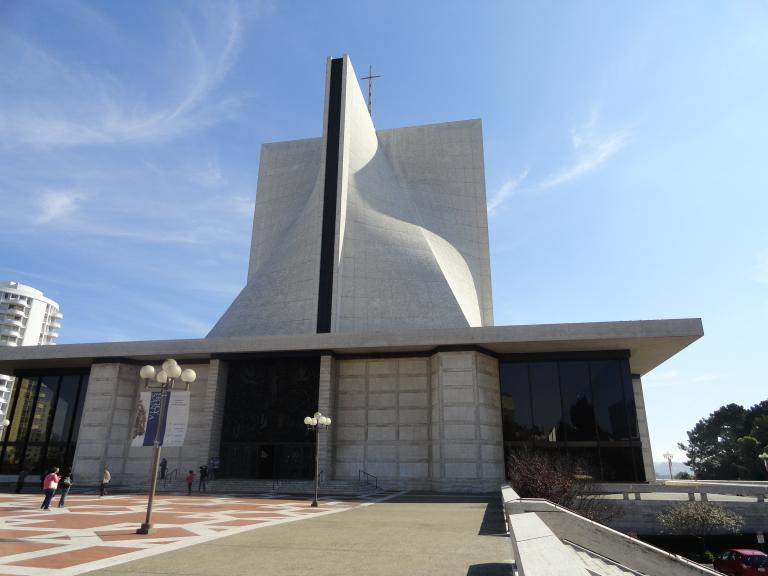
(The Cathedral of St. Mary of the Assumption in San Francisco, California. Source: Wikimedia, Creative Commons License).
Enemies broadly speaking anyway.
This topic has stuck with me. Growing up American (read: secular), attending a Jesuit college, interacting with conservative evangelicals, I’ve met a plethora of Christians. It’s not totally uncommon for me to encounter one, then another, and then hear them bad mouth (or, perhaps, as some say: “charitably—but not to their faces—rebuke”) their theological, social, or simply general, opposite. And although we rarely call these people our enemies, we often treat them as such.
My example will double as a confession. I’ve had my share of trouble with Thomism. For lots of Catholics, the discovery of a rich, orderly system is a light in the postmodern miasma. Alas, for me, as a fan of Nietzsche and Woody Allen, things weren’t so tidy (lamentably, to be honest). Perhaps I would’ve come around, had I not—time and again—encountered self-identified readers of Thomas who seem to enjoy intellectual power trips worthy of Hegel himself.
This applies across the board—to conservatives, traditionalists, even the occasional liberal. Call it a series of unfortunate experiences. But it means I’m still not ready to give some, even major, Thomistic figures their due. Lord knows my angry jokes sometimes border on totally ridiculous criticism. Confessus sum.
Many people know this feeling in one way or another.
It’s easy, really, from far away to look at another Christian and note that he or she violates Church teaching, or quite often emphasizes it in the “wrong way”—he or she doesn’t stress abortion enough, prefers a less aesthetically-rich liturgy, communes without kneeling, etc.
There is nothing wrong with this, of course—recognizing disagreement. The problem comes, often subconsciously, when we forget that the other is faithful, that is, is a Christian. It’s far too easy to slip from disagreement to anger. Check out a comments box or blog to see what I mean.
Sure it’s easy to joke about Sola Scriptura (it is—I do it all the time: “Oh yeah. We can just pick it up and read it. Who needs a tradition or an education?”), but what about the hours that Lutheran spends in prayer? It’s simple enough to quip that Pope Francis is up to it again, but what of his time spent with the Eucharist, filled with awe?
Another example. My college had two Catholic communities: the official campus ministry program and a more traditional set (there was, of course, some overlap). The latter wanted a monthly Latin Mass; the former didn’t mind guitars in a basement chapel. The Jesuits stayed out of the conflict, but, generally, were associated with the official program.
Once at Mass the priest got up and began his homily typically enough—it started with an anecdote about a bus trip he’d taken. “I sat down, and took out my book to pray the Hours…” My roommate and I looked at each other shocked. In our hard-heartedness, we’d forgotten that, as a faithful priest, this man prayed the Hours; he cared about his soul. No matter what his commitments—theologically, liturgically, whatever—he was a devoted priest, a man of God, not some medieval parson with an illicit concubine and children’s inheritances to look after.
I try to remind myself of that all the time. It’s hard, but it’s necessary. Some disagreements are more serious than others, of course; violating Church teaching is nothing to be taken lightly. Yet, we cannot see our “enemies”—our Christian enemies—as without grace, as without love. Our salvation, in fact, depends on it.
As for what to do about it, well, we’ve known for some time. It never hurts to pray, especially not when you hate them or they hate you.
This post is a part of the Patheos Catholic Channel series, “Catholicity: Identity and Its Discontents.” Read more here.
Previous Post

August 13, 2016
The Dirty “P” Word
Next Post

August 19, 2016 How We Live
Browse Our Archives
Select a Category Academia Culture Politics Reviews Theology Uncategorized
Select a Month October 2026 September 2026 August 2026 July 2026 June 2026 May 2026 April 2026 March 2026 February 2026 January 2026 December 2025 November 2025 October 2025 September 2025 August 2025 July 2025 June 2025 May 2025 April 2025 March 2025 February 2025 January 2025 December 2024 November 2024 October 2024 September 2024 August 2024 July 2024 June 2024 May 2024 April 2024 March 2024 February 2024 January 2024 December 2023 November 2023 October 2023 September 2023 August 2023 July 2023 June 2023 May 2023 April 2023 March 2023 February 2023 January 2023 November 2022 October 2022 September 2022 August 2022 July 2022 June 2022 May 2022 April 2022 March 2022 February 2022 July 2021 December 2020 November 2020 July 2020 May 2020 April 2020 February 2020 January 2020 December 2019 November 2019 October 2019 August 2019 July 2019 April 2019 March 2019 December 2018 August 2018 July 2018 June 2018 May 2018 April 2018 March 2018 January 2018 December 2017 November 2017 September 2017 August 2017 July 2017 June 2017 May 2017 April 2017 March 2017 February 2017 January 2017 December 2016 November 2016 October 2016 September 2016 August 2016 July 2016 June 2016 May 2016 April 2016 March 2016 February 2016
Follow Us!
TAKE THE
Religious Wisdom Quiz
What does the Bible say about planning for the future?
Select your answer to see how you score.
Always worry Commit your plans to the Lord Don't think ahead Never plan
Related posts from Jappers and Janglers

If Footmen Tire You, What Will Horses Do?
The Exorcist: If Evil's Real, Then What?


TRENDING AT PATHEOS Religious Music and Entertainment

Dolly Parton’s Last Song Wins Dove Award with...
Bluegrass band The Grascals, speaking on the red carpet at the 57th...

The Image: On the Horror of Capitalism and...
The Image Then went the Pharisees, and took counsel how they might...

We are approaching the date of our new American national holiday: October...

Letters on Living the Faith by C.S. Lewis
Most of us met C.S. Lewis as a public intellectual. Mere Christianity....

When Halloween Unmasks Married Hearts
Written by Dr. David K. Ewen from Eternal Truth Bible College Behind...

Aristotle. He’s been called the father of logic, the father of the...
view all Religious Music and Entertainment blogs
Ad-Free & Subscriber Log-In Subscription Support
- About Us
- 2026 Calendar
- Videos
- Podcasts
- Library of World Religions
- Faith In Media Tracker
- Advertise With Us
- Write for Us
- Privacy Policy
- Terms of Service
- Do Not Sell My Data
- Contact Us
- Radiant Digital
- Manage Newsletter Subscriptions
- Unsubscribe From Notifications
- Sitemap
Copyright 2008-2026, Patheos. All rights reserved.
Subscription Support Ad-Free & Subscriber Log-In
Follow Patheos