
BuddhistCatholicContemplativeEvangelicalGeneral ChristianHinduJewishLatter-day SaintMuslimNew VisionsProgressive Christian
Beliefs
- Buddhist
- Catholic
- Contemplative
- Evangelical
- General Christian
- Hindu
- Jewish
- Latter-day Saint
- More Voices
- Muslim
- New Visions
- Pagan
- Progressive Christian
Topics
- Religion News
- Food and Religion
- Sports and Religion
- Religious Art
- Religious Music and Entertainment
- Religious Events
- History and Religion
- Style and Religion
- Politics and Religion
- Women in Religion
- Recreation Outdoors and Religion
- Business Finance and Religion
- Careers Workplace and Religion
- Education and Religion
- Family Parenting and Religion
- Health Fitness and Religion
- Home and Religion
- Relationships and Religion
- Technology and Religion
- Travel and Religion
Columnists
- Buddhist Columnists
- Business Finance and Religion Columnists
- Careers Workplace and Religion Columnists
- Catholic Columnists
- Contemplative Columnists
- Education and Religion Columnists
- Evangelists Columnists
- Family Parenting and Religion Columnists
- General Christian Columnists
- Health Fitness and Religion Columnists
- Hindu Columnists
- History and Religion Columnists
- Home and Religion Columnists
- Jewish Columnists
- More Voices Columnists
- Latter Day Columnists
- Muslim Columnists
- New Visions Columnists
- Nonreligious Columnists
- Pagan Columnists
- Politics and Religion Columnists
- Progressive Columnists
- Recreation Outdoors and Religion Columnists
- Relationships and Religion Columnists
- Religion News Columnists
- Religious Art Columnists
- Religious Events Columnists
- Religious Music and Entertainment Columnists
- Sports and Religion Columnists
- Style and Religion Columnists
- Technology and Religion Columnists
- Travel and Religion Columnists
- Women in Religion Columnists
Resource Library
- 2026 Calendar
- Library of World Religions
- The 100 Most Holy Places on Earth
- Patheos Answers
- Podcasts
- Videos
- Faith Leaders Database
- Anglican Episcopalian
- Bahai
- Baptist
- Buddhism
- Christianity
- Confucianism
- Eastern Orthodoxy
- Hinduism
- Holiness and Pentecostal
- ISKCON
- Islam
- Judaism
- Lutheran
- Methodist
- The Church of Jesus Christ of Latter-day Saints
- New Age
- Paganism
- Presbytarian and Reformed
- Protestantism
- Religion Behind the Scenes
- Roman Catholic
- Scientology
- Shia Islam
- Sikhism
- Sufism
- Sunni Islam
- Taoism
- Zen
- See all religions
Research Tools
 Ad-Free & Subscriber Log-In Subscription Support
Ad-Free & Subscriber Log-In Subscription Support
Follow Patheos 

- Trending:
- Forgiveness
- |
- Marriage
- |
- Consciousness
- |
- Death Penalty
- |
- Election
- |
- Halloween

- Home
- Religious Music and Entertainment
- Judge Not: An Obscure Monk Sheds Light on Pope Francis
Judge Not: An Obscure Monk Sheds Light on Pope Francis
Last updated on: July 6, 2016 at 11:00 pm by Chase Padusniak
Judge Not: An Obscure Monk Sheds Light on Pope Francis 2016-07-06T23:00:19-04:00 Chase Padusniak
Patheos Explore the world's faith through different perspectives on religion and spirituality! Patheos has the views of the prevalent religions and spiritualities of the world.
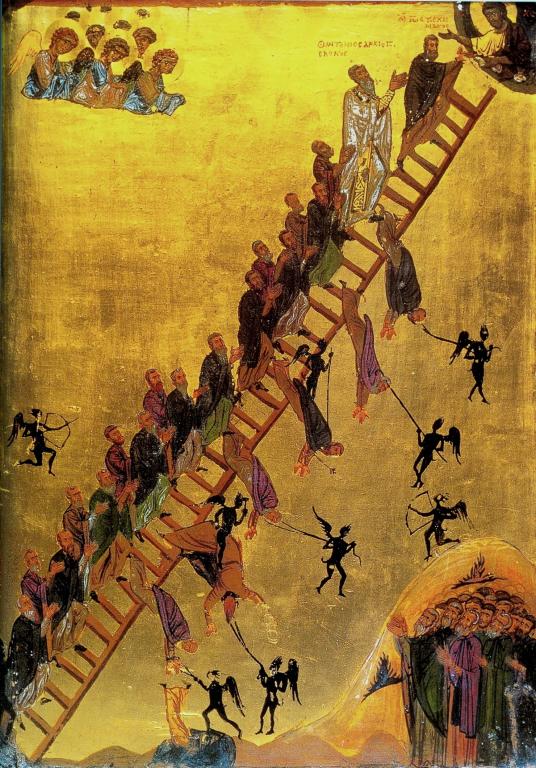
(An Icon of the Ladder of Divine Ascent, 12th century, from St. Catherine’s on Mt. Sinai. Source: Wikimedia, Creative Commons License).
Pope Francis mystifies—and aggravates—many Catholics; his talk of mercy, of suspending judgment has a tendency to attract charges of ambiguity, to draw ire from those who prefer the steady hand of a John Paul or the theological acumen of a Benedict.
In short, Francis is a true servus servorum Dei—clearly more comfortable advising than, well, pontificating. This has its obvious drawbacks—drawbacks which have been both rightly clarified and examined and which have also elicited scrutiny so intense that one is reminded of Jesus and the Pharisees. His emphasis on the pastoral belies a man less comfortable as a teacher and more as an adviser: slow to speak categorically, quick to suspend judgment.
In reflecting on his pontificate I am reminded of a little known saint: an “Uncondemning Monk,” commemorated by both certain Eastern Orthodox and Byzantine Catholic Christians. Notoriously remiss when it came to his duties, this monastic had but one redeeming quality: his absolute faith in the path of non-judgment, his commitment to listening before speaking. His story is found in the Prologue of Ohrid:
This monk was lazy, careless, and lacking in his prayer life; but throughout all of his life, he did not judge anyone. While dying, he was happy. When the brethren asked him how is it that with so many sins, you die happy? He replied, “I now see angels who are showing me a letter with my numerous sins. I said to them, Our Lord said: `stop judging and you will not be judged’ (St. Luke 6:37). I have never judged anyone, and I hope in the mercy of God that He will not judge me.” And the angels tore up the paper. Upon hearing this, the monks were astonished and learned from it.
Some might say this sounds like presumption. To me, it is reminiscent of St. Paul:
Love is patient, love is kind. It is not jealous, [love] is not pompous, it is not inflated, it is not rude, it does not seek its own interests, it is not quick-tempered, it does not brood over injury, it does not rejoice over wrongdoing but rejoices with the truth. It bears all things, believes all things, hopes all things, endures all things. (1 Corinthians 13:4-7)
“I have never judged anyone, and I hope in the mercy of God that He will not judge me.” This is love, if I have ever seen it. Note that the story does not say that the monk never advised others, nor that he never spoke negatively of another. It merely says that above all he placed his hope in the infinite mercy of God.
Pope Francis feels similarly:
[The penitent] ought to reflect on the truth of his life, of what he feels and what he thinks before God. He ought to be able to look earnestly at himself and his sin. He ought to feel like a sinner, so that he can be amazed by God. In order to be filled with his gift of infinite mercy, we need to recognize our need, our emptiness, our wretchedness. We cannot be arrogant.
The path of this pope may not be for all; it may even cause discomfort to many. I merely contend this: Francis’ vision of the teacher as the listener, of the Christian as he who hopes in love, might be a timely corrective to our vision of the faith. The animosity his very lifestyle elicits is, perhaps, the clearest argument for this hypothesis.
Our pope is not perfect; for some, his way might even present itself as a challenge, a corrective too far in one direction. Perhaps.
But let no one say that his conception of the faithful Christian lacks anything in ancient authority. Let no one harden his heart so that he cannot, like the monks in the story, be “astonished and learn[…] from it.”
Previous Post

July 5, 2016
Christian Patriotism: An Oxymoron?
Next Post
July 8, 2016 Liberalism is Conservatism is Not Catholicism
Browse Our Archives
Select a Category Academia Culture Politics Reviews Theology Uncategorized
Select a Month October 2026 September 2026 August 2026 July 2026 June 2026 May 2026 April 2026 March 2026 February 2026 January 2026 December 2025 November 2025 October 2025 September 2025 August 2025 July 2025 June 2025 May 2025 April 2025 March 2025 February 2025 January 2025 December 2024 November 2024 October 2024 September 2024 August 2024 July 2024 June 2024 May 2024 April 2024 March 2024 February 2024 January 2024 December 2023 November 2023 October 2023 September 2023 August 2023 July 2023 June 2023 May 2023 April 2023 March 2023 February 2023 January 2023 November 2022 October 2022 September 2022 August 2022 July 2022 June 2022 May 2022 April 2022 March 2022 February 2022 July 2021 December 2020 November 2020 July 2020 May 2020 April 2020 February 2020 January 2020 December 2019 November 2019 October 2019 August 2019 July 2019 April 2019 March 2019 December 2018 August 2018 July 2018 June 2018 May 2018 April 2018 March 2018 January 2018 December 2017 November 2017 September 2017 August 2017 July 2017 June 2017 May 2017 April 2017 March 2017 February 2017 January 2017 December 2016 November 2016 October 2016 September 2016 August 2016 July 2016 June 2016 May 2016 April 2016 March 2016 February 2016
Follow Us!
TAKE THE
Religious Wisdom Quiz
According to 1 Timothy, what is a trustworthy saying deserving of full acceptance?
Select your answer to see how you score.
God is love Christ Jesus came into the world to save sinners The Lord is our shepherd Faith without works is dead
Related posts from Jappers and Janglers

American Movie: The Beauty of the Chuds

Amateur Hour at the Indie Convent


500 Days of Paralyzing Anxiety
TRENDING AT PATHEOS Religious Music and Entertainment

The Problem with False Prophets
Miller’s Station UMC| 10/18/26| Anchor Verse: Jeremiah 23: 1, 9-23 I...

Emotion in Early Christianity by Andrew Crislip
Andrew Crislip’s Emotion in Early Christianity examines an often overlooked dimension of...

16 Spiritual Touchstones for a More Grounded Life
After decades of spiritual study, here are 16 principles I try...

Catholic Evangelization: Sharing Your Faith Every Day
Welcome back to the Graceful Awakening mini-series called, “From Faith to Mission.” ...

The Pillar of the Boatmen: the Ancient Monument...
The Pillar of the Boatmen is a Romano-Gaulish sculpture that dates from...

In one sense walking into Westminster Abbey is like walking down the...
view all Religious Music and Entertainment blogs
Ad-Free & Subscriber Log-In Subscription Support
- About Us
- 2026 Calendar
- Videos
- Podcasts
- Library of World Religions
- Faith In Media Tracker
- Advertise With Us
- Write for Us
- Privacy Policy
- Terms of Service
- Do Not Sell My Data
- Contact Us
- Radiant Digital
- Manage Newsletter Subscriptions
- Unsubscribe From Notifications
- Sitemap
Copyright 2008-2026, Patheos. All rights reserved.
Subscription Support Ad-Free & Subscriber Log-In
Follow Patheos