
BuddhistCatholicContemplativeEvangelicalGeneral ChristianHinduJewishLatter-day SaintMuslimNew VisionsProgressive Christian
Beliefs
- Buddhist
- Catholic
- Contemplative
- Evangelical
- General Christian
- Hindu
- Jewish
- Latter-day Saint
- More Voices
- Muslim
- New Visions
- Pagan
- Progressive Christian
Topics
- Religion News
- Food and Religion
- Sports and Religion
- Religious Art
- Religious Music and Entertainment
- Religious Events
- History and Religion
- Style and Religion
- Politics and Religion
- Women in Religion
- Recreation Outdoors and Religion
- Business Finance and Religion
- Careers Workplace and Religion
- Education and Religion
- Family Parenting and Religion
- Health Fitness and Religion
- Home and Religion
- Relationships and Religion
- Technology and Religion
- Travel and Religion
Columnists
- Buddhist Columnists
- Business Finance and Religion Columnists
- Careers Workplace and Religion Columnists
- Catholic Columnists
- Contemplative Columnists
- Education and Religion Columnists
- Evangelists Columnists
- Family Parenting and Religion Columnists
- General Christian Columnists
- Health Fitness and Religion Columnists
- Hindu Columnists
- History and Religion Columnists
- Home and Religion Columnists
- Jewish Columnists
- More Voices Columnists
- Latter Day Columnists
- Muslim Columnists
- New Visions Columnists
- Nonreligious Columnists
- Pagan Columnists
- Politics and Religion Columnists
- Progressive Columnists
- Recreation Outdoors and Religion Columnists
- Relationships and Religion Columnists
- Religion News Columnists
- Religious Art Columnists
- Religious Events Columnists
- Religious Music and Entertainment Columnists
- Sports and Religion Columnists
- Style and Religion Columnists
- Technology and Religion Columnists
- Travel and Religion Columnists
- Women in Religion Columnists
Resource Library
- 2026 Calendar
- Library of World Religions
- The 100 Most Holy Places on Earth
- Patheos Answers
- Podcasts
- Videos
- Faith Leaders Database
- Anglican Episcopalian
- Bahai
- Baptist
- Buddhism
- Christianity
- Confucianism
- Eastern Orthodoxy
- Hinduism
- Holiness and Pentecostal
- ISKCON
- Islam
- Judaism
- Lutheran
- Methodist
- The Church of Jesus Christ of Latter-day Saints
- New Age
- Paganism
- Presbytarian and Reformed
- Protestantism
- Religion Behind the Scenes
- Roman Catholic
- Scientology
- Shia Islam
- Sikhism
- Sufism
- Sunni Islam
- Taoism
- Zen
- See all religions
Research Tools
 Ad-Free & Subscriber Log-In Subscription Support
Ad-Free & Subscriber Log-In Subscription Support
Follow Patheos 

- Trending:
- Forgiveness
- |
- Marriage
- |
- Consciousness
- |
- Death Penalty
- |
- Election
- |
- Halloween

- Home
- Religious Music and Entertainment
- 1054: History, Myth, and the Making of a Schism (Part II)
1054: History, Myth, and the Making of a Schism (Part II)
Last updated on: February 10, 2017 at 11:22 pm by Guest Contributor
1054: History, Myth, and the Making of a Schism (Part II) 2017-02-10T23:22:41-04:00 Guest Contributor
Patheos Explore the world's faith through different perspectives on religion and spirituality! Patheos has the views of the prevalent religions and spiritualities of the world.
Here I am proud to present part two of this three-part series on the Great Schism of 1054. Part I may be found here.
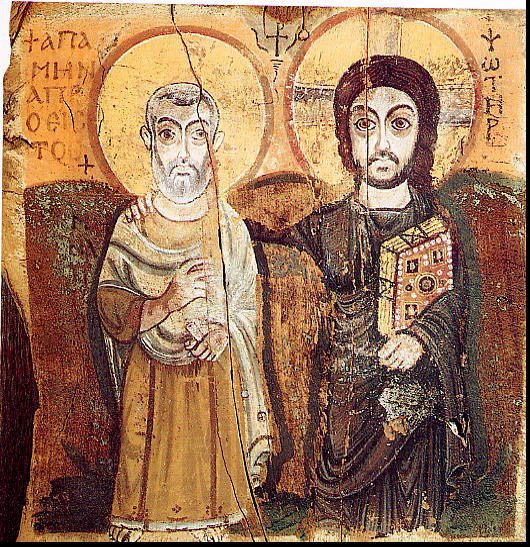
(A 6th-century Coptic icon of Saint Menas with Jesus. Source: Wikimedia, Creative Commons License).
Thus, through these letters, a little of each side’s perspective in this controversy is made clear. The perspective of Cerularius and of his associates is that the West has erred grievously in adopting corrupt customs contrary to divine law and the Scriptures; thus, the Western Church must move to correct these customs at once, with the help and guidance of the Eastern Church and her more ancient traditions. The perspective of Pope Leo and his associates is that Cerularius has wrongfully attacked the peace and unity of the Church by presuming to judge ancient customs and faith based on merely human arguments and conjectures; thus, he must immediately repent of his condemnation, and restore peace to the Church by submitting to the divinely-authorized judgment of the Papacy in these matters, acknowledging that mere differences in custom are no threat to divine faith.
How Cerularius reacted to this letter is not known; certainly, he would have found much in it to rouse his anger. However, after receiving it, he did apparently decide to pursue a more conciliatory course with Rome, hoping, possibly, to facilitate another possible military alliance between the Byzantine Empire and the Papacy. In his own words, he was “trying hard to hold [the Pope] as a well-minded and familiar friend, for his aid against the Westerners” (Caer. Petr. III), and so sent more conciliatory letters to him, along with letters from the Emperor to similar effect. At this stage, an ailing Pope Leo made a fateful decision. Rather than merely write another letter, he decided to send an official diplomatic delegation to Constantinople and Cerularius, a delegation consisting of some his most trusted advisers, headed by Cardinal Humbert. The choice of Humbert no doubt seemed fairly obvious; Humbert was not only one of Leo’s closest collaborators, but he had also thoroughly read the anti-Western works and composed several books in refutation of them. At a cursory glance, he seemed by far the most qualified man for the job. Nevertheless, Humbert was a reformer and polemicist, about as far from a diplomat as one could get; and he was soon to prove this fact beyond any doubt.
When the delegation left Rome in early 1054, the Pope was on his last legs, worn out and brokenhearted; by the time it arrived in Constantinople, on June 24th, 1054, he had died. By canon law, the legates’ commissions and positions would likewise have expired with the Pope’s death, and they would possess no further ability to act on behalf of the Papacy. Whether Humbert and his associates were ignorant of Pope Leo’s death, or whether they acted regardless of it is not known.
In any event, our knowledge of what took place then in Constantinople is fairly limited. Both Humbert and Cerularius would later provide fragmentary written accounts of what took place, but these accounts are colored strongly not only by their own perspectives, but also by their own self-interest. Thus, rather than give a blended account of what took place, I will try to recount what happened from each person’s point of view in turn, as they themselves related it. In doing so, I will pass over, for the moment, the question of how much the participants themselves believed their own account of things.
Humbert’s stated perspective on the matter is quite clear, and a written account of it is preserved not only in the excommunication he wrote against Cerularius and his associates, but also in a “brief and succinct account” he wrote after the fact. According to these documents, Humbert came to Constantinople as an extension of the Roman Church, to see “whether the clamor, which without ceasing comes from this great city to her ears, might be ended by our labor– or if it is not so, that she might know it” (Humbert Exc.). Having arrived in the city, the legates went to the Monastery of the Studium to treat with the monk Nicetas, who had written a book against the Western customs of clerical celibacy, fasting on Saturday, and unleavened bread. After disputing with them for a time in the presence of the Emperor and his court, Nicetas was brought to publicly disavow his book and anathematize all those who denied the primacy of Rome or “presume[d] to censure her always orthodox faith in some matter” (Humbert Acc.). The Emperor then ordered Nicetas’ book to be publicly burned. At a later date, Nicetas returned to the legates and again disavowed his earlier opinions, was received into communion by them, and “was made their familiar friend” (ibid). The Emperor receive the legates warmly and supported them in their efforts, even going so far as to have Humbert’s polemical writings translated into Greek and placed in the royal archive. Overall, then, in Humbert’s own words, they found that “pertaining to the leaders of the Empire and her honored, wise citizens, this city is most Christian and Orthodox” (Humbert Exc.).
However, all this time, Cerularius was refusing to meet with the legates or defend himself to them, and so, finally, the legates were driven to take drastic measures. Humbert composed an excommunication, entirely of his own creation, against Cerularius and his supporters, and, on the morning of July 16, 1054, the legates entered the Hagia Sophia while the priests there were preparing to celebrate the Eucharist, and laid the excommunication down upon the altar, crying out: “Whoever will have obstinately spoken against the faith of the Holy, Roman, and Apostolic See and her Eucharist, let him be Anathema Maranatha, nor let him be held a Catholic Christian, but a Prozymite heretic. Fiat, fiat, fiat!” (Humbert). Then, shaking the dust off their feet with the declaration, “Let God see and judge!” (Humbert Acc.), they made to leave the city.
However, at this point, Cerularius decided to intervene, and persuaded the Emperor to bring the legates back to Constantinople. There, he commanded them to attend the Synod of Constantinople to explain themselves; but Humbert and his associates believed not only that Cerularius had “completely corrupted” their excommunication in the translation, but also that he intended to have them torn apart by the mob when it was displayed at the Synod. Thus, the legates refused to attend, and the Emperor supported them in this, finally ordering them to depart the city, since they were no longer safe there. In response, a furious Cerularius incited a popular sedition against the Emperor and the legates, demanding punishment for their actions. Finally, the Emperor was forced to hand the Latin interpreters, who had translated the legates’ words into Greek, over to the mob to be killed. However, at some later point Humbert heard that the Emperor had recovered an accurate Greek translation of their excommunication, and had displayed it as proof of Cerularius’ treachery.
As for the excommunication itself, it is a remarkable document. First of all, Humbert takes pains to distance Cerularius and his associates from the rest of Constantinople, and especially from the Emperor. His is by no means an excommunication of the entire Eastern Church, or even of the entire Church of Constantinople. In fact, as earlier stated, Humbert indicates that his inspection of the Church and people of Constantinople had discovered “great good” (Humbert Exc.) in them, and found them “most Christian and Orthodox” (Ibid.).
However, as for “Michael, wrongfully called Patriarch, and the partisans of his stupidity” (Humbert Exc.), Humbert is not so positive. Rather, these are guilty of an entire list of theological charges, each one designed to link them directly to a past form of heresy. “Just like Valesians they castrate their guests” (Ibid), and “just like Arians they rebaptize Latins baptized in the name of the Holy Trinity” (Ibid); and so on and so forth. The charges show a haphazard mentality. Some of them, like the charge of defending married priests, would doubtless be true of all Eastern Christians; others, such as believing fermented bread was alive, were obviously not true even of Cerularius and his associates. Most inaccurate of all would be Humbert’s charge that Cerularius and his associates had, “like the Theomachian heretics” (Humbert Exc.), actually deleted the words “and the son,” or filioque, from the Nicene Creed. As a matter of a fact, it was the Western Church that had added these words, as Popes and Western bishops had been aware for hundreds of years; and the controversy occasioned by this addition, under the name filioque, is generally considered the most significant issue leading to the Great Schism. Yet, in fact, this is the first time the filioque appears in this controversy, brought up not by the Eastern Christians, but by Humbert and his fellow Westerners.
The most significant charges, though, seem to be those concerning Cerularius’ attacks on the Western Church and the Papacy. As in Pope Leo’s letter, the title of Ecumenical Patriarch is singled out as an indication of pride and an assault on Papal authority. Likewise, Cerularius is accused of refusing to receive into communion those following the Western custom of shaving their beards, and also of having Western Christians rebaptized. The reason for these actions, Humbert argues, is Cerularius’ heretical belief that “except for the Church of the Greeks, the Church of Christ and the true sacrifice and baptism have perished from the whole world” (Humbert Exc.). Because of these heresies, Cerularius closed the Western Churches and persecuted the Western Christians in Constantinople; and by doing this, he “in her children has anathematized the Apostolic See” (Humbert Exc.), Rome. In the view of a Western Christian, excommunicating the Roman Church was equivalent to excommunicating oneself. Furthermore, Humbert argues, Cerularius then “denied his presence and conversation” (Ibid) to the Roman legates, refusing to answer the charges against him. Because of this, and because Cerularius refused to listen to Pope Leo’s admonitions, Humbert now “subscribes to that which our Lord Pope Leo has written” (Ibid) and delivers the formula of excommunication: “Let Michael the abusive neophyte Patriarch […]; and with him Leo called Bishop of Ohrid; and Michael’s sacrilegious accomplice Constantine […]; and all their followers in the aforementioned errors and presumptions; let them be Anathema Maranatha […] with all heretics, and with the Devil and his angels, unless perhaps they will repent” (Humbert Exc.).
This, then, is Cardinal Humbert’s account of the incident. Cerularius’ stated views are given principally in two documents: a decree of the Synod of Constantinople excommunicating the legates, and a letter written by him after the incident to his fellow Patriarch, Peter of Antioch. According to Michael, the incident began when, having heard of the noble character of Pope Leo, he decided to write to him to discuss “the scandals, subject of common talk, having to do with” (Cer. Petr.) the Western Christians. He then entrusted these letters to an Imperial official, who was tasked with carrying letters from the Emperor to the Pope. At some point after sending these letters, however, Michael claims he was visited by the Archbishop of Trani, a Bishop from the Byzantine areas of Italy According to Michael, the Archbishop revealed to him a remarkable conspiracy against him being played out in Italy. Apparently, the Imperial official bearing Cerularius’ letters had been coopted by one Arguros, the Byzantine Duke of Southern Italy and a political enemy of Cerularius. Arguros, a Latin Christian, had previously disputed with Cerularius about the use of unleavened bread, and as a result had been “not even once only, but even twice and thrice and four times” (Caer. Petr. VII) excommunicated by him. Having persuaded the Imperial official to deliver Cerularius’ and the Pope’s letters to him, Arguros had then summoned together some of his closest allies for a secret meeting. Perhaps through the Archbishop of Trani, Cerularius was supposedly able to learn some fragmentary details about this meeting and who was present at it, information which pointed directly to the three members of the supposed Roman delegation to Constantinople: Humbert, the Archbishop of Amalfi, and the deacon Frederick. According to Michael, however, this delegation was not, in fact, from Rome at all, nor was Frederick actually a Chancellor of the Roman Church. Rather, Arguros and his cronies had merely feigned their Roman positions and commission, “so that he might be able to rule in fraud through this, as through some seemingly irresistible wall” (Caer. Petr. V). These miscreants had then taken the Pope’s letters intended for Cerularius and deliberately altered them, adding arguments taken directly from Arguros’ past disputes with Cerularius. Armed with this fraudulent mission and with fraudulent documents, they had then set out for Constantinople.
Thus, these “impious and ill-omened men […] men emerging out of darkness (for they are spawn of the Western part of the world) […] coming to this pious and God-guarded city […] just like a thunderbolt or an earthquake or an abundance of hail, or, if it is necessary to speak rather more fittingly, as a solitary, savage boar, laid hands to defile right reason with a difference of dogmas” (Caer. Edict). Having arrived in the city, the legates, after meeting with the Emperor, immediately came before Cerularius to present their letters to him. However, Cerularius was immediately offended by their arrogant manner: “what would someone say to so much showiness and imposture and audacity as they employed?” (Caer. Petr. VI). The legates absolutely refused to pay homage to Cerularius, as was customary for ecclesiastical inferiors, and Cerularius found their manner of address disrespectful. Likewise, when they were supposed to celebrate the Liturgy together, the legates refused to process into Church behind the Metropolitan Bishops, but insisted on being at the head of the procession, with the Cross and the Imperial Scepter. “What,” Cerularius later exclaimed,” is more senseless than these things?” (VI).
Having delivered their letters, the legates then departed from Cerularius. However, when Cerularius took up their letters to examine them, he apparently found the seals broken—an indication that they had been read and tampered with—and the letters “full of deceit and fraud” (VII). Combining this information with that purportedly given to him earlier by the Archbishop of Trani, Michael detected what he believed to be Arguros’ hand at work.
However, the supposed legates continued to make trouble, finally casting a document of excommunication onto the altar of the Hagia Sophia–a document “through which by an anathema they assaulted us, or rather the Orthodox Church of God” (Caer. Edict)–and immediately leaving the city. Cerularius, however, “not consenting that so great an outrage and unworthiness against piety remain unexamined and unpunished” (Caer. Edict), immediately went to the Emperor and asked that they be brought back to the city. When the legates returned, Cerularius demanded that they come before the Synod of Constantinople to explain themselves, but the legates absolutely refused, “wish[ing] to die rather than to come into our presence and to the Synod” (Caer. Edict). Cerularius wished the legates to be seized by force and brought before the Synod anyway, but the Emperor refused to allow it; however, “since, again, it was unfitting and otherwise unworthy that so great shamelessness against piety should remain unpunished” (Caer. Edict), Cerularius finally managed to persuade the Emperor to take action. Emperor Constantine IX sent a letter to Cerularius blaming the Latin interpreters “of the party of Arguros” (Caer. Edict), for the whole incident, accusing them of having suborned the legates themselves into doing what they did. Thus, after having them beaten soundly, the Emperor handed over these Latin interpreters to Cerularius to do with as he wished, and threw an Imperial official connected by marriage to Arguros, as well as his son, into prison, “so that in prison they might pass their lives atoning for their evil, just as they deserve because of so great a charge” (Ibid). Finally, the Emperor ordered Cerularius to publicly burn Humbert’s document of excommunication, and then to excommunicate “the ones having conspired to create the document, and the ones having given it out, and the ones having written it, and the ones holding even the smallest knowledge of their doing” (Ibid). Cerularius was only too happy to comply.
Besides the charges of conspiracy and disrespect, Cerularius’ decree of excommunication also lists a number of theological charges against the legates and the Western Church in general, in response to Humbert’s own accusations. One of these, which Cerularius highlights several times, is the Western Church’s custom of having clergymen shave their beards closely, a custom Cerularius considers “against nature” (Caer. Edict), “fitting for women, but […] unfitting for men” (Ibid.), and contrary to God’s judgment and the Scriptures. Likewise, Cerularius takes strong issue with the Western practice of clerical celibacy, as well as the practice of refusing to receive communion from married priests (a tactic used to enforce celibacy on the recalcitrant); he considers both of these things contrary to canon law and tradition. Cerularius does, however, also respond to Humbert’s accusation on the filioque in the strongest of terms, refusing absolutely “to adulterate the sacred and holy Creed […] with counterfeit sayings and interpolated words” (Caer. Edict), “because neither from the evangelists do they take this word, nor from an ecumenical synod have they acquired this dogma of blasphemies” (Ibid). Cerularius, however, goes beyond attacking the addition of these words to the creed to attacking the doctrine of the procession of the Spirit from both the Father and Son itself. In this, he repeats some technical arguments earlier made by Photius in the 9th century, arguing that this doctrine violates the unity of the Trinity and makes the Holy Spirit less divine than the Father and the Son. Justified by these arguments, Cerularius then proceeds to excommunicate the legates and their accomplices in Constantinople—but not, of course, either the Pope himself, or the Western Church in general. [To be continued]
This piece is by Nathan Smolin a Catholic Convert and current PhD student in Classics at the University of North Carolina, Chapel Hill.
Previous Post
July 18, 2016
1054: History, Myth, and the Making of a Schism (Part I)
Next Post
July 20, 2016 1054: History, Myth, and the Making of a Schism (Part III)
Browse Our Archives
Select a Category Academia Culture Politics Reviews Theology Uncategorized
Select a Month October 2026 September 2026 August 2026 July 2026 June 2026 May 2026 April 2026 March 2026 February 2026 January 2026 December 2025 November 2025 October 2025 September 2025 August 2025 July 2025 June 2025 May 2025 April 2025 March 2025 February 2025 January 2025 December 2024 November 2024 October 2024 September 2024 August 2024 July 2024 June 2024 May 2024 April 2024 March 2024 February 2024 January 2024 December 2023 November 2023 October 2023 September 2023 August 2023 July 2023 June 2023 May 2023 April 2023 March 2023 February 2023 January 2023 November 2022 October 2022 September 2022 August 2022 July 2022 June 2022 May 2022 April 2022 March 2022 February 2022 July 2021 December 2020 November 2020 July 2020 May 2020 April 2020 February 2020 January 2020 December 2019 November 2019 October 2019 August 2019 July 2019 April 2019 March 2019 December 2018 August 2018 July 2018 June 2018 May 2018 April 2018 March 2018 January 2018 December 2017 November 2017 September 2017 August 2017 July 2017 June 2017 May 2017 April 2017 March 2017 February 2017 January 2017 December 2016 November 2016 October 2016 September 2016 August 2016 July 2016 June 2016 May 2016 April 2016 March 2016 February 2016
Follow Us!
TAKE THE
Religious Wisdom Quiz
How did God protect Daniel in the lion’s den?
Select your answer to see how you score.
He made the lions fall asleep He made Daniel invisible He sent an angel to shut the lions’ mouths He blinded the guards
Related posts from Jappers and Janglers

Apostasy, Scandal, and a Road Well-Trod
Who Founded the Catholic Church?

TRENDING AT PATHEOS Religious Music and Entertainment

Looking at the Largest Orthodox Cathedral on Earth
There is often a considerable amount of anger and, shall we...

The Problem with False Prophets
Miller’s Station UMC| 10/18/26| Anchor Verse: Jeremiah 23: 1, 9-23 I...

Emotion in Early Christianity by Andrew Crislip
Andrew Crislip’s Emotion in Early Christianity examines an often overlooked dimension of...

16 Spiritual Touchstones for a More Grounded Life
After decades of spiritual study, here are 16 principles I try...

Catholic Evangelization: Sharing Your Faith Every Day
Welcome back to the Graceful Awakening mini-series called, “From Faith to Mission.” ...

The Pillar of the Boatmen: the Ancient Monument...
The Pillar of the Boatmen is a Romano-Gaulish sculpture that dates from...
view all Religious Music and Entertainment blogs
Ad-Free & Subscriber Log-In Subscription Support
- About Us
- 2026 Calendar
- Videos
- Podcasts
- Library of World Religions
- Faith In Media Tracker
- Advertise With Us
- Write for Us
- Privacy Policy
- Terms of Service
- Do Not Sell My Data
- Contact Us
- Radiant Digital
- Manage Newsletter Subscriptions
- Unsubscribe From Notifications
- Sitemap
Copyright 2008-2026, Patheos. All rights reserved.
Subscription Support Ad-Free & Subscriber Log-In
Follow Patheos