
BuddhistCatholicContemplativeEvangelicalGeneral ChristianHinduJewishLatter-day SaintMuslimNew VisionsProgressive Christian
Beliefs
- Buddhist
- Catholic
- Contemplative
- Evangelical
- General Christian
- Hindu
- Jewish
- Latter-day Saint
- More Voices
- Muslim
- New Visions
- Pagan
- Progressive Christian
Topics
- Religion News
- Food and Religion
- Sports and Religion
- Religious Art
- Religious Music and Entertainment
- Religious Events
- History and Religion
- Style and Religion
- Politics and Religion
- Women in Religion
- Recreation Outdoors and Religion
- Business Finance and Religion
- Careers Workplace and Religion
- Education and Religion
- Family Parenting and Religion
- Health Fitness and Religion
- Home and Religion
- Relationships and Religion
- Technology and Religion
- Travel and Religion
Columnists
- Buddhist Columnists
- Business Finance and Religion Columnists
- Careers Workplace and Religion Columnists
- Catholic Columnists
- Contemplative Columnists
- Education and Religion Columnists
- Evangelists Columnists
- Family Parenting and Religion Columnists
- General Christian Columnists
- Health Fitness and Religion Columnists
- Hindu Columnists
- History and Religion Columnists
- Home and Religion Columnists
- Jewish Columnists
- More Voices Columnists
- Latter Day Columnists
- Muslim Columnists
- New Visions Columnists
- Nonreligious Columnists
- Pagan Columnists
- Politics and Religion Columnists
- Progressive Columnists
- Recreation Outdoors and Religion Columnists
- Relationships and Religion Columnists
- Religion News Columnists
- Religious Art Columnists
- Religious Events Columnists
- Religious Music and Entertainment Columnists
- Sports and Religion Columnists
- Style and Religion Columnists
- Technology and Religion Columnists
- Travel and Religion Columnists
- Women in Religion Columnists
Resource Library
- 2026 Calendar
- Library of World Religions
- The 100 Most Holy Places on Earth
- Patheos Answers
- Podcasts
- Videos
- Faith Leaders Database
- Anglican Episcopalian
- Bahai
- Baptist
- Buddhism
- Christianity
- Confucianism
- Eastern Orthodoxy
- Hinduism
- Holiness and Pentecostal
- ISKCON
- Islam
- Judaism
- Lutheran
- Methodist
- The Church of Jesus Christ of Latter-day Saints
- New Age
- Paganism
- Presbytarian and Reformed
- Protestantism
- Religion Behind the Scenes
- Roman Catholic
- Scientology
- Shia Islam
- Sikhism
- Sufism
- Sunni Islam
- Taoism
- Zen
- See all religions
Research Tools
 Ad-Free & Subscriber Log-In Subscription Support
Ad-Free & Subscriber Log-In Subscription Support
Follow Patheos 

- Trending:
- Forgiveness
- |
- Marriage
- |
- Consciousness
- |
- Death Penalty
- |
- Election
- |
- Halloween

- Home
- Religious Music and Entertainment
- The Witch: The Fruits of Desire
The Witch: The Fruits of Desire
Last updated on: March 6, 2016 at 6:37 pm by Chase Padusniak
The Witch: The Fruits of Desire 2016-03-06T18:37:29-04:00 Chase Padusniak
Patheos Explore the world's faith through different perspectives on religion and spirituality! Patheos has the views of the prevalent religions and spiritualities of the world.
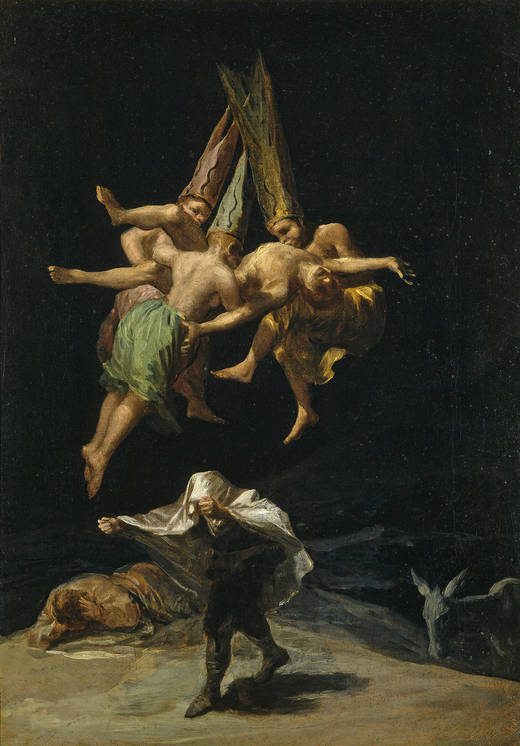
(“Witches’ Flight,” by Francisco José de Goya y Lucientes, 1797-1798. Source: Wikipedia, Creative Commons License).
(The following contains spoilers. And while I hope to keep them mild, if you haven’t seen the film, but plan to do so, I do not recommend reading on)
By and large, The Witch, Robert Eggers’ eerie directorial debut, has been read either as a feminist tale of socially-induced self-designation or a creepy reassertion of the chilling, as opposed to the violent, in the horror genre. Neither of these is wrong, but both miss what, for me as a Christian, was the center piece of the film, what made it both unnerving and fulfilling: the role of desire. The first time I saw it, a secular friend of mine bewilderedly wondered (after the last scene finished), “I don’t know if I should be turned on or horrified.” The entire movie might be read through this lens.
The film follows a family in the early 17th century, relatively recently arrived from England, who are banished from the “plantation” for the father’s dissident religious beliefs or activities. In due course, they arrive in the woods. The mother, father, and five children soon find themselves haunted by an evil force, but not in the traditional way. Many modern horror films concentrate either on the exterior evil or the interior psychology of its characters (think the Halloween series on the one hand and The Shining on the other). It is rare that both the evil faced and the characters themselves are enrapturing, and yet The Witch does this perfectly, precisely because throughout the film we get snapshots of some figure out there, that is, in the woods, while the family debates who among them is an evil interloper (and there are many scenes to suggest to us that one of them might be). The viewer feels himself trapped between the evil he has seen and the one he feels, the crone in the forest and demons in the hearts of these God-fearing Calvinists.
This, of course, is the Christian position; we believe both in something out there (Satan, demons) and something within us (sin), both of which are to be feared and loathed. We need not be Calvinists, like the family in question, to be in this position. Their faith is so real, so visceral, whether when they are shown, kneeling in a field after being exiled, eyes raised to heaven, light shining down through the trees, or when the father, William (Ralph Ineson), declares a fast day for the family’s myriad sins, that we cannot help but feel their pain. Even the most secular viewer is forced to feel both the pull toward Calvinistic good and the desires that ultimately tear the family apart. Each member has his or her own desire that presages and leads to their collective destruction; each seems small at first but blossoms into a hellish holocaust, resulting in not only their destruction but their seduction. By the end, we see that the evil without and the evil within were in league all along. In this sense, the film is a lesson in desire, an unflinching glance at how our wants lead us little-by-little into the hands of he who rules the wood.
William is guilty of pride; he admits as much the night before his death, falling to his knees and begging the Lord’s mercy, though he is “infected with the filth of pride.” We get few clues as to why the family was banished (or, in the accurate dialect of the film, banishèd). Yet, as the film progresses, pride seems the likely culprit. In commenting on the silver cup he stole from his wife to trade for money and the hope of food, he intimates that their family does not need such shiny objects to worship God. We know he is kicked out for having dissident ideas, but these ideas may very well be read as a prideful singularity against the communal church; he is willing to put his family in danger for the sake of his radical interpretation of the Gospel (in him we might see a type of Roger Williams or Anne Hutchinson, yet without any external support).
As blight strikes his crops, he remains convinced he can save the farm through trapping and trading. He fails miserably. His desire to save his family, underpinned by pride, leads him to let his daughter take the blame for fault after fault, creating tension between her and her mother. When William dies, he loudly confesses his own corruption, before being bucked into a pile of wood, a fitting death since, as his daughter reminds him, all he has done successfully since entering the wilderness is chop wood. His love of family, for his place as head of a group that would live the Gospel, even if alone, sows seeds of distrust among the family’s members and results in their destruction.
Katherine, his wife, (Kate Dickie) desires her dead children, desires their love and affection while pining for home, that is England. Taken together, her wants suggest a longing to no longer be a pilgrim, to be settled somewhere familiar and intimate. Once her baby is stolen, she is overwhelmed by grief, and, fearing his soul is in hell, becomes distant. She comes to suspect, in part thanks to William’s hiding his responsibility for various faults, that her daughter, Thomasin (Anya Taylor-Joy), is a witch. Her entire character might be contained in one shot, when we see her violently shaking the body of her dead son, Caleb (Harvey Scrimshaw), almost clawing off its flesh in her zeal, as she shouts Thomasin out of the room. The camera, at floor level, presents her body, bent over and covering that of her son, shaking with uncontrollable sobs. Without her children, her sense of home, she is lost.
And so Katherine’s death sequence shows this characterization in its fullness. Her hair loose, her wimple off (we almost never see her so wild), and her remaining children locked in a shed with the goats, suspected of witchery, she sees her two dead children: Samuel and Caleb (Harvey Scrimshaw). Overwhelmed with joy, she signs a book the older boy gives to her as she lets the younger one feed at her breast. And yet, this desire to see them again is deluded; the next time we see her she is sitting in a chair, cackling as a raven pecks at her breast. The baby she so longs for is dead; in its place is a sign of ill omen, bleeding her dry. Her life ends when, overcome with grief at the death of her entire family, she attacks Thomasin, believing her a witch. Her breast still bloody from the raven, she lands blow after blow on her daughter; her desire unattainable, Thomasin stabs her to death in self-defense.
Caleb is little better off. Becoming a man, he keeps stealing glances at his sister’s budding bosom. Though not truly incestuous, such urges stem from his being alone, apart from anyone else with whom he might grow up and come into his own body and feelings, a situation for which his father’s pride is to blame. At the same time, he wishes himself to be a man, to protect his ailing family. And yet, when he goes off into the woods in an attempt to save them from starvation, everything goes wrong: his sister is thrown from their horse and knocked unconscious, the horse runs away, and their dog is killed. Led along by the hare he hopes to kill so his family might survive, he chances upon a house. The viewer, unsure what to expect, is greeted first by an ankle (and it is rare we see so much skin in this film), emerging from the doorway, and then a full woman, a seductress with plump breasts and a dainty step, who beckons him come. The two kiss and, with a screech from the score, she plants her now gnarled hand into the back of his head.
Later that night, he reappears on the family farm, naked and raving (again, nakedness in this film is associated only with evil characters and their bewitched victims). After coughing up an apple, he loudly declares, before his entire family, his love for Jesus Christ, erotically moaning, parodying the sexual tension of a book like the Song of Songs. And, of course, his fit culminates with his screeching, racked with sexual pleasure: “kiss me with the kisses of your mouth.” His burgeoning desire for manliness, both in his sexuality and his longing to protect his family, is transmogrified into an open, to them anyway, effeminacy, a mockery of the cross.
And then there is Thomasin, arguably the protagonist of the film, who is just coming into her womanhood. She professes to love God, and yet, her family increasingly suspects she might be a witch, while in her desperation she tries to shift the blame to her younger siblings (the twins: Jonas and Mercy, played by Lucas Dawson and Ellie Grainger respectively). What she desires is, perhaps, just to be left alone, so that she might do her job on the farm, be a part of the family, and not be forced off the homestead to work for another family, as her parents plan. Yet, this is impossible. She is there when the baby, Samuel, is stolen; she is the one who accompanies Caleb into the woods where he is bewitched; she is the one who finds him, naked and raving in the rain. By the end, Thomasin is forced to kill her own mother in order to preserve her own life, the seemingly ultimate act against her initial desire to be a faithful daughter. And yet, she goes further. Thomasin approaches Black Philip, the family’s sinister black goat, whom the twins say speaks to them, and asks if she might hear him too. His response is an eerie sublimation of desire: “wouldst thou live deliciously? Wouldst thou see the world?”
And so, we are led into the last scene. She strips naked, and with her hair loose, signs the Devil’s book. Nude, she wanders off into the woods as the cackles and shouts of witches grow louder and louder. The film closes with her joining this cabal, her face twisted in orgasm, overwhelmed by the pleasure of belonging and power. She floats up into the sky, flying as a witch into the full moon, overcome with the sensuality of her new being.
This is the scene on which my friend remarked: “I can’t tell if I should be turned on or horrified.” He was not wrong to say so. The viewer, at least the secular one trained to see sex and desire in a certain way, finds the end erotic. Undoubtedly, the concupiscence in us all does. And yet, that is the moral of this fairy tale (and it invites a moral reading, its subtitle being A New England Folktale): desire, and the pleasure that accompanies it, whether physical or otherwise, cannot be merely personal. When a family is made up of uncommunicated desires, even if they are good in and of themselves, it unravels. Each person, an island, is slowly led, against his or her own wishes, into oblivion. And so we are warned, warned to avoid the pride and selfishness of the father, the nostalgia of the mother, and the overwrought striving of the son. The daughter lies a casualty, her hopes twisted into an orgasmic blossoming into womanhood, a womanhood independent of all structure, yet a womanhood cursed to witchery.
Previous Post
March 3, 2016
Forgetting the Poor, We Got Trump
Next Post
March 7, 2016 In Praise of Papal Ambiguity
Browse Our Archives
Select a Category Academia Culture Politics Reviews Theology Uncategorized
Select a Month October 2026 September 2026 August 2026 July 2026 June 2026 May 2026 April 2026 March 2026 February 2026 January 2026 December 2025 November 2025 October 2025 September 2025 August 2025 July 2025 June 2025 May 2025 April 2025 March 2025 February 2025 January 2025 December 2024 November 2024 October 2024 September 2024 August 2024 July 2024 June 2024 May 2024 April 2024 March 2024 February 2024 January 2024 December 2023 November 2023 October 2023 September 2023 August 2023 July 2023 June 2023 May 2023 April 2023 March 2023 February 2023 January 2023 November 2022 October 2022 September 2022 August 2022 July 2022 June 2022 May 2022 April 2022 March 2022 February 2022 July 2021 December 2020 November 2020 July 2020 May 2020 April 2020 February 2020 January 2020 December 2019 November 2019 October 2019 August 2019 July 2019 April 2019 March 2019 December 2018 August 2018 July 2018 June 2018 May 2018 April 2018 March 2018 January 2018 December 2017 November 2017 September 2017 August 2017 July 2017 June 2017 May 2017 April 2017 March 2017 February 2017 January 2017 December 2016 November 2016 October 2016 September 2016 August 2016 July 2016 June 2016 May 2016 April 2016 March 2016 February 2016
Follow Us!
TAKE THE
Religious Wisdom Quiz
What did Jesus say about worrying about tomorrow?
Select your answer to see how you score.
Plan for every detail Worry every day Do not worry Ignore today
Related posts from Jappers and Janglers

I Walked with a Zombie: Guilt in the...

Altered States: Nutshell 20th Century

Mr. Vampire: Give Me Goofy or Give Me...
TRENDING AT PATHEOS Religious Music and Entertainment

The Problem with False Prophets
Miller’s Station UMC| 10/18/26| Anchor Verse: Jeremiah 23: 1, 9-23 I...

Emotion in Early Christianity by Andrew Crislip
Andrew Crislip’s Emotion in Early Christianity examines an often overlooked dimension of...

16 Spiritual Touchstones for a More Grounded Life
After decades of spiritual study, here are 16 principles I try...

Catholic Evangelization: Sharing Your Faith Every Day
Welcome back to the Graceful Awakening mini-series called, “From Faith to Mission.” ...

The Pillar of the Boatmen: the Ancient Monument...
The Pillar of the Boatmen is a Romano-Gaulish sculpture that dates from...

In one sense walking into Westminster Abbey is like walking down the...
view all Religious Music and Entertainment blogs
Ad-Free & Subscriber Log-In Subscription Support
- About Us
- 2026 Calendar
- Videos
- Podcasts
- Library of World Religions
- Faith In Media Tracker
- Advertise With Us
- Write for Us
- Privacy Policy
- Terms of Service
- Do Not Sell My Data
- Contact Us
- Radiant Digital
- Manage Newsletter Subscriptions
- Unsubscribe From Notifications
- Sitemap
Copyright 2008-2026, Patheos. All rights reserved.
Subscription Support Ad-Free & Subscriber Log-In
Follow Patheos