
BuddhistCatholicContemplativeEvangelicalGeneral ChristianHinduJewishLatter-day SaintMuslimNew VisionsProgressive Christian
Beliefs
- Buddhist
- Catholic
- Contemplative
- Evangelical
- General Christian
- Hindu
- Jewish
- Latter-day Saint
- More Voices
- Muslim
- New Visions
- Pagan
- Progressive Christian
Topics
- Religion News
- Food and Religion
- Sports and Religion
- Religious Art
- Religious Music and Entertainment
- Religious Events
- History and Religion
- Style and Religion
- Politics and Religion
- Women in Religion
- Recreation Outdoors and Religion
- Business Finance and Religion
- Careers Workplace and Religion
- Education and Religion
- Family Parenting and Religion
- Health Fitness and Religion
- Home and Religion
- Relationships and Religion
- Technology and Religion
- Travel and Religion
Columnists
- Buddhist Columnists
- Business Finance and Religion Columnists
- Careers Workplace and Religion Columnists
- Catholic Columnists
- Contemplative Columnists
- Education and Religion Columnists
- Evangelists Columnists
- Family Parenting and Religion Columnists
- General Christian Columnists
- Health Fitness and Religion Columnists
- Hindu Columnists
- History and Religion Columnists
- Home and Religion Columnists
- Jewish Columnists
- More Voices Columnists
- Latter Day Columnists
- Muslim Columnists
- New Visions Columnists
- Nonreligious Columnists
- Pagan Columnists
- Politics and Religion Columnists
- Progressive Columnists
- Recreation Outdoors and Religion Columnists
- Relationships and Religion Columnists
- Religion News Columnists
- Religious Art Columnists
- Religious Events Columnists
- Religious Music and Entertainment Columnists
- Sports and Religion Columnists
- Style and Religion Columnists
- Technology and Religion Columnists
- Travel and Religion Columnists
- Women in Religion Columnists
Resource Library
- 2026 Calendar
- Library of World Religions
- The 100 Most Holy Places on Earth
- Patheos Answers
- Podcasts
- Videos
- Faith Leaders Database
- Anglican Episcopalian
- Bahai
- Baptist
- Buddhism
- Christianity
- Confucianism
- Eastern Orthodoxy
- Hinduism
- Holiness and Pentecostal
- ISKCON
- Islam
- Judaism
- Lutheran
- Methodist
- The Church of Jesus Christ of Latter-day Saints
- New Age
- Paganism
- Presbytarian and Reformed
- Protestantism
- Religion Behind the Scenes
- Roman Catholic
- Scientology
- Shia Islam
- Sikhism
- Sufism
- Sunni Islam
- Taoism
- Zen
- See all religions
Research Tools
 Ad-Free & Subscriber Log-In Subscription Support
Ad-Free & Subscriber Log-In Subscription Support
Follow Patheos 

- Trending:
- Forgiveness
- |
- Marriage
- |
- Consciousness
- |
- Death Penalty
- |
- Election
- |
- Halloween

- Home
- Religious Music and Entertainment
- In Praise of Papal Ambiguity
In Praise of Papal Ambiguity
Last updated on: March 7, 2016 at 2:55 pm by Chase Padusniak
In Praise of Papal Ambiguity 2016-03-07T14:55:45-04:00 Chase Padusniak
Patheos Explore the world's faith through different perspectives on religion and spirituality! Patheos has the views of the prevalent religions and spiritualities of the world.
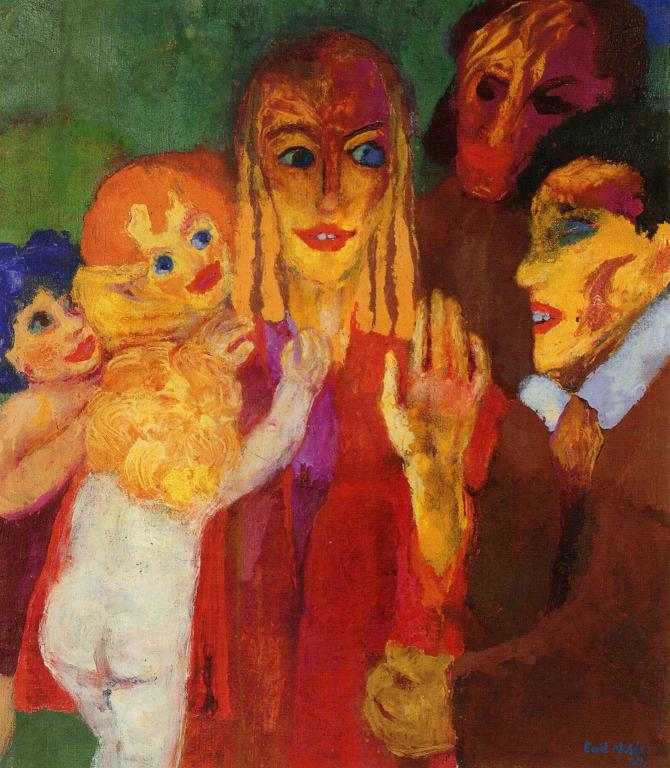
“So Ihr Nicht Werdet Wie Die” by Emil Nolde, 1929. Source: Flickr, Labelled for Reuse).
Even among devout Catholics, it’s not uncommon to hear about the “damage” caused by the pope’s occasionally diplomatic language. While not those who would call him “Bergolio” or lambaste the Novus Ordo (for a particularly remarkable example of that, see here) as such, they represent a certain sort of traditionalism that is wary of things not clear-cut, almost Scholastic in their desire to pick out and propound subtle and varied rules. For them, and for many, this pope is not the antichrist, as some would say, but is instead dangerous in his ambiguity, in the multivalent meanings of his words. These accusations most often arise in the context of controversial issues. Communion for the divorced and contraception come to mind.
While I believe with the Church (and Pope Francis!) that the Eucharist should be reserved from those who re-marry and that contraception is unacceptable I still see a lesson to be learned from the pope’s style, if not his actual words. It’s not as if he is incapable of making decisive statements (take for example his persistent ones on the death penalty). Why speak in such a confusing way then? Why befuddle billions of people worldwide?
Well, for one, he’s a man and he himself gets confused sometimes. But something more profound lurks behind even this explanation. The reality is that our faith is complex; we have dogma, but we also have the difficulty of living in a fallen world. Though the Spirit guides us, the Son of Man no longer dwells among us. I’m not speaking here of questions like the Annunciation, the Incarnation, or the like. These are settled, matters of the very faith we hold. Instead, I refer to the problem of living a Catholic life in this world, beset on all sides by temptations, sins, and general depravity.
I’ll give a small example to illustrate my point. If I am fasting (and in the Eastern tradition this means fasting from a variety of things) and I arrive at my non-religious grandmother’s house, should I politely take some food, though it breaks my fast, or nicely tell her I’m fasting and cannot eat what’s before me? On the one hand, it would seem important to continue corporeal mortification. On the other, we do not wish to blow the trumpet before us. In the best case scenario, perhaps I could take a small amount of the forbidden food and do my best not to relish it, but even this is not always possible (we all know grandmas think we’re all wasting away, famished). My instinct is to say: do whatever possible not to impinge on the hospitality of the other, but the point is clear: Catholic life is messy.
And the Gospels tell us just this. Witness Jesus reprimanding his followers:
When they came to the disciples, they saw a large crowd around them and scribes arguing with them. Immediately on seeing him, the whole crowd was utterly amazed. They ran up to him and greeted him. He asked them, “What are you arguing about with them?” Someone from the crowd answered him, “Teacher, I have brought to you my son possessed by a mute spirit. Wherever it seizes him, it throws him down; he foams at the mouth, grinds his teeth, and becomes rigid. I asked your disciples to drive it out, but they were unable to do so.” He said to them in reply, “O faithless generation, how long will I be with you? How long will I endure you? Bring him to me.” They brought the boy to him. And when he saw him, the spirit immediately threw the boy into convulsions. As he fell to the ground, he began to roll around and foam at the mouth. Then he questioned his father, “How long has this been happening to him?” He replied, “Since childhood. It has often thrown him into fire and into water to kill him. But if you can do anything, have compassion on us and help us.” Jesus said to him, “‘If you can!’ Everything is possible to one who has faith.” Then the boy’s father cried out, “I do believe, help my unbelief!” Jesus, on seeing a crowd rapidly gathering, rebuked the unclean spirit and said to it, “Mute and deaf spirit, I command you: come out of him and never enter him again!” Shouting and throwing the boy into convulsions, it came out. He became like a corpse, which caused many to say, “He is dead!” But Jesus took him by the hand, raised him, and he stood up. When he entered the house, his disciples asked him in private, “Why could we not drive it out?” He said to them, “This kind can only come out through prayer [and through fasting].” (Mark 9:14-29)
On the face of it, we have an exhortation to greater faith. But is that quantifiable? Is there some “correct” amount of prayer and fasting His disciples might’ve undertaken to exorcize the boy successfully? No, of course not. There’s no precise rule for how much they ought to have fasted; their faith can be imagined as a mustard seed, but the Lord is not being literal. There is a deeper significance here, a sententia beneath the littera: that we must have faith (reflected in good works) to accomplish anything, that we are enlivened by this faith, that by living it we come to understand. As the maxim of St. Anselm goes: credo ut intelligam (I believe so that I may understand).
Too often we lead with understanding and not belief. We assume our rules and injunctions can solve every pastoral circumstance in which human beings suffer; this, however, is properly the realm of faith, the realm in which we throw ourselves at the foot of the Cross.
If I am being honest, I encounter this problem all the time. I have friends, with whom I am growing in the faith, who come to me with questions. Rarely is there some clear answer; rarely do they come asking “what am I allowed to eat on Fridays,” instead they come crying “how can I treat this person with charity? How can I deepen my prayer life to reflect my desire to come to know God? How can I grow in the faith?” In a messy world, we get messy questions.
This is, I think, what this papacy most fully highlights: the ambiguity of trying to exist and dwell with the Spirit in a confusing and confused world. And, when not making the comments people find befuddling, the pope has emphasized just this. Fr. Lombardi has quoted him on the issue of remarriage thus: “We should not let ourselves be conditioned by or to reduce the horizons of our work as if the only problem were that of Communion for the divorced and remarried or not.” In other words, things are complicated.
Thus we should not let our desire for a faith-filled life unmarred by any ambiguity hamper the growth that exists in just this shadow. It is, as Eliot wrote:
Between the idea
And the reality
Between the motion
And the act
Falls the Shadow
For Thine is the KingdomBetween the conception
And the creation
Between the emotion
And the response
Falls the Shadow
Life is very longBetween the desire
And the spasm
Between the potency
And the existence
Between the essence
And the descent
Falls the Shadow
For Thine is the Kingdom
Previous Post
March 6, 2016
The Witch: The Fruits of Desire
Next Post
March 8, 2016 “Give all, for all is yours!”
Browse Our Archives
Select a Category Academia Culture Politics Reviews Theology Uncategorized
Select a Month October 2026 September 2026 August 2026 July 2026 June 2026 May 2026 April 2026 March 2026 February 2026 January 2026 December 2025 November 2025 October 2025 September 2025 August 2025 July 2025 June 2025 May 2025 April 2025 March 2025 February 2025 January 2025 December 2024 November 2024 October 2024 September 2024 August 2024 July 2024 June 2024 May 2024 April 2024 March 2024 February 2024 January 2024 December 2023 November 2023 October 2023 September 2023 August 2023 July 2023 June 2023 May 2023 April 2023 March 2023 February 2023 January 2023 November 2022 October 2022 September 2022 August 2022 July 2022 June 2022 May 2022 April 2022 March 2022 February 2022 July 2021 December 2020 November 2020 July 2020 May 2020 April 2020 February 2020 January 2020 December 2019 November 2019 October 2019 August 2019 July 2019 April 2019 March 2019 December 2018 August 2018 July 2018 June 2018 May 2018 April 2018 March 2018 January 2018 December 2017 November 2017 September 2017 August 2017 July 2017 June 2017 May 2017 April 2017 March 2017 February 2017 January 2017 December 2016 November 2016 October 2016 September 2016 August 2016 July 2016 June 2016 May 2016 April 2016 March 2016 February 2016
Follow Us!
TAKE THE
Religious Wisdom Quiz
Three of the four beasts from Daniel's vision are: a bear with three ribs in its mouth, a leopard with four wings and four heads, and a terrifying beast with iron teeth and ten horns. Which beast is missing?
Select your answer to see how you score.
A bull breathing fire A lion with eagle's wings A dragon with seven heads A ram with two sets of gilded horns
Related posts from Jappers and Janglers

American Movie: The Beauty of the Chuds
Shimmering Opacity in a Country Church


500 Days of Paralyzing Anxiety
TRENDING AT PATHEOS Religious Music and Entertainment

The Problem with False Prophets
Miller’s Station UMC| 10/18/26| Anchor Verse: Jeremiah 23: 1, 9-23 I...

Emotion in Early Christianity by Andrew Crislip
Andrew Crislip’s Emotion in Early Christianity examines an often overlooked dimension of...

16 Spiritual Touchstones for a More Grounded Life
After decades of spiritual study, here are 16 principles I try...

Catholic Evangelization: Sharing Your Faith Every Day
Welcome back to the Graceful Awakening mini-series called, “From Faith to Mission.” ...

The Pillar of the Boatmen: the Ancient Monument...
The Pillar of the Boatmen is a Romano-Gaulish sculpture that dates from...

In one sense walking into Westminster Abbey is like walking down the...
view all Religious Music and Entertainment blogs
Ad-Free & Subscriber Log-In Subscription Support
- About Us
- 2026 Calendar
- Videos
- Podcasts
- Library of World Religions
- Faith In Media Tracker
- Advertise With Us
- Write for Us
- Privacy Policy
- Terms of Service
- Do Not Sell My Data
- Contact Us
- Radiant Digital
- Manage Newsletter Subscriptions
- Unsubscribe From Notifications
- Sitemap
Copyright 2008-2026, Patheos. All rights reserved.
Subscription Support Ad-Free & Subscriber Log-In
Follow Patheos