
BuddhistCatholicContemplativeEvangelicalGeneral ChristianHinduJewishLatter-day SaintMuslimNew VisionsProgressive Christian
Beliefs
- Buddhist
- Catholic
- Contemplative
- Evangelical
- General Christian
- Hindu
- Jewish
- Latter-day Saint
- More Voices
- Muslim
- New Visions
- Pagan
- Progressive Christian
Topics
- Religion News
- Food and Religion
- Sports and Religion
- Religious Art
- Religious Music and Entertainment
- Religious Events
- History and Religion
- Style and Religion
- Politics and Religion
- Women in Religion
- Recreation Outdoors and Religion
- Business Finance and Religion
- Careers Workplace and Religion
- Education and Religion
- Family Parenting and Religion
- Health Fitness and Religion
- Home and Religion
- Relationships and Religion
- Technology and Religion
- Travel and Religion
Columnists
- Buddhist Columnists
- Business Finance and Religion Columnists
- Careers Workplace and Religion Columnists
- Catholic Columnists
- Contemplative Columnists
- Education and Religion Columnists
- Evangelists Columnists
- Family Parenting and Religion Columnists
- General Christian Columnists
- Health Fitness and Religion Columnists
- Hindu Columnists
- History and Religion Columnists
- Home and Religion Columnists
- Jewish Columnists
- More Voices Columnists
- Latter Day Columnists
- Muslim Columnists
- New Visions Columnists
- Nonreligious Columnists
- Pagan Columnists
- Politics and Religion Columnists
- Progressive Columnists
- Recreation Outdoors and Religion Columnists
- Relationships and Religion Columnists
- Religion News Columnists
- Religious Art Columnists
- Religious Events Columnists
- Religious Music and Entertainment Columnists
- Sports and Religion Columnists
- Style and Religion Columnists
- Technology and Religion Columnists
- Travel and Religion Columnists
- Women in Religion Columnists
Resource Library
- 2026 Calendar
- Library of World Religions
- The 100 Most Holy Places on Earth
- Patheos Answers
- Podcasts
- Videos
- Faith Leaders Database
- Anglican Episcopalian
- Bahai
- Baptist
- Buddhism
- Christianity
- Confucianism
- Eastern Orthodoxy
- Hinduism
- Holiness and Pentecostal
- ISKCON
- Islam
- Judaism
- Lutheran
- Methodist
- The Church of Jesus Christ of Latter-day Saints
- New Age
- Paganism
- Presbytarian and Reformed
- Protestantism
- Religion Behind the Scenes
- Roman Catholic
- Scientology
- Shia Islam
- Sikhism
- Sufism
- Sunni Islam
- Taoism
- Zen
- See all religions
Research Tools
 Ad-Free & Subscriber Log-In Subscription Support
Ad-Free & Subscriber Log-In Subscription Support
Follow Patheos 

- Trending:
- Forgiveness
- |
- Marriage
- |
- Consciousness
- |
- Death Penalty
- |
- Election
- |
- Halloween

- Home
- Religious Music and Entertainment
- “Give all, for all is yours!”
“Give all, for all is yours!”
Last updated on: March 12, 2016 at 3:24 pm by Chase Padusniak
“Give all, for all is yours!” 2016-03-12T15:24:45-04:00 Chase Padusniak
Patheos Explore the world's faith through different perspectives on religion and spirituality! Patheos has the views of the prevalent religions and spiritualities of the world.
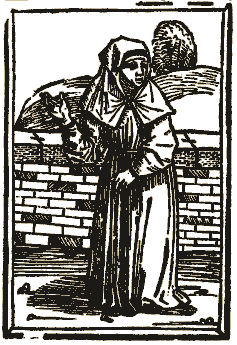
(A beguine the group of which Hadewijch was a part, from a 1489 woodcut. Source: Wikimedia, Creative Commons License).
These are the final words in the first vision of Hadewijch of Brabant (fl. early 13th century). After she is whisked up into a heavenly garden and experiences the fruits of divine mystery, God leaves her with these words: “give all, for all is yours!”
Reading this command yesterday (and for the first time), I was struck, struck by the profundity couched in such simple language, overawed by the essential nature of the Lord’s words, hidden beneath of veneer of terseness. This is, of course, how God is wont to work; He communicates with us through the forgotten, the destitute, and the disenfranchised. The prologue to another mystical work, the Flowing Light of the Godhead by Mechthild of Magdeburg (c. 1210- c. 1282), written by a friend of hers, a Dominican named Brother Heinrich, foregrounds this truth. In the somewhat sexist language of his times, he seeks to convince us that these visions should not be ignored just because they come from a lowly one, and what’s more a woman; he reminds us that God worked through Deborah, a prophet and judge of Israel, and Huldah, a seer and adviser to the righteous king Josiah. Not only, he says, should we not overlook such writings because of their humble origins but we should prize them for that very reason:
Quite often, in fact, almighty God has chosen what is weak in the world to confound what is stronger for its good. Therefore let no one wonder or, lacking trust, fall into disbelief if God in the time of grace renews his marvels. He, who in the time of the law of Moses mercifully saw fit to perform similar works, now reveals his mysteries to the fragile sex […] For who shall describe for us more vividly the perfection of the elect than those very ones in whom and through whom God carries out his works? And who could have made known to the church more beneficially or better the perfection of Paul than Paul himself?
We might also be reminded of the words the prophetess Huldah had for King Josiah:
Thus says the LORD, the God of Israel: As for the words you have heard, because you were heartsick and have humbled yourself before the LORD when you heard what I have spoken concerning this place and its inhabitants, that they would become a desolation and a curse; and because you tore your garments and wept before me, I in turn have heard, oracle of the LORD. I will therefore gather you to your ancestors; you shall go to your grave in peace, and your eyes shall not see all the evil I am about to bring upon this place. (2 Kings 22:18-20)
And so, we should not be surprised to find such wisdom expressed so tersely; God rewards those who recognize the holiness of his most humble servants. In truth, the very act of reading the words of a humble medieval mystic invite us to reflect on the divine’s love for the forgotten.
What then are we to make of Mechthild’s striking command?
I would start with the end of what the Lord says: “for all is yours.” This is to say that all is a gift; everything in our world, from the world within which we dwell, to our own bodies, thoughts, and sensations, is a gift, freely dispensed by the godhead. Here I am reminded of a passage from Aquinas’ Summa, in which he defends a starving man’s taking what he needs on the ground that, at bottom, the use of property is common, that is, the world is a gift to all:
Things which are of human right cannot derogate from natural right or Divine right. Now according to the natural order established by Divine Providence, inferior things are ordained for the purpose of succoring man’s needs by their means. Wherefore the division and appropriation of things which are based on human law, do not preclude the fact that man’s needs have to be remedied by means of these very things. Hence whatever certain people have in superabundance is due, by natural law, to the purpose of succoring the poor. For this reason Ambrose says, and his words are embodied in the Decretals (Dist. xlvii, can. Sicut ii): “It is the hungry man’s bread that you withhold, the naked man’s cloak that you store away, the money that you bury in the earth is the price of the poor man’s ransom and freedom.”
All things are radically and unconditionally given to us, in all of our unworthiness, so that we may steward them for right use.
The question then arises: what is right use? Taking a hint from Ambrose, we might say that the right use of gift is giving, that is we must lovingly dispense with, and empty ourselves of, the gifts allotted us. Christ gave Himself for us and so we give ourselves for Christ; God gave us the world and so we give the world up for Him.
Again, we might look to Hadewijch for help. In her third vision, God tells her:
With regard to all things know what I, Love, am in them. And when you fully bring me yourself, as pure humanity in myself, through all the ways of perfect Love, you shall have fruition of me as the Love who I am. Until that day, you shall love what I, Love, am. And then you will be love, as I am Love. And you shall not live less than what I, Love, am, from that day until the death that will make you alive […] Go forth and live what I am: and return bringing me full divinity, and have fruition of me as who I am.
We must recognize God’s love, Himself, in His manifold creation; we must give ourselves up for the sake not only of worldly others but also for God. In fact, we give ourselves to them precisely because we love Him. His total emptying of self is the path that draws us back to Him. In other words, we as extensions of and participants in the divine gift, must return ourselves to the divine giver. Only because all has been presented to us, do we have the possibility to give it back; only because the Lord loves us and all things do we have the ability to love Him and His creation in turn.
Previous Post

March 7, 2016
In Praise of Papal Ambiguity
Next Post

March 12, 2016 Understanding the Pope and His Critics
Browse Our Archives
Select a Category Academia Culture Politics Reviews Theology Uncategorized
Select a Month October 2026 September 2026 August 2026 July 2026 June 2026 May 2026 April 2026 March 2026 February 2026 January 2026 December 2025 November 2025 October 2025 September 2025 August 2025 July 2025 June 2025 May 2025 April 2025 March 2025 February 2025 January 2025 December 2024 November 2024 October 2024 September 2024 August 2024 July 2024 June 2024 May 2024 April 2024 March 2024 February 2024 January 2024 December 2023 November 2023 October 2023 September 2023 August 2023 July 2023 June 2023 May 2023 April 2023 March 2023 February 2023 January 2023 November 2022 October 2022 September 2022 August 2022 July 2022 June 2022 May 2022 April 2022 March 2022 February 2022 July 2021 December 2020 November 2020 July 2020 May 2020 April 2020 February 2020 January 2020 December 2019 November 2019 October 2019 August 2019 July 2019 April 2019 March 2019 December 2018 August 2018 July 2018 June 2018 May 2018 April 2018 March 2018 January 2018 December 2017 November 2017 September 2017 August 2017 July 2017 June 2017 May 2017 April 2017 March 2017 February 2017 January 2017 December 2016 November 2016 October 2016 September 2016 August 2016 July 2016 June 2016 May 2016 April 2016 March 2016 February 2016
Follow Us!
TAKE THE
Religious Wisdom Quiz
How many days and nights did it rain during the flood?
Select your answer to see how you score.
10 7 40 12
Related posts from Jappers and Janglers

American Movie: The Beauty of the Chuds

TRENDING AT PATHEOS Religious Music and Entertainment

The Iron Gates and the Lion of the...
Yesterday, I didn't finish my report about, well, yesterday. So I'll...

Dolly Parton’s Last Song Wins Dove Award with...
Bluegrass band The Grascals, speaking on the red carpet at the 57th...

The Image: On the Horror of Capitalism and...
The Image Then went the Pharisees, and took counsel how they might...

We are approaching the date of our new American national holiday: October...

Letters on Living the Faith by C.S. Lewis
Most of us met C.S. Lewis as a public intellectual. Mere Christianity....

When Halloween Unmasks Married Hearts
Written by Dr. David K. Ewen from Eternal Truth Bible College Behind...
view all Religious Music and Entertainment blogs
Ad-Free & Subscriber Log-In Subscription Support
- About Us
- 2026 Calendar
- Videos
- Podcasts
- Library of World Religions
- Faith In Media Tracker
- Advertise With Us
- Write for Us
- Privacy Policy
- Terms of Service
- Do Not Sell My Data
- Contact Us
- Radiant Digital
- Manage Newsletter Subscriptions
- Unsubscribe From Notifications
- Sitemap
Copyright 2008-2026, Patheos. All rights reserved.
Subscription Support Ad-Free & Subscriber Log-In
Follow Patheos