
BuddhistCatholicContemplativeEvangelicalGeneral ChristianHinduJewishLatter-day SaintMuslimNew VisionsProgressive Christian
Beliefs
- Buddhist
- Catholic
- Contemplative
- Evangelical
- General Christian
- Hindu
- Jewish
- Latter-day Saint
- More Voices
- Muslim
- New Visions
- Pagan
- Progressive Christian
Topics
- Religion News
- Food and Religion
- Sports and Religion
- Religious Art
- Religious Music and Entertainment
- Religious Events
- History and Religion
- Style and Religion
- Politics and Religion
- Women in Religion
- Recreation Outdoors and Religion
- Business Finance and Religion
- Careers Workplace and Religion
- Education and Religion
- Family Parenting and Religion
- Health Fitness and Religion
- Home and Religion
- Relationships and Religion
- Technology and Religion
- Travel and Religion
Columnists
- Buddhist Columnists
- Business Finance and Religion Columnists
- Careers Workplace and Religion Columnists
- Catholic Columnists
- Contemplative Columnists
- Education and Religion Columnists
- Evangelists Columnists
- Family Parenting and Religion Columnists
- General Christian Columnists
- Health Fitness and Religion Columnists
- Hindu Columnists
- History and Religion Columnists
- Home and Religion Columnists
- Jewish Columnists
- More Voices Columnists
- Latter Day Columnists
- Muslim Columnists
- New Visions Columnists
- Nonreligious Columnists
- Pagan Columnists
- Politics and Religion Columnists
- Progressive Columnists
- Recreation Outdoors and Religion Columnists
- Relationships and Religion Columnists
- Religion News Columnists
- Religious Art Columnists
- Religious Events Columnists
- Religious Music and Entertainment Columnists
- Sports and Religion Columnists
- Style and Religion Columnists
- Technology and Religion Columnists
- Travel and Religion Columnists
- Women in Religion Columnists
Resource Library
- 2026 Calendar
- Library of World Religions
- The 100 Most Holy Places on Earth
- Patheos Answers
- Podcasts
- Videos
- Faith Leaders Database
- Anglican Episcopalian
- Bahai
- Baptist
- Buddhism
- Christianity
- Confucianism
- Eastern Orthodoxy
- Hinduism
- Holiness and Pentecostal
- ISKCON
- Islam
- Judaism
- Lutheran
- Methodist
- The Church of Jesus Christ of Latter-day Saints
- New Age
- Paganism
- Presbytarian and Reformed
- Protestantism
- Religion Behind the Scenes
- Roman Catholic
- Scientology
- Shia Islam
- Sikhism
- Sufism
- Sunni Islam
- Taoism
- Zen
- See all religions
Research Tools
 Ad-Free & Subscriber Log-In Subscription Support
Ad-Free & Subscriber Log-In Subscription Support
Follow Patheos 

- Trending:
- Forgiveness
- |
- Marriage
- |
- Consciousness
- |
- Death Penalty
- |
- Election
- |
- Halloween

- Home
- Religious Music and Entertainment
- Beyond Good and Evil: A Triduum Reflection
Beyond Good and Evil: A Triduum Reflection
Last updated on: March 26, 2016 at 12:33 pm by Chase Padusniak
Beyond Good and Evil: A Triduum Reflection 2016-03-26T12:33:20-04:00 Chase Padusniak
Patheos Explore the world's faith through different perspectives on religion and spirituality! Patheos has the views of the prevalent religions and spiritualities of the world.
God is dead! Such is the news of Good Friday as we contemplate the visceral core of Christian reality: the unjust sentencing, scourging, beating, mocking, cheating, and eventual death of God. Jesus, God who became man, is notorious for challenging our notion of “messiah” itself; the Jews expected a political or military leader, someone who would break the Roman yoke like Judas Maccabeus:
The LORD says to my lord:
“Sit at my right hand,
while I make your enemies your footstool.”
The scepter of your might:
the LORD extends your strong scepter from Zion.
Have dominion over your enemies!
Yours is princely power from the day of your birth.
In holy splendor before the daystar,
like dew I begot you.
The LORD has sworn and will not waver:
“You are a priest forever in the manner of Melchizedek.”
At your right hand is the Lord,
who crushes kings on the day of his wrath,
Who judges nations, heaps up corpses,
crushes heads across the wide earth,
Who drinks from the brook by the wayside
and thus holds high his head. (Psalms 110:1-7)
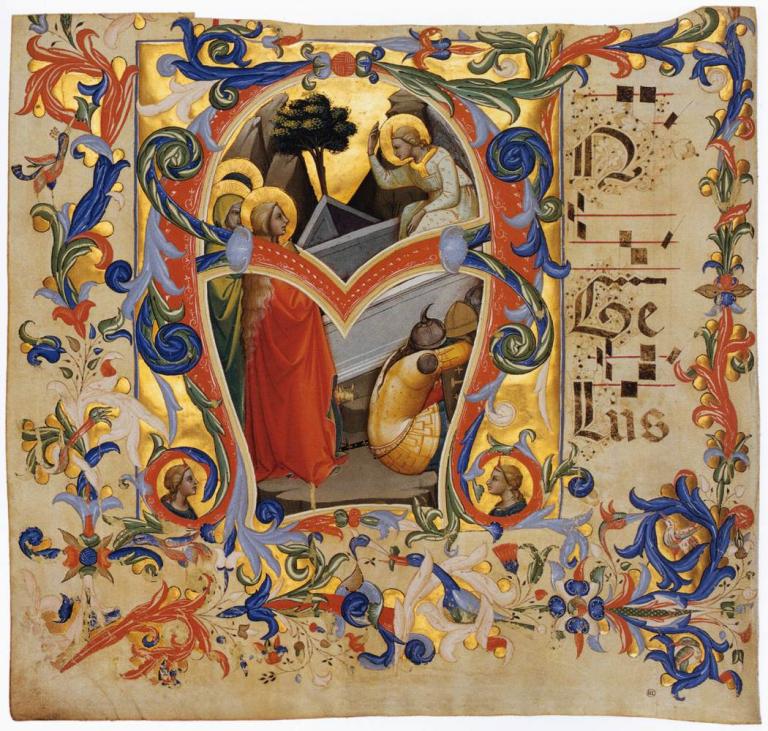
(The Three Marys at the Tomb of Jesus, from a medieval manuscript illumination. Source: Wikimedia, Creative Commons License).
As Christians, it is easy retroactively to read Christ into this passage, but for first-century Jews, living under the imperium of the Romans, it is not hard to imagine why a military figure would’ve been expected. Christ, of course, shattered this mold, something we recall most rightly on Palm Sunday, when we remember the meek Galilean entering Jerusalem saturated by symbols of peace: the donkey, the palms, and the cheering crowd, despite not having conquered anything in any traditional sense. Christ is the Prince of Peace, the Messiah who conquers death by death, who, from the very beginning, surprises believers and disbelievers alike, always prepared to upend our expectations.
Yet, the Crucifixion teaches us more than the (very important) peaceful nature of Christ; it allows us a glimpse into a mode of understanding God as beyond good and evil, as a deity who cannot be captured by our human conceptualizations. Further, it invites us to see the Kingdom in these same terms.
God is not good. God is good by analogy, a merely earthly attempt to capture an essence far beyond our meager minds. He is only good, if we keep in mind the symbolic nature of that “is.”
In a sense, this is the lesson of the Lord’s death on the Cross. Here we have a God-man, the Messiah, accepting His own end, surrounded by a jeering crowd, which mocks Him and yells at Him, in order to reveal His divinity by defeating death. As it says in the Gospel of Matthew:
Those passing by reviled him, shaking their heads and saying, “You who would destroy the temple and rebuild it in three days, save yourself, if you are the Son of God, [and] come down from the cross!” Likewise the chief priests with the scribes and elders mocked him and said, “He saved others; he cannot save himself. So he is the king of Israel! Let him come down from the cross now, and we will believe in him. He trusted in God; let him deliver him now if he wants him. For he said, ‘I am the Son of God.’” The revolutionaries who were crucified with him also kept abusing him in the same way. (Matthew 27:39-44)
Here we have God allowing His own Son to die, to scream out “Eli, Eli, lema sabachthani,” not so that worldly kingdoms may be upended or that earthly justice may be done, but so that souls may be saved through the sanctification of flesh! Is this any normative notion of good? Does this not expand how we might understand even that most nebulous concept of goodness? Christ’s very death is an invitation to peer beyond our human notions into the incomprehensibility of the Godhead.
Pseudo-Dionysius the Areopagite, a fifth- or sixth-century Christian writer, tells us just this in his Mystical Theology:
Again, ascending yet higher, we maintain that it [the ultimate cause of all things] is neither soul nor intellect; nor has it imagination, opinion reason or understanding; nor can it be expressed or conceived, since it is neither number nor order; nor greatness nor smallness; nor equality nor inequality; nor similarity nor dissimilarity; neither is it standing, nor moving, nor at rest; neither has it power nor is power, nor is light; neither does it live nor is it life; neither is it essence, nor eternity nor time; nor is it subject to intelligible contact; nor is it science nor truth, nor kingship nor wisdom; neither one nor oneness, nor godhead nor goodness; nor is it spirit according to our understanding, nor filiation, nor paternity; nor anything else known to us or to any other beings of the things that are or the things that are not; neither does anything that is know it as it is; nor does it know existing things according to existing knowledge; neither can the reason attain to it, nor name it, nor know it; neither is it darkness nor light, nor the false nor the true; nor can any affirmation or negation be applied to it, for although we may affirm or deny the things below it, we can neither affirm nor deny it, inasmuch as the all-perfect and unique Cause of all things transcends all affirmation, and the simple pre-eminence of Its absolute nature is outside of every negation- free from every limitation and beyond them all.
Note that God cannot be captured by affirmation nor by negation; He is no more “good” than He is “not good.” And the same may be said about the Kingdom He will bring and brings in us, His faithful, the faithful who find the invitation to the Kingdom in God’s death on the Cross (and eventual Resurrection).
Now, the Kingdom may be taken in two sense, that which is already happening through God’s leading His people in time by the example of the life of Christ, and that which will be brought to fruition at the end of time. As we learn in the Gospel of Luke:
Asked by the Pharisees when the kingdom of God would come, he said in reply, “The coming of the kingdom of God cannot be observed, and no one will announce, ‘Look, here it is,’ or, ‘There it is.’ For behold, the kingdom of God is among you.” Then he said to his disciples, “The days will come when you will long to see one of the days of the Son of Man, but you will not see it. There will be those who will say to you, ‘Look, there he is,’ [or] ‘Look, here he is.’ Do not go off, do not run in pursuit. For just as lightning flashes and lights up the sky from one side to the other, so will the Son of Man be [in his day]. But first he must suffer greatly and be rejected by this generation. As it was in the days of Noah, so it will be in the days of the Son of Man; they were eating and drinking, marrying and giving in marriage up to the day that Noah entered the ark, and the flood came and destroyed them all. Similarly, as it was in the days of Lot: they were eating, drinking, buying, selling, planting, building; on the day when Lot left Sodom, fire and brimstone rained from the sky to destroy them all. So it will be on the day the Son of Man is revealed. (Luke 17:20-31)
And so here, we have the present nature of the Kingdom tied to the Crucifixion, with hints of a Kingdom to come. This dual sense is precisely an invitation beyond good and evil, a nudge so that we might recognize what God said in Genesis: that all He has created is good. But here we must take “good” to mean more than our normative conception, to be more than merely “nice” or “positive.” Meister Eckhart may be of help:
Our Lord saith that the Kingdom of God is near us. Yea, the Kingdom of God is within us as St. Paul saith “our salvation is nearer than when we believed.” Now we should know in what manner the Kingdom of God is near us. Therefore let us pay diligent attention to the meaning of the words… If the soul is to see God, it must look at nothing in time; for while the soul is occupied with time or place or any image of the kind, it cannot recognize God. If it is to know Him, it must have no fellowship with nothingness. Only he knows God who recognizes that all creatures are nothingness… The whole Being of God is contained in God alone. The whole of humanity is not contained in one man, for one man is not all men. But in God the soul knows all humanity, and all things at their highest level of existence, since it knows them in their essence. Suppose any one to be in a beautifully adorned house: he would know much more about it than one who had never entered therein, and yet wished to speak much about it. Thus, I am as sure, as I am of my own existence and God’s, that, if the soul is to know God, it must know Him outside of time and place. Such a soul will know clearly how near God’s kingdom is.
Though perhaps confusing at first glance, we can extract one fundamental truth from Eckhart’s words: God’s kingdom may be glimpsed through the process of affirmation and negation proposed by Pseudo-Dionysius, by “look[ing] at nothingness in time.” The Kingdom is espied, and exists, by passing beyond merely human conceptions of good and evil, beyond understanding God solely as delimited by our conceptual notions of what He ought to be. We use images, ideas, and concepts to understand something of God; we negate them so that we may see that, though they describe Him, these concepts are not Him. His truth lies even beyond affirmation and negation, beyond good and evil.
The Crucifixion itself is a testament to this truly divine essence, that which is above our understanding, that which invites us, via our deification, to be like God, to pass beyond the merely good and evil of the world, and thereby to see “how near God’s kingdom is.”
Previous Post

March 21, 2016
Be Not Angry with Your Brother: A Reflection for Holy Week
Next Post
March 26, 2016 Easter: A Weekly Sabbath
Browse Our Archives
Select a Category Academia Culture Politics Reviews Theology Uncategorized
Select a Month October 2026 September 2026 August 2026 July 2026 June 2026 May 2026 April 2026 March 2026 February 2026 January 2026 December 2025 November 2025 October 2025 September 2025 August 2025 July 2025 June 2025 May 2025 April 2025 March 2025 February 2025 January 2025 December 2024 November 2024 October 2024 September 2024 August 2024 July 2024 June 2024 May 2024 April 2024 March 2024 February 2024 January 2024 December 2023 November 2023 October 2023 September 2023 August 2023 July 2023 June 2023 May 2023 April 2023 March 2023 February 2023 January 2023 November 2022 October 2022 September 2022 August 2022 July 2022 June 2022 May 2022 April 2022 March 2022 February 2022 July 2021 December 2020 November 2020 July 2020 May 2020 April 2020 February 2020 January 2020 December 2019 November 2019 October 2019 August 2019 July 2019 April 2019 March 2019 December 2018 August 2018 July 2018 June 2018 May 2018 April 2018 March 2018 January 2018 December 2017 November 2017 September 2017 August 2017 July 2017 June 2017 May 2017 April 2017 March 2017 February 2017 January 2017 December 2016 November 2016 October 2016 September 2016 August 2016 July 2016 June 2016 May 2016 April 2016 March 2016 February 2016
Follow Us!
TAKE THE
Religious Wisdom Quiz
What does "Levi" (as in the tribe and the priesthood) mean?
Select your answer to see how you score.
Strong Blessed Attached/Joined Firstborn
Related posts from Jappers and Janglers

American Movie: The Beauty of the Chuds

Apostasy, Scandal, and a Road Well-Trod

Which is the Original Bible? Is it the...
TRENDING AT PATHEOS Religious Music and Entertainment

'Super Scam Me' Exposes AI Jon Bon Jovi...
Leslie Pickett believed she was in a relationship with Jon Bon Jovi....

The Brazilian Remake of Kendricks' 'Flywheel' Opens in...
“Flywheel,” the story that launched the Kendrick Brothers’ filmmaking career is getting...

The Dangers of Gradual Accommodation (Winking at Sin)
Recently, the “law of gradualness” resurfaced during the opening of a weeklong,...

The Iron Gates and the Lion of the...
Yesterday, I didn't finish my report about, well, yesterday. So I'll...

The Image: On the Horror of Capitalism and...
The Image Then went the Pharisees, and took counsel how they might...

We are approaching the date of our new American national holiday: October...
view all Religious Music and Entertainment blogs
Ad-Free & Subscriber Log-In Subscription Support
- About Us
- 2026 Calendar
- Videos
- Podcasts
- Library of World Religions
- Faith In Media Tracker
- Advertise With Us
- Write for Us
- Privacy Policy
- Terms of Service
- Do Not Sell My Data
- Contact Us
- Radiant Digital
- Manage Newsletter Subscriptions
- Unsubscribe From Notifications
- Sitemap
Copyright 2008-2026, Patheos. All rights reserved.
Subscription Support Ad-Free & Subscriber Log-In
Follow Patheos