
BuddhistCatholicContemplativeEvangelicalGeneral ChristianHinduJewishLatter-day SaintMuslimNew VisionsProgressive Christian
Beliefs
- Buddhist
- Catholic
- Contemplative
- Evangelical
- General Christian
- Hindu
- Jewish
- Latter-day Saint
- More Voices
- Muslim
- New Visions
- Pagan
- Progressive Christian
Topics
- Religion News
- Food and Religion
- Sports and Religion
- Religious Art
- Religious Music and Entertainment
- Religious Events
- History and Religion
- Style and Religion
- Politics and Religion
- Women in Religion
- Recreation Outdoors and Religion
- Business Finance and Religion
- Careers Workplace and Religion
- Education and Religion
- Family Parenting and Religion
- Health Fitness and Religion
- Home and Religion
- Relationships and Religion
- Technology and Religion
- Travel and Religion
Columnists
- Buddhist Columnists
- Business Finance and Religion Columnists
- Careers Workplace and Religion Columnists
- Catholic Columnists
- Contemplative Columnists
- Education and Religion Columnists
- Evangelists Columnists
- Family Parenting and Religion Columnists
- General Christian Columnists
- Health Fitness and Religion Columnists
- Hindu Columnists
- History and Religion Columnists
- Home and Religion Columnists
- Jewish Columnists
- More Voices Columnists
- Latter Day Columnists
- Muslim Columnists
- New Visions Columnists
- Nonreligious Columnists
- Pagan Columnists
- Politics and Religion Columnists
- Progressive Columnists
- Recreation Outdoors and Religion Columnists
- Relationships and Religion Columnists
- Religion News Columnists
- Religious Art Columnists
- Religious Events Columnists
- Religious Music and Entertainment Columnists
- Sports and Religion Columnists
- Style and Religion Columnists
- Technology and Religion Columnists
- Travel and Religion Columnists
- Women in Religion Columnists
Resource Library
- 2026 Calendar
- Library of World Religions
- The 100 Most Holy Places on Earth
- Patheos Answers
- Podcasts
- Videos
- Faith Leaders Database
- Anglican Episcopalian
- Bahai
- Baptist
- Buddhism
- Christianity
- Confucianism
- Eastern Orthodoxy
- Hinduism
- Holiness and Pentecostal
- ISKCON
- Islam
- Judaism
- Lutheran
- Methodist
- The Church of Jesus Christ of Latter-day Saints
- New Age
- Paganism
- Presbytarian and Reformed
- Protestantism
- Religion Behind the Scenes
- Roman Catholic
- Scientology
- Shia Islam
- Sikhism
- Sufism
- Sunni Islam
- Taoism
- Zen
- See all religions
Research Tools
 Ad-Free & Subscriber Log-In Subscription Support
Ad-Free & Subscriber Log-In Subscription Support
Follow Patheos 

- Trending:
- Forgiveness
- |
- Marriage
- |
- Consciousness
- |
- Death Penalty
- |
- Election
- |
- Halloween

- Home
- Religious Music and Entertainment
- Karl Marx: Moralist
Karl Marx: Moralist
Last updated on: February 24, 2016 at 1:59 pm by Chase Padusniak
Karl Marx: Moralist 2016-02-24T13:59:03-04:00 Chase Padusniak
Patheos Explore the world's faith through different perspectives on religion and spirituality! Patheos has the views of the prevalent religions and spiritualities of the world.
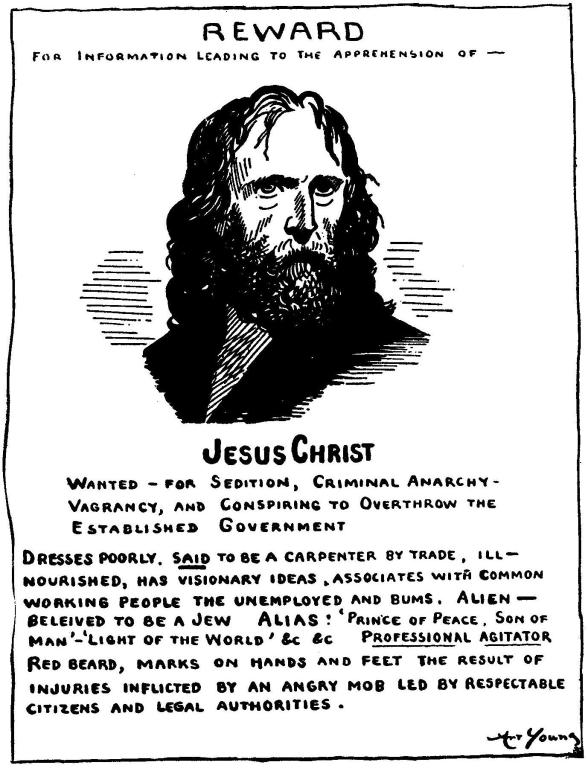
(Wanted Poster, depicting Jesus, by Art Young. First published in “The Masses” in 1917. Later reprinted in Ammon Hennacy’s autobiography. Source: Wikimedia, Creative Commons License).
If you’d asked me a year ago, I’m not sure I could’ve envisioned myself writing this piece, not because I never thought I’d read Marx, but because what I found was incredibly different from my expectations. Raised in a mostly secular, but still generally politically-conservative, post-Soviet environment, the idea of going near Marx was scandalous. As I became religious, the father of Communism seemed less odious (because I was no longer beholden to the strictures of American political ideologies—liberal and conservative), but still an unlikely ally. Then, last fall, I read the entirety of Capital (Volume One) for a class. And while I still would not identify as a Marxist and have (obvious) problems with Marxian thought taken as a whole, I was floored by how much I learned.
His weird moralism struck me. I know how much the name “Marx” ruffles many an American feather, and not for bad reasons. But, if you can’t proceed in charity, I’d recommend these two superb articles from Ethika Politika on how a Catholic can learn from the man (located here and here). The most important thing to understand is that Karl Marx does not equal the Soviet Union, which does not equal China, which does not equal modern campus activism. Luther’s revolt might give us “Protestantism” proper, but Luther was not the first Protestant, nor are his ideas solely responsible for non-denominational American Christianity, Seventh-Day Adventism, or Pentecostalism. Please read with this distinction in mind.
I shall cite entirely from Capital (Volume One); I’ve read other works of his, but as his magnum opus, I hope it will suffice. Besides, I want to be suggestive, not systematic.
In his landmark autobiography, Whittaker Chambers, ex-Communist, relates that part of the reason he joined up with Soviet spies was their rich moral fiber. Given the starvation of millions, gulags, and political purges, it’s hard to imagine a moral Marx. Yet, we must remember that Marx himself did not advocate any of these. In fact, Capital is filled with moral exhortations; he faults capitalism for forcing women to work outside the home, having limited regard for the moral damage done to a family that has to live in close quarters (think nudity), giving unjust wages to workers (in fact he would say the wage form is itself unjust), and actually decreasing standards of living, sinking many people into unimaginably dire poverty. Witness (Whittaker Chambers’ reference intended) the following, all from Capital (Volume One):
Time for education, for intellectual development, for the fulfillment of social functions, for social intercourse, for the free play of the vital forces of his body and his mind, even the rest time of Sunday…what foolishness [from the perspective of the capitalist]. But in its blind and measureless drive, its insatiable appetite for surplus labour [the extra work Capital makes workers do for its profit as opposed to for their ability to buy life’s necessities], capital oversteps not only the moral but even the physical limits of the working day. It usurps the time for growth, development and healthy maintenance of the body. It steals the time required for the consumption of fresh air and sunlight. It haggles over the meal-times, where possible incorporating them into the production process itself, so that food is added to the boiler, and grease and oil to the machinery. It reduces the sound sleep needed for the restoration, renewal, and refreshment of the vital forces to the exact amount of torpor essential to the revival of an absolutely exhausted organism…Capital asks no questions about the length of life of labour-power [workers]. What interests it is purely and simply the maximum of labour-power that can be set in motion in a working day, It attains this objective by shortening the life of labour-power, in the same way as a greedy farmer snatches more produce from the soil by robbing it of its fertility. (375-376)
And frankly, having seen the sacrifices of my father and mother and heard of those of my grandparents, this portrait is not totally wrong. But we needn’t look backwards to see this phenomenon (examples here, here, and here). And, I, like many, could churn out anecdote after anecdote. Even as workplace pressures decrease for some, those of social media and our generally over-technological society bear on others. One way or another, we feel trapped.
Of the witnesses examined by Commissioner White (1863), 270 [of those working there] were under 18, fifty under 10, ten only 8, and five only 6 years old. With a working day ranging from 12 to 14 or 15 hours, night-labour, irregular meal-times, and meals mostly taken in the workrooms themselves, pestilent with phosphorous, Dante would have found the worst horrors in his Inferno surpassed in this industry…J Leach’s deposition: “Last winter six out of nineteen girls were away from ill-health at one time from over-work. I have to bawl at them to keep them awake.” W. Duffy: “I have seen when the children could none of them keep their eyes open for the work; indeed, none of us could…G. Apsden: “That boy of mine…when he was 7 years old I used to carry him on my back to and fro through the snow, and he used to have 16 hours a day…I have often knelt down to feed him as he stood by the machine, for he could not leave it or stop it.” (356-357)
This sounds like something out of Fritz Lang’s Metropolis, a veritable nightmare, which ceased to exist thanks to resistance by workers and other organizers. And even as we, in America, have escaped them. Such conditions continue in the “Third World.” How could a Christian not be concerned?
As was shown by an official medical inquiry in the year 1861, the high death-rates are, apart from local causes, principally due to the employment of the mothers away from their homes, and to the neglect and maltreatment arising from their absence, which consists in such things as insufficient nourishment, unsuitable food and dosing with opiates; besides this, there arises an unnatural estrangement between mother and child, and as a consequence intentional starving and poisoning of the children. In those agricultural districts “where a minimum in the employment of women exists, the death-rate is on the other hand very low.” (521)
Marx sounds like a contemporary religious conservative. And he doesn’t stop there:
[Here he is quoting a commission’s report] A frightful source of demoralization is the mode of living…Whether members of his family or not, the men, boys and girls all sleep in the cottage, which contains generally two, exceptionally three rooms, all on the ground floor, and badly ventilated. These people are so exhausted after the day’s hard work, that neither the rules of health, of cleanliness, nor of decency are in the least observed. Many of these cottages are models of untidiness, dirt, and dust…The greatest evil of the system that employs young girls on this sort of work, consists in this, that, as a rule, it chains them fast from childhood for the whole of their after-life to the most abandoned rabble. They become tough, foulmouthed boys, before Nature has taught them that they are women. Clothed in a few dirty rags, the legs naked far above the knees, hair and face besmeared with dirt, they learn to treat all feelings of decency and shame with contempt.”…That excessive drunkenness is prevalent from childhood upwards among the whole of this class is only natural. (593-594)
He could be my grandmother! Or at least some other figure who decries today’s excesses. I won’t add any more block quotes; I wish only to be suggestive. But, as you can see, Marx really did care. For him, capitalism meant social decay, a decay that included the erosion of traditional mores. He also happens to have thought population control was a capitalist dream used to further yoke the working class! How wrong are the many depictions of him as an advocate of population control!
On top of this, his criticisms of faith are tepid. We’ve all heard the famous “religion is the opiate of the masses” quote, but that’s one line in a corpus larger than I (and probably every one of my readers combined) will ever produce. Marx was an atheist, and an especially problematical one at that. He certainly didn’t like religion. That said, his opposition to it was not rooted in an irrational hatred of God or his carbuncles (as some have claimed). No, Marx just felt religion too often occupied a position it used to oppress the working class: plain and simple. It was another super-structural impediment to a better life for workers. For example, in a footnote he writes: “Moses said: ‘Thou shalt not muzzle the ox when he treadeth out the corn’ [Deuteronomy 25:4]. But the Christian philanthropists of Germany fastened a wooden board round the necks of their serfs, whom they used as a motive power for grinding, in order to prevent them from putting flour into their mouths with their hands” (496, n. 7).
Again, none of this justifies his attitude toward religion; I’m merely trying to show that his opposition was surprisingly tepid. He does not make much reference to religion in Capital. It pops up now and then, but its presence is far from ubiquitous. His real enemy is clearly the capitalist; any rage directed at religious people (besides Malthus, whom he really, really hates) is ancillary.
Flatly put, Marx is not that concerned with economics either. The subtitle to Capital is A Critique of Political Economy. Throughout the texts, Marx evaluates how thinkers like Smith, Locke, Malthus, and both J.S. Mill and his father, understood economic processes. He tries to show that their definitions contain contradictions. But even if he’s wrong, his moral analysis stands. Not unlike Heidegger, Marx invents his own language to describe problems previous “political economists” had failed to recognize, or under-evaluated: value, labor power, surplus labor, surplus value, etc. His challenge is to the entire field of economics; he has little desire to get into statistical quibbles (though he sometimes did), and instead every desire to demonstrate the negative effects of their current political and economic orders. Increasing productivity is very far from his mind. Once or twice, he even praises the medieval guild system for standing in the way of the singular accumulation of capital!
He was also not a fan of the state, but that’s a question for another day…
But what makes Capital so readable as a Catholic is that it hardly mentions anything positive; it is a critique and mostly remains just that: an attempt to return man to meaningful labor and social relations (for Marx does believe man requires labor to be happy, or at least that’s the standard interpretation).
After reading this text, it’s little wonder to me how famous Christian figures like Simone Weil, Dorothy Day, and Jacques Ellul found Marx so compelling while shunning Communism themselves. Not refusing Marx, but not buying his atheism either, we might say with Simone Weil that “[t]he struggle between the opponents and defenders of capitalism is a struggle between innovators who do not know what innovation to make and conservatives who do not know what to conserve.” Would that American Christianity understood this.
Previous Post
February 22, 2016
Erotics, Difference, and Loving ISIS
Next Post

February 25, 2016 How I Came to be Christian: Part One
Browse Our Archives
Select a Category Academia Culture Politics Reviews Theology Uncategorized
Select a Month October 2026 September 2026 August 2026 July 2026 June 2026 May 2026 April 2026 March 2026 February 2026 January 2026 December 2025 November 2025 October 2025 September 2025 August 2025 July 2025 June 2025 May 2025 April 2025 March 2025 February 2025 January 2025 December 2024 November 2024 October 2024 September 2024 August 2024 July 2024 June 2024 May 2024 April 2024 March 2024 February 2024 January 2024 December 2023 November 2023 October 2023 September 2023 August 2023 July 2023 June 2023 May 2023 April 2023 March 2023 February 2023 January 2023 November 2022 October 2022 September 2022 August 2022 July 2022 June 2022 May 2022 April 2022 March 2022 February 2022 July 2021 December 2020 November 2020 July 2020 May 2020 April 2020 February 2020 January 2020 December 2019 November 2019 October 2019 August 2019 July 2019 April 2019 March 2019 December 2018 August 2018 July 2018 June 2018 May 2018 April 2018 March 2018 January 2018 December 2017 November 2017 September 2017 August 2017 July 2017 June 2017 May 2017 April 2017 March 2017 February 2017 January 2017 December 2016 November 2016 October 2016 September 2016 August 2016 July 2016 June 2016 May 2016 April 2016 March 2016 February 2016
Follow Us!
TAKE THE
Religious Wisdom Quiz
What did Aaron make for the people while Moses was on the mountain?
Select your answer to see how you score.
An altar A golden calf A silver snake A wooden idol
Related posts from Jappers and Janglers




Apostasy, Scandal, and a Road Well-Trod
TRENDING AT PATHEOS Religious Music and Entertainment

Methodist Central Hall and Westminster Abbey
Situated on the same square is Methodist Central Hall and Westminster Abbey. ...

57th Dove Awards Honor Dolly Parton, Crown New...
On gospel music’s biggest night, the 57th annual GMA Dove Awards honored...

The First Eucharistic Controversy: Christ’s Real Presence
For Catholics, the Eucharist is the source and summit of the Christian...

What a Stop Sign Can Teach Us About...
How to Make a Decision When You Can't Hear God Main point:...

Archdiocese Hosts Military Marriage Retreat in Germany
RASTATT, Germany — The transient military lifestyle, with its frequent deployments and...

Nearly every morning, I make the drive to Detroit with my high-school-age...
view all Religious Music and Entertainment blogs
Ad-Free & Subscriber Log-In Subscription Support
- About Us
- 2026 Calendar
- Videos
- Podcasts
- Library of World Religions
- Faith In Media Tracker
- Advertise With Us
- Write for Us
- Privacy Policy
- Terms of Service
- Do Not Sell My Data
- Contact Us
- Radiant Digital
- Manage Newsletter Subscriptions
- Unsubscribe From Notifications
- Sitemap
Copyright 2008-2026, Patheos. All rights reserved.
Subscription Support Ad-Free & Subscriber Log-In
Follow Patheos