
BuddhistCatholicContemplativeEvangelicalGeneral ChristianHinduJewishLatter-day SaintMuslimNew VisionsProgressive Christian
Beliefs
- Buddhist
- Catholic
- Contemplative
- Evangelical
- General Christian
- Hindu
- Jewish
- Latter-day Saint
- More Voices
- Muslim
- New Visions
- Pagan
- Progressive Christian
Topics
- Religion News
- Food and Religion
- Sports and Religion
- Religious Art
- Religious Music and Entertainment
- Religious Events
- History and Religion
- Style and Religion
- Politics and Religion
- Women in Religion
- Recreation Outdoors and Religion
- Business Finance and Religion
- Careers Workplace and Religion
- Education and Religion
- Family Parenting and Religion
- Health Fitness and Religion
- Home and Religion
- Relationships and Religion
- Technology and Religion
- Travel and Religion
Columnists
- Buddhist Columnists
- Business Finance and Religion Columnists
- Careers Workplace and Religion Columnists
- Catholic Columnists
- Contemplative Columnists
- Education and Religion Columnists
- Evangelists Columnists
- Family Parenting and Religion Columnists
- General Christian Columnists
- Health Fitness and Religion Columnists
- Hindu Columnists
- History and Religion Columnists
- Home and Religion Columnists
- Jewish Columnists
- More Voices Columnists
- Latter Day Columnists
- Muslim Columnists
- New Visions Columnists
- Nonreligious Columnists
- Pagan Columnists
- Politics and Religion Columnists
- Progressive Columnists
- Recreation Outdoors and Religion Columnists
- Relationships and Religion Columnists
- Religion News Columnists
- Religious Art Columnists
- Religious Events Columnists
- Religious Music and Entertainment Columnists
- Sports and Religion Columnists
- Style and Religion Columnists
- Technology and Religion Columnists
- Travel and Religion Columnists
- Women in Religion Columnists
Resource Library
- 2026 Calendar
- Library of World Religions
- The 100 Most Holy Places on Earth
- Patheos Answers
- Podcasts
- Videos
- Faith Leaders Database
- Anglican Episcopalian
- Bahai
- Baptist
- Buddhism
- Christianity
- Confucianism
- Eastern Orthodoxy
- Hinduism
- Holiness and Pentecostal
- ISKCON
- Islam
- Judaism
- Lutheran
- Methodist
- The Church of Jesus Christ of Latter-day Saints
- New Age
- Paganism
- Presbytarian and Reformed
- Protestantism
- Religion Behind the Scenes
- Roman Catholic
- Scientology
- Shia Islam
- Sikhism
- Sufism
- Sunni Islam
- Taoism
- Zen
- See all religions
Research Tools
 Ad-Free & Subscriber Log-In Subscription Support
Ad-Free & Subscriber Log-In Subscription Support
Follow Patheos 

- Trending:
- Forgiveness
- |
- Marriage
- |
- Consciousness
- |
- Death Penalty
- |
- Election
- |
- Halloween

- Home
- Religious Music and Entertainment
- Hypocrisy: A Christian Virtue
Hypocrisy: A Christian Virtue
Last updated on: February 22, 2016 at 6:00 pm by Chase Padusniak
Hypocrisy: A Christian Virtue 2016-02-22T18:00:21-04:00 Chase Padusniak
Patheos Explore the world's faith through different perspectives on religion and spirituality! Patheos has the views of the prevalent religions and spiritualities of the world.
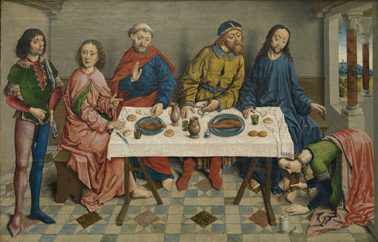
(“Simon the Pharisee,” by Aelbrecht Bouts. Source: Wikimedia, Creative Commons License).
(EDIT: A friend of mine has published a response here. I actually don’t think much separates us, but I would like to include his objections).
What follows is exploratory and suggestive. I don’t consider myself an ethicist, nor do I have a wholly transparent and satisfactory resolution to the problem interrogated in this blog post. I ask you, dear reader, to please read it in that spirit.
Hypocrisy is supposed to be a bad thing; Christ denounces it in the Gospels; virtually no one self-identifies as a hypocrite. Yet, what Jesus attacks is not exactly what we mean when we use the term. According to Merriam-Webster, its “simple definition” is “the behavior of people who do things that they tell other people not to do: behavior that does not agree with what someone claims to believe or feel.”
But what does the Messiah say about hypocrisy? Matthew 23 is filled with examples, but its opening gives us the key to interpreting the rest of the chapter:
Then Jesus spoke to the crowds and to his disciples, saying, “The scribes and the Pharisees have taken their seat on the chair of Moses. Therefore, do and observe all things whatsoever they tell you, but do not follow their example. For they preach but they do not practice. They tie up heavy burdens [hard to carry] and lay them on people’s shoulders, but they will not lift a finger to move them. All their works are performed to be seen. They widen their phylacteries and lengthen their tassels. They love places of honor at banquets, seats of honor in synagogues, greetings in marketplaces, and the salutation ‘Rabbi.’” (Matthew 23:1-7)
Thus far, His definition seems to accord with our normative one. The Pharisees do not do what they say. I propose, however, that that is not all that they are doing wrong. It is not their failure to live up the Law that is the problem. More fundamentally, they fail, but expect perfection of others; they pretend to have it all figured out. Essentially, then, they lack humility:
Do not be called “Master”; you have but one master, the Messiah. The greatest among you must be your servant. Whoever exalts himself will be humbled; but whoever humbles himself will be exalted. Woe to you, scribes and Pharisees, you hypocrites. You lock the kingdom of heaven before human beings. You do not enter yourselves, nor do you allow entrance to those trying to enter. (Matthew 23:10-13)
Thus, as the Christian faith teaches, it is okay to fail to practice what one believe; in fact, we all do. None of us is perfect as our heavenly Father is perfect. The problem lies not in our failure, but in our pretending that our failure is success, and thus passing it off to others as an ideal. In this sense, it is absolutely okay not to practice what one preaches, as long as one strives to do so. Forgiveness is available for the penitent.
This issue has been with me a long time, but my struggle with it feels particularly acute at the moment, because last night, during a web seminar, my group discussed Paul Griffiths’ Intellectual Appetite: a Theological Grammar. In it, he denounces the idea of intellectual property, specifically our contemporary obsession with plagiarism. For him, everything is a gift from our creator. Plagiarism is bad not because it involves stealing (knowledge cannot be stolen!), but because it requires extreme ingratitude, both toward the creator and the sub-creators (specifically human beings), who participate in the unfolding of the divine work of manifestation.
Such a stance was not popular in the seminar, predominantly because everyone in attendance was either a professor or a graduate student. Almost all of my peers wanted to read the situation practically: “even if he’s right, how am I supposed to get a job, tenure, or even discipline plagiarizing students if I take this man seriously?”
To me, such questions, while understandable, start in the wrong place. God asks crazy things of us, like giving away our possessions, forsaking our parents, and, for that matter, belief in a human incarnation of Himself. From that point of view, the question should not be “how can this be what God is saying,” but “how can I actualize these commandments in a fallen world?”
Here, hypocrisy enters the picture. Very few of us will actually give away all of our possessions to follow Christ; very few of us will denounce our parents, should they be disbelievers; very few of us even manage to get through the day without lustful or covetous thoughts! But all of these are requirements for taking up the Cross. The answer, it seems to me, is not to say “well, that’s difficult,” and instead to admit that we fail, repent, and strive to do better: to cut out our vicious thoughts, to detach ourselves from possessions as much as possible, and even to discern how we can stop pretending knowledge is something we can “own.” In this sense, it is okay to be a hypocrite (using our normative definition).
To illustrate my point, I’ve two examples. One from my own life and one from that of a friend.
This morning I woke up quite depressed. The why and what of that sadness is less important than the recognition that it happened; it made me lethargic, and as a result, I e-mailed my professor telling him I just could not make it to 9 AM Latin. This was wrong, and it’s the first time I’ve ever done anything like it. Thankfully, it’s a class I’m in voluntarily (I receive no grade and attend only for my own edification), and so the only person I’ve hurt is myself. Still, I must accept that what I did was wrong, not make excuses or pretend my depression should stop me from the work of self-betterment. No excuse can or should be made. I failed to achieve something, though hard, which I could’ve done and was called to do. Mea culpa, mea culpa, mea maxima culpa.
The other example comes from a Jewish friend of mine. His family is quite devout, but once, while on vacation in Australia, they drove on a Saturday, something he had never done before. Before doing so, his father sat him and his sister down and said: “this is wrong. What we are doing is wrong. I recognize that; we are on vacation and are doing this for that reason, but that’s no excuse.” Dare I say, his father was right. Note the lack of excuse. His question is not “God, why have you given me this difficult commandment, which I have to find a way out of” and is instead “I am sorry.” Teshuvah.
Is that not the call to repentance at the heart of Christianity: the recognition that I, above all others, have gravely sinned, in my thoughts and in my words, in what I have done and in what I have failed to do? The work of the Christian is never that of excuse; instead, it is that of ashes and sackcloth, of wonder at a God who has given so much and whose demands are (for humans) difficult, but always given in love. Thus, setting aside evasive explanations, we ought to declare with St. Andrew of Crete:
My inward being is wounded, my body is weak; my spirit is ill, and the word is powerless. Life is giving way to death and the end is near. What shall I do when the Judge comes and I must stand before Him?
I have reminded you, O my soul, from the books of Moses how the world was created, and from accounts throughout the Old Testament have shown examples of both the righteous and the unrighteous. But of these you have imitated the latter rather than the former and thereby have sinned against your God.
The law has no power over you, O my soul. You have made the Gospel fruitless, scorned the Scriptures, and reaped yourself no value from the prophets or the writings of the just. Your wounds have increased and you have no physician to heal you.
Therefore, O my soul, I will remind you of examples from the New Testament to lead you to contrition. Imitate the righteous and shun the ways of sinners that through prayer, fasting, purity, and reverence you may obtain the mercy of Christ.
Christ became a man, taking our flesh and of His own free will enduring everything which pertains to human nature (except sin). He has shown you an image of His own condescension.
Christ became a man and called both robbers and prostitutes to repentance. Return, therefore, O my soul, to Him. For the doors of the kingdom now stand open and the Pharisees, tax collectors and adulterers who have changed their ways are entering ahead of you!
Previous Post

February 17, 2016
St. Perpetua, Young Thug, and the Christian Counter-Culture
Next Post

February 20, 2016 Embracing Our Pagan Heritage
Browse Our Archives
Select a Category Academia Culture Politics Reviews Theology Uncategorized
Select a Month October 2026 September 2026 August 2026 July 2026 June 2026 May 2026 April 2026 March 2026 February 2026 January 2026 December 2025 November 2025 October 2025 September 2025 August 2025 July 2025 June 2025 May 2025 April 2025 March 2025 February 2025 January 2025 December 2024 November 2024 October 2024 September 2024 August 2024 July 2024 June 2024 May 2024 April 2024 March 2024 February 2024 January 2024 December 2023 November 2023 October 2023 September 2023 August 2023 July 2023 June 2023 May 2023 April 2023 March 2023 February 2023 January 2023 November 2022 October 2022 September 2022 August 2022 July 2022 June 2022 May 2022 April 2022 March 2022 February 2022 July 2021 December 2020 November 2020 July 2020 May 2020 April 2020 February 2020 January 2020 December 2019 November 2019 October 2019 August 2019 July 2019 April 2019 March 2019 December 2018 August 2018 July 2018 June 2018 May 2018 April 2018 March 2018 January 2018 December 2017 November 2017 September 2017 August 2017 July 2017 June 2017 May 2017 April 2017 March 2017 February 2017 January 2017 December 2016 November 2016 October 2016 September 2016 August 2016 July 2016 June 2016 May 2016 April 2016 March 2016 February 2016
Follow Us!
TAKE THE
Religious Wisdom Quiz
How did Jesus die?
Select your answer to see how you score.
Hanging Spearing Stoning Crucifixion
Related posts from Jappers and Janglers

American Movie: The Beauty of the Chuds



Apostasy, Scandal, and a Road Well-Trod
TRENDING AT PATHEOS Religious Music and Entertainment

In one sense walking into Westminster Abbey is like walking down the...

'Super Scam Me' Exposes AI Jon Bon Jovi...
Leslie Pickett believed she was in a relationship with Jon Bon Jovi....

The Brazilian Remake of Kendricks' 'Flywheel' Opens in...
“Flywheel,” the story that launched the Kendrick Brothers’ filmmaking career is getting...

The Dangers of Gradual Accommodation (Winking at Sin)
Recently, the “law of gradualness” resurfaced during the opening of a weeklong,...

The Iron Gates and the Lion of the...
Yesterday, I didn't finish my report about, well, yesterday. So I'll...

The Image: On the Horror of Capitalism and...
The Image Then went the Pharisees, and took counsel how they might...
view all Religious Music and Entertainment blogs
Ad-Free & Subscriber Log-In Subscription Support
- About Us
- 2026 Calendar
- Videos
- Podcasts
- Library of World Religions
- Faith In Media Tracker
- Advertise With Us
- Write for Us
- Privacy Policy
- Terms of Service
- Do Not Sell My Data
- Contact Us
- Radiant Digital
- Manage Newsletter Subscriptions
- Unsubscribe From Notifications
- Sitemap
Copyright 2008-2026, Patheos. All rights reserved.
Subscription Support Ad-Free & Subscriber Log-In
Follow Patheos