
BuddhistCatholicContemplativeEvangelicalGeneral ChristianHinduJewishLatter-day SaintMuslimNew VisionsProgressive Christian
Beliefs
- Buddhist
- Catholic
- Contemplative
- Evangelical
- General Christian
- Hindu
- Jewish
- Latter-day Saint
- More Voices
- Muslim
- New Visions
- Pagan
- Progressive Christian
Topics
- Religion News
- Food and Religion
- Sports and Religion
- Religious Art
- Religious Music and Entertainment
- Religious Events
- History and Religion
- Style and Religion
- Politics and Religion
- Women in Religion
- Recreation Outdoors and Religion
- Business Finance and Religion
- Careers Workplace and Religion
- Education and Religion
- Family Parenting and Religion
- Health Fitness and Religion
- Home and Religion
- Relationships and Religion
- Technology and Religion
- Travel and Religion
Columnists
- Buddhist Columnists
- Business Finance and Religion Columnists
- Careers Workplace and Religion Columnists
- Catholic Columnists
- Contemplative Columnists
- Education and Religion Columnists
- Evangelists Columnists
- Family Parenting and Religion Columnists
- General Christian Columnists
- Health Fitness and Religion Columnists
- Hindu Columnists
- History and Religion Columnists
- Home and Religion Columnists
- Jewish Columnists
- More Voices Columnists
- Latter Day Columnists
- Muslim Columnists
- New Visions Columnists
- Nonreligious Columnists
- Pagan Columnists
- Politics and Religion Columnists
- Progressive Columnists
- Recreation Outdoors and Religion Columnists
- Relationships and Religion Columnists
- Religion News Columnists
- Religious Art Columnists
- Religious Events Columnists
- Religious Music and Entertainment Columnists
- Sports and Religion Columnists
- Style and Religion Columnists
- Technology and Religion Columnists
- Travel and Religion Columnists
- Women in Religion Columnists
Resource Library
- 2026 Calendar
- Library of World Religions
- The 100 Most Holy Places on Earth
- Patheos Answers
- Podcasts
- Videos
- Faith Leaders Database
- Anglican Episcopalian
- Bahai
- Baptist
- Buddhism
- Christianity
- Confucianism
- Eastern Orthodoxy
- Hinduism
- Holiness and Pentecostal
- ISKCON
- Islam
- Judaism
- Lutheran
- Methodist
- The Church of Jesus Christ of Latter-day Saints
- New Age
- Paganism
- Presbytarian and Reformed
- Protestantism
- Religion Behind the Scenes
- Roman Catholic
- Scientology
- Shia Islam
- Sikhism
- Sufism
- Sunni Islam
- Taoism
- Zen
- See all religions
Research Tools
 Ad-Free & Subscriber Log-In Subscription Support
Ad-Free & Subscriber Log-In Subscription Support
Follow Patheos 

- Trending:
- Forgiveness
- |
- Marriage
- |
- Consciousness
- |
- Death Penalty
- |
- Election
- |
- Halloween

- Home
- Religious Music and Entertainment
- How I Came to be Christian: Part Three
How I Came to be Christian: Part Three
Last updated on: February 29, 2016 at 2:19 am by Chase Padusniak
How I Came to be Christian: Part Three 2016-02-29T02:19:19-04:00 Chase Padusniak
Patheos Explore the world's faith through different perspectives on religion and spirituality! Patheos has the views of the prevalent religions and spiritualities of the world.
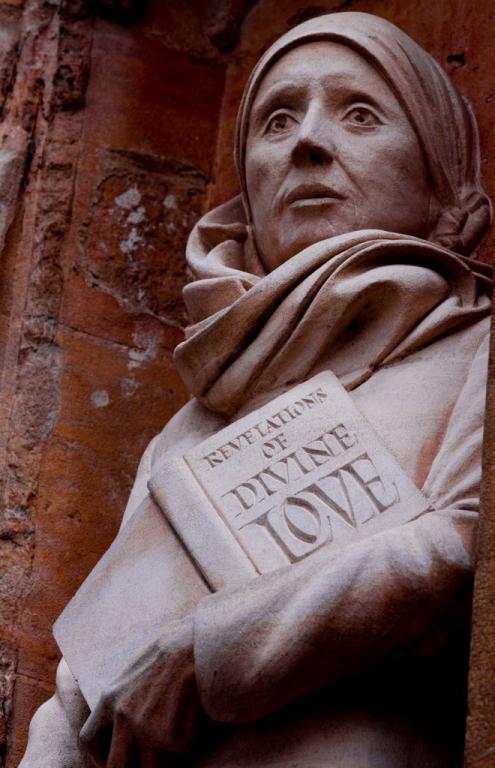
(Statue of Julian of Norwich on the façade of Norwich Cathedral. Source: Wikimedia, Creative Commons License).
(This post is part of a series. Parts one and two can be found here and here).
So far, I’ve detailed how Nietzsche cleared the ground for my faith journey and how Kierkegaard started to edify something on the empty plain of my soul. Obviously words cannot exhaust my personal path, but I’d like to take this final installment to focus on a Catholic (for once), specifically Julian of Norwich.
As I’ve hinted previously, systematic theology has more-or-less failed to do it for me. Whether it’s because my experience of the world seems fragmented and broken, or simply because my mind lends itself to the celebration of mystery as opposed to its elucidation, I’ve preferred the mystics for as long as I can remember. Kierkegaard’s thought is far from a clear system; in fact, it stands as a challenge to Hegel’s all-encompassing systematic approach. And anyone who has read Nietzsche can tell you that his scattered aphorisms and pseudo-poetical mode look very little like most of what is called philosophy today, especially in the Anglo-American sphere. Once could say that Continental, rather than Analytic, philosophy has long spoken to my mind.
While I love picking up the Summa its exegetes tend to leave me annoyed; while I love rigorous theological discourse the faith has always, for me, remained a mystery to be experienced far more than a sphere to be understood rationally. Aquinas’ late-in-life remark about his thought and straw comes to mind. Witness Kierkegaard: “But who is the systematic thinker? Well, it is he who himself is outside existence and yet in existence, who in his eternity is forever concluded and yet includes existence within himself…it is God.” In short, I wanted a faith to live and experience, not one to write about (how ironic).
Julian of Norwich (the long version of her text, whence I will quote, can be found here) was probably the first actual mystic I read, the first writer who exemplified the tropes I’ve since come to find so compelling: the ineffability of God, the need for affirmation of God’s attributes, which we then negate to understand his absolute transcendence, and an emphasis on paradox. More important than any one thing she said was her mindset, her hermeneutic, or way of looking at the world. Her recasting of the Fall narrative might help here. In this vision, Julian sees a lord (God) and a servant (Adam / man). The servant is so eager to do his master’s bidding that he trips and falls, becoming so absorbed in his own pain, in his own concerns, that he forgets the lord, whose bidding he initially sought to do. In pity, this master sends comfort, as he sorrows over his self-absorbed servant:
And this was a beginning of teaching which I saw in the same time, whereby I might come to know in what manner He beholdeth us in our sin. And then I saw that only Pain blameth and punisheth, and our courteous Lord comforteth and sorroweth; and ever He is to the soul in glad Cheer, loving, and longing to bring us to His bliss. The place that the Lord sat on was simple, on the earth, barren and desert, alone in wilderness; his clothing was ample and full seemly, as falleth to a Lord; the colour of his cloth was blue as azure, most sad and fair. [H]is cheer was merciful; the colour of his face was fair-brown,—with full seemly features; his eyes were black, most fair and seemly, shewing [outward] full of lovely pity, and [shewing], within him, an high Regard, long and broad, all full of endless heavens. And the lovely looking wherewith He looked upon His Servant continually,—and especially in his falling,—methought it might melt our hearts for love and burst them in two for joy. The fair looking shewed [itself] of a seemly mingledness which was marvellous to behold: the one [part] was Ruth and Pity, the other was Joy and Bliss. The Joy and Bliss passeth as far Ruth and Pity as Heaven is above earth: the Pity was earthly and the Bliss was heavenly: the Ruth and Pity of the Father was [in regard] of the falling of Adam, which is His most loved creature; the Joy and Bliss was [in regard] of His dearworthy Son, which is even with the Father. The Merciful Beholding of His Countenance of love fulfilled all earth and descended down with Adam into hell, with which continuant pity Adam was kept from endless death. And thus Mercy and Pity dwelleth with mankind unto the time we come up into Heaven. But man is blinded in this life and therefore we may not see our Father, God, as He is. And what time that He of His goodness willeth to shew Himself to man, He sheweth Himself homely, as man.
“[M]ethought it might melt our heart for love and burst them in two for joy.” These were the sorts of words I did not hear enough in the world, a world seemingly pitiless and selfish. What Julian captured for me was God’s love for us, not a love to be delimited, even really understood, but to be accepted (in our unworthiness) and given over to brothers and sisters in order to be a light in a world filled with pain, to recognize and indicate every tiny blessing from the miracle of life itself to inexplicable healings. In a word, Julian recasts the Fall narrative from its dourness into love, without losing the truth that man sinned and fell; her exegesis, though literary and not analytic, presented me with an unfathomable truth: God is calling us; our duty as Christians is to answer that call in love. She continues:
And in this endless Love man’s Soul is kept whole, as the matter of the Revelations signifieth and sheweth: in which endless Love we be led and kept of God and never shall be lost. For He willeth we be aware that our Soul is a life, which life of His Goodness and His Grace shall last in Heaven without end, Him loving, Him thanking, Him praising. And right the same that we shall be without end, the same we were treasured in God and hid, known and loved from without beginning.
This is the woman who tells us “sin is naught” and that “all shall be well; all shall be well; and all manner of thing shall be well.” Her emphasis on personal unworthiness combined with love of other was astounding. Here was a woman, an anchoress, that is a woman who lived alone, attached to a small cell adjoined to a church, who concentrated on her own sin, despite her holy life. Of course, many a saint felt this way; I dare say all of them did. Still, Julian seemed even more remarkable; her life emanated the Gospel. Her concern was never condemning others, but emphasizing God’s desire to save all, even as she doubted that God could want to save one as filthy as herself (or so she intimates). What Julian gave me was a faith obsessed with charity in all its dimensions, a faith that spends so much time digging for the log in its own eye, it never has time to glance up at the speck in its neighbor’s. Would that I could ever achieve half of her holiness (insofar as these things can be quantified. Spoiler: they can’t).
As a final note, I’d like to mention a poem that really changed my life: Piers Plowman. It’s far too long and complex for me to summarize here. Suffice it to say that the author, William Langland, was concerned with how to live the Gospel in a corrupt world, specifically in a world in which institutional structures (including the Church) offered no guidance. Among the first things to happen in the poem is the protagonist’s discussing how he ought to act with an allegorical figure called “Holy Church.” She basically tells him it’s easy:
“It is natural knowing,” quoth she · “that teacheth thine heart
For to love thy good Lord · liefer than thyself;
No deadly sin to do · die though thou shouldest:
This I trow to be Truth · who can teach thee better,
See you suffer him to say · and then teach it after.
For thus witnesseth his words · work thou thereafter;
For Truth telleth that Love · is the remedy of Heaven;
No sin may be seen in him · that useth that sort,
And all his works he wrought · with Love as he listed;
And taught it Moses for the best thing · and most like to Heaven
With the plant of peace · most precious of virtues.”
Her exit is abrupt and disappointing:
Many pastors keep themselves · clean in their bodies
But are cumbered with covetousness · they can not drive it from them
So hardly hath avarice · hasped them together.
And that is no truth of the Trinity · but treachery of hell,
Lessoning the unlearned · to withhold their alms.“Therefore these words · are written in the Gospel,
Date et dabitur vobis · for I give to you all.
And that is the lock of Love · that letteth out my grace
To comfort the care full · encumbered with sin.“Love is leech of life · and next our Lord’s self,
And also the right road · that runneth unto Heaven;
Therefore I say as I said · before by the texts,
When all treasures be tried · Truth is the best.
Now have I told thee what Truth is · that no treasure is better;
I may linger no longer thee with · now look on thee our Lord!”
But the protagonist remains disappointed:
Yet I knelt on my knees · and cried of her grace,
And said: “Mercy, Madame · for Mary’s love of Heaven,
That bore that blissful Child · that bought us on the rood,
Teach me by some skilled way · Falsehood to know.”
Yet, the poem is thoroughly Catholic (see Catholic convert David Aers’ new book on this point). Later on a character named “Hunger” is brought in to keep lazy peasants in line, a dream-within-a-dream leads to Adam and the Patriarchs exploding out of an apple and falling into Hell (again), and a quasi-Jesus figure jousts with Satan. I love the poem so much that the name of this blog comes from it!
Anyway, I won’t give away the ending, but Piers remains raucously funny, amazingly smart, and reform-minded without breaking with the Church. In short, it helped me to see how to do concretely what Julian preached: live and love in a fallen world.
This series of posts has gotten long enough. These days, I mostly attend Ruthenian Catholic divine liturgy, partly because of a deep and abiding respect for Eastern theology, and partly because I’m a contrarian (or so I tell myself). My faith remains young as I strive to remain a child for Christ. My journey has taken me from chronic illness and the loss of my mother to a belief in salvific self-abnegation in the name of a 1st-century Jewish God-man. My sorrow and pain became a desire to live for others in a spirit of unending charity. And yet, I fail every day, always trying, remembering that God is beyond all of our systems and explanations, a deity so far above our understanding, and so rich in love, that He became man and suffered as we suffer.
Christianity demands holy foolishness of us. That much I know.
Previous Post

February 27, 2016
How I Came to be Christian: Part Two
Next Post

February 29, 2016 The Not So Dumpf Donald Drumpf
Browse Our Archives
Select a Category Academia Culture Politics Reviews Theology Uncategorized
Select a Month October 2026 September 2026 August 2026 July 2026 June 2026 May 2026 April 2026 March 2026 February 2026 January 2026 December 2025 November 2025 October 2025 September 2025 August 2025 July 2025 June 2025 May 2025 April 2025 March 2025 February 2025 January 2025 December 2024 November 2024 October 2024 September 2024 August 2024 July 2024 June 2024 May 2024 April 2024 March 2024 February 2024 January 2024 December 2023 November 2023 October 2023 September 2023 August 2023 July 2023 June 2023 May 2023 April 2023 March 2023 February 2023 January 2023 November 2022 October 2022 September 2022 August 2022 July 2022 June 2022 May 2022 April 2022 March 2022 February 2022 July 2021 December 2020 November 2020 July 2020 May 2020 April 2020 February 2020 January 2020 December 2019 November 2019 October 2019 August 2019 July 2019 April 2019 March 2019 December 2018 August 2018 July 2018 June 2018 May 2018 April 2018 March 2018 January 2018 December 2017 November 2017 September 2017 August 2017 July 2017 June 2017 May 2017 April 2017 March 2017 February 2017 January 2017 December 2016 November 2016 October 2016 September 2016 August 2016 July 2016 June 2016 May 2016 April 2016 March 2016 February 2016
Follow Us!
TAKE THE
Religious Wisdom Quiz
Who said, "I am not ashamed of the gospel"?
Select your answer to see how you score.
Peter James Paul John
Related posts from Jappers and Janglers

American Movie: The Beauty of the Chuds


Apostasy, Scandal, and a Road Well-Trod
TRENDING AT PATHEOS Religious Music and Entertainment

'Super Scam Me' Exposes AI Jon Bon Jovi...
Leslie Pickett believed she was in a relationship with Jon Bon Jovi....

The Brazilian Remake of Kendricks' 'Flywheel' Opens in...
“Flywheel,” the story that launched the Kendrick Brothers’ filmmaking career is getting...

The Dangers of Gradual Accommodation (Winking at Sin)
Recently, the “law of gradualness” resurfaced during the opening of a weeklong,...

The Iron Gates and the Lion of the...
Yesterday, I didn't finish my report about, well, yesterday. So I'll...

The Image: On the Horror of Capitalism and...
The Image Then went the Pharisees, and took counsel how they might...

We are approaching the date of our new American national holiday: October...
view all Religious Music and Entertainment blogs
Ad-Free & Subscriber Log-In Subscription Support
- About Us
- 2026 Calendar
- Videos
- Podcasts
- Library of World Religions
- Faith In Media Tracker
- Advertise With Us
- Write for Us
- Privacy Policy
- Terms of Service
- Do Not Sell My Data
- Contact Us
- Radiant Digital
- Manage Newsletter Subscriptions
- Unsubscribe From Notifications
- Sitemap
Copyright 2008-2026, Patheos. All rights reserved.
Subscription Support Ad-Free & Subscriber Log-In
Follow Patheos