
BuddhistCatholicContemplativeEvangelicalGeneral ChristianHinduJewishLatter-day SaintMuslimNew VisionsProgressive Christian
Beliefs
- Buddhist
- Catholic
- Contemplative
- Evangelical
- General Christian
- Hindu
- Jewish
- Latter-day Saint
- More Voices
- Muslim
- New Visions
- Pagan
- Progressive Christian
Topics
- Religion News
- Food and Religion
- Sports and Religion
- Religious Art
- Religious Music and Entertainment
- Religious Events
- History and Religion
- Style and Religion
- Politics and Religion
- Women in Religion
- Recreation Outdoors and Religion
- Business Finance and Religion
- Careers Workplace and Religion
- Education and Religion
- Family Parenting and Religion
- Health Fitness and Religion
- Home and Religion
- Relationships and Religion
- Technology and Religion
- Travel and Religion
Columnists
- Buddhist Columnists
- Business Finance and Religion Columnists
- Careers Workplace and Religion Columnists
- Catholic Columnists
- Contemplative Columnists
- Education and Religion Columnists
- Evangelists Columnists
- Family Parenting and Religion Columnists
- General Christian Columnists
- Health Fitness and Religion Columnists
- Hindu Columnists
- History and Religion Columnists
- Home and Religion Columnists
- Jewish Columnists
- More Voices Columnists
- Latter Day Columnists
- Muslim Columnists
- New Visions Columnists
- Nonreligious Columnists
- Pagan Columnists
- Politics and Religion Columnists
- Progressive Columnists
- Recreation Outdoors and Religion Columnists
- Relationships and Religion Columnists
- Religion News Columnists
- Religious Art Columnists
- Religious Events Columnists
- Religious Music and Entertainment Columnists
- Sports and Religion Columnists
- Style and Religion Columnists
- Technology and Religion Columnists
- Travel and Religion Columnists
- Women in Religion Columnists
Resource Library
- 2026 Calendar
- Library of World Religions
- The 100 Most Holy Places on Earth
- Patheos Answers
- Podcasts
- Videos
- Faith Leaders Database
- Anglican Episcopalian
- Bahai
- Baptist
- Buddhism
- Christianity
- Confucianism
- Eastern Orthodoxy
- Hinduism
- Holiness and Pentecostal
- ISKCON
- Islam
- Judaism
- Lutheran
- Methodist
- The Church of Jesus Christ of Latter-day Saints
- New Age
- Paganism
- Presbytarian and Reformed
- Protestantism
- Religion Behind the Scenes
- Roman Catholic
- Scientology
- Shia Islam
- Sikhism
- Sufism
- Sunni Islam
- Taoism
- Zen
- See all religions
Research Tools
 Ad-Free & Subscriber Log-In Subscription Support
Ad-Free & Subscriber Log-In Subscription Support
Follow Patheos 

- Trending:
- Forgiveness
- |
- Marriage
- |
- Consciousness
- |
- Death Penalty
- |
- Election
- |
- Halloween

- Home
- Religious Music and Entertainment
- How I Came to be Christian: Part One
How I Came to be Christian: Part One
Last updated on: February 25, 2016 at 8:34 pm by Chase Padusniak
How I Came to be Christian: Part One 2016-02-25T20:34:49-04:00 Chase Padusniak
Patheos Explore the world's faith through different perspectives on religion and spirituality! Patheos has the views of the prevalent religions and spiritualities of the world.
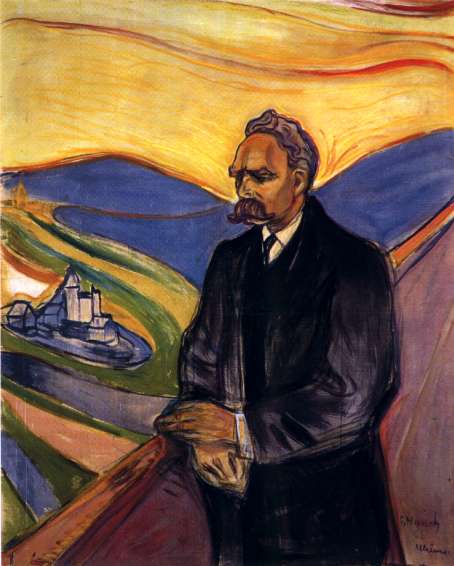
(“Friedrich Nietzsche,” by Edvard Munch, from 1901. Source: Wikiart, Public Domain).
Today and for the next day or two I’ll focus on my journey to Christianity, with specific references to the events, thinkers, and ideas that guided me along the way. With faith, I hope doing so will acquaint readers with that journey while guiding me along the befuddling and treacherous path that is bearing the cross.
I was baptized, and that’s about it. We never attended Mass, not even on Christmas and Easter. All of my catechesis and the later sacraments of initiation came to me because I went to Catholic school, and despite some cringeworthy memories, I owe very much to those years. Of course, I understood virtually nothing of Christianity, but without those VeggieTales movies and weird elementary-school plays about the prophet Hosea, I probably never would’ve thought about Christianity. My basis was not firm, but it existed. As a friend recently told me, he didn’t realize the cross was a religious symbol until he was in college (despite being from a “Christian” background). He’s from New Jersey and it’s a common ornament there. I may not have understood much, but at least there was a spark of the sacred in my life.
In high school I was diagnosed with Crohn’s Disease, lost my ability to walk properly for a bit, and then lost my mother to cancer (on the day of my graduation, no less). To me, it was apparent that life was not fair, not in some grand sense, but merely on the mundane level. I could expect nothing, positive or negative, from the world and its inhabitants. If I was well liked, that was a glimmer of light in an otherwise dense darkness. Anything bad that happened merely became par for the course. Suffering didn’t make sense to me, but I readily accepted it as part and parcel of what it meant to exist. No explanatory system, New Age or ancient, could convince me that there was some way to eradicate all suffering. To this day, I am at best puzzled, at worst offended, by the “Prosperity Gospel.”
My path had to be circuitous. With all due respect to my Thomist brothers and sisters or those who find refuge in clear-cut theological systems, none of that would have made sense to me (nor does some of it now). I was (and inescapably am) some derivative form of Judy from Doug, a wannabe Beat or Sartrean existentialist in a black turtleneck sucking on an unfiltered cigarette. I say that un-ironically and welcome the charge that such views are for adolescents.
Thus it was Nietzsche who showed me the way. Friedrich Nietzsche, and then later Søren Kierkegaard, confirmed my feeling that life did not have to make sense; I didn’t need to expect miracles, even minor successes, but could simply live, taking responsibility for my actions. To this day, I am in full agreement with a statement from my teacher’s teacher, Walter Kaufmann: “I know of no other great writer in the whole nineteenth century, perhaps even in the whole of world literature, to whom I respond with less happiness and with a more profound sense that I am on trial and found wanting, unless it were Søren Kierkegaard.” Part of me wanted to feel scrutinized, held accountable. Ecclesiastes and Job made (and make) more sense to me than theological evasions. I didn’t want or need a sound system; I needed something to look me square in the eyes and tell me to be thankful for the fact that I wasn’t dead, something to make me want to get up in the morning not because life was going to be better, but because it was life as such. Hence why being pro-choice never made any sense to me (even before I was religious). It seemed the ultimate act of ingratitude.
Further, in a mundane sense, Nietzsche’s predictions (Last Men, Nihilists, etc.) made perfect sense to me. The blasé politics of my day barely concealed that they were a mere secularization of Christian doctrine, a bunch of people wanting to be nice with a limited ground for trying to do so. People acted like happiness was comfort, when it was more than apparent to me that comfort was at best ephemeral, at worst a distraction. Science was similar; even in its practical applications, it could do little more than delay the inevitable, and even then run the risk of fleeing an inescapable suffering. Hence, when I first read George Grant’s book on Nietzsche Time as History, passages like this one jumped out at me: “In much writing in English, Nietzsche is spoken of as a second-rate poet masquerading as a philosopher, or as an aphorist who did not face questions comprehensively, or as a romantic of the feelings who was not concerned with science. His thoughts are impugned by the fact that he retreated into madness (to use that ambiguous word).” “This is me,” I thought, and I blinked.
Enter Christianity. Nietzsche’s anti-Christian invective read more to me like an indictment of liberalism than of Christianity per se. His solutions rarely fascinated me so much as his diagnoses engrossed me. If, once we’d killed God, the best we could do was deny human rights, turn most everything into a form of Realpolitik, and mock our enemies, I knew there had to be something more. Nietzsche did the negative work of clearing the ground. Innately, I knew I had a sense of justice, a desire to see others comforted and loved. And yet, in Nietzsche I found what seemed to be the essence of earthly matters:
We simply do not consider it desirable that a realm of justice and concord should be established on earth (because it would certainly be the realm of the deepest leveling and chinoiserie); we are delighted with all who love, as we do, danger, war, and adventures, who refuse to compromise, to be captured, reconciled, and castrated; we count ourselves among conquerors; we think about the necessity for new orders, also for a new slavery — for every strengthening and enhancement of the human type also involves a new kind of enslavement.
I couldn’t fault this, not at the human level anyway. I knew I didn’t want this, but I could not deny the sad truths at its core. Grant, through whom I first encountered Nietzsche, and who read him because his son was fascinated by him, provided the right lens for my developing understanding. He made it clear that God’s death was an opportunity to return to a more authentic Christianity, unconcerned with liberalism or with fairness, one that embraced a loving God, one who suffered and knows suffering as the correlative to this seeming meaninglessness. This God was not nice, He loved. Suffering was part and parcel of what He promised, a loving reminder of His presence and sacrifice. This God made sense; in Him I could find hope.
Unfortunately, I’ve class very soon and must run. With God’s help, I hope to pick up and further explain my journey tomorrow. In the meantime, I commend you to Qoheleth:
All this I have kept in my heart and all this I examined: The just, the wise, and their deeds are in the hand of God. Love from hatred mortals cannot tell; both are before them. Everything is the same for everybody: the same lot for the just and the wicked, for the good, for the clean and the unclean, for the one who offers sacrifice and the one who does not. As it is for the good, so it is for the sinner; as it is for the one who takes an oath, so it is for the one who fears an oath. Among all the things that are done under the sun, this is the worst, that there is one lot for all. Hence the hearts of human beings are filled with evil, and madness is in their hearts during life; and afterward—to the dead! (Ecclesiastes 9:1-3)
Previous Post
February 24, 2016
Karl Marx: Moralist
Next Post

February 27, 2016 How I Came to be Christian: Part Two
Browse Our Archives
Select a Category Academia Culture Politics Reviews Theology Uncategorized
Select a Month October 2026 September 2026 August 2026 July 2026 June 2026 May 2026 April 2026 March 2026 February 2026 January 2026 December 2025 November 2025 October 2025 September 2025 August 2025 July 2025 June 2025 May 2025 April 2025 March 2025 February 2025 January 2025 December 2024 November 2024 October 2024 September 2024 August 2024 July 2024 June 2024 May 2024 April 2024 March 2024 February 2024 January 2024 December 2023 November 2023 October 2023 September 2023 August 2023 July 2023 June 2023 May 2023 April 2023 March 2023 February 2023 January 2023 November 2022 October 2022 September 2022 August 2022 July 2022 June 2022 May 2022 April 2022 March 2022 February 2022 July 2021 December 2020 November 2020 July 2020 May 2020 April 2020 February 2020 January 2020 December 2019 November 2019 October 2019 August 2019 July 2019 April 2019 March 2019 December 2018 August 2018 July 2018 June 2018 May 2018 April 2018 March 2018 January 2018 December 2017 November 2017 September 2017 August 2017 July 2017 June 2017 May 2017 April 2017 March 2017 February 2017 January 2017 December 2016 November 2016 October 2016 September 2016 August 2016 July 2016 June 2016 May 2016 April 2016 March 2016 February 2016
Follow Us!
TAKE THE
Religious Wisdom Quiz
Who wrote the Book of Acts?
Select your answer to see how you score.
Luke Paul Peter Mark
Related posts from Jappers and Janglers

American Movie: The Beauty of the Chuds
The Good Samaritan: Who Is My Neighbor?

Which is the Original Bible? Is it the...
TRENDING AT PATHEOS Religious Music and Entertainment

Emotion in Early Christianity by Andrew Crislip
Andrew Crislip’s Emotion in Early Christianity examines an often overlooked dimension of...

16 Spiritual Touchstones for a More Grounded Life
After decades of spiritual study, here are 16 principles I try...

Catholic Evangelization: Sharing Your Faith Every Day
Welcome back to the Graceful Awakening mini-series called, “From Faith to Mission.” ...

The Pillar of the Boatmen: the Ancient Monument...
The Pillar of the Boatmen is a Romano-Gaulish sculpture that dates from...

In one sense walking into Westminster Abbey is like walking down the...

'Super Scam Me' Exposes AI Jon Bon Jovi...
Leslie Pickett believed she was in a relationship with Jon Bon Jovi....
view all Religious Music and Entertainment blogs
Ad-Free & Subscriber Log-In Subscription Support
- About Us
- 2026 Calendar
- Videos
- Podcasts
- Library of World Religions
- Faith In Media Tracker
- Advertise With Us
- Write for Us
- Privacy Policy
- Terms of Service
- Do Not Sell My Data
- Contact Us
- Radiant Digital
- Manage Newsletter Subscriptions
- Unsubscribe From Notifications
- Sitemap
Copyright 2008-2026, Patheos. All rights reserved.
Subscription Support Ad-Free & Subscriber Log-In
Follow Patheos