
BuddhistCatholicContemplativeEvangelicalGeneral ChristianHinduJewishLatter-day SaintMuslimNew VisionsProgressive Christian
Beliefs
- Buddhist
- Catholic
- Contemplative
- Evangelical
- General Christian
- Hindu
- Jewish
- Latter-day Saint
- More Voices
- Muslim
- New Visions
- Pagan
- Progressive Christian
Topics
- Religion News
- Food and Religion
- Sports and Religion
- Religious Art
- Religious Music and Entertainment
- Religious Events
- History and Religion
- Style and Religion
- Politics and Religion
- Women in Religion
- Recreation Outdoors and Religion
- Business Finance and Religion
- Careers Workplace and Religion
- Education and Religion
- Family Parenting and Religion
- Health Fitness and Religion
- Home and Religion
- Relationships and Religion
- Technology and Religion
- Travel and Religion
Columnists
- Buddhist Columnists
- Business Finance and Religion Columnists
- Careers Workplace and Religion Columnists
- Catholic Columnists
- Contemplative Columnists
- Education and Religion Columnists
- Evangelists Columnists
- Family Parenting and Religion Columnists
- General Christian Columnists
- Health Fitness and Religion Columnists
- Hindu Columnists
- History and Religion Columnists
- Home and Religion Columnists
- Jewish Columnists
- More Voices Columnists
- Latter Day Columnists
- Muslim Columnists
- New Visions Columnists
- Nonreligious Columnists
- Pagan Columnists
- Politics and Religion Columnists
- Progressive Columnists
- Recreation Outdoors and Religion Columnists
- Relationships and Religion Columnists
- Religion News Columnists
- Religious Art Columnists
- Religious Events Columnists
- Religious Music and Entertainment Columnists
- Sports and Religion Columnists
- Style and Religion Columnists
- Technology and Religion Columnists
- Travel and Religion Columnists
- Women in Religion Columnists
Resource Library
- 2026 Calendar
- Library of World Religions
- The 100 Most Holy Places on Earth
- Patheos Answers
- Podcasts
- Videos
- Faith Leaders Database
- Anglican Episcopalian
- Bahai
- Baptist
- Buddhism
- Christianity
- Confucianism
- Eastern Orthodoxy
- Hinduism
- Holiness and Pentecostal
- ISKCON
- Islam
- Judaism
- Lutheran
- Methodist
- The Church of Jesus Christ of Latter-day Saints
- New Age
- Paganism
- Presbytarian and Reformed
- Protestantism
- Religion Behind the Scenes
- Roman Catholic
- Scientology
- Shia Islam
- Sikhism
- Sufism
- Sunni Islam
- Taoism
- Zen
- See all religions
Research Tools
 Ad-Free & Subscriber Log-In Subscription Support
Ad-Free & Subscriber Log-In Subscription Support
Follow Patheos 

- Trending:
- Forgiveness
- |
- Marriage
- |
- Consciousness
- |
- Death Penalty
- |
- Election
- |
- Halloween

- Home
- Catholic
- Politics and Religion
- Are 28% of Americans truly functionally illiterate?
Are 28% of Americans truly functionally illiterate?
Last updated on: April 5, 2026 at 9:35 pm by Jane the Actuary
Are 28% of Americans truly functionally illiterate? 2026-04-05T21:35:43-06:00 Jane the Actuary
Patheos Explore the world's faith through different perspectives on religion and spirituality! Patheos has the views of the prevalent religions and spiritualities of the world.
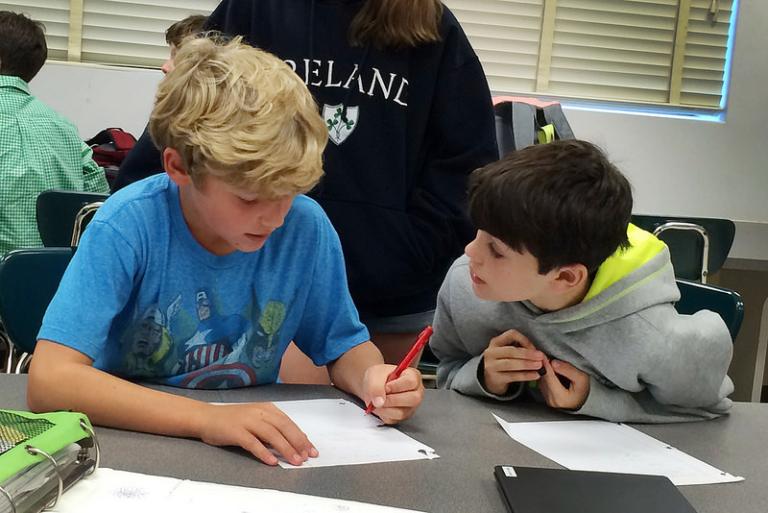
https://www.flickr.com/photos/wwworks/15344079560
That’s the quickie headline for a long read-through of the 2023 PIAAC report. This study, the Program for the International Assessment of Adult Competencies, sponsored by OECD, is similar to the PISA report, but it measures adults’ education. It does not define its results in terms of “grade level” but instead is more complicated than that, so I’m going back to my old practice of using the blog as a means of working through information.
The labels:
Let’s start with the webpage that explains the levels used by the study, and the sample questions. (One piece of background: if you click on the link, it talks about cycle 1 vs cycle 2; the test was changed in 2023, so that’s “cycle 2.”) There’s also a PDF with more detail on the sample questions, here.
The numeracy part is easier:
Below level 1 includes tasks like counting and adding and subtracting small numbers.
Level 1 includes basic arithmetic including multiplication and division, working with money, and understanding the concept of decimals, as well as conceptually understanding maps.
Level 2 includes math with fractions, time, averages, simple proportions, and solving problems with multiple-step reasoning. A sample question is to ask the test-taker to decide whether three negative numbers in a list fall within a specified range (it’s as simple as it sounds). Another example asks the test-taker to correct incorrect data entry (this requires recognizing that what should be 52 centimeters was entered as .52 centimeters, that is, understanding decimals, as well as being able to read and figure out the “trick” of the question).
Level 3 and above are more complicated levels of reasoning and problem-solving, including algebra, rates and ratios, and ability to assess statistics. Although the highest levels correspond to the more complex math engineers or actuaries would use professionally, the focus is really on abilities adults have for basic proficiency, managing their finances, following healthcare instructions or a manual at their blue collar job. A level 3 sample question gives a building material, which weights 20 kg per bag and covers 5 square meters, and asks the test-taker how many kilograms are needed for a wall of 5 x 4 meters. Another sample question simply presents an inforsheet with details on a type of paint and asks the test-taker to identify the information that’s needed to determine how many cans of paint are needed (the coverage per liter, and the number of liters in the can). A third example shows an image of a scale and asks the test taker to estimate the weight shown.
Literacy is fuzzier, and for reasons that are unclear to me, the sample items are described as low or moderate difficulty rather than using the Levels 1 – 5 framework.
Here are the descriptions:
Below 1 does not mean “illiterate” but includes adults who can decode and grasp meaning at a very rudimentary level. This is tested by asking the test taker to answer whether a sentence “makes sense” or not — “The red car had a flat tire” makes sense but “Airplanes are made of dogs” does not.
Level 1 means the ability to understand information at very simple levels, with up to a few hundred words or with a simple list, and with a very direct and obvious connection. “Low difficulty” test items include reading a simple list of preschool rules to find the one item on the list which has to do with school arrival time. Another item labelled as “low difficulty” is actually more complicated, in terms of sentence structure and vocabulary, a description of how bread gets hard and crackers get soft when exposed to air, so I don’t know if it is really meant to correspond to “Level 1”! If it is, it suggests that they assume everyone has a basic vocabulary but some fall short in reasoning abilities.
Level 2 requires more indirect inferences and the ability to manage unfamiliar situations. A “moderate difficulty” item (which may be level 2 or level 3 – it’s not specified) is a question with the same list of preschool rules and a second text, a teacher e-mail, allowing children to bring stuffed animals for a special theme day. The question is, to which rule is this an exception, and the test-taker has to find the “no toys” rule.
Level 3 requires multi-step operations to answer questions about a text, and to navigate through irrelevant “red herring” information.
Level 4 includes the ability to navigate through long and dense texts across multiple pages to complete a task.
Level 5 nominally exists but the test does not have the ability measure higher levels of ability.
The US results
Results are presented in two different ways, first as averages, and second as percents of test-takers scoring in the different levels.
For 2023, the average literacy score was 258, which is at the mid to high Level 2. The average numeracy scores was 249, which is in the midpoint of the Level 2. Both of these are drops from 2017. Honestly, I don’t know what to make of these drops, since the structure shifted and they changed from pen-and-paper to using tablets, so it seems to me the Ockham’s razor explanation is just that the change in the test structure produced lower scores, though at the same time, the experts certainly seem to think the scores are entirely comparable.
But focusing only on 2023, 28% of adult Americans are at level 1 or below in literacy and 34% in numeracy. And only 44% and 38%, respectively, are at or above level 3 in these domains.
By age, for both literacy and numeracy, either scores have improved over time (that is, for different cohorts), then gotten worse for the youngest group, or the increase in Level 1 or belows as age band increase is a matter of, first, cognitive maturity, and then cognitive decline. For numeracy, the 16-24 year olds have 34% in the lowest band, the 25-34 year olds have 31%, and then the rates increase to 38% at ages 55-65.
By ethnicity, for literacy, 16% of white test-takers, 45% of Hispanic test-takers, and 50% of black test-takers scored in the lowest tier. For clarification, the test does not provide a translated version for immigrants; the justification for this is that they are trying to measure impairments to employment and civic participation and consider illiteracy in English to be the key barrier even if a person reads and writes in another language. For math, 21% of whites, 55% of Hispanics, and 62% of Blacks perform at the lowest tier.
A full data set breaks this down further:
For literacy, 4% of whites, 22% of blacks, and 24% of Hispanics were at “below level 1” — remember that this means they can read the words in very simple sentences but not more than that.
For numeracy, 6% of whites, 27% of Hispanics, and 32% of Blacks perform “below level 1” — remember that this means they cannot do more than add small numbers.
These are dire numbers.
The international comparisons
These are in the full report; the appendix also has a link to a file with all the data tables.
For literacy, out of 28 countries, the US has the 5th highest “below level 1.” Other levels are not particularly distinctive. The actual percents are 11.5% below 1 for the US, compared to 25.1% for Chile (which is an outlier across the board), Israel at 13.8%, Portugal at 15.1%, and Poland at 12.3%. Possibly some of the issue here is the language barrier for many of these countries.
For math, the US 14.8% is third worst, with only 26.5% for Chile and 16.4% for Portugal as worse.
The lowest below 1’s were both in Japan, with 3.8% for literacy and 3.4% for numeracy.
These detailed tables also show the score breakdown for immigrants:
For the US, 54% of foreign-born test-takers scored at level 1 or below in literacy (compared to the OECD average for this group of 50.5%) and 33.3% of native-born of foreign-born parents did. The “level 1 or below” literacy percent for Hispanics of 45% is explicable in part since it’s a mix of foreign and native born.
For math the figure is 53.3% of foreign-born test takers (compared to 45.9% average for the OECD), and 45.7% for native-born of foreign-born parents. The 55% of Hispanic test-takers scoring at level 1 or below does not make sense unless we assume that the differences between Hispanics and other immigrants work in different directions.
But what’s it all mean?
This is the trickiest part.
Honestly, what was most surprising about the sample test questions was that they fundamentally were about ability to think and reason rather than just mechanically solve math problems or answer simple reading passage questions. They are meant to model real-world needs, after all.
I wanted to make sense of this. Yes, I turned to AI, in this case Grok, to do more reading and synthesizing and generate what’d I’d call a working “null hypothesis.” (No, I don’t fully trust AI. Yes, I know it’s only as useful as its source information, and risks hallucinations but it provides baseline information for consideration.) Here’s the full Q & A.
The key question: how do the “levels” translate to IQ under the assumption of a “good-enough” educational system and no impediments? And the answers surprised me: that the test is very “g-loaded” – meaning that it strongly correlates with IQ rather than academic instruction, with the following match-ups:
Level 1, IQ of 75 – 90
Level 2, IQ of 90 – 105,
Level 3, IQ of 105 – 120,
Level 4, 120 – 135,
Level 5, 135+.
(In full disclosure, I really don’t know what my IQ is. I’ve always figured it’s on the higher side of normal but not gifted/genius.)
It surprised me that level 3 would be above average IQs, given the description, especially for math, given that “Algebra” and “Algebra 2” are basic high school classes. According to Grok (and again, I haven’t done further research), success in these classes, or in math skills beyond arithmetic (including fractions and the like), really is an upper-half of the IQ range skill.
Here’s the full table Grok generated for me:
Algebra 1, 9th grade, corresponds to the OECD’s Level three and students can be reliably successful with an IQ of 105 to 120.
Geometry, 10th grade, is Level 3/low Level 4, IQ 105 – 125.
Algebra 2, 11th grade, Level 4, IQ 120 – 135.
Calc 1/2, High Level 4/low Level 5, IQ 125 – 140
Multivariate calc/Calc 3, Level 5, IQ 135+.
Again, do I trust these numbers? I don’t know.
Grok also posits that the improvement in scores (fewer level 1 or belows) for younger test takers isn’t as much about better education opportunities so much as cognitive decline beginning at a younger age than I would have considered.
The bottom line (if this is correct)
Readers may know that I am running for office, and that one of the reasons I am badly suited for the endeavor is that I do not like giving simplistic answers which may not be true.
This is one of those cases. Everyone’s running around waving the test scores and saying “the incumbents have failed to fix education and I can do better!”
We have to at least seriously consider the possibility that our ability to “fix” education is pretty limited, that expecting the majority of students to continue on to college and succeed in a “standard” college curriculum is likely a foolish task. It’s also the unfortunate reality that, however much it might be desirable for all Americans to have a strong level of financial literacy, be able to manage their retirement and personal savings, intelligently purchase, understand, and use their health insurance, a significant portion of Americans just won’t be able to do so.
The state of Illinois also has a “comprehensive numeracy plan” with a heavy emphasis on problem-solving and investigation rather than simply learning mechanical methods. But if a large minority of students will simply not be able to manage problem-solving but could learn the mechanical skills, it would do more harm than good for them.
So after nearly 2000 words I don’t really have an answer, except that we have to consider the full range of potential actions.
Previous Post

March 8, 2026
About Amelia Wittkoetter (for Women's History Month)
Next Post
April 30, 2026 Is there a fix for gerrymandering?
Recent Comments
"Yup, Pretty sure that trans athletes are a major issue that needs to be decided ..."
In which I comment on the ..."
"Do you pray to the golden calf, too? You seem like the type."
Is there a fix for gerrymandering?
"This includes our President, who according to all accounts doesn't read unless it's 1) small ..."
Are 28% of Americans truly functionally ..."
"For the test being digital vs paper, people do tend to do better with hard-copy, ..."
Are 28% of Americans truly functionally ..."
Browse Our Archives
Select a Category Actuarial/Retirement Issues Politics Uncategorized
Select a Month September 2026 August 2026 July 2026 June 2026 April 2026 March 2026 February 2026 January 2026 December 2025 November 2025 October 2025 July 2025 June 2025 May 2025 April 2025 March 2025 February 2025 January 2025 December 2024 November 2024 October 2024 September 2024 August 2024 July 2024 June 2024 May 2024 April 2024 March 2024 February 2024 December 2023 November 2023 October 2023 September 2023 August 2023 July 2023 December 2022 September 2022 August 2022 July 2022 June 2022 May 2022 February 2022 January 2022 December 2021 August 2021 June 2021 April 2021 February 2021 January 2021 December 2020 November 2020 October 2020 September 2020 August 2020 July 2020 June 2020 May 2020 April 2020 March 2020 February 2020 January 2020 December 2019 November 2019 October 2019 September 2019 August 2019 July 2019 June 2019 May 2019 April 2019 March 2019 February 2019 January 2019 December 2018 November 2018 October 2018 September 2018 August 2018 July 2018 June 2018 May 2018 April 2018 March 2018 February 2018 January 2018 December 2017 November 2017 October 2017 September 2017 August 2017 July 2017 June 2017 May 2017 April 2017 March 2017 February 2017 January 2017 December 2016 November 2016 October 2016 September 2016 August 2016 July 2016 June 2016 May 2016 April 2016 March 2016 February 2016 January 2016 December 2015 November 2015 October 2015 September 2015 August 2015 July 2015 June 2015 May 2015 April 2015 March 2015 February 2015 January 2015 December 2014 November 2014 October 2014 September 2014 August 2014 July 2014 June 2014 May 2014 April 2014 March 2014 February 2014 January 2014 December 2013 November 2013 October 2013 September 2013 August 2013 July 2013
Follow Us!
TAKE THE
Religious Wisdom Quiz
What body of water did Peter walk on at Jesus' invitation?
Select your answer to see how you score.
Dead Sea Sea of Galilee Red Sea Mediterranean Sea
Related posts from Jane the Actuary

What happens to the rest of us, when...


In which, apparently, the country has completely lost...
Will The Pandemic School Closures Cause An Education...
TRENDING AT PATHEOS Catholic

Swimfan: Forgotten Aughts Pleasures
This is a recovery effort. In 2002, My Big Fat Greek Wedding...

Top Three Anti-Catholic Lies About Catholicism
This is my initial transcript for the video, "THE 3 WORST...

Pope Leo Celebrates Mass for Nurses & Docs...
I don't have any idea how he did it, but Pope Leo...

The Sermon on the Mount, Part I: Matthew...
The Sermon on the Mount, Part I (Matthew 4:12-5:12) St. Matthew moves...

What's up from Crossway: Reviewing some of their latest A few weeks...

Janie Learns the Way of the Cross: A...
Teaching children about Jesus' Passion can be challenging. Many parents and educators...
view all Catholic blogs
What Are Your Thoughts?leave a comment
Ad-Free & Subscriber Log-In Subscription Support
- About Us
- 2026 Calendar
- Videos
- Podcasts
- Library of World Religions
- Faith In Media Tracker
- Advertise With Us
- Write for Us
- Privacy Policy
- Terms of Service
- Do Not Sell My Data
- Contact Us
- Radiant Digital
- Manage Newsletter Subscriptions
- Unsubscribe From Notifications
- Sitemap
Copyright 2008-2026, Patheos. All rights reserved.
Subscription Support Ad-Free & Subscriber Log-In
Follow Patheos