
BuddhistCatholicContemplativeEvangelicalGeneral ChristianHinduJewishLatter-day SaintMuslimNew VisionsProgressive Christian
Beliefs
- Buddhist
- Catholic
- Contemplative
- Evangelical
- General Christian
- Hindu
- Jewish
- Latter-day Saint
- More Voices
- Muslim
- New Visions
- Pagan
- Progressive Christian
Topics
- Religion News
- Food and Religion
- Sports and Religion
- Religious Art
- Religious Music and Entertainment
- Religious Events
- History and Religion
- Style and Religion
- Politics and Religion
- Women in Religion
- Recreation Outdoors and Religion
- Business Finance and Religion
- Careers Workplace and Religion
- Education and Religion
- Family Parenting and Religion
- Health Fitness and Religion
- Home and Religion
- Relationships and Religion
- Technology and Religion
- Travel and Religion
Columnists
- Buddhist Columnists
- Business Finance and Religion Columnists
- Careers Workplace and Religion Columnists
- Catholic Columnists
- Contemplative Columnists
- Education and Religion Columnists
- Evangelists Columnists
- Family Parenting and Religion Columnists
- General Christian Columnists
- Health Fitness and Religion Columnists
- Hindu Columnists
- History and Religion Columnists
- Home and Religion Columnists
- Jewish Columnists
- More Voices Columnists
- Latter Day Columnists
- Muslim Columnists
- New Visions Columnists
- Nonreligious Columnists
- Pagan Columnists
- Politics and Religion Columnists
- Progressive Columnists
- Recreation Outdoors and Religion Columnists
- Relationships and Religion Columnists
- Religion News Columnists
- Religious Art Columnists
- Religious Events Columnists
- Religious Music and Entertainment Columnists
- Sports and Religion Columnists
- Style and Religion Columnists
- Technology and Religion Columnists
- Travel and Religion Columnists
- Women in Religion Columnists
Resource Library
- 2026 Calendar
- Library of World Religions
- The 100 Most Holy Places on Earth
- Patheos Answers
- Podcasts
- Videos
- Faith Leaders Database
- Anglican Episcopalian
- Bahai
- Baptist
- Buddhism
- Christianity
- Confucianism
- Eastern Orthodoxy
- Hinduism
- Holiness and Pentecostal
- ISKCON
- Islam
- Judaism
- Lutheran
- Methodist
- The Church of Jesus Christ of Latter-day Saints
- New Age
- Paganism
- Presbytarian and Reformed
- Protestantism
- Religion Behind the Scenes
- Roman Catholic
- Scientology
- Shia Islam
- Sikhism
- Sufism
- Sunni Islam
- Taoism
- Zen
- See all religions
Research Tools
 Ad-Free & Subscriber Log-In Subscription Support
Ad-Free & Subscriber Log-In Subscription Support
Follow Patheos 

- Trending:
- Forgiveness
- |
- Marriage
- |
- Consciousness
- |
- Death Penalty
- |
- Election
- |
- Halloween

- Home
- Catholic
- Politics and Religion
- How “Blind Spots” are driving up medical costs – and worse
How “Blind Spots” are driving up medical costs – and worse
Last updated on: January 5, 2025 at 10:04 am by Jane the Actuary
How “Blind Spots” are driving up medical costs – and worse 2025-01-05T10:03:53-06:00 Jane the Actuary
Patheos Explore the world's faith through different perspectives on religion and spirituality! Patheos has the views of the prevalent religions and spiritualities of the world.
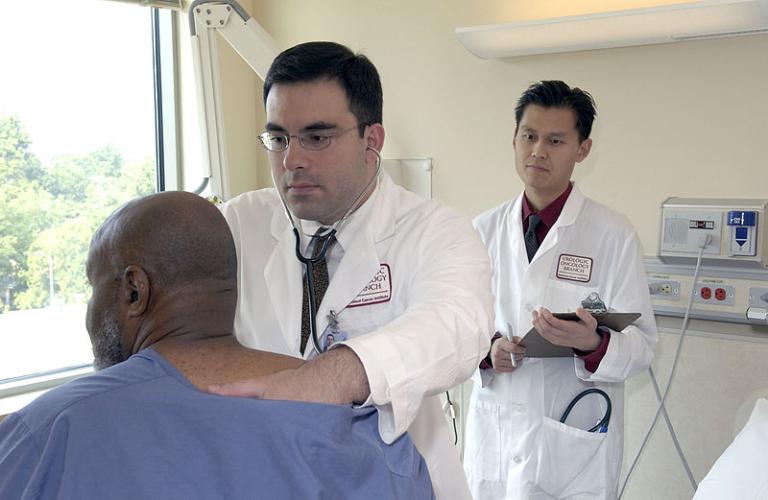
https://commons.wikimedia.org/wiki/File%3ADoctor_examines_patient_(1).jpg; By Unknown photographer [Public domain], via Wikimedia Commons
Yes, I just finished Marty Makary’s new book, the topic of which is clear from the subtitle, “When Medicine Gets It Wrong and What It Means for Our Health,” and the story he tells is grim. It’s a slim book and probably available for checkout at your local library (though I had to wait for it to come off hold) and honestly I don’t understand why his nomination for a cabinet position in the Trump administration was treated as suspicious — Dr. Makary has been a consistent advocate for a better healthcare system, and is nothing remotely like JFK Jr.’s anti-vax nuttery. The largest part of the book is a set of brief reports on ways in which the groupthink of medical professionals got things wrong, with deadly/costly consequences.
Here’s a short list:
Peanut allergies: in 1998, based on a total misinterpretation of a 1996 study, the UK health department recommended “peanut abstinence” for high-risk young children to avoid peanut allergies. In 2000, the American Academy of Pediatrics (AAP) went even further, and said that no child should be given peanuts before age 3. This caused peanut allergies among children to climb dramatically – resulting in high costs due to EpiPens and serious medical harm to allergic children when they are exposed, as well as an upheaval as classrooms became “peanut-free.” It took until 2015 for a researcher to look at the available evidence (including much smaller rates of allergies outside of the US and the UK, even in places such as Israel where a common baby food, Bamba, is made of peanuts), conduct a study (despite heavy criticism) and publish the results — the discovery that peanut exposure in infancy results in an 86% reduction in peanut allergies compared to following the AAP recommendation. But it took 2 further years for the AAP to reverse its guidance.
HRT: Hormone Replacement Therapy for women suffering from symptoms of menopause was pretty much the norm, until a 2002 study announcing that HRT increased a woman’s risk of breast cancer. Now women are told to take hormones in menopause for the shortest dose and the least time needed to alleviate symptoms such as hot flashes. The truth is actually that the “proof” of breast cancer risk didn’t pass statistical significance tests, and at the same time HRT has been proven, at rates that pass statistical significance tests, to reduce risks for heart disease, Alzheimer’s, and more. But the influence of the first study, and the power of the lead researcher (who, it seems, simply disliked HRT and wanted to find reasons to end the practice), means these positive benefits can’t get traction.
Antibiotics: It’s generally known that antibiotics cause short-term tummy troubles, but it turns out that there are long-term consequences to frequent doses of antibiotics, with associations with higher rates of obesity, learning disabilities, ADHD, asthma, and celiac disease. (It’s not 100% clear whether this is a matter of children whose doctors overprescribed antibiotics, say, for ear infections or viral illnesses, vs. the cause potentially being having illnesses which required more frequent antibiotics, but Makary is so concerned about appropriate statistical analysis that I would be pretty disappointed if he made this mistake.) It’s also the case that Crohn’s disease and ulcerative colitis didn’t really exist before the 1940s, coinciding with the advent of antibiotics.
Cholesterol: This chapter was the least surprising because it is now common knowledge, I think, that dietary cholesterol does not cause blood cholesterol, and that fat in one’s diet is not the cause of being fat.
Blood from HIV-infected donors: Yikes! The Red Cross did not begin screening donated blood until 1985, despite the existence of a test years earlier, based on an almost-magical belief that blood was safe.
Ovarian Cancer: The norm for the last 70 years has been that women past childbearing age who are having surgery for any other reason, have been encouraged to also have their ovaries removed, as protection against ovarian cancer. Apparently, “hundreds of millions” of women have had the procedure. But it turns out that even after menopause, the ovaries still produce hormones, just at a smaller level, and what’s more, ovarian cancer is not what it seems, but it’s really “fallopian tube cancer” which quickly spreads to the ovaries, so that fallopian tube removal, a much less invasive procedure which doesn’t impact women’s health or well-being afterwards. Scientists are now conducting trials as to the impact of this procedure as a purely preventive measure.
Silicon breast implants: Silicone breast implants became very popular, but then came to a screeching halt when, in 1990, news anchor Connie Chung reported on “breast implant illness.” One thing led to another and in 1995, Dow Corning paid $3.2 billion to 440,000 women to settle claims, leading to the company’s bankruptcy. But it turns out that there was never any evidence and in 1999, an Institute of Medicine report by independent scientists concluded that the claims that these breast implants caused diseases such as autoimmune disease, were false.
What’s the cause of these failures? “Groupthink” is a pat answer, but a large part of it is in fact a “don’t rock the boat” mindset. Getting along with colleagues, playing by the rules of orderly paper submission, maintaining the existing paradigm — the medical and scientific world simply doesn’t like dissent.
And Makary concludes with “what else are we getting wrong?” — as potential items to rethink include flouride in drinking water, the supposed harmlessness of marijuana, the use of tylenol for fevers (that is, bringing down low-grade fevers rather than enabling the body to use fever as an infection-fighting mechanism), certain types of early cancer detection, so-called “gender affirming care” for children, and more.
So what’s to be done? I don’t know. But the book’s overdue at the library and I wanted to write down the key points.
Previous Post

December 22, 2024
Ray Bradbury, Book Burning, dystopias and prognostication
Next Post

January 5, 2025 Dear Cardinal Cupich: enough with endless Capital Campaigns!
Recent Comments
"Yup, Pretty sure that trans athletes are a major issue that needs to be decided ..."
In which I comment on the ..."
"Do you pray to the golden calf, too? You seem like the type."
Is there a fix for gerrymandering?
"This includes our President, who according to all accounts doesn't read unless it's 1) small ..."
Are 28% of Americans truly functionally ..."
"For the test being digital vs paper, people do tend to do better with hard-copy, ..."
Are 28% of Americans truly functionally ..."
Browse Our Archives
Select a Category Actuarial/Retirement Issues Politics Uncategorized
Select a Month September 2026 August 2026 July 2026 June 2026 April 2026 March 2026 February 2026 January 2026 December 2025 November 2025 October 2025 July 2025 June 2025 May 2025 April 2025 March 2025 February 2025 January 2025 December 2024 November 2024 October 2024 September 2024 August 2024 July 2024 June 2024 May 2024 April 2024 March 2024 February 2024 December 2023 November 2023 October 2023 September 2023 August 2023 July 2023 December 2022 September 2022 August 2022 July 2022 June 2022 May 2022 February 2022 January 2022 December 2021 August 2021 June 2021 April 2021 February 2021 January 2021 December 2020 November 2020 October 2020 September 2020 August 2020 July 2020 June 2020 May 2020 April 2020 March 2020 February 2020 January 2020 December 2019 November 2019 October 2019 September 2019 August 2019 July 2019 June 2019 May 2019 April 2019 March 2019 February 2019 January 2019 December 2018 November 2018 October 2018 September 2018 August 2018 July 2018 June 2018 May 2018 April 2018 March 2018 February 2018 January 2018 December 2017 November 2017 October 2017 September 2017 August 2017 July 2017 June 2017 May 2017 April 2017 March 2017 February 2017 January 2017 December 2016 November 2016 October 2016 September 2016 August 2016 July 2016 June 2016 May 2016 April 2016 March 2016 February 2016 January 2016 December 2015 November 2015 October 2015 September 2015 August 2015 July 2015 June 2015 May 2015 April 2015 March 2015 February 2015 January 2015 December 2014 November 2014 October 2014 September 2014 August 2014 July 2014 June 2014 May 2014 April 2014 March 2014 February 2014 January 2014 December 2013 November 2013 October 2013 September 2013 August 2013 July 2013
Follow Us!
TAKE THE
Religious Wisdom Quiz
What question did Jesus ask Saul on the road to Damascus?
Select your answer to see how you score.
Why do you persecute my followers? Saul, Saul, why do you persecute me? Why do you hate me? Do you not know who I am?
Related posts from Jane the Actuary

Tell me about your health insurance
Where does insurance end, and social insurance begin?
Healthcare spending: two questions
Why, oh, why, won't single-payer/public option go away?
TRENDING AT PATHEOS Catholic

Emotion in Early Christianity by Andrew Crislip
Andrew Crislip’s Emotion in Early Christianity examines an often overlooked dimension of...

16 Spiritual Touchstones for a More Grounded Life
After decades of spiritual study, here are 16 principles I try...

Catholic Evangelization: Sharing Your Faith Every Day
Welcome back to the Graceful Awakening mini-series called, “From Faith to Mission.” ...

The Pillar of the Boatmen: the Ancient Monument...
The Pillar of the Boatmen is a Romano-Gaulish sculpture that dates from...

In one sense walking into Westminster Abbey is like walking down the...

'Super Scam Me' Exposes AI Jon Bon Jovi...
Leslie Pickett believed she was in a relationship with Jon Bon Jovi....
view all Catholic blogs
What Are Your Thoughts?leave a comment
Ad-Free & Subscriber Log-In Subscription Support
- About Us
- 2026 Calendar
- Videos
- Podcasts
- Library of World Religions
- Faith In Media Tracker
- Advertise With Us
- Write for Us
- Privacy Policy
- Terms of Service
- Do Not Sell My Data
- Contact Us
- Radiant Digital
- Manage Newsletter Subscriptions
- Unsubscribe From Notifications
- Sitemap
Copyright 2008-2026, Patheos. All rights reserved.
Subscription Support Ad-Free & Subscriber Log-In
Follow Patheos