
BuddhistCatholicContemplativeEvangelicalGeneral ChristianHinduJewishLatter-day SaintMuslimNew VisionsProgressive Christian
Beliefs
- Buddhist
- Catholic
- Contemplative
- Evangelical
- General Christian
- Hindu
- Jewish
- Latter-day Saint
- More Voices
- Muslim
- New Visions
- Pagan
- Progressive Christian
Topics
- Religion News
- Food and Religion
- Sports and Religion
- Religious Art
- Religious Music and Entertainment
- Religious Events
- History and Religion
- Style and Religion
- Politics and Religion
- Women in Religion
- Recreation Outdoors and Religion
- Business Finance and Religion
- Careers Workplace and Religion
- Education and Religion
- Family Parenting and Religion
- Health Fitness and Religion
- Home and Religion
- Relationships and Religion
- Technology and Religion
- Travel and Religion
Columnists
- Buddhist Columnists
- Business Finance and Religion Columnists
- Careers Workplace and Religion Columnists
- Catholic Columnists
- Contemplative Columnists
- Education and Religion Columnists
- Evangelists Columnists
- Family Parenting and Religion Columnists
- General Christian Columnists
- Health Fitness and Religion Columnists
- Hindu Columnists
- History and Religion Columnists
- Home and Religion Columnists
- Jewish Columnists
- More Voices Columnists
- Latter Day Columnists
- Muslim Columnists
- New Visions Columnists
- Nonreligious Columnists
- Pagan Columnists
- Politics and Religion Columnists
- Progressive Columnists
- Recreation Outdoors and Religion Columnists
- Relationships and Religion Columnists
- Religion News Columnists
- Religious Art Columnists
- Religious Events Columnists
- Religious Music and Entertainment Columnists
- Sports and Religion Columnists
- Style and Religion Columnists
- Technology and Religion Columnists
- Travel and Religion Columnists
- Women in Religion Columnists
Resource Library
- 2026 Calendar
- Library of World Religions
- The 100 Most Holy Places on Earth
- Patheos Answers
- Podcasts
- Videos
- Faith Leaders Database
- Anglican Episcopalian
- Bahai
- Baptist
- Buddhism
- Christianity
- Confucianism
- Eastern Orthodoxy
- Hinduism
- Holiness and Pentecostal
- ISKCON
- Islam
- Judaism
- Lutheran
- Methodist
- The Church of Jesus Christ of Latter-day Saints
- New Age
- Paganism
- Presbytarian and Reformed
- Protestantism
- Religion Behind the Scenes
- Roman Catholic
- Scientology
- Shia Islam
- Sikhism
- Sufism
- Sunni Islam
- Taoism
- Zen
- See all religions
Research Tools
 Ad-Free & Subscriber Log-In Subscription Support
Ad-Free & Subscriber Log-In Subscription Support
Follow Patheos 

- Trending:
- Forgiveness
- |
- Marriage
- |
- Consciousness
- |
- Death Penalty
- |
- Election
- |
- Halloween

- Home
- Catholic
- Politics and Religion
- Ray Bradbury, Book Burning, dystopias and prognostication
Ray Bradbury, Book Burning, dystopias and prognostication
Last updated on: December 23, 2024 at 9:06 am by Jane the Actuary
Ray Bradbury, Book Burning, dystopias and prognostication 2024-12-23T09:06:14-06:00 Jane the Actuary
Patheos Explore the world's faith through different perspectives on religion and spirituality! Patheos has the views of the prevalent religions and spiritualities of the world.

By Raysonho @ Open Grid Scheduler / Grid Engine (Own work) [Public domain], via Wikimedia Commons
Who was Ray Bradbury?
According to Wikipedia, he was born in 1920, spent most of his early childhood years in Waukegan Illinois, then moved to Los Angeles at the age of 14. He dreamed of being a writer from an early age, and began publishing science fiction in 1938, continuing to build his career during the wartime years because bad eyesight exempted him from the draft. In 1951, so, at the age of 31, he published The Fireman as a short story, then was invited to extend its length to be publishable as a novel, which occurred in 1953 as Fahrenheit 451.
In recent years, this book has been claimed to be seen as prophetic, foreseeing the “censorship” of books in the U.S., with endless caterwauling about “Banned Books Week” and the unfairness of schools removing from their collections such books as Let’s Talk About It, This Book is Gay, and All Boys Aren’t Blue, the first two of which contain explicit instruction on such things as accessing porn and anonymous hook-ups, and the last of which features as a primary plot point the author of the memoir having identity-affirming gay sex (in explicit detail). Indeed, the fact that there exists a dystopian book that contains as its premise the burning of books is used as prima facie evidence that any restriction on youth reading material is bad.
As it happens, a couple of weeks ago, my son’s school performed as a radio play an adaptation of the book, with a note in the program stating that the book is particularly relevant now because of the practice of parents challenging books. (Never mind that the rise in “number of books challenged” is a direct consequence of the increasing number of books directed at children or perceived by teachers/librarians as appropriate for children which are sexually explicit . . . ) And I pulled the book off the bookshelf for a quick reread.
Why, in Bradbury’s telling, did the United States of the future choose to burn books? It is not because of a desire to persecute sexual or ethnic minorities (the claim of modern-day “anti-book banning” activists), or to protect a dictatorship from the opposition (the practice of real-life dictatorships). Instead, the firehouse captain Beatty tells fireman Montag (starting on page 51 of my “60th-anniversary” edition), that the history of book-burning followed a different trajectory.
“It didn’t come from the Government down. There was no dictum, no declaration, no censorship, to star with, no! Technology, mass exploitation, and minority pressure carried the trick, thank God. Today, thanks to them, you can stay happy all the time, you are allowed to read comics, the good old confessions, or trade journals.”
Why did that happen? The advent of mass media, beginning with photography, then movies, radio, and television, each providing more “eyes and elbows and mouths” and
“films and radios, magazines, books leveled down to a sort of paste, pudding norm. . . . Books cut shorter. Condensations. Digests. Tabloids. Everything boils down to the gag, the snap ending.”
Beatty continues:
“School is shortened, discipline relaxed, philosophies, histories, languages dropped, English and spelling gradually neglected, finally almost completely ignored. Life is immediate, the job counts, pleasure lies all about after work. Why learn anything save pressing buttons, pulling switches, fitting nuts and bolts?”
Why, then, ban books?
The advent of this popular culture and fun and simplification and entertainment meant that
“the word ‘intellectual,’ of course, became the swear word it deserved to be. You always dread the unfamilar.”
Because, Beatty says, the brightest children were “better” than the others, they must be tamped down, prevented from causing harm or even making others feel bad.
What’s more, in order to preserve “happiness” in society, minorities had to be prevented from being upset.
“Colored people don’t like Little Black Sambo. Burn it. White people don’t feel good about Uncle Tom’s Cabin. Burn it. . . . Serenity, Montag. Peace, Montag.”
So what is the actual present-day analogy in the book? Not the practice of, or desire of parents to restrict books with explicit sex from high schools. Instead, it sounds a heck of a lot more like Bradbury is warning us of the impact of a country with its young adults addicted to Tik Tok and other videos, paired with the concern of policymakers and other “experts” with weeding out materials that are “offensive” to minorities. And ironically pretty much at the same time as I got back from this performance there was a claim being circulated on Twitter that schools should discontinue teaching Shakespeare:
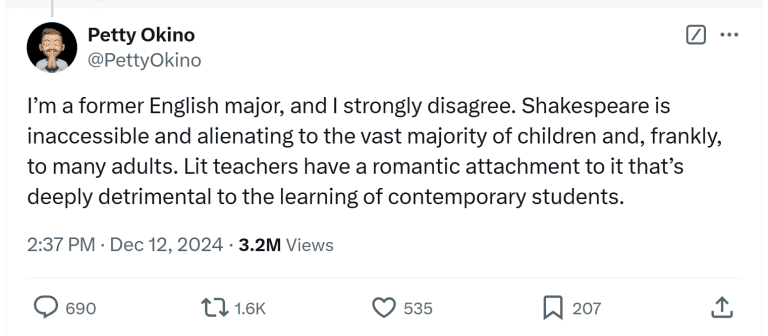
Of course, both interpretations — the “Fahrenheit 451 means we should stop even small-scale book bans because it is the path to total destruction of the written word” version as well as “Fahrenheit 451 is a warning of the consequences of short-form videos replacing reading” — rely on Bradbury being a prophet, having the ability to foresee the long-term impact of short-term trends and decisions. And I don’t know that there’s necessarily evidence that a 31-year-old science fiction & fantasy writer had this ability. We don’t know what the long-term effect will be of the dramatic decline in the degree to which Americans, especially children and young adults, read, and the rise of TikTok and other videos for entertainment and as a news source. Teachers consider watching a Romeo & Juliet movie to constitute “teaching Shakespeare,” and likewise in other ways have shifted to “teaching” by means of assigning videos to watch. Reports are growing that even in the short time that ChatGPT has become available, students have become dependent on it. And so on. But the “solution” isn’t found in a dystopian novel.
Previous Post

December 22, 2024
Trust an Actuary: The Social Security Fairness Act is unfair
Next Post

January 5, 2025 How "Blind Spots" are driving up medical costs - and worse
Recent Comments
"Yup, Pretty sure that trans athletes are a major issue that needs to be decided ..."
In which I comment on the ..."
"Do you pray to the golden calf, too? You seem like the type."
Is there a fix for gerrymandering?
"This includes our President, who according to all accounts doesn't read unless it's 1) small ..."
Are 28% of Americans truly functionally ..."
"For the test being digital vs paper, people do tend to do better with hard-copy, ..."
Are 28% of Americans truly functionally ..."
Browse Our Archives
Select a Category Actuarial/Retirement Issues Politics Uncategorized
Select a Month September 2026 August 2026 July 2026 June 2026 April 2026 March 2026 February 2026 January 2026 December 2025 November 2025 October 2025 July 2025 June 2025 May 2025 April 2025 March 2025 February 2025 January 2025 December 2024 November 2024 October 2024 September 2024 August 2024 July 2024 June 2024 May 2024 April 2024 March 2024 February 2024 December 2023 November 2023 October 2023 September 2023 August 2023 July 2023 December 2022 September 2022 August 2022 July 2022 June 2022 May 2022 February 2022 January 2022 December 2021 August 2021 June 2021 April 2021 February 2021 January 2021 December 2020 November 2020 October 2020 September 2020 August 2020 July 2020 June 2020 May 2020 April 2020 March 2020 February 2020 January 2020 December 2019 November 2019 October 2019 September 2019 August 2019 July 2019 June 2019 May 2019 April 2019 March 2019 February 2019 January 2019 December 2018 November 2018 October 2018 September 2018 August 2018 July 2018 June 2018 May 2018 April 2018 March 2018 February 2018 January 2018 December 2017 November 2017 October 2017 September 2017 August 2017 July 2017 June 2017 May 2017 April 2017 March 2017 February 2017 January 2017 December 2016 November 2016 October 2016 September 2016 August 2016 July 2016 June 2016 May 2016 April 2016 March 2016 February 2016 January 2016 December 2015 November 2015 October 2015 September 2015 August 2015 July 2015 June 2015 May 2015 April 2015 March 2015 February 2015 January 2015 December 2014 November 2014 October 2014 September 2014 August 2014 July 2014 June 2014 May 2014 April 2014 March 2014 February 2014 January 2014 December 2013 November 2013 October 2013 September 2013 August 2013 July 2013
Follow Us!
TAKE THE
Religious Wisdom Quiz
Who was Rebekah's father?
Select your answer to see how you score.
Terah Abraham Laban Bethuel
Related posts from Jane the Actuary

On Maus, Book-Banning, and Common Sense

The Handmaid's cautionary tale . . .


Illinois’ Assisted Suicide Law is, yes, literally deadly
TRENDING AT PATHEOS Catholic

Letters on Living the Faith by C.S. Lewis
Most of us met C.S. Lewis as a public intellectual. Mere Christianity....

When Halloween Unmasks Married Hearts
Written by Dr. David K. Ewen from Eternal Truth Bible College Behind...

Aristotle. He’s been called the father of logic, the father of the...

Methodist Central Hall and Westminster Abbey
Situated on the same square is Methodist Central Hall and Westminster Abbey. ...

57th Dove Awards Honor Dolly Parton, Crown New...
On gospel music’s biggest night, the 57th annual GMA Dove Awards honored...

The First Eucharistic Controversy: Christ’s Real Presence
For Catholics, the Eucharist is the source and summit of the Christian...
view all Catholic blogs
What Are Your Thoughts?leave a comment
Ad-Free & Subscriber Log-In Subscription Support
- About Us
- 2026 Calendar
- Videos
- Podcasts
- Library of World Religions
- Faith In Media Tracker
- Advertise With Us
- Write for Us
- Privacy Policy
- Terms of Service
- Do Not Sell My Data
- Contact Us
- Radiant Digital
- Manage Newsletter Subscriptions
- Unsubscribe From Notifications
- Sitemap
Copyright 2008-2026, Patheos. All rights reserved.
Subscription Support Ad-Free & Subscriber Log-In
Follow Patheos