
BuddhistCatholicContemplativeEvangelicalGeneral ChristianHinduJewishLatter-day SaintMuslimNew VisionsProgressive Christian
Beliefs
- Buddhist
- Catholic
- Contemplative
- Evangelical
- General Christian
- Hindu
- Jewish
- Latter-day Saint
- More Voices
- Muslim
- New Visions
- Pagan
- Progressive Christian
Topics
- Religion News
- Food and Religion
- Sports and Religion
- Religious Art
- Religious Music and Entertainment
- Religious Events
- History and Religion
- Style and Religion
- Politics and Religion
- Women in Religion
- Recreation Outdoors and Religion
- Business Finance and Religion
- Careers Workplace and Religion
- Education and Religion
- Family Parenting and Religion
- Health Fitness and Religion
- Home and Religion
- Relationships and Religion
- Technology and Religion
- Travel and Religion
Columnists
- Buddhist Columnists
- Business Finance and Religion Columnists
- Careers Workplace and Religion Columnists
- Catholic Columnists
- Contemplative Columnists
- Education and Religion Columnists
- Evangelists Columnists
- Family Parenting and Religion Columnists
- General Christian Columnists
- Health Fitness and Religion Columnists
- Hindu Columnists
- History and Religion Columnists
- Home and Religion Columnists
- Jewish Columnists
- More Voices Columnists
- Latter Day Columnists
- Muslim Columnists
- New Visions Columnists
- Nonreligious Columnists
- Pagan Columnists
- Politics and Religion Columnists
- Progressive Columnists
- Recreation Outdoors and Religion Columnists
- Relationships and Religion Columnists
- Religion News Columnists
- Religious Art Columnists
- Religious Events Columnists
- Religious Music and Entertainment Columnists
- Sports and Religion Columnists
- Style and Religion Columnists
- Technology and Religion Columnists
- Travel and Religion Columnists
- Women in Religion Columnists
Resource Library
- 2026 Calendar
- Library of World Religions
- The 100 Most Holy Places on Earth
- Patheos Answers
- Podcasts
- Videos
- Faith Leaders Database
- Anglican Episcopalian
- Bahai
- Baptist
- Buddhism
- Christianity
- Confucianism
- Eastern Orthodoxy
- Hinduism
- Holiness and Pentecostal
- ISKCON
- Islam
- Judaism
- Lutheran
- Methodist
- The Church of Jesus Christ of Latter-day Saints
- New Age
- Paganism
- Presbytarian and Reformed
- Protestantism
- Religion Behind the Scenes
- Roman Catholic
- Scientology
- Shia Islam
- Sikhism
- Sufism
- Sunni Islam
- Taoism
- Zen
- See all religions
Research Tools
 Ad-Free & Subscriber Log-In Subscription Support
Ad-Free & Subscriber Log-In Subscription Support
Follow Patheos 

- Trending:
- Forgiveness
- |
- Marriage
- |
- Consciousness
- |
- Death Penalty
- |
- Election
- |
- Halloween

- Home
- Catholic
- Politics and Religion
- Do The God-Fearers have a place in the Catholic Church?
Do The God-Fearers have a place in the Catholic Church?
Last updated on: December 28, 2023 at 3:56 pm by Jane the Actuary
Do The God-Fearers have a place in the Catholic Church? 2023-12-28T15:56:20-06:00 Jane the Actuary
Patheos Explore the world's faith through different perspectives on religion and spirituality! Patheos has the views of the prevalent religions and spiritualities of the world.
Who are the God-Fearers, you ask?
Let’s rephrase that as, “who were the God-Fearers?” — because this dates back to the ancient Roman Empire.
Here’s Wikipedia:
God-fearers (Koinē Greek: φοβούμενοι τὸν Θεόν, phoboumenoi ton Theon)[1] or God-worshippers (Koinē Greek: θεοσεβεῖς, Theosebeis)[1] were a numerous class of Gentile sympathizers to Hellenistic Judaism that existed in the Greco-Roman world,[2][3][4][5] which observed certain Jewish religious rites and traditions without becoming full converts to Judaism.[1][2][3][5][6][7][8]
The overall story here is that as Jews migrated to cities outside Judea in the 1st through 3rd centuries AD, Judaism was appealing to many gentiles/pagans, that is, believers in the traditional polytheistic Greek/Roman religion who were attracted by the monotheism and the moral code of Judaism but who did not want to fully convert because that entailed circumcision and required the complete observance of all of the Laws of Moses.
According to “Gentiles, God-Fearers and Proselytes,” by David Sim, via Google Books (a footnote in the Wikipedia article), the God-Fearers were considered to be a part of the local Jewish community to at least the extent that monuments listing donors included these individuals as a subcategory. They were also permitted to remain in that status indefinitely. In the end, though, these half-converts to Judaism ended up, by and large, as full-converts to Christianity, especially after the Apostles sorted out the initial questions of whether Jewish observances were required of Gentile converts.
And while this bit of history is interesting in its own right, I also find myself wondering whether this God-Fearer status (which I suppose in today’s terminology we might call “seekers”) could exist now.
Let’s imagine, for the sake of argument, that there had been no Reformation, so that an individual who rejected certain teachings didn’t have an alternative in choosing from a dozen Protestant churches nearby? Or let’s consider someone who, in fact, feels more at home in a Catholic liturgy, despite those disagreements?
Could such an individual be welcomed? Could we as Catholics do that welcoming without abandoning our beliefs?
This is what I’m not sure of: the culture at large has now created a belief that there is no half-in, that to be welcomed means to have all ones’ beliefs affirmed. I do not know whether “half-in” “God-Fearer” status is anything any such individual would accept.
But beyond that, the other practical difficulty is that communion in a Catholic church is reserved for those in a state of grace and who have observed a Eucharistic Fast. Back in a pre-Vatican II world, to my understanding, that meant not having eaten since the night before, and the threshold for “state of grace” was enough higher than now that it was expected that you needed to have gone to confession the day before, so that it was relatively common for even reasonably observant Catholics to stay in the pews at communion-time. It is also the case that non-Catholics ought not receive communion but it is my understanding that it is increasing common in practice for this prohibition to be brushed off. And because not-receiving-communion just isn’t on anyone’s radar any longer, we get homilies that preach about communion, taking it for granted that everyone present will be receiving (which, yes, cause me to cringe each time I’m there with my husband).
So in a way it seems like it’s possible to describe an idealized future state, in which “God-Fearers” who are drawn to Catholic worship by the liturgy and by church teaching but cannot accept the moral teachings in full, are accepted with the understanding that they are continuing to pray about it, and are ministered to without affirming those disagreements, and in which enough people stay in the pews at communion time that no one feels weird about it, and maybe there’s an acknowledgement that people could refrain for varied reasons without judgement and with an invitation to prayer instead, perhaps with prayer cards. But I don’t know how we, as a church, could get from here to there, when “everyone receives communion at every mass” has become our post-Vatican II norm.
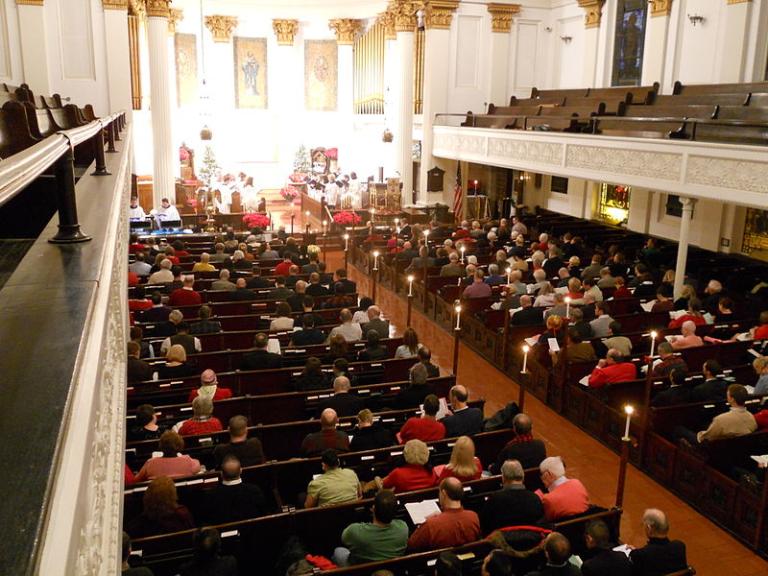
Church of St. Luke and the Epiphany, Philadelphia (public domain via Wikipedia)
Previous Post
December 28, 2023
Why was Jesus born in Bethlehem?
Next Post

February 10, 2024 Can "Small Groups" change the world? (+Trump, Biden, & Food)
Recent Comments
"Yup, Pretty sure that trans athletes are a major issue that needs to be decided ..."
In which I comment on the ..."
"Do you pray to the golden calf, too? You seem like the type."
Is there a fix for gerrymandering?
"This includes our President, who according to all accounts doesn't read unless it's 1) small ..."
Are 28% of Americans truly functionally ..."
"For the test being digital vs paper, people do tend to do better with hard-copy, ..."
Are 28% of Americans truly functionally ..."
Browse Our Archives
Select a Category Actuarial/Retirement Issues Politics Uncategorized
Select a Month September 2026 August 2026 July 2026 June 2026 April 2026 March 2026 February 2026 January 2026 December 2025 November 2025 October 2025 July 2025 June 2025 May 2025 April 2025 March 2025 February 2025 January 2025 December 2024 November 2024 October 2024 September 2024 August 2024 July 2024 June 2024 May 2024 April 2024 March 2024 February 2024 December 2023 November 2023 October 2023 September 2023 August 2023 July 2023 December 2022 September 2022 August 2022 July 2022 June 2022 May 2022 February 2022 January 2022 December 2021 August 2021 June 2021 April 2021 February 2021 January 2021 December 2020 November 2020 October 2020 September 2020 August 2020 July 2020 June 2020 May 2020 April 2020 March 2020 February 2020 January 2020 December 2019 November 2019 October 2019 September 2019 August 2019 July 2019 June 2019 May 2019 April 2019 March 2019 February 2019 January 2019 December 2018 November 2018 October 2018 September 2018 August 2018 July 2018 June 2018 May 2018 April 2018 March 2018 February 2018 January 2018 December 2017 November 2017 October 2017 September 2017 August 2017 July 2017 June 2017 May 2017 April 2017 March 2017 February 2017 January 2017 December 2016 November 2016 October 2016 September 2016 August 2016 July 2016 June 2016 May 2016 April 2016 March 2016 February 2016 January 2016 December 2015 November 2015 October 2015 September 2015 August 2015 July 2015 June 2015 May 2015 April 2015 March 2015 February 2015 January 2015 December 2014 November 2014 October 2014 September 2014 August 2014 July 2014 June 2014 May 2014 April 2014 March 2014 February 2014 January 2014 December 2013 November 2013 October 2013 September 2013 August 2013 July 2013
Follow Us!
TAKE THE
Religious Wisdom Quiz
James compares faith without works to what?
Select your answer to see how you score.
A tree without fruit A body without spirit (dead) A house without foundation A lamp without oil
Related posts from Jane the Actuary
Is Cardinal Cupich a "prayer-denialist"?
Happy Elizabeth Ann Seton Day! (with discussion questions)

Would you invite a neighbor to church?

"Use words if necessary" is a cop-out
TRENDING AT PATHEOS Catholic

Emotion in Early Christianity by Andrew Crislip
Andrew Crislip’s Emotion in Early Christianity examines an often overlooked dimension of...

16 Spiritual Touchstones for a More Grounded Life
After decades of spiritual study, here are 16 principles I try...

Catholic Evangelization: Sharing Your Faith Every Day
Welcome back to the Graceful Awakening mini-series called, “From Faith to Mission.” ...

The Pillar of the Boatmen: the Ancient Monument...
The Pillar of the Boatmen is a Romano-Gaulish sculpture that dates from...

In one sense walking into Westminster Abbey is like walking down the...

'Super Scam Me' Exposes AI Jon Bon Jovi...
Leslie Pickett believed she was in a relationship with Jon Bon Jovi....
view all Catholic blogs
What Are Your Thoughts?leave a comment
Ad-Free & Subscriber Log-In Subscription Support
- About Us
- 2026 Calendar
- Videos
- Podcasts
- Library of World Religions
- Faith In Media Tracker
- Advertise With Us
- Write for Us
- Privacy Policy
- Terms of Service
- Do Not Sell My Data
- Contact Us
- Radiant Digital
- Manage Newsletter Subscriptions
- Unsubscribe From Notifications
- Sitemap
Copyright 2008-2026, Patheos. All rights reserved.
Subscription Support Ad-Free & Subscriber Log-In
Follow Patheos