
BuddhistCatholicContemplativeEvangelicalGeneral ChristianHinduJewishLatter-day SaintMuslimNew VisionsProgressive Christian
Beliefs
- Buddhist
- Catholic
- Contemplative
- Evangelical
- General Christian
- Hindu
- Jewish
- Latter-day Saint
- More Voices
- Muslim
- New Visions
- Pagan
- Progressive Christian
Topics
- Religion News
- Food and Religion
- Sports and Religion
- Religious Art
- Religious Music and Entertainment
- Religious Events
- History and Religion
- Style and Religion
- Politics and Religion
- Women in Religion
- Recreation Outdoors and Religion
- Business Finance and Religion
- Careers Workplace and Religion
- Education and Religion
- Family Parenting and Religion
- Health Fitness and Religion
- Home and Religion
- Relationships and Religion
- Technology and Religion
- Travel and Religion
Columnists
- Buddhist Columnists
- Business Finance and Religion Columnists
- Careers Workplace and Religion Columnists
- Catholic Columnists
- Contemplative Columnists
- Education and Religion Columnists
- Evangelists Columnists
- Family Parenting and Religion Columnists
- General Christian Columnists
- Health Fitness and Religion Columnists
- Hindu Columnists
- History and Religion Columnists
- Home and Religion Columnists
- Jewish Columnists
- More Voices Columnists
- Latter Day Columnists
- Muslim Columnists
- New Visions Columnists
- Nonreligious Columnists
- Pagan Columnists
- Politics and Religion Columnists
- Progressive Columnists
- Recreation Outdoors and Religion Columnists
- Relationships and Religion Columnists
- Religion News Columnists
- Religious Art Columnists
- Religious Events Columnists
- Religious Music and Entertainment Columnists
- Sports and Religion Columnists
- Style and Religion Columnists
- Technology and Religion Columnists
- Travel and Religion Columnists
- Women in Religion Columnists
Resource Library
- 2026 Calendar
- Library of World Religions
- The 100 Most Holy Places on Earth
- Patheos Answers
- Podcasts
- Videos
- Faith Leaders Database
- Anglican Episcopalian
- Bahai
- Baptist
- Buddhism
- Christianity
- Confucianism
- Eastern Orthodoxy
- Hinduism
- Holiness and Pentecostal
- ISKCON
- Islam
- Judaism
- Lutheran
- Methodist
- The Church of Jesus Christ of Latter-day Saints
- New Age
- Paganism
- Presbytarian and Reformed
- Protestantism
- Religion Behind the Scenes
- Roman Catholic
- Scientology
- Shia Islam
- Sikhism
- Sufism
- Sunni Islam
- Taoism
- Zen
- See all religions
Research Tools
 Ad-Free & Subscriber Log-In Subscription Support
Ad-Free & Subscriber Log-In Subscription Support
Follow Patheos 

- Trending:
- Forgiveness
- |
- Marriage
- |
- Consciousness
- |
- Death Penalty
- |
- Election
- |
- Halloween

- Home
- Catholic
- Politics and Religion
- What happens to the rest of us, when kids fail to learn?
What happens to the rest of us, when kids fail to learn?
Last updated on: August 26, 2023 at 8:39 pm by Jane the Actuary
What happens to the rest of us, when kids fail to learn? 2023-08-26T20:39:05-06:00 Jane the Actuary
Patheos Explore the world's faith through different perspectives on religion and spirituality! Patheos has the views of the prevalent religions and spiritualities of the world.
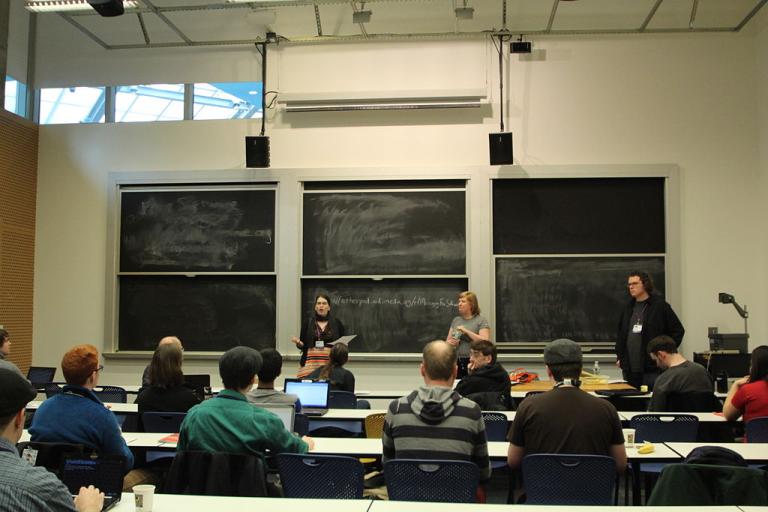
“LibrePlanet 2014 27” by Lionel Allorge – Own work. Licensed under CC BY-SA 3.0 via Wikimedia Commons – http://commons.wikimedia.org/wiki/File:LibrePlanet_2014_27.jpg#mediaviewer/File:LibrePlanet_2014_27.jpg
Here’s a collection of recent reports on students and young adults in schools and the workforce:
“‘How Do I Do That?’ The New Hires of 2023 Are Unprepared for Work,” August 2, in the Wall Street Journal. This is paywalled, though I read it through my local library’s website and you can probably do the same, though you can read also excerpts at The Federalist. It’s a litany of complaints of ways things are going wrong not just in schools but amount young adults entering the workforce, both young professionals passing qualifying exams (for engineering, nursing, etc.) at lower rates than pre-Covid, and young adults working at less-skilled jobs just not having the basic working skills like making change or even serving customers rather than scrolling through social media.
“Millions of kids are missing weeks of school as attendance tanks across the US,” AP, August 11. Even though we are almost at a new school year, this is an analysis of data for the 2021 – 2022 school year, reporting that, nationwide, more than 25% of students were chronically absent, that is, missing 10% or more of school days, compared to only 15% before the pandemic (2018 – 2019). The article provides data by state: Alaska had been worst before the pandemic, at 29%, and increased to 49% (heavily concentrated among Native students), Michigan went from 20% to 39% and Illinois, from 18% to 30%. Among states with comparatively low rates before the pandemic, there were significant disparities in their post-pandemic rates: California increased from 12% to 30%, Texas from 11% to 26%, and, on the other end, New Jersey and Alabama were low before, at 11%, and were the lowest post-pandemic, at 18% each. The very high absenteeism rates are explained, in part, because, “Educators and experts say some parents and students have been conditioned to stay home at the slightest sign of sickness,” in addition to some students’ medical issues (e.g., a student staying home because he needed a school nurse present and the school had staffing shortages), but the bottom line primary reason is simpler:
School relationships have frayed, and after months at home, many parents and students don’t see the point of regular attendance.
“For almost two years, we told families that school can look different and that schoolwork could be accomplished in times outside of the traditional 8-to-3 day. Families got used to that,” said Elmer Roldan, of Communities in Schools of Los Angeles, which helps schools follow up with absent students.
“A Fundamental Miscalculation; California’s new math framework ignores decades of scientific research about how children learn,” at City Journal.
This is a report on the new math curriculum in California, a framework that is poised to do for math education what “whole language” and “sight words” did for reading: focusing on “inquiry” and “discovery” without the explicit instruction and core computational skills that underpin the rest even though
A vast body of empirical research has consistently shown that more structured methods—with clear objectives, clear explanations, clear corrections, and lots of practice—achieve superior results.
And in the same way as “whole language” reading instruction looked at the highly skilled leaders, saw that they did not get explicity phonoics instruction, and thought this could apply to everyone, the advocates of this curriculum are looking at the most talented students, seeing that they are highly inquisitive, and thinking that the basics that these students have already mastered, don’t need to be taught.
It’s a mistake to rush students ahead to application before they’ve mastered the basics. We still accept this basic rule of thumb in other realms such as music and sports. No one would send a novice straight off a ski jump and call it a success. By downplaying the need to learn the basics, California will prevent students from ever attaining mastery.
So I’ll be honest: as the mother of three teen/young adult boys, there is a degree to which I look at these reports and feel some assurance that my kids will have a competitive advantage here: just by the fact that we push them to stay on task, do their homework/put in a good day’s work at work, etc., they will be ahead of their peers, so it’s a win for them, right? The youngest will be applying to colleges and for scholarships, the middle one will be job hunting in two years, and the oldest will be looking to advance in his career. And, well, they are/will be young adults who will be dating and, one hopes, marrying, at some point in the future, and from all reports, the dating scene is a mess in this day and age, with it increasingly difficult for young people to meet others “in person” and online dating tending to have a very low success rate at actually resulting in quality relationships. Plus, young women are increasingly more likely than young men to attend college, and yet continue to expect to marry a man who is better educated than she is. So, again being very cynical, if the low quality of the dating pool, from a woman’s perspective, means my children are less likely to be rejected by potential dates, that’s a win, right?
Of course, all snark aside, I’m increasingly seeing references to what’s being called the “competency crisis,” a constellation of concerns that, even though, generally speaking, there may be a disproportionate number of people with college credentials relative to the number of jobs which really require the skills of a college degree, we do not now have, or will not have in the future, enough Americans who are competent at the key skills needed to keep our society functioning. A recent article at Palladium tied this to an excessive focus on “diversity hires” but gave a number of examples:
The FAA added a “Biographical Questionnaire” to its hiring process in 2014, explicitly to recruit racial/ethnic minority candidates who otherwise weren’t making it through the Air Traffic Selection and Training exam, a rigorous exam taken by would-be air traffic controllers; whether by coincidence or as a result, there have been increasing numbers of “near misses.” (The author states that the FAA has now backed away from this but it’s not clear if they are back to purely merit-based hiring.)
The author ties a push for diversity in the US military to an increasing number of serious incidents related to crew training and skill, or lack thereof.
The failure of the power grid in Texas in February of 2021, the author attributes to competency failures:
The modern U.S. is a system of systems interacting together in intricate ways. All these complex systems are simply assumed to work. In February of 2021, cold weather in Texas caused shutdowns at unwinterized natural gas power plants. The failure rippled through the systems with interlocking dependencies. As a result, 246 people died. In straightforward work, declining competency means that things happen more slowly, and products are lower quality or more expensive. In complex systems, declining competency results in catastrophic failures.
And had this article been published more recently, the author would surely have mentioned the multiple failures resulting in the as-yet-untallied loss of life in Maui, from the failure to warn residents with emergency sirens and the barricaded road out of town, the 5 hour delay in releasing water for firefighting, and the electric company’s failure to implement its 2019 wildfire prevention plan.
So how much of a risk do we face of experiencing serious harms, as a society and as individuals, because we don’t have enough competent individuals in management, in our hospitals, building our buildings, and so on?
Previous Post

July 17, 2023
What's A Pro-Life Illinoisan To do?
Next Post

August 26, 2023 News from the world of English Language Learning
Recent Comments
"Yup, Pretty sure that trans athletes are a major issue that needs to be decided ..."
In which I comment on the ..."
"Do you pray to the golden calf, too? You seem like the type."
Is there a fix for gerrymandering?
"This includes our President, who according to all accounts doesn't read unless it's 1) small ..."
Are 28% of Americans truly functionally ..."
"For the test being digital vs paper, people do tend to do better with hard-copy, ..."
Are 28% of Americans truly functionally ..."
Browse Our Archives
Select a Category Actuarial/Retirement Issues Politics Uncategorized
Select a Month September 2026 August 2026 July 2026 June 2026 April 2026 March 2026 February 2026 January 2026 December 2025 November 2025 October 2025 July 2025 June 2025 May 2025 April 2025 March 2025 February 2025 January 2025 December 2024 November 2024 October 2024 September 2024 August 2024 July 2024 June 2024 May 2024 April 2024 March 2024 February 2024 December 2023 November 2023 October 2023 September 2023 August 2023 July 2023 December 2022 September 2022 August 2022 July 2022 June 2022 May 2022 February 2022 January 2022 December 2021 August 2021 June 2021 April 2021 February 2021 January 2021 December 2020 November 2020 October 2020 September 2020 August 2020 July 2020 June 2020 May 2020 April 2020 March 2020 February 2020 January 2020 December 2019 November 2019 October 2019 September 2019 August 2019 July 2019 June 2019 May 2019 April 2019 March 2019 February 2019 January 2019 December 2018 November 2018 October 2018 September 2018 August 2018 July 2018 June 2018 May 2018 April 2018 March 2018 February 2018 January 2018 December 2017 November 2017 October 2017 September 2017 August 2017 July 2017 June 2017 May 2017 April 2017 March 2017 February 2017 January 2017 December 2016 November 2016 October 2016 September 2016 August 2016 July 2016 June 2016 May 2016 April 2016 March 2016 February 2016 January 2016 December 2015 November 2015 October 2015 September 2015 August 2015 July 2015 June 2015 May 2015 April 2015 March 2015 February 2015 January 2015 December 2014 November 2014 October 2014 September 2014 August 2014 July 2014 June 2014 May 2014 April 2014 March 2014 February 2014 January 2014 December 2013 November 2013 October 2013 September 2013 August 2013 July 2013
Follow Us!
TAKE THE
Religious Wisdom Quiz
True or False: Ecclesiastes teaches that there is a time for everything under heaven.
Select your answer to see how you score.
TRUE FALSE
Related posts from Jane the Actuary
Are 28% of Americans truly functionally illiterate?

In which, apparently, the country has completely lost...
Will The Pandemic School Closures Cause An Education...
TRENDING AT PATHEOS Catholic

Emotion in Early Christianity by Andrew Crislip
Andrew Crislip’s Emotion in Early Christianity examines an often overlooked dimension of...

16 Spiritual Touchstones for a More Grounded Life
After decades of spiritual study, here are 16 principles I try...

Catholic Evangelization: Sharing Your Faith Every Day
Welcome back to the Graceful Awakening mini-series called, “From Faith to Mission.” ...

The Pillar of the Boatmen: the Ancient Monument...
The Pillar of the Boatmen is a Romano-Gaulish sculpture that dates from...

In one sense walking into Westminster Abbey is like walking down the...

'Super Scam Me' Exposes AI Jon Bon Jovi...
Leslie Pickett believed she was in a relationship with Jon Bon Jovi....
view all Catholic blogs
What Are Your Thoughts?leave a comment
Ad-Free & Subscriber Log-In Subscription Support
- About Us
- 2026 Calendar
- Videos
- Podcasts
- Library of World Religions
- Faith In Media Tracker
- Advertise With Us
- Write for Us
- Privacy Policy
- Terms of Service
- Do Not Sell My Data
- Contact Us
- Radiant Digital
- Manage Newsletter Subscriptions
- Unsubscribe From Notifications
- Sitemap
Copyright 2008-2026, Patheos. All rights reserved.
Subscription Support Ad-Free & Subscriber Log-In
Follow Patheos