
BuddhistCatholicContemplativeEvangelicalGeneral ChristianHinduJewishLatter-day SaintMuslimNew VisionsProgressive Christian
Beliefs
- Buddhist
- Catholic
- Contemplative
- Evangelical
- General Christian
- Hindu
- Jewish
- Latter-day Saint
- More Voices
- Muslim
- New Visions
- Pagan
- Progressive Christian
Topics
- Religion News
- Food and Religion
- Sports and Religion
- Religious Art
- Religious Music and Entertainment
- Religious Events
- History and Religion
- Style and Religion
- Politics and Religion
- Women in Religion
- Recreation Outdoors and Religion
- Business Finance and Religion
- Careers Workplace and Religion
- Education and Religion
- Family Parenting and Religion
- Health Fitness and Religion
- Home and Religion
- Relationships and Religion
- Technology and Religion
- Travel and Religion
Columnists
- Buddhist Columnists
- Business Finance and Religion Columnists
- Careers Workplace and Religion Columnists
- Catholic Columnists
- Contemplative Columnists
- Education and Religion Columnists
- Evangelists Columnists
- Family Parenting and Religion Columnists
- General Christian Columnists
- Health Fitness and Religion Columnists
- Hindu Columnists
- History and Religion Columnists
- Home and Religion Columnists
- Jewish Columnists
- More Voices Columnists
- Latter Day Columnists
- Muslim Columnists
- New Visions Columnists
- Nonreligious Columnists
- Pagan Columnists
- Politics and Religion Columnists
- Progressive Columnists
- Recreation Outdoors and Religion Columnists
- Relationships and Religion Columnists
- Religion News Columnists
- Religious Art Columnists
- Religious Events Columnists
- Religious Music and Entertainment Columnists
- Sports and Religion Columnists
- Style and Religion Columnists
- Technology and Religion Columnists
- Travel and Religion Columnists
- Women in Religion Columnists
Resource Library
- 2026 Calendar
- Library of World Religions
- The 100 Most Holy Places on Earth
- Patheos Answers
- Podcasts
- Videos
- Faith Leaders Database
- Anglican Episcopalian
- Bahai
- Baptist
- Buddhism
- Christianity
- Confucianism
- Eastern Orthodoxy
- Hinduism
- Holiness and Pentecostal
- ISKCON
- Islam
- Judaism
- Lutheran
- Methodist
- The Church of Jesus Christ of Latter-day Saints
- New Age
- Paganism
- Presbytarian and Reformed
- Protestantism
- Religion Behind the Scenes
- Roman Catholic
- Scientology
- Shia Islam
- Sikhism
- Sufism
- Sunni Islam
- Taoism
- Zen
- See all religions
Research Tools
 Ad-Free & Subscriber Log-In Subscription Support
Ad-Free & Subscriber Log-In Subscription Support
Follow Patheos 

- Trending:
- Forgiveness
- |
- Marriage
- |
- Consciousness
- |
- Death Penalty
- |
- Election
- |
- Halloween

- Home
- Catholic
- Politics and Religion
- Trans Kids and Data Analysis: Understanding the “Gender Affirming Care is Lifesaving” Claim
Trans Kids and Data Analysis: Understanding the “Gender Affirming Care is Lifesaving” Claim
Last updated on: July 8, 2023 at 10:47 pm by Jane the Actuary
Trans Kids and Data Analysis: Understanding the “Gender Affirming Care is Lifesaving” Claim 2023-07-08T22:47:23-06:00 Jane the Actuary
Patheos Explore the world's faith through different perspectives on religion and spirituality! Patheos has the views of the prevalent religions and spiritualities of the world.

Yes, I’m going there: it’s time to address the “transkid” issue — hopefully with an angle that will provide a different perspective on a debate where, at least here in Illinois, so-called “gender affirming care” is now the law of the land, justified by the refrain that it is “lifesaving” — because, after all,
“Would you rather have a dead daughter or a living son?”
is the question that’s been posed to parents of girls who begin identifying as transgender, as a means of pressuring them to support administration of cross-sex hormones and even surgery to acquire male sex characteristics/eliminate female ones, because, it’s asserted, without these interventions, those girls (or boys) would be at such a high risk of suicide that the avoidance of suicide trumps all other considerations.
But consider this:
In 2007, health researcher and New America Foundation senior fellow Shannon Brownlee published Overtreated: Why Too Much Medicine is Making Us Sicker and Poorer. Its (seeming lack of) effect on the health care debate (at least in the general public) since then might be illustrated by the fact that, in order to reread the book, I had to request it from Interlibrary Loan, because only two copies existed in my local library’s partner library system, the original copy owned by my library having been de-accessed sometime between then and now. Or perhaps my local library simply has a faulty de-accession policy – which is admittedly another story.
In any event, what particularly stuck with me since first reading the book was Brownlee’s description of the debacle of “high-dose chemotherapy with autologous bone marrow transplant” as a treatment for breast cancer. This treatment was developed in the 1980s based on a similar treatment for leukemia: in order maximize the effectiveness of chemotherapy for breast cancer, a patient’s bone marrow was harvested, then the patient was given chemotherapy dosages so high as to destroy the bone marrow, the previously-harvested bone marrow was re-transfused, and finally the patient was kept in isolation until the bone marrow regrew (unless chemo side effects or infections killed them first). The chemo shrunk tumors in cases that otherwise seemed hopeless, and 18-month survival rates were impressive. Then, in the 1990s, a series of lawsuits against insurance companies, including a 1993 lawsuit with $89 million in damages, “threw open the legal floodgates”; mandated insurance coverage of a highly-profitable procedure meant ever-growing numbers of women undergoing this treatment and ever-growing numbers of doctors and hospitals churning women through their process.
Yet there was no evidence that this was an effective procedure. Instead, the data that was being cited as “proof” was a comparison of success rates compared to conventional treatments, but it was not a randomized trial with a control group. Without selecting the control group randomly, results of a study are not valid; for example, women undertaking the bone marrow transplant treatment might be in overall better health than others, because they would be more likely to be judged able to survive it. And it took until the end of that decade, in 1999, for results from those clinical trials to be made available – results which revealed that, considering both risks of dying during treatment and survival afterwards, more women died after this new treatment than the alternative.
Why did the medical community adopt this treatment without evidence? Brownlee provides several pieces to an explanation. First, oncologists reasoned by analogy from leukemia treatment without recognizing the differences between this and breast cancer. Second, oncologists were not trained in statistical analysis and didn’t understand that the apparent proof they relied on was not reliable evidence at all. Third, the treatment was incredibly profitable. Fourth, the very fact that the treatment was so risky and difficult to endure added to the perception that it had to be better. And, ultimately, once it became accepted as a treatment, doctors were unwilling to participate in random trials because their conviction of the effectiveness of the transplant meant they deemed it unethical not to provide it, as would be required in a random trial.
Why does this matter?
I revisited this because of its parallels to so-called “gender-affirming care,” especially for children and teenagers, in the form of social transition, puberty blockers, cross-sex hormones, and surgeries, which such institutions as the American Academy of Pediatricians and, locally, Lurie Children’s Hospital will readily state is the standard of care for those questioning their gender or believing themselves to be of the opposite sex from their birth sex.
As with the bone marrow transplant, experts have become convinced that these treatments are the “best” care and are “lifesaving,” and as with the bone marrow transplant, there is no evidence. Studies touted as proving the effectiveness of these treatments lack control groups, follow up on patients for too-brief periods, and fail to consider the effect of other factors, such as pre-existing mental health issues. (Folks, I intended to dig up the links to the “bad studies” in order to document this, but you’ll just have to trust me as I don’t want to keep this sitting in my drafts folder.)
So, to “gender affirming care” supporters, I would like to say: please take a step back. Recognize that a desire to be on the “right side” of a culture war isn’t a good basis for supporting children making permanent changes to their bodies with lifelong consequences and serious risks, and that proper evidence is absolutely vital. Women died because doctors rushed into breast-cancer stem cell transplants without valid evidence. We should learn from that mistake rather than repeat it over and over again.
And to opponents: I read a lot of accusations that progressives’ support of child sex transitions is nefarious, rooted in pedophilia, transhumanism, Marxism, or other “isms”. But it seems to me that, for many such supporters, especially your typical suburban mom with the “Pride Progress” flag in her flower bed or Facebook profile picture, but also, likely, many of the folks touting themselves as “experts,” there’s nothing at all nefarious. It’s just that it is all too easy to become convinced of the rightness of a treatment once, for whatever reason, it has become the norm.
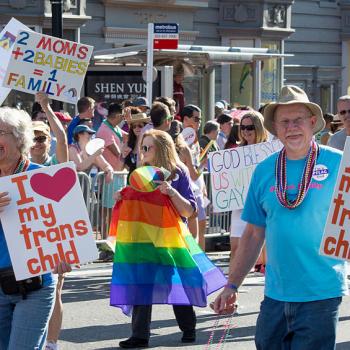
Image: https://commons.wikimedia.org/wiki/File:PFLAG_of_the_Lower_Shenandoah_07_-_DC_Capital_Pride_-_2014-06-07.jpg; Tim Evanson [CC BY-SA 2.0 (https://creativecommons.org/licenses/by-sa/2.0)], via Wikimedia Commons

Next Post

July 17, 2023 What's A Pro-Life Illinoisan To do?
Recent Comments
"Yup, Pretty sure that trans athletes are a major issue that needs to be decided ..."
In which I comment on the ..."
"Do you pray to the golden calf, too? You seem like the type."
Is there a fix for gerrymandering?
"This includes our President, who according to all accounts doesn't read unless it's 1) small ..."
Are 28% of Americans truly functionally ..."
"For the test being digital vs paper, people do tend to do better with hard-copy, ..."
Are 28% of Americans truly functionally ..."
Browse Our Archives
Select a Category Actuarial/Retirement Issues Politics Uncategorized
Select a Month September 2026 August 2026 July 2026 June 2026 April 2026 March 2026 February 2026 January 2026 December 2025 November 2025 October 2025 July 2025 June 2025 May 2025 April 2025 March 2025 February 2025 January 2025 December 2024 November 2024 October 2024 September 2024 August 2024 July 2024 June 2024 May 2024 April 2024 March 2024 February 2024 December 2023 November 2023 October 2023 September 2023 August 2023 July 2023 December 2022 September 2022 August 2022 July 2022 June 2022 May 2022 February 2022 January 2022 December 2021 August 2021 June 2021 April 2021 February 2021 January 2021 December 2020 November 2020 October 2020 September 2020 August 2020 July 2020 June 2020 May 2020 April 2020 March 2020 February 2020 January 2020 December 2019 November 2019 October 2019 September 2019 August 2019 July 2019 June 2019 May 2019 April 2019 March 2019 February 2019 January 2019 December 2018 November 2018 October 2018 September 2018 August 2018 July 2018 June 2018 May 2018 April 2018 March 2018 February 2018 January 2018 December 2017 November 2017 October 2017 September 2017 August 2017 July 2017 June 2017 May 2017 April 2017 March 2017 February 2017 January 2017 December 2016 November 2016 October 2016 September 2016 August 2016 July 2016 June 2016 May 2016 April 2016 March 2016 February 2016 January 2016 December 2015 November 2015 October 2015 September 2015 August 2015 July 2015 June 2015 May 2015 April 2015 March 2015 February 2015 January 2015 December 2014 November 2014 October 2014 September 2014 August 2014 July 2014 June 2014 May 2014 April 2014 March 2014 February 2014 January 2014 December 2013 November 2013 October 2013 September 2013 August 2013 July 2013
Follow Us!
TAKE THE
Religious Wisdom Quiz
What did Jesus wear on His head during the crucifixion?
Select your answer to see how you score.
A helmet A cloth Nothing A crown of thorns
Related posts from Jane the Actuary
The end of "boys who wear dresses"?
Yes, you should object to saying "they"
Why the Equality Act is actually much worse...
"Jury refuses to protect 7 year old from...
TRENDING AT PATHEOS Catholic

In one sense walking into Westminster Abbey is like walking down the...

'Super Scam Me' Exposes AI Jon Bon Jovi...
Leslie Pickett believed she was in a relationship with Jon Bon Jovi....

The Brazilian Remake of Kendricks' 'Flywheel' Opens in...
“Flywheel,” the story that launched the Kendrick Brothers’ filmmaking career is getting...

The Dangers of Gradual Accommodation (Winking at Sin)
Recently, the “law of gradualness” resurfaced during the opening of a weeklong,...

The Iron Gates and the Lion of the...
Yesterday, I didn't finish my report about, well, yesterday. So I'll...

The Image: On the Horror of Capitalism and...
The Image Then went the Pharisees, and took counsel how they might...
view all Catholic blogs
What Are Your Thoughts?leave a comment
Ad-Free & Subscriber Log-In Subscription Support
- About Us
- 2026 Calendar
- Videos
- Podcasts
- Library of World Religions
- Faith In Media Tracker
- Advertise With Us
- Write for Us
- Privacy Policy
- Terms of Service
- Do Not Sell My Data
- Contact Us
- Radiant Digital
- Manage Newsletter Subscriptions
- Unsubscribe From Notifications
- Sitemap
Copyright 2008-2026, Patheos. All rights reserved.
Subscription Support Ad-Free & Subscriber Log-In
Follow Patheos