
BuddhistCatholicContemplativeEvangelicalGeneral ChristianHinduJewishLatter-day SaintMuslimNew VisionsProgressive Christian
Beliefs
- Buddhist
- Catholic
- Contemplative
- Evangelical
- General Christian
- Hindu
- Jewish
- Latter-day Saint
- More Voices
- Muslim
- New Visions
- Pagan
- Progressive Christian
Topics
- Religion News
- Food and Religion
- Sports and Religion
- Religious Art
- Religious Music and Entertainment
- Religious Events
- History and Religion
- Style and Religion
- Politics and Religion
- Women in Religion
- Recreation Outdoors and Religion
- Business Finance and Religion
- Careers Workplace and Religion
- Education and Religion
- Family Parenting and Religion
- Health Fitness and Religion
- Home and Religion
- Relationships and Religion
- Technology and Religion
- Travel and Religion
Columnists
- Buddhist Columnists
- Business Finance and Religion Columnists
- Careers Workplace and Religion Columnists
- Catholic Columnists
- Contemplative Columnists
- Education and Religion Columnists
- Evangelists Columnists
- Family Parenting and Religion Columnists
- General Christian Columnists
- Health Fitness and Religion Columnists
- Hindu Columnists
- History and Religion Columnists
- Home and Religion Columnists
- Jewish Columnists
- More Voices Columnists
- Latter Day Columnists
- Muslim Columnists
- New Visions Columnists
- Nonreligious Columnists
- Pagan Columnists
- Politics and Religion Columnists
- Progressive Columnists
- Recreation Outdoors and Religion Columnists
- Relationships and Religion Columnists
- Religion News Columnists
- Religious Art Columnists
- Religious Events Columnists
- Religious Music and Entertainment Columnists
- Sports and Religion Columnists
- Style and Religion Columnists
- Technology and Religion Columnists
- Travel and Religion Columnists
- Women in Religion Columnists
Resource Library
- 2026 Calendar
- Library of World Religions
- The 100 Most Holy Places on Earth
- Patheos Answers
- Podcasts
- Videos
- Faith Leaders Database
- Anglican Episcopalian
- Bahai
- Baptist
- Buddhism
- Christianity
- Confucianism
- Eastern Orthodoxy
- Hinduism
- Holiness and Pentecostal
- ISKCON
- Islam
- Judaism
- Lutheran
- Methodist
- The Church of Jesus Christ of Latter-day Saints
- New Age
- Paganism
- Presbytarian and Reformed
- Protestantism
- Religion Behind the Scenes
- Roman Catholic
- Scientology
- Shia Islam
- Sikhism
- Sufism
- Sunni Islam
- Taoism
- Zen
- See all religions
Research Tools
 Ad-Free & Subscriber Log-In Subscription Support
Ad-Free & Subscriber Log-In Subscription Support
Follow Patheos 

- Trending:
- Forgiveness
- |
- Marriage
- |
- Consciousness
- |
- Death Penalty
- |
- Election
- |
- Halloween

- Home
- Catholic
- Politics and Religion
- It’s 1975 again. Was it avoidable?
It’s 1975 again. Was it avoidable?
Last updated on: September 11, 2021 at 2:32 pm by Jane the Actuary
It’s 1975 again. Was it avoidable? 2021-09-11T14:32:48-06:00 Jane the Actuary
Patheos Explore the world's faith through different perspectives on religion and spirituality! Patheos has the views of the prevalent religions and spiritualities of the world.
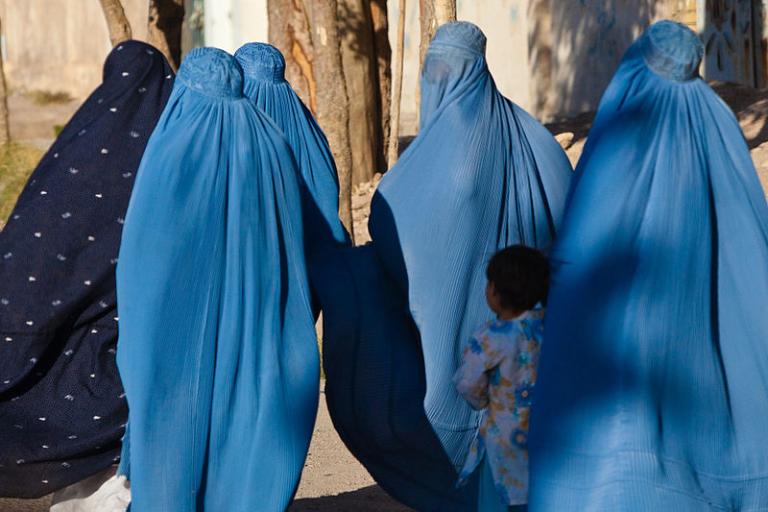
https://commons.wikimedia.org/wiki/File%3AWomen_in_burqa_with_their_children_in_Herat%2C_Afghanistan.jpg; By Arnesen (Woman and Children) [CC BY-SA 2.0 (http://creativecommons.org/licenses/by-sa/2.0)], via Wikimedia Commons
Hey, everyone — I wrote the following on that first weekend when the collapse of Kabul was underway. I may or may not write up some reflections on September 11th itself, but in the meantime, I’ll click publish on this piece.
I’ve been following the reports on Afghanistan: the collapse of the Afghan army as the Taliban gains more and more territory (and more and more American military equipment), the desperate attempts of the American government to evacuate American personnel and Afghan employees and dependents before Kabul itself falls, the apparent surprise of the Biden administration as to how quickly the country is falling, their calls for the Taliban to “be nice” to give the Americans enough time to leave, with a feeble threat that their international recognition is at stake, etc.
I wonder what a 1975 twitter would have looked like, whether it was simply taken as a given that South Vietnam would fall, with the more leftist elements of the US considering that to be a positive development, or whether the politicians of the time insisted that the South Vietnamese government would be able to hold off Ho Chi Minh even without US manpower or materiel, or even that the North Vietnamese government would peacefully stay within their borders.
And, honestly, in 2001, nearly 20 years ago, I believed — and, yes, I’ll say I believed this alongside nearly all Americans — that Afghanis, men and women both, were just waiting for liberation from the Taliban and would thereupon, with the necessary rebuilding assistance, adapt to Western ways. It sound insane to my ears now, but, as someone just today on twitter pointed out, we were all seeing pictures — if not on twitter, then in the news — of pre-Soviet-Invasion Kabul, with fashionable young women around town, no different than similar photos of pre-Revolution Iran.
Here’s one example:
https://twitter.com/EricRWeinstein/status/1426592799441383435
Yet another twitter account today shared the missing context to these images: they were of the elite, who had adopted Western ways. Even in Kabul, most women wore burqas.
This individual goes on to say: “Most of these upper class, affluent people migrated out of Afghanistan from 1980s onwards because they could afford to leave a war torn country. You will find most of them settled down in western nations today where they have become even more westernized.”
In the meantime, two books shaped my perspective on Afghanistan.
The first I blogged about way back in 2015: In the Land of Blue Burqas, by Kate McCord. This was a memoir by a Christian woman who went to the country to do humanitarian work. She learned the local language and interacted directly with village women, and one passage that served as a radical undoing of my expectations was her description of a conversation with her (female) language tutor, as she wanted to share with them the message of “God loves you.” Mind you, she was not trying to convert them to Christianity in any way, but share this simple message of hope and encouragement — and her tutor said, “God is not love; God is kind.” This expression was, she says, a common one, but does not mean what Americans would think it might, an expression that God is a generous bestower of good gifts. She doesn’t cite precisely what this means to Afghans, but from the contexts she gives, it’s the equivalent of “the Lord giveth and the Lord taketh away; blessed be the name of the Lord.” And she relates further anecdotes in which the experience people have of God is that of a harsh taskmaster who measures deeds and punishes those who don’t measure up, those who haven’t fasted properly, for example.
Now, is it true, in general, that Muslims believe that God is in his essence a being who judges and punishes, rather than a being who loves and cares? I suspect that Westernized Muslims believe in “God is love”; that is, that it’s more of a cultural difference than one of religion. But it makes it clear that the cultural norms of the people of Afghanistan are radically different than those of Americans.
Second, The WEIRDest People in the World, by Joseph Henrich. I blogged about this over at Forbes, tying it in to retirement, of course, but the fundamental premise of the book is that the West (that is, Christian Europe, most specifically Western Christianity, and its descendants in Anglo-America) diverged from the rest of the world in terms of its culture and psychology in the Middle Ages when Popes and Councils decreed that one may not marry cousins, then widened the definition of a “cousin” to include second, third, even sixth cousins, and, although that prohibition was relaxed over time, it caused a chain of events, as Europeans relied on their communities rather than building up family “dynasties”: guilds, universities, elected town mayors, other community groups, and more all developed, as well as a psychology that is still with us today, in which we believe that one ought to do what’s right in an absolute sense, rather than what benefits one’s tribe or family, for example.
And it was reading this book, about a year ago, that crystallized my thoughts on Afghanistan — that it was foolish of us to have believed that the Afghan people would have acted as we would have wanted them to, in every respect from the corruption in our nation-building efforts to the apparent indifference of the Afghan army to fighting the Taliban, to their willingness to fight for the well-being of their daughters.
In fact, a year and a half ago, in March of 2020, I wrote that “I fully expect that we will at some point be helicoptering people out in a replay of 1975 Vietnam,” but I didn’t have any confidence as to why, listing “cultural differences” as only one possible explanation, and considered other explanations, including an unwillingness to fight against other Afghanis, or that those who might have been fighting had fled for Europe, or that there was simply a dearth of men who were both willing to and capable of fighting.
Lastly, some miscellaneous links:
Biden, during the campaign in 2020, stating that the US had no particular obligation to ensure the well-being of Afghanis just because we had been occupiers, and that the only consideration for any such intervention should be American national interest. (We’ll see if that holds up the next time there’s an outrage somewhere else.)
On July 8th, “And the likelihood there’s going to be one unified government in Afghanistan controlling the whole country is highly unlikely. . . . The Taliban is not the south — the North Vietnamese army. They’re not — they’re not remotely comparable in terms of capability. There’s going to be no circumstance where you see people being lifted off the roof of a embassy in the — of the United States from Afghanistan. It is not at all comparable. . . . The likelihood there’s going to be the Taliban overrunning everything and owning the whole country is highly unlikely.”
Slate, August 11th: “When the Taliban’s assaults first began in late June, U.S. intelligence analysts worried that the Taliban might take over in six to 12 months; now they’re saying it could happen in 90 days. That estimate too may prove overly optimistic.”
Today, CNN: “A diplomatic source told CNN that one intelligence assessment indicated that Kabul could be isolated by the Taliban within the week, possibly within the next 72 hours.”
On twitter:
https://twitter.com/MrMaitra/status/1425994490834268164
Also:
https://twitter.com/billroggio/status/1425955000262479873
More commentary here:
No one I talked to in Kabul believes the Americans can be so incompetent. They think it is all deliberation and dissimulation. Can you blame them? Incompetence at this level has indeed never been witnessed
— Bruno Maçães (@MacaesBruno) August 14, 2021
So what’s it all add up to?
That we are leaving is inevitable.
That we are doing so in a catastrophic way, is not. Whether this is due to pure organizational incompetence or to a fundamental delusion on the part of the Biden administration that the Taliban would “play by the rules,” would want to “be a part of the international community,” etc., so they had plenty of time, is not so clear to me.
Previous Post

August 11, 2021
Doing the COVID math

Browse Our Archives
Select a Category Actuarial/Retirement Issues Politics Uncategorized
Select a Month September 2026 August 2026 July 2026 June 2026 April 2026 March 2026 February 2026 January 2026 December 2025 November 2025 October 2025 July 2025 June 2025 May 2025 April 2025 March 2025 February 2025 January 2025 December 2024 November 2024 October 2024 September 2024 August 2024 July 2024 June 2024 May 2024 April 2024 March 2024 February 2024 December 2023 November 2023 October 2023 September 2023 August 2023 July 2023 December 2022 September 2022 August 2022 July 2022 June 2022 May 2022 February 2022 January 2022 December 2021 August 2021 June 2021 April 2021 February 2021 January 2021 December 2020 November 2020 October 2020 September 2020 August 2020 July 2020 June 2020 May 2020 April 2020 March 2020 February 2020 January 2020 December 2019 November 2019 October 2019 September 2019 August 2019 July 2019 June 2019 May 2019 April 2019 March 2019 February 2019 January 2019 December 2018 November 2018 October 2018 September 2018 August 2018 July 2018 June 2018 May 2018 April 2018 March 2018 February 2018 January 2018 December 2017 November 2017 October 2017 September 2017 August 2017 July 2017 June 2017 May 2017 April 2017 March 2017 February 2017 January 2017 December 2016 November 2016 October 2016 September 2016 August 2016 July 2016 June 2016 May 2016 April 2016 March 2016 February 2016 January 2016 December 2015 November 2015 October 2015 September 2015 August 2015 July 2015 June 2015 May 2015 April 2015 March 2015 February 2015 January 2015 December 2014 November 2014 October 2014 September 2014 August 2014 July 2014 June 2014 May 2014 April 2014 March 2014 February 2014 January 2014 December 2013 November 2013 October 2013 September 2013 August 2013 July 2013
Follow Us!
TAKE THE
Religious Wisdom Quiz
What was the name of the sea Jesus walked on?
Select your answer to see how you score.
Red Sea Caspian Sea Dead Sea Sea of Galilee
Related posts from Jane the Actuary
Afghanistan, Vietnam, and the limits of power


Illinois’ Assisted Suicide Law is, yes, literally deadly

Revising the "Disability [Pride] Flag"
TRENDING AT PATHEOS Catholic

The First Eucharistic Controversy: Christ’s Real Presence
For Catholics, the Eucharist is the source and summit of the Christian...

How to Make a Decision When You Can't...
Main point: It’s much more valuable to stay close to God so...

Archdiocese Hosts Military Marriage Retreat in Germany
RASTATT, Germany — The transient military lifestyle, with its frequent deployments and...

Nearly every morning, I make the drive to Detroit with my high-school-age...

The Real AI Story Is Adoption Without Trust
Artificial intelligence has crossed a political threshold. It is no longer a...

A new article, written by Jeff Lindsay and Gale L. Pooley,...
view all Catholic blogs
Ad-Free & Subscriber Log-In Subscription Support
- About Us
- 2026 Calendar
- Videos
- Podcasts
- Library of World Religions
- Faith In Media Tracker
- Advertise With Us
- Write for Us
- Privacy Policy
- Terms of Service
- Do Not Sell My Data
- Contact Us
- Radiant Digital
- Manage Newsletter Subscriptions
- Unsubscribe From Notifications
- Sitemap
Copyright 2008-2026, Patheos. All rights reserved.
Subscription Support Ad-Free & Subscriber Log-In
Follow Patheos