
BuddhistCatholicContemplativeEvangelicalGeneral ChristianHinduJewishLatter-day SaintMuslimNew VisionsProgressive Christian
Beliefs
- Buddhist
- Catholic
- Contemplative
- Evangelical
- General Christian
- Hindu
- Jewish
- Latter-day Saint
- More Voices
- Muslim
- New Visions
- Pagan
- Progressive Christian
Topics
- Religion News
- Food and Religion
- Sports and Religion
- Religious Art
- Religious Music and Entertainment
- Religious Events
- History and Religion
- Style and Religion
- Politics and Religion
- Women in Religion
- Recreation Outdoors and Religion
- Business Finance and Religion
- Careers Workplace and Religion
- Education and Religion
- Family Parenting and Religion
- Health Fitness and Religion
- Home and Religion
- Relationships and Religion
- Technology and Religion
- Travel and Religion
Columnists
- Buddhist Columnists
- Business Finance and Religion Columnists
- Careers Workplace and Religion Columnists
- Catholic Columnists
- Contemplative Columnists
- Education and Religion Columnists
- Evangelists Columnists
- Family Parenting and Religion Columnists
- General Christian Columnists
- Health Fitness and Religion Columnists
- Hindu Columnists
- History and Religion Columnists
- Home and Religion Columnists
- Jewish Columnists
- More Voices Columnists
- Latter Day Columnists
- Muslim Columnists
- New Visions Columnists
- Nonreligious Columnists
- Pagan Columnists
- Politics and Religion Columnists
- Progressive Columnists
- Recreation Outdoors and Religion Columnists
- Relationships and Religion Columnists
- Religion News Columnists
- Religious Art Columnists
- Religious Events Columnists
- Religious Music and Entertainment Columnists
- Sports and Religion Columnists
- Style and Religion Columnists
- Technology and Religion Columnists
- Travel and Religion Columnists
- Women in Religion Columnists
Resource Library
- 2026 Calendar
- Library of World Religions
- The 100 Most Holy Places on Earth
- Patheos Answers
- Podcasts
- Videos
- Faith Leaders Database
- Anglican Episcopalian
- Bahai
- Baptist
- Buddhism
- Christianity
- Confucianism
- Eastern Orthodoxy
- Hinduism
- Holiness and Pentecostal
- ISKCON
- Islam
- Judaism
- Lutheran
- Methodist
- The Church of Jesus Christ of Latter-day Saints
- New Age
- Paganism
- Presbytarian and Reformed
- Protestantism
- Religion Behind the Scenes
- Roman Catholic
- Scientology
- Shia Islam
- Sikhism
- Sufism
- Sunni Islam
- Taoism
- Zen
- See all religions
Research Tools
 Ad-Free & Subscriber Log-In Subscription Support
Ad-Free & Subscriber Log-In Subscription Support
Follow Patheos 

- Trending:
- Forgiveness
- |
- Marriage
- |
- Consciousness
- |
- Death Penalty
- |
- Election
- |
- Halloween

- Home
- Catholic
- Politics and Religion
- What does Juneteenth mean?
What does Juneteenth mean?
Last updated on: June 21, 2021 at 7:31 am by Jane the Actuary
What does Juneteenth mean? 2021-06-21T07:31:33-06:00 Jane the Actuary
Patheos Explore the world's faith through different perspectives on religion and spirituality! Patheos has the views of the prevalent religions and spiritualities of the world.
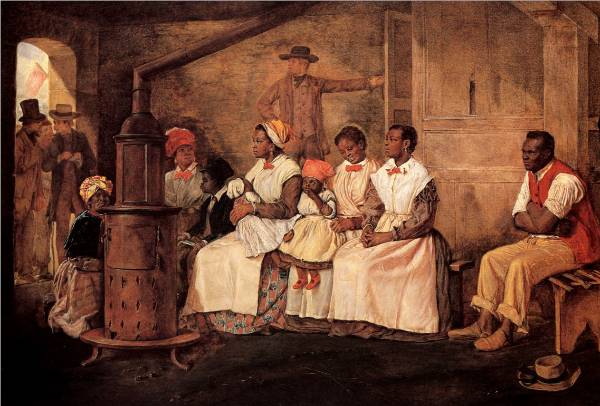
https://commons.wikimedia.org/wiki/File:Crowe-Slaves_Waiting_for_Sale_-_Richmond,_Virginia.jpg; Eyre Crowe [Public domain]
Yeah, this is another one of my little blog posts in which I write based on memory rather than pulling up links, but here’s the question: what is Juneteenth about?
Yes, the date commemorates the arrival of the Union Army in Texas proclaiming the liberation of the slaves, on June 19, 1865, some two months after the surrender of Lee and the end of the Civil War, and some two years after the Emancipation Proclamation.
And I’ve been reading a number of takes on the significance of that date, that we should interpret the selection of this date, highlighting the unwillingness of Texas slaveowners to liberate their slaves when Lee surrendered, or when the Emancipation Proclamation was issued, as an indicator that Juneteenth is, or should be, about the failures of the United States to dismantle racism, the ongoing discrimination of Jim Crow and redlining long after slavery ended, and the racial disparities that still exist today. It should be a day of contemplation, a day, in particular, for white people to pledge to Do Better and commit to actively opposing racism and supporting reparations.
But that misses the point.
There was no single date which is the “right” date when “the slaves were freed.” Abraham Lincoln signed the Emancipation Proclamation, announcing that slaves were freed in all rebellious states, at a point at which the Union Army had no means of enforcing the order. It was a part of military strategy. In reality, slaves were freed in the wake of the Union Army’s occupation; it was necessary for the military to announce the liberation of slaves in Texas because they were not already occupied. And at the end of the Civil War, there were four states in which slavery remained, because these states had not taken up arms against the United States, and the Emancipation Proclamation specifically addressed only the rebellious states. Only with the passage of the Thirteenth Amendment in December were all slaves finally freed.
And, looked at another way, this is a part of a longer history. At the beginning of our nation’s history, slavery was not limited to south of the Mason-Dixon line; New York, Pennsylvania, Massachusetts, etc., permitted slavery, or, rather, did not ban it. Abolitionism was a gradual process, as the northern states banned slavery in the early nineteenth century, in some cases with phase-outs of various sorts rather than simply immediate liberation, as young slaves became indentured servants instead. Do we consider this as evidence that the United States as a whole was immoral and tainted, or do we see and value instead the gradual recognition that slavery was wrong, as a meaningful transformation, especially in light of the fact that slavery was not itself an invention of the United States but has existed for millennia?
And, likewise, the time between the American Revolution and the Civil War was not a stand-still in terms of the federal government and slavery, let alone a matter of the federal government supporting and maintaining the institution of slavery. The Kansas-Nebraska Act, the Compromise of 1850 (or whenever it was), and, well, again, I’m admittedly not looking this up right now, but the Fugitive Slave Act was not passed because of some unanimous support by Americans, North and South, for slavery. The Civil War did not come out of nowhere, but was a build-up of tensions.
So, what, then, was the significance of this date? Communities in Texas had, for generations, maintained a tradition of celebration on this date. The reason why people now lament the apparent injustice that “Juneteenth isn’t being taught in schools”? Memories are short. The date is of no special historical significance, but just one piece of an overall story of The End of Slavery in America, and it was, really, only a few years ago that this celebration became widely known outside those homegrown celebrations. And there is something very appealing about Juneteenth as a community celebration passed on through generations — but that means that we simply can’t build some hidden meaning to the date of the celebration.
Slavery has existed since the dawn of time, or, rather, since the beginning of civilization, of agriculture, of cities. It has existed in every continent, in China, Africa, pre-Columbian America. In some times and places, slave status was passed on from parent to child; in others, manumission was possible and slaves were granted a considerable degree of free movement and economic independence in the meantime (even to the point of a slave owning another slave); in yet others, status of children of slaves was irrelevant as slaves were sent to the mines or galleys until they died. In some circumstances, the lot of slaves was an improvement over what their ancestors would have faced, as conquering armies in the past might otherwise simply have slaughtered the conquered. In other times and places, slaves were captured by slave traders in raids for that express purpose — after all, the word “slave” came from Slav, as Slavs taken captive by Vikings for Arab and Byzantine slaveowners were a primary source of slaves in the early Middle Ages. But, yes, American slavery was distinctive for the development that Africans/individuals of African ancestry became considered “naturally” slaves unless proven otherwise, but does that make it worse or more immoral than slavery in, for example, the Ottoman Empire? (And, yes, this existed up until the early 20th century, and, no, I don’t trust the very rosy account told by Wikipedia authors).
And what about the manner in which American slaves of the South were emancipated? Yes, one might wish that, as in England, they were liberated sooner (in 1833, there), and by means of a unanimous vote, rather than it requiring a brutal war with all its suffering. Was this because Americans were uniquely racist? Or was this due to the particular degree of economic and political power of slaveowners, which itself was due to the climate and historical patterns of settlement of slave states?
So do we look at Juneteenth — as one of many possible dates for the emancipation of American slaves — as a date to mourn the fact that slavery existed, or as a date to celebrate that, however much delayed, slavery finally ended? My preference is the latter — while retaining Martin Luther King Jr. Day as a day for acknowledging the continuing economic disparities experienced by American descendants of slaves.
Previous Post

April 10, 2021
Remembering my father
Next Post

June 25, 2021 Now on Twitter: Second-Guessing Reconstruction
Browse Our Archives
Select a Category Actuarial/Retirement Issues Politics Uncategorized
Select a Month September 2026 August 2026 July 2026 June 2026 April 2026 March 2026 February 2026 January 2026 December 2025 November 2025 October 2025 July 2025 June 2025 May 2025 April 2025 March 2025 February 2025 January 2025 December 2024 November 2024 October 2024 September 2024 August 2024 July 2024 June 2024 May 2024 April 2024 March 2024 February 2024 December 2023 November 2023 October 2023 September 2023 August 2023 July 2023 December 2022 September 2022 August 2022 July 2022 June 2022 May 2022 February 2022 January 2022 December 2021 August 2021 June 2021 April 2021 February 2021 January 2021 December 2020 November 2020 October 2020 September 2020 August 2020 July 2020 June 2020 May 2020 April 2020 March 2020 February 2020 January 2020 December 2019 November 2019 October 2019 September 2019 August 2019 July 2019 June 2019 May 2019 April 2019 March 2019 February 2019 January 2019 December 2018 November 2018 October 2018 September 2018 August 2018 July 2018 June 2018 May 2018 April 2018 March 2018 February 2018 January 2018 December 2017 November 2017 October 2017 September 2017 August 2017 July 2017 June 2017 May 2017 April 2017 March 2017 February 2017 January 2017 December 2016 November 2016 October 2016 September 2016 August 2016 July 2016 June 2016 May 2016 April 2016 March 2016 February 2016 January 2016 December 2015 November 2015 October 2015 September 2015 August 2015 July 2015 June 2015 May 2015 April 2015 March 2015 February 2015 January 2015 December 2014 November 2014 October 2014 September 2014 August 2014 July 2014 June 2014 May 2014 April 2014 March 2014 February 2014 January 2014 December 2013 November 2013 October 2013 September 2013 August 2013 July 2013
Follow Us!
TAKE THE
Religious Wisdom Quiz
How many times does Jesus perform a miracle in the Gospel of John?
Select your answer to see how you score.
7 10 5 12
Related posts from Jane the Actuary


Illinois’ Assisted Suicide Law is, yes, literally deadly

Revising the "Disability [Pride] Flag"
TRENDING AT PATHEOS Catholic

When Halloween Unmasks Married Hearts
Written by Dr. David K. Ewen from Eternal Truth Bible College Behind...

Aristotle. He’s been called the father of logic, the father of the...

Methodist Central Hall and Westminster Abbey
Situated on the same square is Methodist Central Hall and Westminster Abbey. ...

57th Dove Awards Honor Dolly Parton, Crown New...
On gospel music’s biggest night, the 57th annual GMA Dove Awards honored...

The First Eucharistic Controversy: Christ’s Real Presence
For Catholics, the Eucharist is the source and summit of the Christian...

What a Stop Sign Can Teach Us About...
How to Make a Decision When You Can't Hear God Main point:...
view all Catholic blogs
Ad-Free & Subscriber Log-In Subscription Support
- About Us
- 2026 Calendar
- Videos
- Podcasts
- Library of World Religions
- Faith In Media Tracker
- Advertise With Us
- Write for Us
- Privacy Policy
- Terms of Service
- Do Not Sell My Data
- Contact Us
- Radiant Digital
- Manage Newsletter Subscriptions
- Unsubscribe From Notifications
- Sitemap
Copyright 2008-2026, Patheos. All rights reserved.
Subscription Support Ad-Free & Subscriber Log-In
Follow Patheos