
BuddhistCatholicContemplativeEvangelicalGeneral ChristianHinduJewishLatter-day SaintMuslimNew VisionsProgressive Christian
Beliefs
- Buddhist
- Catholic
- Contemplative
- Evangelical
- General Christian
- Hindu
- Jewish
- Latter-day Saint
- More Voices
- Muslim
- New Visions
- Pagan
- Progressive Christian
Topics
- Religion News
- Food and Religion
- Sports and Religion
- Religious Art
- Religious Music and Entertainment
- Religious Events
- History and Religion
- Style and Religion
- Politics and Religion
- Women in Religion
- Recreation Outdoors and Religion
- Business Finance and Religion
- Careers Workplace and Religion
- Education and Religion
- Family Parenting and Religion
- Health Fitness and Religion
- Home and Religion
- Relationships and Religion
- Technology and Religion
- Travel and Religion
Columnists
- Buddhist Columnists
- Business Finance and Religion Columnists
- Careers Workplace and Religion Columnists
- Catholic Columnists
- Contemplative Columnists
- Education and Religion Columnists
- Evangelists Columnists
- Family Parenting and Religion Columnists
- General Christian Columnists
- Health Fitness and Religion Columnists
- Hindu Columnists
- History and Religion Columnists
- Home and Religion Columnists
- Jewish Columnists
- More Voices Columnists
- Latter Day Columnists
- Muslim Columnists
- New Visions Columnists
- Nonreligious Columnists
- Pagan Columnists
- Politics and Religion Columnists
- Progressive Columnists
- Recreation Outdoors and Religion Columnists
- Relationships and Religion Columnists
- Religion News Columnists
- Religious Art Columnists
- Religious Events Columnists
- Religious Music and Entertainment Columnists
- Sports and Religion Columnists
- Style and Religion Columnists
- Technology and Religion Columnists
- Travel and Religion Columnists
- Women in Religion Columnists
Resource Library
- 2026 Calendar
- Library of World Religions
- The 100 Most Holy Places on Earth
- Patheos Answers
- Podcasts
- Videos
- Faith Leaders Database
- Anglican Episcopalian
- Bahai
- Baptist
- Buddhism
- Christianity
- Confucianism
- Eastern Orthodoxy
- Hinduism
- Holiness and Pentecostal
- ISKCON
- Islam
- Judaism
- Lutheran
- Methodist
- The Church of Jesus Christ of Latter-day Saints
- New Age
- Paganism
- Presbytarian and Reformed
- Protestantism
- Religion Behind the Scenes
- Roman Catholic
- Scientology
- Shia Islam
- Sikhism
- Sufism
- Sunni Islam
- Taoism
- Zen
- See all religions
Research Tools
 Ad-Free & Subscriber Log-In Subscription Support
Ad-Free & Subscriber Log-In Subscription Support
Follow Patheos 

- Trending:
- Forgiveness
- |
- Marriage
- |
- Consciousness
- |
- Death Penalty
- |
- Election
- |
- Halloween

- Home
- Catholic
- Politics and Religion
- Now on Twitter: Second-Guessing Reconstruction
Now on Twitter: Second-Guessing Reconstruction
Last updated on: June 25, 2021 at 8:55 am by Jane the Actuary
Now on Twitter: Second-Guessing Reconstruction 2021-06-25T08:55:51-06:00 Jane the Actuary
Patheos Explore the world's faith through different perspectives on religion and spirituality! Patheos has the views of the prevalent religions and spiritualities of the world.
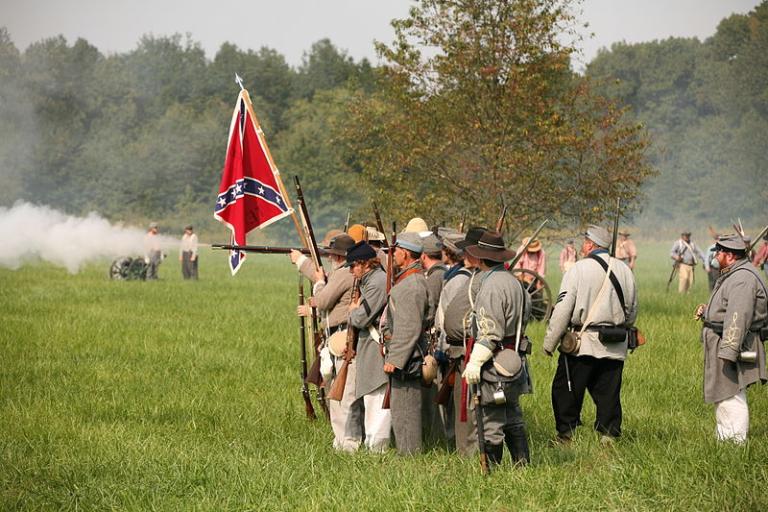
https://commons.wikimedia.org/wiki/File%3ACivil_war_reenactment_1.jpg; By Daniel Schwen (Own work) [CC BY-SA 4.0 (http://creativecommons.org/licenses/by-sa/4.0)], via Wikimedia Commons
Let’s start with a one-paragraph review of the Reconstruction Era, shall we?
In the period immediately following the end of the Civil War and Lincoln’s assassination, former Vice President Andrew Johnson favored leniency toward the rebellious states, but the Radical Republican faction gained control over Congress in 1866 and pushed for civil rights, protections, and social-welfare efforts for the freed slaves, overriding Johnson’s vetoes. In 1868, President Ulysses S. Grant replaced Johnson and continued the Radical Republicans’ policies, including combatting the KKK, essentially wiping them out by 1872. What’s more, in the immediate aftermath of the war, the South was in a state of martial law/military occupation, and, to varying degrees, former Confederate soldiers were barred from voting until the 1872 Amnesty Act. However, political support faded, white paramilitary groups gained power, and by 1877, as part of a bargain to place Republican Rutherford Hayes into office, Union army troops were withdrawn from the last three states where they had continued as an occupying force, setting the stage for Jim Crow laws, the loss of the right to vote by Southern blacks, the Tulsa Massacre, Woodrow Wilson’s re-segregation of the U.S. government, and so on. (Yes, that’s from Wikipedia.)
Of course “40 acres and a mule” is now a part of the ongoing claims for reparations — that is, the claim that the freedmen were promised this during Reconstruction, but that this promise was broken, so the government has a responsibility to pay its debt. And there’s a sense that somehow the federal government did something wrong that, had it not made this mistake, the former slaves would have had their happily-ever-after after all, and the continued racism experienced since then wouldn’t have happened.
Yet at the same time, Reconstruction, to some degree or another, lasted for 15 years. We are now going on 20 years of military presence in Afghanistan. And, indeed, for many years, when Democrats (and anti-interventionists, generally speaking) called for us to leave the country, I believed we needed to stay, needed to try harder to get the “nation-building” right, because I was horrified at the prospect of leaving the country and abandoning women and girls to the fate they had suffered under the Taliban before the arrival of the U.S.: banned from education, banned from leaving home, forced to wear a burqa. And indeed, as the Taliban resume control, they are kicking girls out of school once again. It’s terrible. But there also comes a point at which we have to admit that the American military cannot perpetually fight this battle, cannot indefinitely rationalize that we just didn’t get it right in the past. Could the military leadership have done a better job with its nation-building efforts? Could they have prevented corruption, convinced the people that becoming a “civilized” country with education, economic development, and democratic governance is worth fighting for, rather than just being passively provided goodies by the rich West, if only Americans had tried harder and been smarter about it? Or is the culture and mindset of Afghans so radically different that our way of seeing the world never made sense to them and had no real chance of taking hold? Especially after reading Joseph Henrich’s The Weirdest People in the World, I became convinced that the latter is more likely, however much it feels that that this is no more than abandoning women and girls to a terrible fate. (And yes, I am dodging the question of where to draw the line, and what more extreme level of injustice warrants staying in the fight as long as it takes, in perpetuity if need me.)
You can see where I’m going with this: without engaging in the exercise of condemning Northern politicians and voters for their decisions in the aftermath of the Civil War and their unwillingness to stay the course in pursuit of justice and economic assistance for the freedmen, is there a path toward understanding what went wrong, and whether the actual outcome of reconstruction was a matter of decisions and events that might have gone the other way (Lincoln not shot, one more Senator being willing to impeach Johnson, etc.), or whether it simply is not a Thing That Can Happen for outsiders to effect this sort of change.
All that being said, you might wonder why I’m thinking about this now and that gets me to a twitter back-and-forth, or, rather, a series of responses to my tweet, itself a reply to another tweet, about Reconstruction:
The Post-Reconstruction South reminds me to some extent of the (presumed) future of Afghanistan when the U.S. military completely pulls out. Should the Union army have stayed indefinitely?
— Jane the Actuary (@JanetheActuary) June 23, 2021
Now, Tim Carney, a columnist at the Washington Examiner, has some 60,000 followers, so my reply got some further replies from his followers, such as these insights and proposals:
They should have continued the military or "policing" action to uphold federal law and protect democracy. Instead it was left to the same states that had recently shredded the US Constitution to oppress a people group and maintain their free labor force.
— Geoffrey Baron (@geoffbaron) June 23, 2021
“Continued”? For how long should they have continued the military occupation?
Plus:
https://twitter.com/rycarson/status/1407814699912089606
And:
https://twitter.com/Gin_on_rocks/status/1407813945277222913
As well as:
Continued military occupation, and the execution of anyone who took up arms against the United States of America. A proper bloody purge of traitors.
— Infinite Sadness (@FiltertronTele) June 23, 2021
Though, in all fairness, someone whose biography reads, “High School Teacher of History and Psychology. Ph.D. in European History,” quite sensibly points out that
This is one of those questions where changes over a century (greater African-American organization, shifting attitudes on race, changes in the Democratic Party, discrediting of eugenics, the Cold War) explain why it could do something in the
— Ron Bialkowski (@Zrbialk) June 24, 2021
dramatically that he went along with the Brownsville affair and later refused to seat integrated Southern delegations at the Bull Moose convention for the 1912 Presidential race.
— Ron Bialkowski (@Zrbialk) June 24, 2021
So where does that leave us?
In the first place: the advocacy of mass executions. Yikes. Yes, these are just a couple random people on the internet, but I’m not pleased to know that anyone thinks massacres of defeated armies is a sound and appropriate action. I suppose that would make Game of Throne’s final season explicable, but, still, yikes.
In the second place, well, I am not a fan of counterfactual history, but there is, again, probably some value in identifying whether there were junctures at which “accidents of history” determined what happened, so that there was a possibility of another outcome, rather than the past simply being the past, with the Radical Republicans having no better prospects for creating long-term change in a culture, rather than its evolving organically, than American “nation-builders” in Afghanistan. Again: directly expropriating land from plantation-owners to give to former slaves sounds like an easy fix. The former slaves wouldn’t have been forced to become sharecroppers, the plantation-owners would have lost their power. One might say that it “should have” happened, and, indeed, history is replete with land expropriations, but whether there was a realistic path towards it actually having happened is another matter.
It is foolish to set forth these expectations of how people in the past “should have” behaved, rather than simply seeking to understand how they understood their world and following that long chain of cause and effect. It is equally a challenge to look at what’s happening in places across the world where we see injustice — girls deprived of education in rural Afghanistan, honor killings in the Middle East, or, yes, abortion as the normative response to unexpected pregnancies in many parts of the world — and struggle with a response that’s not just outsiders coming in and saying, “don’t do that!”
Previous Post
June 21, 2021
What does Juneteenth mean?
Next Post

August 11, 2021 Doing the COVID math
Browse Our Archives
Select a Category Actuarial/Retirement Issues Politics Uncategorized
Select a Month September 2026 August 2026 July 2026 June 2026 April 2026 March 2026 February 2026 January 2026 December 2025 November 2025 October 2025 July 2025 June 2025 May 2025 April 2025 March 2025 February 2025 January 2025 December 2024 November 2024 October 2024 September 2024 August 2024 July 2024 June 2024 May 2024 April 2024 March 2024 February 2024 December 2023 November 2023 October 2023 September 2023 August 2023 July 2023 December 2022 September 2022 August 2022 July 2022 June 2022 May 2022 February 2022 January 2022 December 2021 August 2021 June 2021 April 2021 February 2021 January 2021 December 2020 November 2020 October 2020 September 2020 August 2020 July 2020 June 2020 May 2020 April 2020 March 2020 February 2020 January 2020 December 2019 November 2019 October 2019 September 2019 August 2019 July 2019 June 2019 May 2019 April 2019 March 2019 February 2019 January 2019 December 2018 November 2018 October 2018 September 2018 August 2018 July 2018 June 2018 May 2018 April 2018 March 2018 February 2018 January 2018 December 2017 November 2017 October 2017 September 2017 August 2017 July 2017 June 2017 May 2017 April 2017 March 2017 February 2017 January 2017 December 2016 November 2016 October 2016 September 2016 August 2016 July 2016 June 2016 May 2016 April 2016 March 2016 February 2016 January 2016 December 2015 November 2015 October 2015 September 2015 August 2015 July 2015 June 2015 May 2015 April 2015 March 2015 February 2015 January 2015 December 2014 November 2014 October 2014 September 2014 August 2014 July 2014 June 2014 May 2014 April 2014 March 2014 February 2014 January 2014 December 2013 November 2013 October 2013 September 2013 August 2013 July 2013
Follow Us!
TAKE THE
Religious Wisdom Quiz
How many times does the Bible mention the word "love"?
Select your answer to see how you score.
Over 300 700 100 500
Related posts from Jane the Actuary

Hold the mocking on the Civil War ....


Illinois’ Assisted Suicide Law is, yes, literally deadly
TRENDING AT PATHEOS Catholic

A new article, written by Jeff Lindsay and Gale L. Pooley,...

Swimfan: Forgotten Aughts Pleasures
This is a recovery effort. In 2002, My Big Fat Greek Wedding...

Top Three Anti-Catholic Lies About Catholicism
This is my initial transcript for the video, "THE 3 WORST...

Pope Leo Celebrates Mass for Nurses & Docs...
I don't have any idea how he did it, but Pope Leo...

The Sermon on the Mount, Part I: Matthew...
The Sermon on the Mount, Part I (Matthew 4:12-5:12) St. Matthew moves...

What's up from Crossway: Reviewing some of their latest A few weeks...
view all Catholic blogs
Ad-Free & Subscriber Log-In Subscription Support
- About Us
- 2026 Calendar
- Videos
- Podcasts
- Library of World Religions
- Faith In Media Tracker
- Advertise With Us
- Write for Us
- Privacy Policy
- Terms of Service
- Do Not Sell My Data
- Contact Us
- Radiant Digital
- Manage Newsletter Subscriptions
- Unsubscribe From Notifications
- Sitemap
Copyright 2008-2026, Patheos. All rights reserved.
Subscription Support Ad-Free & Subscriber Log-In
Follow Patheos