
BuddhistCatholicContemplativeEvangelicalGeneral ChristianHinduJewishLatter-day SaintMuslimNew VisionsProgressive Christian
Beliefs
- Buddhist
- Catholic
- Contemplative
- Evangelical
- General Christian
- Hindu
- Jewish
- Latter-day Saint
- More Voices
- Muslim
- New Visions
- Pagan
- Progressive Christian
Topics
- Religion News
- Food and Religion
- Sports and Religion
- Religious Art
- Religious Music and Entertainment
- Religious Events
- History and Religion
- Style and Religion
- Politics and Religion
- Women in Religion
- Recreation Outdoors and Religion
- Business Finance and Religion
- Careers Workplace and Religion
- Education and Religion
- Family Parenting and Religion
- Health Fitness and Religion
- Home and Religion
- Relationships and Religion
- Technology and Religion
- Travel and Religion
Columnists
- Buddhist Columnists
- Business Finance and Religion Columnists
- Careers Workplace and Religion Columnists
- Catholic Columnists
- Contemplative Columnists
- Education and Religion Columnists
- Evangelists Columnists
- Family Parenting and Religion Columnists
- General Christian Columnists
- Health Fitness and Religion Columnists
- Hindu Columnists
- History and Religion Columnists
- Home and Religion Columnists
- Jewish Columnists
- More Voices Columnists
- Latter Day Columnists
- Muslim Columnists
- New Visions Columnists
- Nonreligious Columnists
- Pagan Columnists
- Politics and Religion Columnists
- Progressive Columnists
- Recreation Outdoors and Religion Columnists
- Relationships and Religion Columnists
- Religion News Columnists
- Religious Art Columnists
- Religious Events Columnists
- Religious Music and Entertainment Columnists
- Sports and Religion Columnists
- Style and Religion Columnists
- Technology and Religion Columnists
- Travel and Religion Columnists
- Women in Religion Columnists
Resource Library
- 2026 Calendar
- Library of World Religions
- The 100 Most Holy Places on Earth
- Patheos Answers
- Podcasts
- Videos
- Faith Leaders Database
- Anglican Episcopalian
- Bahai
- Baptist
- Buddhism
- Christianity
- Confucianism
- Eastern Orthodoxy
- Hinduism
- Holiness and Pentecostal
- ISKCON
- Islam
- Judaism
- Lutheran
- Methodist
- The Church of Jesus Christ of Latter-day Saints
- New Age
- Paganism
- Presbytarian and Reformed
- Protestantism
- Religion Behind the Scenes
- Roman Catholic
- Scientology
- Shia Islam
- Sikhism
- Sufism
- Sunni Islam
- Taoism
- Zen
- See all religions
Research Tools
 Ad-Free & Subscriber Log-In Subscription Support
Follow Patheos 

- Trending:
- Advent
- |
- Forgiveness
- |
- Thanksgiving
- |
- Election
- |
- Seasonal Holidays
- |
- Marriage

- Home
- Catholic
- Politics and Religion
- Biden’s immigration bill will not “fix” illegal immigration
Biden’s immigration bill will not “fix” illegal immigration
Last updated on: February 23, 2021 at 11:47 am by Jane the Actuary
Biden’s immigration bill will not “fix” illegal immigration 2021-02-23T11:47:59-06:00 Jane the Actuary
Patheos Explore the world's faith through different perspectives on religion and spirituality! Patheos has the views of the prevalent religions and spiritualities of the world.
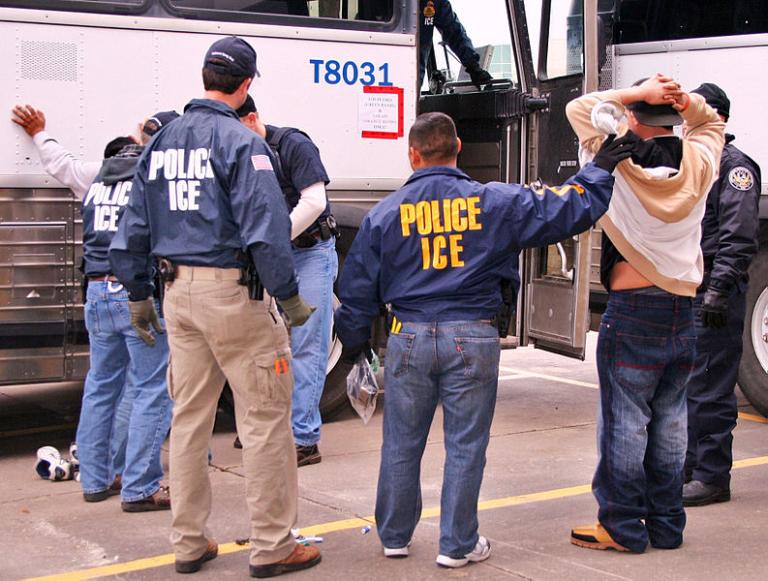
https://commons.wikimedia.org/wiki/File%3A100203houston_lg.jpg; By U.S. Immigration and Customs Enforcement (ICE), www.ice.gov. Please credit by saying “Photo Courtesy of ICE”. [Public domain], via Wikimedia Commons
Remember the George Bush immigration reform proposal in 2006, when he claimed that he would “solve” the issue of future illegal immigration by granting a new form of work visa, the “blue card”? Because, you see, people came to the US illegally because of our plentiful low-skill jobs which “Americans don’t want,” the idea was that employers would be allowed to recruit, legally, abroad, for any job at all, so long as they paid minimum wage. So there would still be a huge workforce willing to work at low wages, and drive down wages for jobs that had formerly paid better — but strictly speaking they would be legal workers, so, problem solved, eh?
Of course, this was a bit of a fantasy even then, but it’s been a long time since we’ve believed that there were endless numbers of low-wage jobs in the US going unfilled because American citizens were too prosperous to bother taking them. In fact, the situation is now quite the reverse, as activists seek to take those same jobs and make them better-paying by means of a minimum wage hike.
But it’s useful to contemplate the claims past amnesty programs have made as to how they will solve the issue of illegal immigration in the future rather than the mere one-time fix of converting today’s illegal immigrants into legal immigrants — because the new bill appears to have designed into it future illegal immigration as a permanent feature of American society. The description of the bill at CNN suggests that it’s essentially identical to the Biden proposal released earlier: amnesty for anyone who plausibly claims to have arrived before 2021 as well as Trump-administration deportees, 5 years to a green card and 3 years to naturalization afterwards (or immediate green cards and 3 years’ wait for naturalization for “Dreamers” — just in time for the 2024 election), with no meaningful enforcement mechanisms, and a claim to end the “push” factors for immigration with $4 billion in aid to Central America.
In the short term, there are issues around would-be immigrants claiming asylum, Central Americans who had been waiting under Trump’s “remain in Mexico” policy expecting to be allowed into the US in an expedited fashion. There are fears among at least some Democrats that a rush to the border will produce bad “optics” and they’ll lose their majorities in 2022.
But there’s a larger long-term issue: in establishing enforcement requirements in which only perpetrators of serious felonies would be even considered for deportation (and alongside “sanctuary city” policies which oppose even this) the bill normalizes illegal immigration. Without actions to illegal immigrants from working, it establishes/maintains the idea that illegal immigrants are simply a part of the fabric of American life, however much they may have particular hardships because they’re not authorized to work legally.
I spent, really, more time than I should have reading through the actual text of the bill, and my full summary appears below, but here are some of the key points:
The label “earned path to citizenship” continues to be used but there’s really no element of “earned-ness” in the bill. If you were present on January 1, 2021 or deported in the prior 4 years after 3 previous years of residency, you get to stay. And the list of documents that may be used to prove presence is extensive, and, if that doesn’t do the trick, a sworn affidavit is permitted as an alternative, with the feds being permitted, optionally, to restrict the use of any type of document if they discover it’s being used fraudulently, only after a proper public comment period, of course. There’s a requirement for a background check, of course, but failure commit a crime doesn’t constitute “earning” anything. I did not even see an end point at which individuals may no longer apply for residency.
The “fix Central America” provisions consist of a lot of wishful thinking; there’s an extensive list of actions that $1 billion per year for 4 years is supposed to fund, and, let’s face it, how often have Americans attempted, and failed, at this sort of nation-building? In addition, prior reports I had read suggested that the real plan was that the $4 billion would be a carrot to get each of our neighbors to the south to enforce their own southern borders so that we don’t have to, but the only “carrot” element is that half the money is contingent on the State Department certifying that these three countries have made adequate progress towards anti-corruption goals and the like.
The only provisions with respect to the border itself are ones which have to do with the smuggling of narcotics and other contraband, plus enhanced penalties for coyotes bringing in more than 10 individuals at a single time. At the same time, extensive efforts are made to reduce the risks individuals take when coming in with smaller groups — from mandates that Border Patrol agents be trained as EMT and have more first aid supplies to requirements for rescue beacons. They seem to be expecting more border-crossers, based on a requirement that they have more buses at each station to more quickly transport them elsewhere.
There will be an advisory committee with respect to E-Verify, which will have the goal — no, not of widening its use, but of advising on whether “false positives” cause harm, and, in particular, to disadvantaged people. And there will be provisions with workplace enforcement, but to offer protections to workers whose employers had violated labor laws.
Now, to be sure, the bill does not, so far as I can tell, codify the prohibition on deporting non-criminals, but there’s a lot that’s buried in references to other legislation that’s difficult to untangle. And there’s even a section that says that if a person is deportable due to having been convicted of a deportation-meriting crime, the judge can recommend that he be allowed to stay for “humanitarian” or other suitable reasons. And there are a multitude of provisions that rely on administrative interpretations: to what extent fees should be waived, for instance, or what constitutes the “public interest” in waiving a deportation, or whether or not to disqualify a certain document presented as proof of presence. Is there a fixed deadline at which individuals may no longer apply for residency? I don’t even see this. Could a future administration, at some point in the future, determine that because of the time lapse, no document can be considered authentic, and cut off claims in this way? Or would another administration let it be know that it will accept a scribble on a piece of scrap paper?
In any case, this creates a situation in which, fundamentally, we set forth (or, as far as many are concerned, reaffirm) an approach that says, “as long as you don’t mind not being eligible for welfare, you can come and work.” Of course, we’ll then repeat the cycle of sad stories of individuals continuing to work in their old age or after injuries because they don’t have Social Security for old age or disability benefits; will a new generation promote expanding eligibility or a new round of amnesties?
It’s a mess.
And, finally, here’s my look at the full text.
Word change
The word “alien” is replaced with “noncitizen.” This is trivial but it bugs me, because “alien” has a specific context, that of someone residing in a country where they are not a citizen; “noncitizen” as a coinage does not have that specific element in its meaning of residing in a host country. A person of German citizenship residing in the US is an “alien”; a person of German citizenship residing anywhere is a “noncitizen.”
Earned Path to Citizenship (Title 1)
“Lawful prospective immigrant” status granted to all eligible applicants, valid for 6 years and renewable for additional 6 year terms. The only limitations of this immigration category are that they’re not eligible for Obamacare subsidies. They’re eligible to work and will receive Social Security numbers, and can enlist in the military.
After 5 years, they are eligible for true permanent resident status, so long as they’ve paid all taxes. (Note this is generally not relevant as they’re likely to not have any tax liability and may even have refunds due to child tax credits coming their way.)
For someone who entered before age 18, and has a high school diploma or GED, and has 2 years of college or 3 years of work history, permanent resident status will be granted immediately, with streamlined procedures for DACA recipients, and with restrictions on welfare eligibility removed for this group. They will also be eligible for in-state tuition, protected from any limits on mortgage eligibility, and given other protections.
Individuals who had had Temporary Protected Status or Deferred Enforced Departure, as well as individuals who had worked in agriculture for 400 work days in the past 5 years, will also be granted immediate permanent legal residency.
Applicants will be charged fees needed to recover processing costs except that “for good cause” the feds may reduce fees or exempt individuals.
Individuals must have been present on January 1, 2021 or must have been deported after Trump took office, “for humanitarian purposes, to ensure family unity, or if such a waiver is otherwise in the public interest.”
Ineligibility grounds include a felony conviction (except for ID theft), 3 or more misdemeanors (except pot use, minor traffic offenses, etc.), but these can be waived.
There are certain other provisions which reference other legislation but appear to give benefits to “essential workers.”
“Continuous physical presence” can be proved by passport entries (e.g., visa overstayers), any DHS document noting date of entry, school records, employment records, military service records, religious records (“official records from a religious entity confirming the noncitizen’s participation in a religious ceremony”), a child’s birth certificate, hospital records, automobile registration, mortgages, rental contracts, rent receipts, utility bills (“bearing the noncitizen’s name or the name of an immediate family member of the noncitizen”), tax receipts, insurance policies, remittance records, travel records, dated bank transactions, or “sworn affidavits from at least two individuals,” or “any other evidence determined to be credible. (Yes, this is a long list, and yes, this suggests that the 1/1/2021 cutoff will not be meaningful, but the only cutoff that will count is if there is a date at which the government says, “we will no longer accept applications.”) If the Secretary determines that any such document is true fraud-prone, they are able to prohibit it.
Subtitle B – Other Reforms
Lots of references to other legislation here which makes it difficult to interpret. But there’s a provision which allows a court which has sentenced a noncitizen found guilty of a criminal offense that would be deportable, to recommend that the person not be deported, and then he won’t be. There are also further provisions allowing for more “humanitarian”/”family unity” waivers of inadmissibility.
Plus, there are some extra provisions relating to the Northern Mariana Islands and Guam.
Title 2: Addressing the Root Causes of Migration and Responsibly Managing the Southern Border
Subtitle A
There will be a 4 year Strategy to get Central America to reform, combat corruption, improve policing, etc. It’s a long list of actions, including education, workforce development, small business development, etc., and $1 billion is intended to be spent in each of four years. 50% is to be spent without condition, and 50% spent if the Secretary of State certifies that the governments of El Salvador, Guatemala, and Honduras are properly “taking effective steps” to fight corruption, implement reform, fight poverty, etc. That’s another long list of things they must certify.
Subtitle B
This has to do with the idea of outsourcing refugee processing, and trying to get other governments to “resettle refugees from Central America” — but it’s vague (which countries? why would they do so?). There will be an informational campaign to say, “don’t travel to the US” (how long will this last?). And there will be refugee processing centers in Central America, with particular attention to children of individuals already in the US, but maybe any minor in Central America.
Subtitle C
There will be a technology deployment plan for cargo, to better fight contraband/narcotics, as well as a generic “smart technology” plan to “counter transnational criminal networks.” (There appears to be nothing oriented towards reducing border-crossing of would-be immigrants.) There will be more training of border patrol agents, including medical training (EMT), with pay boosts for EMT or paramedic-certified border patrol agents, followed by mandates that 10% of agents have EMT certification, as well as other demands for medical supplies. This certainly suggests that they expect that there will be substantial numbers of border crossers in the future. They will also require more commercial driver’s license-certified agents, as well as requirements for more buses at stations to “avoid subjecting detainees to long wait times.”
There will be a “Border Community Stakeholder Advisory Committee” — to include individual landowners, tribal lands representatives, and human rights organizations.
It will mandate rescue beacons.
Subtitle D
There will be new guidelines for individuals detained by Border Patrol. There will be new penalties for smugglers of more than 10 people at a time (not counting family members), as well as narcotics smugglers.
Title 3 – Reform of the Immigrant Visa System
Boosts in the number of visas for family members and employment-based visas. Redefines “immediate relative” (for family reunification purposes) to include a child, spouse, or parent of a citizen, a child or spouse of a legal resident, and their spouses/children. Plus more edits to existing legislation that are harder to make sense of in isolation. Boosting the number of visas from any particular country. The repeal of the 3 and 10 year and permanent bans on re-entry by those previously deported. Also, if a family sponsor dies before a visa can be processed, even though the visas are nominally about unification, the family members can still enter.
New visa status for a “permanent partner,” for cases where the home country doesn’t permit marriage.
Subtitle B – nondiscrimination provisions. Not really sure what this is about, actually.
Subtitle C – boosting diversity visas from 55,000 to 80,000 annually.
Subtitle D — reforming employment-based immigration
It appears that anyone with a PhD. in a “STEM” field is automatically eligible for residency. Plus, no per-country limits on employment-based visas. DHS has the option to temporarily limit employment-based immigration during periods of high unemployment.
10,000 immigrants in a pilot program for specific regions for “economic development.” Priority for certain visas for higher-paying jobs.
Subtitle E – Promoting Immigrant and Refugee Integration
Establish a foundation for integration, citizenship prep, etc. (Note that it’s headed “integration” but really more narrowly about naturalization. Separate program for “integration” grants for improving English skills, workforce training, civics, financial literacy, etc. There’s a new waiver for English language requirements for naturalization which looks a lot like the old one but presumably eases the waiver requirements.
Title IV — Immigration Courts, Family Values, and Vulnerable Individuals
Expanding alternatives to detention, increasing immigration court judges, etc. Right to counsel: not just right to use an attorney, but the Attorney General is to provide attorneys to noncitizens in deportation proceedings, as well as to children and pregnant and lactating women.
Subtitle B Provisions on immigrant children
Subtitle C Refugees, asylum seekers, etc.
No time limits on application. Boosting numbers of U visas available from 10,000 to 30,000. Asylum seekers get work authorization. Alternatives to detention. Protections for certain Afghans, Iraqis, and Syrians.
Title V – Employment Authorization and Protecting Workers from Exploitation
Commission on Employment Authorization, with representatives from employer, labor, and civil rights communities, to make recommendations regarding eligibility-verification processes, including review of E-Verify error rates, “including the impact on various populations by national origin, race, gender and socioeconomic background.” (Sounds like putting in place a means of ending E-Verify.)
A worker who has been mistreated in the workplace is given protected status.
In enforcement actions against unlawful employment of “noncitizens” — well, it’s not clear what’s going on except that there are protections that appear to mean workers can’t actually be deported and employers are penalized for violations against labor laws, plus, regardless of their illegal status (“unauthorized noncitizen”), they are still eligible for back pay. More provisions: it will be illegal “to use an immigration status verification system, service, or method other than those described in section 274A for purposes of verifying employment eligibility.”
“Fairness for farmworkers” – prohibits mandatory overtime.
Labor law enforcement fund.
And that’s it.
Next Post

April 10, 2021 Remembering my father
Browse Our Archives
Select a Category Actuarial/Retirement Issues Politics Uncategorized
Select a Month October 2026 September 2026 August 2026 July 2026 June 2026 April 2026 March 2026 February 2026 January 2026 December 2025 November 2025 October 2025 July 2025 June 2025 May 2025 April 2025 March 2025 February 2025 January 2025 December 2024 November 2024 October 2024 September 2024 August 2024 July 2024 June 2024 May 2024 April 2024 March 2024 February 2024 December 2023 November 2023 October 2023 September 2023 August 2023 July 2023 December 2022 September 2022 August 2022 July 2022 June 2022 May 2022 February 2022 January 2022 December 2021 August 2021 June 2021 April 2021 February 2021 January 2021 December 2020 November 2020 October 2020 September 2020 August 2020 July 2020 June 2020 May 2020 April 2020 March 2020 February 2020 January 2020 December 2019 November 2019 October 2019 September 2019 August 2019 July 2019 June 2019 May 2019 April 2019 March 2019 February 2019 January 2019 December 2018 November 2018 October 2018 September 2018 August 2018 July 2018 June 2018 May 2018 April 2018 March 2018 February 2018 January 2018 December 2017 November 2017 October 2017 September 2017 August 2017 July 2017 June 2017 May 2017 April 2017 March 2017 February 2017 January 2017 December 2016 November 2016 October 2016 September 2016 August 2016 July 2016 June 2016 May 2016 April 2016 March 2016 February 2016 January 2016 December 2015 November 2015 October 2015 September 2015 August 2015 July 2015 June 2015 May 2015 April 2015 March 2015 February 2015 January 2015 December 2014 November 2014 October 2014 September 2014 August 2014 July 2014 June 2014 May 2014 April 2014 March 2014 February 2014 January 2014 December 2013 November 2013 October 2013 September 2013 August 2013 July 2013
Follow Us!
TAKE THE
Religious Wisdom Quiz
What does Proverbs 22:6 say about training a child?
Select your answer to see how you score.
Teach a child discipline, and he will live in wisdom. Children should be seen and not heard. Train up a child in the way he should go, and when he is old he will not depart from it. Guide the young, and they will not stumble.
Related posts from Jane the Actuary

The moral response to immigration enforcement: negotiation
Actually, Card. Cupich is hurting, not helping, immigrants
In which we learn that Biden isn't a...
545 separated kids? Why that's not what it...
TRENDING AT PATHEOS Catholic

"Why Do Churches Talk So Much About Money?"
If you were inclined to do so, you could probably find any...

Watch and Pray: On Mark 13:33-37
Jesus said to his disciples: “Be watchful! Be alert! You do not...

Debate on Purgatory & Biblical Evidences for It
This is from a combox on my video channel, Catholic Bible Highlights....

Set the table for the coming King
On Thursday we visited my sister-in-law for Thanksgiving, and throughout the entire...

If I Stop Becoming, Will I Disappear?
(At our most recent half day Zen retreat, Dr Chris Hoff, a...

A Modest Proposal for President Trump
Trump should just quit the loser Republicans who failed him so badly...
view all Catholic blogs
Ad-Free & Subscriber Log-In Subscription Support
- About Us
- 2026 Calendar
- Videos
- Podcasts
- Library of World Religions
- Faith In Media Tracker
- Advertise With Us
- Write for Us
- Privacy Policy
- Terms of Service
- Do Not Sell My Data
- Contact Us
- Radiant Digital
- Manage Newsletter Subscriptions
- Unsubscribe From Notifications
- Sitemap
Copyright 2008-2026, Patheos, part of the Radiant Digital network of media brands. All rights reserved.
Subscription Support Ad-Free & Subscriber Log-In
Follow Patheos