
BuddhistCatholicContemplativeEvangelicalGeneral ChristianHinduJewishLatter-day SaintMuslimNew VisionsProgressive Christian
Beliefs
- Buddhist
- Catholic
- Contemplative
- Evangelical
- General Christian
- Hindu
- Jewish
- Latter-day Saint
- More Voices
- Muslim
- New Visions
- Pagan
- Progressive Christian
Topics
- Religion News
- Food and Religion
- Sports and Religion
- Religious Art
- Religious Music and Entertainment
- Religious Events
- History and Religion
- Style and Religion
- Politics and Religion
- Women in Religion
- Recreation Outdoors and Religion
- Business Finance and Religion
- Careers Workplace and Religion
- Education and Religion
- Family Parenting and Religion
- Health Fitness and Religion
- Home and Religion
- Relationships and Religion
- Technology and Religion
- Travel and Religion
Columnists
- Buddhist Columnists
- Business Finance and Religion Columnists
- Careers Workplace and Religion Columnists
- Catholic Columnists
- Contemplative Columnists
- Education and Religion Columnists
- Evangelists Columnists
- Family Parenting and Religion Columnists
- General Christian Columnists
- Health Fitness and Religion Columnists
- Hindu Columnists
- History and Religion Columnists
- Home and Religion Columnists
- Jewish Columnists
- More Voices Columnists
- Latter Day Columnists
- Muslim Columnists
- New Visions Columnists
- Nonreligious Columnists
- Pagan Columnists
- Politics and Religion Columnists
- Progressive Columnists
- Recreation Outdoors and Religion Columnists
- Relationships and Religion Columnists
- Religion News Columnists
- Religious Art Columnists
- Religious Events Columnists
- Religious Music and Entertainment Columnists
- Sports and Religion Columnists
- Style and Religion Columnists
- Technology and Religion Columnists
- Travel and Religion Columnists
- Women in Religion Columnists
Resource Library
- 2026 Calendar
- Library of World Religions
- The 100 Most Holy Places on Earth
- Patheos Answers
- Podcasts
- Videos
- Faith Leaders Database
- Anglican Episcopalian
- Bahai
- Baptist
- Buddhism
- Christianity
- Confucianism
- Eastern Orthodoxy
- Hinduism
- Holiness and Pentecostal
- ISKCON
- Islam
- Judaism
- Lutheran
- Methodist
- The Church of Jesus Christ of Latter-day Saints
- New Age
- Paganism
- Presbytarian and Reformed
- Protestantism
- Religion Behind the Scenes
- Roman Catholic
- Scientology
- Shia Islam
- Sikhism
- Sufism
- Sunni Islam
- Taoism
- Zen
- See all religions
Research Tools
 Ad-Free & Subscriber Log-In Subscription Support
Ad-Free & Subscriber Log-In Subscription Support
Follow Patheos 

- Trending:
- Forgiveness
- |
- Marriage
- |
- Consciousness
- |
- Death Penalty
- |
- Election
- |
- Halloween

- Home
- Catholic
- Politics and Religion
- Let’s talk about ‘Dr.’ Biden
Let’s talk about ‘Dr.’ Biden
Last updated on: December 14, 2020 at 1:54 pm by Jane the Actuary
Let’s talk about ‘Dr.’ Biden 2020-12-14T13:54:04-06:00 Jane the Actuary
Patheos Explore the world's faith through different perspectives on religion and spirituality! Patheos has the views of the prevalent religions and spiritualities of the world.
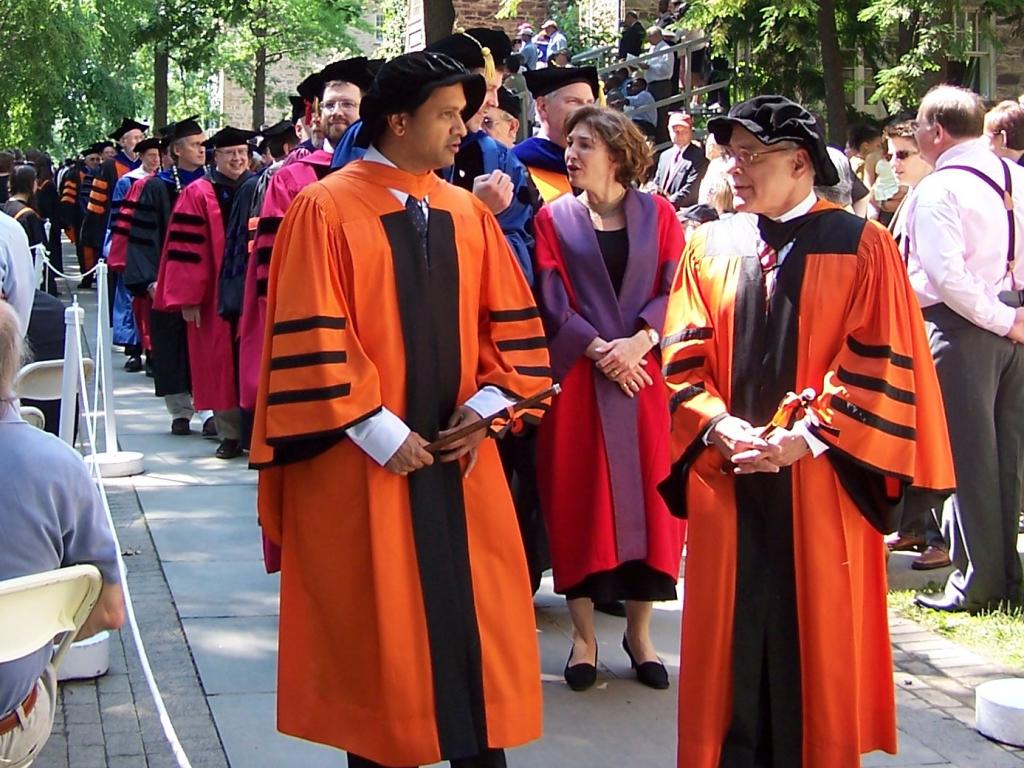
https://commons.wikimedia.org/wiki/File:Princeton_University_Commencement_Procession_2003.jpg; Charles Pence, CC BY-SA 2.0 <https://creativecommons.org/licenses/by-sa/2.0>, via Wikimedia Commons
So there was a dust-up over the weekend about a Wall Street Journal opinion piece criticizing Jill Biden and her supporters for her/their wish/demand/insistence that she be called “Dr. Jill Biden,” because of her academic degree.
Is Jill Biden a doctor?
Not in the ordinary American usage of the term.
Does she merit being addressed with the title, “Dr. Biden”?
Under some circumstances, by some people, yes.
Is that customary usage actually reasonable?
No, not really.
Let’s start from the beginning: with the Doctor of Education.
Here’s Wikipedia:
In January 2007, at age 55, she received a Doctor of Education in educational leadership from the University of Delaware. Her dissertation, Student Retention at the Community College: Meeting Students’ Needs, was published under the name Jill Jacobs-Biden.
What’s a “doctor of education”? It is not, in fact, a Ph.D. It is what’s called a “professional doctorate,” an invention, it appears, of the American education system, as a way to grant a credential more advanced than “master” without the rigorous study and the dissertation requirement of a Ph.D. And in this respect, the Wikipedia article is incorrect; Biden did not write a dissertation but what she herself, in the work itself, calls an “executive position paper.” (Here’s a link to read it.) The paper is longer than a typical college “term paper” but not at the level of a true dissertation; the individual on twitter who found a non-paywalled link to the document read it and observes that, in addition to the overall weakness of the research (consisting of surveys and interviews at one community college) there are instances of math errors and proofreading lapses. In total, the paper amounts to 136 pages, of which only 40 are research, with the remainder a review of literature, documentation of the interviews, etc.
According to the applicable Wikipedia article, the Doctor of Education was established first at Harvard in 1921 and its purpose was to give students the ability to advance in their careers in teaching, rather than prepare them for academic careers. This degree exists in only a small number of other countries outside the US, all a part of the Anglosphere; in at least some of those countries, it is made clear that the EdD is exactly as rigorous as the Ph.D.
Another indicator of the degree of rigor is this: the “doctor of education” takes far less time to complete than a Ph.D. Biden’s own program was a 3 – 4 year part-time program. For other examples, see Online EdD Programs which states this is 3 years of full-time study; USC Rossier, which considers the three year requirement to be on a part-time basis — “completed while you work”; Teach dot com, which reports a completion time of two years; and Franklin University reports a duration of 2 years full-time, or four years or more part-time.
A Ph.D., of course, can be expected to take 5 or more years.
And the “doctor of education” is not the only “professional doctorate.”
In the same manner as one can obtain an MBA, there’s an option of a DBA, a doctor of business administration. In this case, Wikipedia gives no history of the degree. But, again, the program bears little resemblance to the rigor and learning of a Ph.D. At DePaul, for instance, it’s marketed as a three-year part-time program. At Concordia University, the part-time-ness isn’t explicitly stated but appears to be assumed as students take one class at a time for 9 semesters (it appears one studies continuously without summer breaks).
Is it reasonable to expect that someone who successfully completes one of these programs be addressed by the title “Dr.”? These program’s promoters certainly believe so, and I can well believe that, within the education field, enough people have a vested interest in maintaining the belief that the Ed.D. is equivalent to the Ph.D. and a demonstration of superior scholarly achievement, that they maintain this practice in that environment. I have a hard time believing that a business executive who completed a DBA program would use that title or expect others to do so, except perhaps within the academic field.
But — for the purposes of discussion — what if Biden had earned a Ph.D.? Would it be appropriate for her to insist (or for others to insist, on her behalf) that she be accorded this title?
If this was within the context of reporting on research she had achieved, sure. If this is with respect to her role as the spouse of the president, or some particular activity within the campaign, or any activity she had independently pursued, not really. And that rule is, in fact, applied fairly consistently: no one in the media reported on Dr. Condi Rice, Dr. Newt Gingrich, Dr. Lynne Cheney, etc., and, so far as I know, none of these individuals took offense at this, nor did anyone do so on their behalf.
Would it be a different story in, say, Germany? Yes, of course. In that country, “Doktor” is a title accorded to those with a Ph.D. In contrast to the United States, where, in my own profession, actuaries who had previously earned doctorates dropped that, even in the form of the “Ph.D.” initials in their signature, when they left academia for the business world, in Germany, those who had earned doctorates are addressed as such consistently, and there were multiple such individuals among my contacts in the German office of my employer. (Well, OK, by convention, they were addressed by first names as colleagues, but they would have been addressed that way by clients.) It’s also the case in Germany that titles stack: an individual who had earned two doctorates and was now a professor would be “Professor Dr. Dr. so-and-so.” Without the professorship, it would be “Frau Dr. Dr. so-and-so.”
And here we need to talk about language and formality:
After all, in German, the word for medical doctor is different than that of “person with a Ph.D.” — the former is Arzt. In French, it’s médecin vs. docteur. In Latin, medicus vs. doctor. In English, we have, here as in many other similar cases, two such words: doctor and physician. The usage of doctor in the sense of physician dates back to 1377, according to the OED (a screen-shot shared by twitter), though the usages that they cite that are most unmistakably of this sort date only to Shakespeare; the word physician dates back further, coming from the French. According to the Online Etymological Dictionary,
The sense of “medical professional, person duly licensed to practice medicine” (replacing native leech (n.2)) grew gradually out of this from c., 1400, though this use of the word was not common until late 16c. The transitional stage is exemplified in Chaucer’s Doctor of phesike (Latin physica came to be used extensively in Medieval Latin for medicina).
That no man … practyse in Fisyk … but he be Bacheler or Doctour of Fisyk, havynge Lettres testimonyalx sufficeantz of on of those degrees of the Universite. [Rolls of Parliament, 1421]Middle English also used medicin for “a medical doctor” (mid-15c.), from French. Similar usage of the equivalent of doctor is colloquial in most European languages: Italian dottore, French docteur, German doktor, Lithuanian daktaras, though these typically are not the main word in those languages for a medical healer.
Now, why it is that in English, we didn’t hold onto the Old English word leech, isn’t clear. The answer floating around twitter is that physicians appropriated the word “doctor” for their own purposes, to emphasize their qualifications, but that doesn’t explain why this would have happened in English but not in other languages. Presumably the fact that English was busily evolving in so many ways, and so many Old English words were being supplanted, produced this outcome in English but not elsewhere. According to that site, incidentally, it is conventionally believed that “leech” to refer to the bloodsucking worm originated from “leech” as a physician, but they may simply have been homonyms.
At the same time, etymology and multilingual comparisons can explain how we got where we are, but it does not have any power to compel anything. Regardless of what other countries do, regardless of the history of the word, in the United States, the primary meaning of “doctor” is “medical professional,” and “individual with a Ph.D.” is a secondary meaning which should generally be avoided due to the possibility of confusion. And we customarily use the title “Dr.” to refer to medical practitioners to show respect and deference for their expertise in the field of medicine, not to honor them for the extensiveness of study and expertise in any field, in the same manner as we use the honorific of “Rev.” for those who have been ordained by their religious communities, not as a marker of extensive academic study and attainment.
But what about academia and misogyny?
It is true that women within academia have objected regularly of being treated in a manner that’s inconsistent with their male colleagues. They voice complaints (for example, on twitter), that students are more likely to address them as Professor so-and-so while they address male faculty as “Dr. so-and-so.” They view this as a sign of disrespect.
Are they coming to Biden’s defense because they are responding to this sense of mistreatment in academia? Presumably that is part of their motivation. And I have no means of assessing whether they are correct in this behavior on the part of students. I don’t actually recall addressing any of my professors by the title of “Dr.” in either college or grad school, but, then again, let’s face it, it was a long time ago. (I do recall that one professor took the approach of addressing each of us as “Mr.” or “Mrs.” so-and-so to give each of us the same level of “using titles to show respect” as professors were accorded, and some students were a bit disconcerted — “how will we know what each other’s first names are?” “why don’t you just ask?”)
But is this germane to the debate of the use of honorifics outside of academia?
No.
I see no indication that there is any such differential treatment of men and women. Some individuals with doctorates, for idiosyncratic reasons, have been called “dr.” — for example, I believe Henry Kissinger was called “Dr. Kissinger.” It makes sense that Dr. Martin Luther King, Jr.’s title was emphasized to prod his critics to accord him respect.
Is any of this worth spending time on?
Yes and no. It does appear to be a giant waste of time to argue against Biden’s use of the title. If she wants to put “Dr. Jill Biden” in her twitter bio, what does it matter?
But it does matter if the “pro-doctor” side insists that one is obliged to refer to her as “Dr. Jill Biden” or “Dr. Biden,” or if, indeed, they attempt to force a new usage of language and insist that, despite trends toward less and less formality, individuals with degrees conferred on them which are labelled by the conferring body as “doctorate,” must in all cases be addressed with this title or the speaker has been disrespectful or, regarding a woman, misogynist.
What’s more, one could make a case that the practice of insisting on the “Dr.” usage actively does harm, by encouraging the proliferation of credentials. Again, 3 years of part-time study and an extra-long term paper are enough to lay claim to the title of “Dr.” — and not as a replacement for Ms. or Mr. but as an add-on even in circumstances in which we have long since abandoned the usage of Mr. or Ms. for everyone else. And the same people who call for student loan forgiveness and “free college!” seem to be quite OK with ever-ratcheting demands for the amount of education people are expected to have.
Previous Post

November 21, 2020
Actually, workers on Food Stamps is a good thing
Next Post
January 6, 2021 A GRE postmortem
Browse Our Archives
Select a Category Actuarial/Retirement Issues Politics Uncategorized
Select a Month September 2026 August 2026 July 2026 June 2026 April 2026 March 2026 February 2026 January 2026 December 2025 November 2025 October 2025 July 2025 June 2025 May 2025 April 2025 March 2025 February 2025 January 2025 December 2024 November 2024 October 2024 September 2024 August 2024 July 2024 June 2024 May 2024 April 2024 March 2024 February 2024 December 2023 November 2023 October 2023 September 2023 August 2023 July 2023 December 2022 September 2022 August 2022 July 2022 June 2022 May 2022 February 2022 January 2022 December 2021 August 2021 June 2021 April 2021 February 2021 January 2021 December 2020 November 2020 October 2020 September 2020 August 2020 July 2020 June 2020 May 2020 April 2020 March 2020 February 2020 January 2020 December 2019 November 2019 October 2019 September 2019 August 2019 July 2019 June 2019 May 2019 April 2019 March 2019 February 2019 January 2019 December 2018 November 2018 October 2018 September 2018 August 2018 July 2018 June 2018 May 2018 April 2018 March 2018 February 2018 January 2018 December 2017 November 2017 October 2017 September 2017 August 2017 July 2017 June 2017 May 2017 April 2017 March 2017 February 2017 January 2017 December 2016 November 2016 October 2016 September 2016 August 2016 July 2016 June 2016 May 2016 April 2016 March 2016 February 2016 January 2016 December 2015 November 2015 October 2015 September 2015 August 2015 July 2015 June 2015 May 2015 April 2015 March 2015 February 2015 January 2015 December 2014 November 2014 October 2014 September 2014 August 2014 July 2014 June 2014 May 2014 April 2014 March 2014 February 2014 January 2014 December 2013 November 2013 October 2013 September 2013 August 2013 July 2013
Follow Us!
TAKE THE
Religious Wisdom Quiz
Who was Moses' wife?
Select your answer to see how you score.
Rachel Zipporah Leah Miriam
Related posts from Jane the Actuary

Are 28% of Americans truly functionally illiterate?

What happens to the rest of us, when...
In which, apparently, the country has completely lost...

Will The Pandemic School Closures Cause An Education...
TRENDING AT PATHEOS Catholic

The First Eucharistic Controversy: Christ’s Real Presence
For Catholics, the Eucharist is the source and summit of the Christian...

What a Stop Sign Can Teach Us About...
How to Make a Decision When You Can't Hear God Main point:...

Archdiocese Hosts Military Marriage Retreat in Germany
RASTATT, Germany — The transient military lifestyle, with its frequent deployments and...

Nearly every morning, I make the drive to Detroit with my high-school-age...

The Real AI Story Is Adoption Without Trust
Artificial intelligence has crossed a political threshold. It is no longer a...

A new article, written by Jeff Lindsay and Gale L. Pooley,...
view all Catholic blogs
Ad-Free & Subscriber Log-In Subscription Support
- About Us
- 2026 Calendar
- Videos
- Podcasts
- Library of World Religions
- Faith In Media Tracker
- Advertise With Us
- Write for Us
- Privacy Policy
- Terms of Service
- Do Not Sell My Data
- Contact Us
- Radiant Digital
- Manage Newsletter Subscriptions
- Unsubscribe From Notifications
- Sitemap
Copyright 2008-2026, Patheos. All rights reserved.
Subscription Support Ad-Free & Subscriber Log-In
Follow Patheos