
BuddhistCatholicContemplativeEvangelicalGeneral ChristianHinduJewishLatter-day SaintMuslimNew VisionsProgressive Christian
Beliefs
- Buddhist
- Catholic
- Contemplative
- Evangelical
- General Christian
- Hindu
- Jewish
- Latter-day Saint
- More Voices
- Muslim
- New Visions
- Pagan
- Progressive Christian
Topics
- Religion News
- Food and Religion
- Sports and Religion
- Religious Art
- Religious Music and Entertainment
- Religious Events
- History and Religion
- Style and Religion
- Politics and Religion
- Women in Religion
- Recreation Outdoors and Religion
- Business Finance and Religion
- Careers Workplace and Religion
- Education and Religion
- Family Parenting and Religion
- Health Fitness and Religion
- Home and Religion
- Relationships and Religion
- Technology and Religion
- Travel and Religion
Columnists
- Buddhist Columnists
- Business Finance and Religion Columnists
- Careers Workplace and Religion Columnists
- Catholic Columnists
- Contemplative Columnists
- Education and Religion Columnists
- Evangelists Columnists
- Family Parenting and Religion Columnists
- General Christian Columnists
- Health Fitness and Religion Columnists
- Hindu Columnists
- History and Religion Columnists
- Home and Religion Columnists
- Jewish Columnists
- More Voices Columnists
- Latter Day Columnists
- Muslim Columnists
- New Visions Columnists
- Nonreligious Columnists
- Pagan Columnists
- Politics and Religion Columnists
- Progressive Columnists
- Recreation Outdoors and Religion Columnists
- Relationships and Religion Columnists
- Religion News Columnists
- Religious Art Columnists
- Religious Events Columnists
- Religious Music and Entertainment Columnists
- Sports and Religion Columnists
- Style and Religion Columnists
- Technology and Religion Columnists
- Travel and Religion Columnists
- Women in Religion Columnists
Resource Library
- 2026 Calendar
- Library of World Religions
- The 100 Most Holy Places on Earth
- Patheos Answers
- Podcasts
- Videos
- Faith Leaders Database
- Anglican Episcopalian
- Bahai
- Baptist
- Buddhism
- Christianity
- Confucianism
- Eastern Orthodoxy
- Hinduism
- Holiness and Pentecostal
- ISKCON
- Islam
- Judaism
- Lutheran
- Methodist
- The Church of Jesus Christ of Latter-day Saints
- New Age
- Paganism
- Presbytarian and Reformed
- Protestantism
- Religion Behind the Scenes
- Roman Catholic
- Scientology
- Shia Islam
- Sikhism
- Sufism
- Sunni Islam
- Taoism
- Zen
- See all religions
Research Tools
 Ad-Free & Subscriber Log-In Subscription Support
Ad-Free & Subscriber Log-In Subscription Support
Follow Patheos 

- Trending:
- Forgiveness
- |
- Marriage
- |
- Consciousness
- |
- Death Penalty
- |
- Election
- |
- Halloween

- Home
- Catholic
- Politics and Religion
- A rant about medieval hospitals
A rant about medieval hospitals
Last updated on: November 2, 2020 at 3:03 pm by Jane the Actuary
A rant about medieval hospitals 2020-11-02T15:03:32-06:00 Jane the Actuary
Patheos Explore the world's faith through different perspectives on religion and spirituality! Patheos has the views of the prevalent religions and spiritualities of the world.
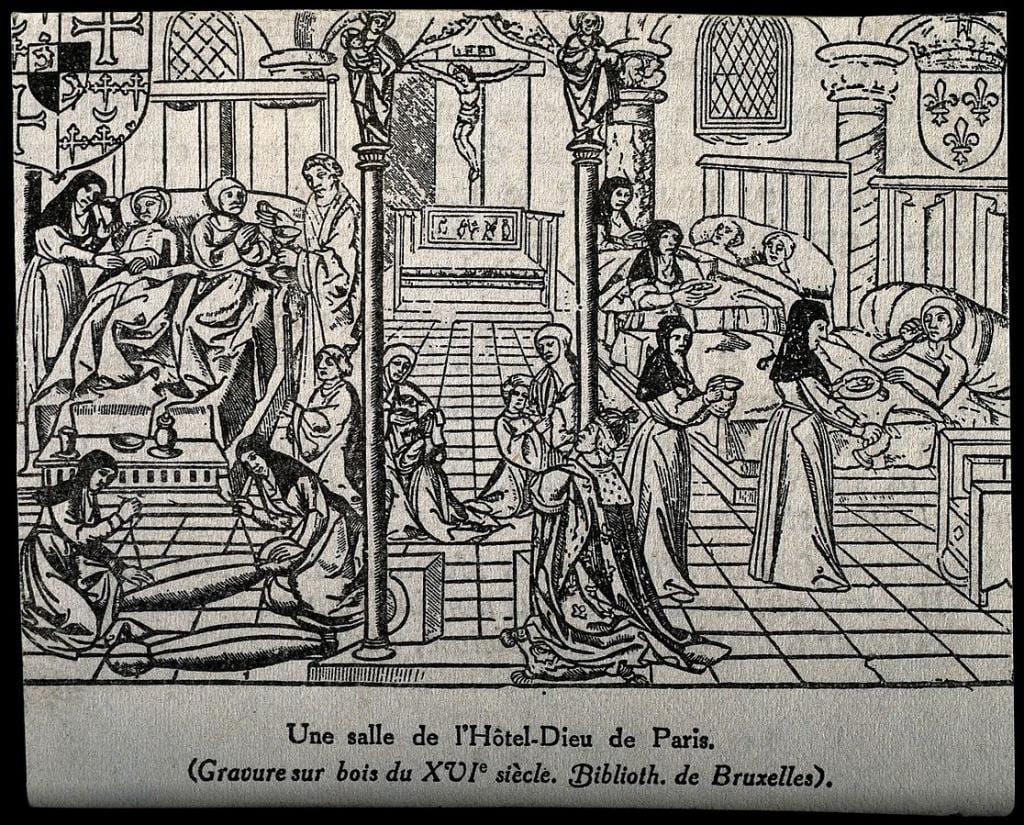
The Hôtel Dieu, Paris: interior showing patients being nursed by monks and nuns. Woodcut.. https://commons.wikimedia.org/wiki/File:The_H%C3%B4tel_Dieu,_Paris;_interior_showing_patients_being_nurse_Wellcome_V0014307.jpg
Ever have one of those days, when you just can’t focus on the work at hand? I have multiple articles sitting in draft form at my Forbes writing platform — on the Secure Act II, CPI for Social Security, and Illinois’ retirement income tax exemption — and I can’t muster the will to write about any of them, as I’ve been dealing with a tension headache all day and, much as I hate to admit being affected by politics, the election has me stressed. It’s not that I’m worried about the ultimate outcome of the presidential race — I don’t think Trump has a realistic chance — but I don’t know about the Senate and I worry about the Democrats’ actions if they take the Senate. What’s more, the reports of the boarding-up of businesses and expectations of riots have me unnerved — and as much as I don’t believe the claims that the Supreme Court will “steal” the election in favor of Trump, there is a risk of conflict over such issues as “how far after Election Day must unpostmarked ballots still be accepted?” and “where is the line to be drawn in terms of disparity between the voter’s signature in registration rolls and on the ballot?” where, yes, the more liberal the interpretation, the greater the risk of voter fraud. And, of course, at the same time, efforts to invalidate “drive-through” voting in Texas are driving me batty, though I cannot tell whether this represents anything like a mainstream Republican opinion. And locally, the two contested items on the ballot are the the so-called “fair tax” (an amendment to the state constitution to enable a graduated income tax) and the race for state representative, which is a rematch of the 2018 race which landed in favor of the incumbent Republican by double-digit votes — and each of these is stressing me out for the misleading advertising, from the claims of supporters of the “fair tax” who insist that 97% of Illinoisans will get a tax cut and millionaires and billionaires will “finally pay their fair share,” and the Personal PAC mailers for the challenger Democrat Maggie Trevor, the most recent of which claimed that she “took action” to support victims of sexual assault, but if you read between the lines, she actually didn’t do anything. Oh, and then there’s the endless mailers for the local incumbent Democratic judge, appointed by Democrats 3 years ago and now touting that she has “judicial experience” despite the fact that, prior to her appointment, she worked in HR.
Ugh.
Time for some distraction.
Why on earth would I want to rant about medieval hospitals?
For clarity, what I’m interested in is our 21st century lack of understanding about them. And, in particular, about the bad rap they got in a video called “Poor Us: an Animated History of Poverty,” which dates back to 2012 but recently was shared on twitter and is used in college classes. the video — a 60 minute documentary — was funded in part by America’s PBS but was a project of the BBC. It was produced by a filmmaker by the name of Ben Lewis but I can’t quite put together the national origins of the whole project, as the narrators speak with accents (or perhaps affectations) that are neither American nor British.
The film itself is narrated in the second person: “you are a poor person in [given time and place].” It starts with prehistory, then Ancient Greece, then moves on to Cairo, 1100 (at about the 8 minute mark), where the second person “you” of the story is drawn as the very stereotype of the Jew, not just with a menorah but with a hooked nose and a beard. “You” are barricading the door of your carpenter’s shop, apparently to hide from the beggars in the city streets (from the visuals), or, ostensibly, to hide from the tax collectors who would take away money you need to feed your family.
This is a very odd segment, as the narration moves to charity in Islam “wiping away bad deeds” and quotes from Muslim and Buddhist religious figures about charity, which have nothing to do with anything — but then the Jewish carpenter writes to the local rabbi saying, “I have debts to Muslims and my family is starving.” Perhaps this is just an attempt to incorporate actual documentary evidence — that is, the documents of the Cairo Genizah, found in 1896 — but with a narration so poorly done as to make it wholly unclear what is going on (is the Jewish family a part of the narration because they are receiving aid from other Jews? because they are refusing to provide aid to beggars?). This is what caught the eye of the folks on twitter who shared it: a vignette which appears to contain anti-Semitism of the sort that is simply so much a part of the filmmakers’ world view that their insertion of a Jewish family into the narration makes no sense.
Be that as it may, the narration moves next to Paris, 1300, where “you” are a poor man, a “beggar in a sea of beggars.” Historian Sharon Farmer appears (she’s a real historian and the author of Surviving Poverty in Medieval Paris, from which the anecdote is presumably taken), and she cites a story of a pig herder in a village who is injured, stays with his brother for two months, then in “the local village hospital” for two months, but the other residents are annoyed by the stench of his wound and encourage him to seek a miraculous cure at a shrine in Paris. The animation shows a teeming mass of poor people coming to seek coins as given out at a funeral, and sneers at the new religious orders such as Franciscans, who begged “in competition with the real poor.” An unnamed expert then tells us that “the basic lesson of medieval poverty is that there are bureaucracies and systems being built on the sufferings of others all the time, and that’s true now, as it has always been. And you look at your average medieval cathedral, maybe designed to honor the poor, and yet I don’t think many of the statues and monuments are very eatable or helpful.” Farmer then comes back, to say that rich artisans and merchants made provisions in their wills to give out alms.
From there the narration skips to the Incan Empire, where, preposterously, the animation shows the ruler being carried on a litter by servants, but then claims, implicitly, that poverty there did not begin until the Spanish colonized the continent. We see more about Africa and Europe, and end up in China in 1743, when the government undertook a “model relief effort” in the face of a widespread famine, with grain relief provided to 2 million people. “Lucky you are not in the West, but in the East.”
And the narrative continues with more anti-colonialist, Marxist rhetoric, in which the decline of poverty in the twentieth century is presented as mysterious and unexplainable, having nothing to do with industrialization, technological advancement, or capitalism — and yet “poverty” returns in modern times, in the form of “income inequality.”
But let’s go back to Paris — because regular readers will recall that I was, in fact, once a graduate student in medieval history. In fact, if I had had the necessary level of skill and focus (and had records been more plentiful), I would have written a dissertation on medieval hospitals and on the religious sisters who worked there — because they took religious vows but, unlike nuns in convents, were actively involved in caring for the poor, hospitals being not necessarily places busy caring for the sick but also for the poor.
In fact, as true as it may be that large swathes of the population of medieval Paris, or any such city, were poor (though “poor” is always relative, anyway), and as much as the “expert” sneers at the use of money to build a cathedral rather than to help the poor, this fails to acknowledge that in Paris, a hospital dedicated to the care of the poor and the sick had been in existence for nearly 500 years by the point of this scene — with its first recorded mention being in the year 829.
In fact — well, if you’re a regular reader of my writing at Forbes, you’ll know that I recently wrote about The WEIRDest People in the World, a book which explains western distinctiveness as arising in the Middle Ages from the church’s prohibition on marriages between related people, which had the consequence, whether planned or accidental, of obliging medieval folk to form community organizations to replace what would have been strong clan ties elsewhere: guilds for skilled craftsmen (and women) in the cities, universities, even self-government within those cities. And the fact that the Hotel-Dieu in Paris and hospitals throughout Europe were funded and staffed by lay people and religious orders, rather than managed by the government, does not make them somehow “less worthy.”
Of course, does it really matter that everyone thinks of the European Middle Ages as teeming with beggars, and the new conventional wisdom is that the Islamic World and the Far East greatly surpassed medieval European civilization? In one sense, no, not really, but, at the same time, I think there is a degree to which this conventional wisdom extends beyond just an evaluation of the economic and technological level of development of these regions at any given time into an evaluation of moral superiority, or lack thereof: “because in the Middle Ages, Christendom had a lot of catching-up to do, their eventual success in having done so and indeed outstripping other regions in economic development and industrialization is undeserved.”
And with that, I at least feel more up to the task of writing about retirement.
Previous Post

November 1, 2020
Some Comments on Equity vs. Equality
Next Post
November 6, 2020 On paywalls
Browse Our Archives
Select a Category Actuarial/Retirement Issues Politics Uncategorized
Select a Month September 2026 August 2026 July 2026 June 2026 April 2026 March 2026 February 2026 January 2026 December 2025 November 2025 October 2025 July 2025 June 2025 May 2025 April 2025 March 2025 February 2025 January 2025 December 2024 November 2024 October 2024 September 2024 August 2024 July 2024 June 2024 May 2024 April 2024 March 2024 February 2024 December 2023 November 2023 October 2023 September 2023 August 2023 July 2023 December 2022 September 2022 August 2022 July 2022 June 2022 May 2022 February 2022 January 2022 December 2021 August 2021 June 2021 April 2021 February 2021 January 2021 December 2020 November 2020 October 2020 September 2020 August 2020 July 2020 June 2020 May 2020 April 2020 March 2020 February 2020 January 2020 December 2019 November 2019 October 2019 September 2019 August 2019 July 2019 June 2019 May 2019 April 2019 March 2019 February 2019 January 2019 December 2018 November 2018 October 2018 September 2018 August 2018 July 2018 June 2018 May 2018 April 2018 March 2018 February 2018 January 2018 December 2017 November 2017 October 2017 September 2017 August 2017 July 2017 June 2017 May 2017 April 2017 March 2017 February 2017 January 2017 December 2016 November 2016 October 2016 September 2016 August 2016 July 2016 June 2016 May 2016 April 2016 March 2016 February 2016 January 2016 December 2015 November 2015 October 2015 September 2015 August 2015 July 2015 June 2015 May 2015 April 2015 March 2015 February 2015 January 2015 December 2014 November 2014 October 2014 September 2014 August 2014 July 2014 June 2014 May 2014 April 2014 March 2014 February 2014 January 2014 December 2013 November 2013 October 2013 September 2013 August 2013 July 2013
Follow Us!
TAKE THE
Religious Wisdom Quiz
Who betrayed Jesus for 30 pieces of silver?
Select your answer to see how you score.
Judas Iscariot John Simon Peter James
Related posts from Jane the Actuary
What will the French do in the Notre...


Illinois’ Assisted Suicide Law is, yes, literally deadly

Revising the "Disability [Pride] Flag"
TRENDING AT PATHEOS Catholic

The First Eucharistic Controversy: Christ’s Real Presence
For Catholics, the Eucharist is the source and summit of the Christian...

What a Stop Sign Can Teach Us About...
How to Make a Decision When You Can't Hear God Main point:...

Archdiocese Hosts Military Marriage Retreat in Germany
RASTATT, Germany — The transient military lifestyle, with its frequent deployments and...

Nearly every morning, I make the drive to Detroit with my high-school-age...

The Real AI Story Is Adoption Without Trust
Artificial intelligence has crossed a political threshold. It is no longer a...

A new article, written by Jeff Lindsay and Gale L. Pooley,...
view all Catholic blogs
Ad-Free & Subscriber Log-In Subscription Support
- About Us
- 2026 Calendar
- Videos
- Podcasts
- Library of World Religions
- Faith In Media Tracker
- Advertise With Us
- Write for Us
- Privacy Policy
- Terms of Service
- Do Not Sell My Data
- Contact Us
- Radiant Digital
- Manage Newsletter Subscriptions
- Unsubscribe From Notifications
- Sitemap
Copyright 2008-2026, Patheos. All rights reserved.
Subscription Support Ad-Free & Subscriber Log-In
Follow Patheos