
BuddhistCatholicContemplativeEvangelicalGeneral ChristianHinduJewishLatter-day SaintMuslimNew VisionsProgressive Christian
Beliefs
- Buddhist
- Catholic
- Contemplative
- Evangelical
- General Christian
- Hindu
- Jewish
- Latter-day Saint
- More Voices
- Muslim
- New Visions
- Pagan
- Progressive Christian
Topics
- Religion News
- Food and Religion
- Sports and Religion
- Religious Art
- Religious Music and Entertainment
- Religious Events
- History and Religion
- Style and Religion
- Politics and Religion
- Women in Religion
- Recreation Outdoors and Religion
- Business Finance and Religion
- Careers Workplace and Religion
- Education and Religion
- Family Parenting and Religion
- Health Fitness and Religion
- Home and Religion
- Relationships and Religion
- Technology and Religion
- Travel and Religion
Columnists
- Buddhist Columnists
- Business Finance and Religion Columnists
- Careers Workplace and Religion Columnists
- Catholic Columnists
- Contemplative Columnists
- Education and Religion Columnists
- Evangelists Columnists
- Family Parenting and Religion Columnists
- General Christian Columnists
- Health Fitness and Religion Columnists
- Hindu Columnists
- History and Religion Columnists
- Home and Religion Columnists
- Jewish Columnists
- More Voices Columnists
- Latter Day Columnists
- Muslim Columnists
- New Visions Columnists
- Nonreligious Columnists
- Pagan Columnists
- Politics and Religion Columnists
- Progressive Columnists
- Recreation Outdoors and Religion Columnists
- Relationships and Religion Columnists
- Religion News Columnists
- Religious Art Columnists
- Religious Events Columnists
- Religious Music and Entertainment Columnists
- Sports and Religion Columnists
- Style and Religion Columnists
- Technology and Religion Columnists
- Travel and Religion Columnists
- Women in Religion Columnists
Resource Library
- 2026 Calendar
- Library of World Religions
- The 100 Most Holy Places on Earth
- Patheos Answers
- Podcasts
- Videos
- Faith Leaders Database
- Anglican Episcopalian
- Bahai
- Baptist
- Buddhism
- Christianity
- Confucianism
- Eastern Orthodoxy
- Hinduism
- Holiness and Pentecostal
- ISKCON
- Islam
- Judaism
- Lutheran
- Methodist
- The Church of Jesus Christ of Latter-day Saints
- New Age
- Paganism
- Presbytarian and Reformed
- Protestantism
- Religion Behind the Scenes
- Roman Catholic
- Scientology
- Shia Islam
- Sikhism
- Sufism
- Sunni Islam
- Taoism
- Zen
- See all religions
Research Tools
 Ad-Free & Subscriber Log-In Subscription Support
Ad-Free & Subscriber Log-In Subscription Support
Follow Patheos 

- Trending:
- Forgiveness
- |
- Marriage
- |
- Consciousness
- |
- Death Penalty
- |
- Election
- |
- Halloween

- Home
- Catholic
- Politics and Religion
- Let’s talk about natural-born citizens
Let’s talk about natural-born citizens
Last updated on: August 18, 2020 at 9:16 am by Jane the Actuary
Let’s talk about natural-born citizens 2020-08-18T09:16:53-06:00 Jane the Actuary
Patheos Explore the world's faith through different perspectives on religion and spirituality! Patheos has the views of the prevalent religions and spiritualities of the world.
I have a stake in this, of course. My youngest son was born in Germany.
He meets the rules for citizenship — that is, I an an American citizen and had lived in the US for the required minimum of five years including two after age 14 — and, in fact, has an American Consular Record of Birth as well as a German birth certificate.
Is he, in fact, a natural-born citizen? I generally tend to think the answer is “yes” — that is, that there are two types of citizen, and any citizen who never needed to be naturalized by virtue of having been a citizen at birth, is a natural-born citizen.
But I don’t think this is a view for which there’s a firm consensus.
In 2008, after all, we had the first “natural born citizen” controversy.
You know: was John McCain a Natural Born Citizen? He was born overseas, to American-citizen parents. Specificially, the “overseas” was the Panama Canal Zone, at the time the “property” of the United States but not with the same status as a “regular” state, commonwealth, or territory.
FactCheck dot org said, at the time (February 25, 2008), “duh, of course.”
More precisely,
McCain is a natural-born citizen, even though he was not born within this country’s borders, since his parents were citizens at the time of his birth.
Citing 1790 Congressional legislation:
And the children of citizens of the United States, that may be born beyond sea, or out of the limits of the United States, shall be considered as natural born citizens.
But it wasn’t actually that straightforward.
At about the same time, NBC News featured an in-depth article on the question.
But is John McCain a natural born citizen? The Constitution does not define the term further, and legal scholars say the notes of the Constitution’s drafters shed little light on what they meant. It seems clear only that the founders wanted to make certain that whoever was president would be loyal to the U.S. alone and not to some other country. But the term “natural born citizen,” many scholars say, was not in common use at the time the Constitution was written.
Sen. McCain’s supporters draw some comfort from a law passed in 1790 by the first Congress. It provided that the children of US citizens born outside the US “shall be considered as natural born citizens.” The law is no longer in effect, but it provides some guidance on what the founders had in mind at the time of the Constitution. . . .
In 1964, the Supreme Court seemed to say, without deciding, that “natural born” meant born inside the United States. In an opinion on an unrelated issue, the court observed, “The rights of citizenship of the native born and of the naturalized person are of the same dignity and are coextensive. The only difference drawn by the Constitution is that only the ‘natural born’ citizen is eligible to be President.” But that language is not legally binding, and the Supreme Court has never ruled on what “natural born” means. . . .
Besides, many legal scholars say the Canal Zone never was sovereign U.S. territory. In a February 1978 speech to the nation on the Panama Canal Treaty, heavily vetted by government lawyers, President Carter said, “We have never had sovereignty over it. We have only had the right to use it. The US Supreme Court and previous American presidents have repeatedly acknowledged the sovereignty of Panama over the Canal Zone.”
Much later, in 2016, the Washington Post revisited the question, reminding readers that in May of 2008, the Senate had passed a resolution stating that McCain was indeed a natural-born citizen, but that resolution was nonbinding and fairly useless to the wider question, stating only that McCain himself was a natural born citizen, and justifying that statement both because his parents were American citizens and because his father was serving his country in the military. Other defenses included the additional claim that the Canal Zone “counted” as well. Piling on these justifications means that the issue was not, is indeed still not settled at all — is there a third class of citizens, those who were citizens at birth but not “natural born”? And, if so, who are they?
Because, yes, there is a claim circulating that Kamala Harris is not a natural-born citizen, not because her parents were immigrants (as the retellings generally claim), but because they were not permanent residents at the time but only here on student visas. I had rambled about the question of birthright citizenship before — in particular with respect to the question of birth tourism and whether the amendment could be interpreted, by its tenses, to require ongoing residence rather than merely presence on American soil at the time of birth.
And I’m still inclined to think that, if ever there was a circumstance in which we could reasonably say, “the Founders didn’t envision the circumstances we now find ourselves in,” this is it. Illegal immigration? Student visas? Birth tourism?
But in the meantime, we find ourselves with no actual answer on the question of the definition of “natural born citizen.” Should Congress define this by legislation, not merely in the form of a “resolution” but an explicit definition? Or does Congress even have the power to legislate an interpretation of the constitution? If they don’t, then, yes, we need a constitutional amendment — and we shouldn’t freak out that somehow amendments are sacred and holy and should never be contemplated except for the most serious of reasons.
Here’s my text:
“Natural-born citizen,” for the purpose of eligibility for the presidency or other purposes, shall mean any individual who was defined a citizen at birth, that is, without the necessity of naturalization.
Any individual born within the borders of the United States, including its states, territories, and commonwealths, shall be defined a citizen at birth, provided that at least one parent was a citizen or a permanent resident as defined by law at the time of birth. Congress shall have the power to legislate other circumstances providing for automatic citizenship, and to define the citizenship provisions for geographical areas with other forms of association to the United States.
In other words:
The Constitution would define “natural-born citizen” expansively.
Separately, the Constitution would set minimum standards for the definition of “citizen” more generally speaking, but would enable Congress to expand the definition beyond this minimum. There should probably be a restriction that Congress can’t take away citizenship from a whole group of people previously presumed to posses it, but I haven’t attempted to write that in Constitution-ese.
And having said all that:
no, it isn’t racist to discuss the topic.
This is a longstanding issue which should proactively be resolved rather than, each time it comes up, putting up a fuss that it’s somehow racist (or other “-ist,” e.g., anti-children-of-military-personnel) or partisan to raise the question. And the fact that we can’t discuss and fix this demonstrates our brokenness as a country.
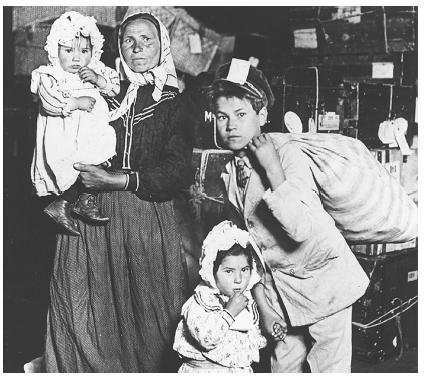
By Lewis W. Hine(Life time: 1874-1940) – Original publication: Photo-study Immediate source: Brooklyn Museum, Public Domain, https://commons.wikimedia.org/w/index.php?curid=51292180 The caption of the uncropped version says “lost baggage is the cause of their worried expressions” which I find fascinating because it counters the narrative of “immigrants arrived with nothing other than the shirts on their backs.”
Previous Post

August 14, 2020
School district 214, school reopenings, transparency, and trust
Next Post

August 18, 2020 The Mailbox Hoax
Browse Our Archives
Select a Category Actuarial/Retirement Issues Politics Uncategorized
Select a Month September 2026 August 2026 July 2026 June 2026 April 2026 March 2026 February 2026 January 2026 December 2025 November 2025 October 2025 July 2025 June 2025 May 2025 April 2025 March 2025 February 2025 January 2025 December 2024 November 2024 October 2024 September 2024 August 2024 July 2024 June 2024 May 2024 April 2024 March 2024 February 2024 December 2023 November 2023 October 2023 September 2023 August 2023 July 2023 December 2022 September 2022 August 2022 July 2022 June 2022 May 2022 February 2022 January 2022 December 2021 August 2021 June 2021 April 2021 February 2021 January 2021 December 2020 November 2020 October 2020 September 2020 August 2020 July 2020 June 2020 May 2020 April 2020 March 2020 February 2020 January 2020 December 2019 November 2019 October 2019 September 2019 August 2019 July 2019 June 2019 May 2019 April 2019 March 2019 February 2019 January 2019 December 2018 November 2018 October 2018 September 2018 August 2018 July 2018 June 2018 May 2018 April 2018 March 2018 February 2018 January 2018 December 2017 November 2017 October 2017 September 2017 August 2017 July 2017 June 2017 May 2017 April 2017 March 2017 February 2017 January 2017 December 2016 November 2016 October 2016 September 2016 August 2016 July 2016 June 2016 May 2016 April 2016 March 2016 February 2016 January 2016 December 2015 November 2015 October 2015 September 2015 August 2015 July 2015 June 2015 May 2015 April 2015 March 2015 February 2015 January 2015 December 2014 November 2014 October 2014 September 2014 August 2014 July 2014 June 2014 May 2014 April 2014 March 2014 February 2014 January 2014 December 2013 November 2013 October 2013 September 2013 August 2013 July 2013
Follow Us!
TAKE THE
Religious Wisdom Quiz
I am an offering without defect, completely burned on the altar as a pleasing aroma to the Lord. What am I?
Select your answer to see how you score.
A grain offering A burnt offering A peace offering A sin offering
Related posts from Jane the Actuary
ACB, the ACA, and Constitutionalism

Remember Marbury vs. Madison? A question for readers
TRENDING AT PATHEOS Catholic

Methodist Central Hall and Westminster Abbey
Situated on the same square is Methodist Central Hall and Westminster Abbey. ...

57th Dove Awards Honor Dolly Parton, Crown New...
On gospel music’s biggest night, the 57th annual GMA Dove Awards honored...

The First Eucharistic Controversy: Christ’s Real Presence
For Catholics, the Eucharist is the source and summit of the Christian...

What a Stop Sign Can Teach Us About...
How to Make a Decision When You Can't Hear God Main point:...

Archdiocese Hosts Military Marriage Retreat in Germany
RASTATT, Germany — The transient military lifestyle, with its frequent deployments and...

Nearly every morning, I make the drive to Detroit with my high-school-age...
view all Catholic blogs
Ad-Free & Subscriber Log-In Subscription Support
- About Us
- 2026 Calendar
- Videos
- Podcasts
- Library of World Religions
- Faith In Media Tracker
- Advertise With Us
- Write for Us
- Privacy Policy
- Terms of Service
- Do Not Sell My Data
- Contact Us
- Radiant Digital
- Manage Newsletter Subscriptions
- Unsubscribe From Notifications
- Sitemap
Copyright 2008-2026, Patheos. All rights reserved.
Subscription Support Ad-Free & Subscriber Log-In
Follow Patheos