
BuddhistCatholicContemplativeEvangelicalGeneral ChristianHinduJewishLatter-day SaintMuslimNew VisionsProgressive Christian
Beliefs
- Buddhist
- Catholic
- Contemplative
- Evangelical
- General Christian
- Hindu
- Jewish
- Latter-day Saint
- More Voices
- Muslim
- New Visions
- Pagan
- Progressive Christian
Topics
- Religion News
- Food and Religion
- Sports and Religion
- Religious Art
- Religious Music and Entertainment
- Religious Events
- History and Religion
- Style and Religion
- Politics and Religion
- Women in Religion
- Recreation Outdoors and Religion
- Business Finance and Religion
- Careers Workplace and Religion
- Education and Religion
- Family Parenting and Religion
- Health Fitness and Religion
- Home and Religion
- Relationships and Religion
- Technology and Religion
- Travel and Religion
Columnists
- Buddhist Columnists
- Business Finance and Religion Columnists
- Careers Workplace and Religion Columnists
- Catholic Columnists
- Contemplative Columnists
- Education and Religion Columnists
- Evangelists Columnists
- Family Parenting and Religion Columnists
- General Christian Columnists
- Health Fitness and Religion Columnists
- Hindu Columnists
- History and Religion Columnists
- Home and Religion Columnists
- Jewish Columnists
- More Voices Columnists
- Latter Day Columnists
- Muslim Columnists
- New Visions Columnists
- Nonreligious Columnists
- Pagan Columnists
- Politics and Religion Columnists
- Progressive Columnists
- Recreation Outdoors and Religion Columnists
- Relationships and Religion Columnists
- Religion News Columnists
- Religious Art Columnists
- Religious Events Columnists
- Religious Music and Entertainment Columnists
- Sports and Religion Columnists
- Style and Religion Columnists
- Technology and Religion Columnists
- Travel and Religion Columnists
- Women in Religion Columnists
Resource Library
- 2026 Calendar
- Library of World Religions
- The 100 Most Holy Places on Earth
- Patheos Answers
- Podcasts
- Videos
- Faith Leaders Database
- Anglican Episcopalian
- Bahai
- Baptist
- Buddhism
- Christianity
- Confucianism
- Eastern Orthodoxy
- Hinduism
- Holiness and Pentecostal
- ISKCON
- Islam
- Judaism
- Lutheran
- Methodist
- The Church of Jesus Christ of Latter-day Saints
- New Age
- Paganism
- Presbytarian and Reformed
- Protestantism
- Religion Behind the Scenes
- Roman Catholic
- Scientology
- Shia Islam
- Sikhism
- Sufism
- Sunni Islam
- Taoism
- Zen
- See all religions
Research Tools
 Ad-Free & Subscriber Log-In Subscription Support
Ad-Free & Subscriber Log-In Subscription Support
Follow Patheos 

- Trending:
- Forgiveness
- |
- Marriage
- |
- Consciousness
- |
- Death Penalty
- |
- Election
- |
- Halloween

- Home
- Catholic
- Politics and Religion
- “Whiteness” — and the insolvability of multiculturalism
“Whiteness” — and the insolvability of multiculturalism
Last updated on: July 29, 2020 at 8:16 am by Jane the Actuary
“Whiteness” — and the insolvability of multiculturalism 2020-07-29T08:16:00-06:00 Jane the Actuary
Patheos Explore the world's faith through different perspectives on religion and spirituality! Patheos has the views of the prevalent religions and spiritualities of the world.

My husband is German. Well, as of two years ago, he is also American, but he spent his childhood in Germany, came to the U.S. for grad school, and stayed. Which meant that he had to accustom himself to American culture — and at the same time, I had to learn that some of his quirks were really more a matter of his German culture not being entirely the same as American culture: it pains him to be late, for instance. In the course of living in Germany myself (for two years, over 10 years ago now), I learned more cultural differences: politeness is super-important, even to the point of greeting everyone with handshakes upon arriving and then leaving a gathering. Swabia, the region of my husband’s hometown, has a particular reputation for being work-and-savings obsessed, with the phrase “schaffe schaffe Hausle baue” — or “work, work, build a house” — denoting this. And it was clear to me that cultural differences were fairly deep, even though I was not fluent in German enough, or socially active enough, to really build deep enough connections with Germans to be able to articulate all the differences, and, yes, even though Germany and America are both “white” cultures.
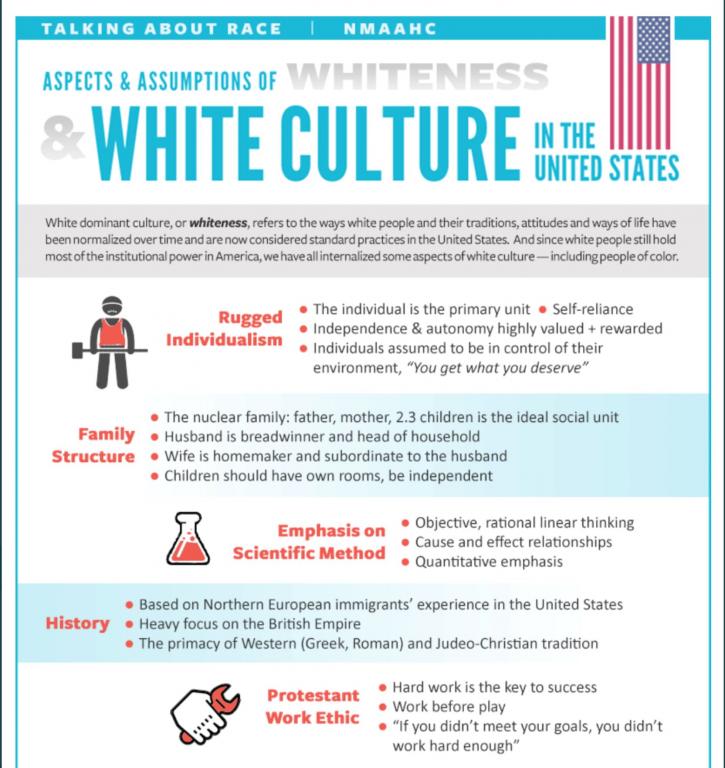
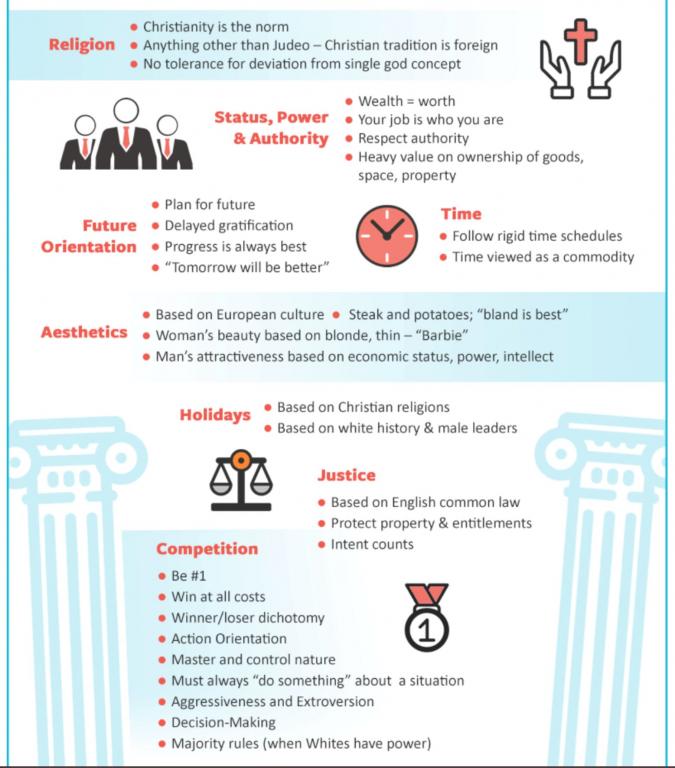
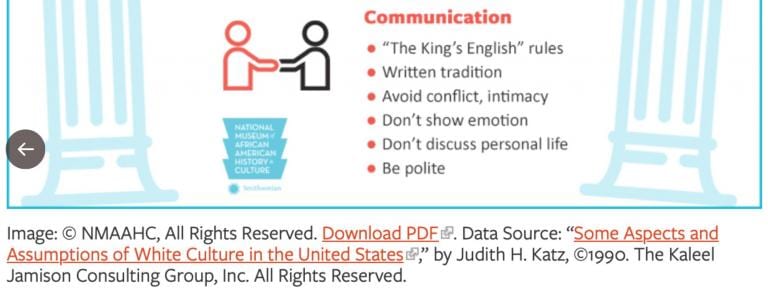
And this experience — as well as my experiences working with non-Americans for a decade, and with various reading on the topic — means I have a few things to say about the National Museum of African American History & Culture’s essay “Whiteness” and in particular, its graphic “Aspects & Assumptions of Whiteness and White Culture in the United States,” which was either recently* published or recently discovered, at any rate, and shared on twitter. (The graphic itself has now been removed from that site; for reference, I’ve uploaded it at the end of this piece, based on the screen grabs at the linked tweet.)
(*OK, “recently” is relative; it’s now been a while since I first drafted this post.)
Let’s start with their definitions:
Whiteness and white racialized identity refer to the way that white people, their customs, culture, and beliefs operate as the standard by which all other groups of are compared. Whiteness is also at the core of understanding race in America. Whiteness and the normalization of white racial identity throughout America’s history have created a culture where nonwhite persons are seen as inferior or abnormal. . . .
White dominant culture describes how white people and their practices, beliefs, and culture have been normalized over time and are now considered standard in the United States. As a result, all Americans have all adopted various aspects of white culture, including people of color.
And then the graphic — originally just a list, written in 1990, by Judith H. Katz, of the Kaleel Jamison Consulting Group. Who is Katz? She is the Executive Vice President and Client Brand Lead at a company which provides Diversity and Inclusion training to corporations, and promotes its “rapid response team” which can provide services within 24 to 48 hours if immediate action is needed for situations such as “leaders losing credibility” or “acquisition backlash.”
Now, the text itself does not explicitly say: “white culture is bad.” It doesn’t tell the reader what to think, exactly. Here are some “aspects of whiteness” (quoted or paraphrased):
- Rugged individualism: self-reliance, independence
- The “traditional” family, breadwinning father, homemaking mother, 2.3 children
- “Emphasis on scientific method”; “objective, rational linear thinking,” “cause and effect relationships,” “quantitative emphasis.”
- “Protestant work ethic”: “hard work is the key to success”
- “Christianity is the norm”; “no tolerance for deviation from single god concept.”
- Status: “your job is who you are.”
- “Future orientation”: “delayed gratification”
- Time: “follow rigid time schedules”
- Asethetics: steak and potatoes, blonde & thin women
- Justice: “Protect property and entitlements,” “Intent counts.”
And so on —
And if one were to label this “cultural characteristics of the dominant American culture,” and revise this list substantially, you might be providing a meaningful description of normative American middle class culture — which is not necessarily “white” culture, or, at least, it’s fair to say that insofar as nonwhite people share this culture they have transformed it from being “white” to being “American middle class norms.” And, in fact, a 2017 (post-Trump) book on the white working class pointed out significant cultural differences between what that author, Joan C. Williams, described as the white working class (no college degree but respectable employment) and the professional/managerial elite (as someone of that social class, the author did not seem to consider that there were larges numbers of Americans who were white collar but neither professional nor managerial): for instance, working class folk are much less likely to derive a sense of identity from their jobs, are more rooted in a particular community, are much less likely to hyper-schedule their children, and the like.
But to look at some of these characteristics: yes, it seems a bit nutty to say that the dominant American culture includes male breadwinners and female homemakers, but in 1990, I suppose the era in which that was true was not so far distant as it is now. And, yes, it is likewise the case that in black families that was much rarer, as women were obliged to work, for instance, as maids in the South in the pre-Civil Rights era, in order for families to manage to support themselves. And while “hard work” is not unique to the dominant American culture, and, in fact, the Chinese, for instance, had a centuries-long history of determined study at civil servant exams providing success, it is nonetheless true that the belief that hard work, studiousness, and diligent saving can improve one’s lot in life, is not a shared characteristic across all cultures, and other cultures may believe that one’s lot in life is more determined by the gods’ caprice, or destined to be the same as one’s fathers and their fathers before them. (The hosting of elaborate quinceanara celebrations by immigrant families when the money could have been saved for college tuition is sometimes explained in this manner.) In the latter case, “hard work” might still be a sign of being an upstanding member of the community and might signify moral worthiness, but might not have the same connotation of “key to success.” Other defining characteristics of dominant American culture include the notion that, yes, “intent matters” in the justice system — we believe that self-defense is an appropriate defense, and a death as the result of a genuine accident is no homicide at all, but that’s not the case elsewhere; here’s what I wrote in 2017, as a description of Korean culture based on a recent book on the topic:
One of the examples that the author provides about the differences between American and Korean culture is that there was a great deal of uproar over the unintentional death of Korean civilians due to an accident in which a U.S. military vehicle was on a public road. The people recognized that the driver was not at fault and did not personally bear guilt, but still wanted the soldier(s) to be tried (even if ultimately freed from prison) to assuage the anger and grief that the people felt over these deaths. Their sense of justice meant that the soldier’s imprisonment would serve to make things right. Our belief in justice says that people should only be imprisoned as appropriate punishment for criminal acts that they have been found guilty of by a jury assessing the facts of the case.
Similarly, while we consider some individuals to have more status than others — as evidenced, for example, by the fact that doctors are addressed with the title “doctor” — the importance of status in day-to-day life is quite a bit greater in places like Korea.
All this being said — once we recognize that there are cultural characteristics of the dominant American culture which may or may not be shared by cultures in other parts of the world, or subcultures (“Black” culture, insofar as it describes a distinct community, or “Hillbilly” culture, or the like) within America, what next? Where do you go with that?
In the business world, a certain amount of “cultural competency” training is essential for those who would do business out of the country. It is reasonably well-known that someone wishing to do business in Japan, for instance, will be expected to spend substantial amounts of time drinking (and trust-building) before any agreement is made. Carly Fiorina describes a similar experience (more eating than drinking) in Italy in her memoir. One presumes that when someone from outside arrives in America, they will have been briefed to expect that Americans will want to get down to business right away.
Similarly, it’s well-known that cultures vary in terms of their approach to time, and timeliness. In Germany, prompt arrival is demanded, even more so than in the U.S. In Latin America, that’s not the case. How do individuals from those cultures do business with each other? One of the parties must be aware enough of the differences and willing to accommodate the other’s alternate expectations.
And that’s all well and good when it’s a matter of two geographically distinct cultures, in which the interaction occurs at discrete points in time. But as far as I can tell, what is implicit in the project of calling out these cultural characteristics as “whiteness,” is the claim that people of non-white “cultures” should be able to live in the United States without any adaptation to “white” (dominant American middle-class) culture, without any discomfort at being a minority, and with equal outcomes in terms of income, health, and the like despite potentially significant differences in cultural norms — though, of course, we’re left to guess at what differences the author and other promoters of the concept of “whiteness” have in mind.
And some of this is, or should be, trivial.
Do they “merely” want to make distinctions that in this or that nonwhite culture, the role of the extended family is more important, or that jobs are only a small part of one’s identity? Funny, many white people also depend on extended families and reject job-based identity.
Or do they believe that differences are deeper? For instances, in some countries, it’s perfectly normal to hire based on neoptism/cronyism because “where you’re from” establishes your character; in the U.S., it’s not acceptable (but head over to the county clerk’s office and you’ll see that so many of the employees are of the same ethnicity, and clearly recent immigrants, that it can’t be a coincidence). Or how can a society manage when some of its people believe what’s important is individual achievement and others believe your loyalties like with your group, whatever it might be, and what’s most important is to help your group get ahead? Or if a minority reject “saving for tomorrow”? And, of course, if two parties have differing expectations about what “on time” means. The notion that it is at all possible for another culture with wholly different beliefs to operate parallel to the dominant culture, with the assumptions of each culture both simultaneously in operation when it comes to the education system, the business world, and politics and the legal system, simply doesn’t work.
And here’s another example: an open letter that was shared on twitter, written by a black woman who had recently resigned from a position at the Union of Concerned Scientists. (The letter is undated but an apology-reply posted at their site was dated June 5, 2020.) Much of the letter is the sort of radicalism that is perhaps worth pointing out in some other context but not particularly relevant to this issue (she objects to the concept of “jobs” because of a Marxist notion that we should not be obliged to work at jobs but should obtain food and shelter as a matter of justice, for instance) but of relevance are her laments about the work environment:
I resented the office culture. Feeling like I was being surveilled in a sterile, factory-like environment. I asked my supervisor if I could work from home because my role was intended to work primarily with partners who were never in the office. I was told I couldn’t work from home because “it was against company policy” (which wasn’t actually written anywhere in the personnel policy at the time). Or because I wasn’t senior enough… hadn’t been there long enough… hadn’t proven myself… because if I did it, everyone else would do it. This resistance to change from a supposedly science-based organization ignoring the scientifically proven benefits of workers being more productive when able to choose when and how they work was an act of paternalism and power hoarding. I saw how in making hiring decisions, staff questioned whether candidates would be able to “adjust” to the office culture, instead of whether UCS should do some adjusting to be more inclusive.
I tried to bring the storytelling, song, and laughter that my ancestors gifted me with to the office. I tried to disrupt our robotic weekly team meetings with check in questions that helped us get to know each other on a personal level and build trust, bring excitement, fun. But I eventually stopped. My voice got tired. I tried to share poems. I tried to bring life. I tried to bring spirit. But it almost always just felt like death. I was drowned in the loneliness of my sterile, box office. I sent long emails about my feelings, just hoping to connect, throwing a line to be pulled up from the water. No replies. Not urgent enough. The funders didn’t ask for you to talk about your feelings.
I tried to spend as much time as I could away from the office. Going to every conference that came up. To learn about how I could do the job(s) better since no one around me was able to teach/support me. But also just wanting to connect with people. That was the only time things felt real. Filled with spirit and lead by (BIPOC) people driven by genuine transformation and committed to the work beyond their jobs. In the office we talked about people as if they were only numbers contributing to our action alerts whose goals were created in our white conference rooms from white minds and white values.
I felt the stress, tension, and/or apathy in our meetings and wanted to take collective breaths, but felt like there was no space or time to just be together as humans. I wondered if people needed hugs.
So what do you do with this culture clash, which she identifies as a clash between “white” and “black” culture? She felt that her office was “sterile,” the team meetings “robotic.” Did her colleagues, did management have an obligation to accommodate her? How could they have done so in the first place without being compelled to change their own culture, if they say, “I don’t want to talk about my feelings or hear about yours or read poems or give hugs; I just want to do my job, to get the work done that needs to be done, to put in an honest day’s work for the company and go home so that I can spend time with my spouse, my children, my friends”? The author may not have liked the standard American white-collar/office culture, but you get what you get and you don’t throw a fit, as my kids once would have said. Even in this very narrow sense of the operative work culture, you cannot have two simultaneous cultures at the same time.
And, finally, some of the pundits and blue check-marks and others who have an audience who listen to them with respect to such matters are beginning to call out the harms experienced by the American “meritocracy” — by which they don’t mean the notion that individuals with the most “merit” or intelligence or skill do best, but the evolution of our educational system, in which upper-middle class teenagers struggle mightily to gain admission to top-tier colleges, and not-quite-so-upper middle-class teens accumulate debt because of the credentialism that demands a college degree for all manner of jobs which fundamentally don’t require it. (Once upon a time, my employer wanted new-hire secretaries to have degrees.) And there’s no reason this couldn’t change. Likewise, various experts call on Japan to change its workplace norms in which employees must work long hours to prove their devotion to the company. But, again, having a multiplicity of cultural norms at the same workplace, or within the same working world in general, cannot work.
Now, this is getting overly-long, so, to sum up: there are real, definable characteristics of the American middle-class dominant culture that merit understanding. But as long as the purported anti-racist experts continue to insist that so-called “white culture” stands in opposition to something else, we will never be able to move away from our divisions.
“Whiteness” infographic
Top image: from pixabay.com; public domain
Next Post

July 30, 2020 A brief rant on names and pronunciations
Browse Our Archives
Select a Category Actuarial/Retirement Issues Politics Uncategorized
Select a Month September 2026 August 2026 July 2026 June 2026 April 2026 March 2026 February 2026 January 2026 December 2025 November 2025 October 2025 July 2025 June 2025 May 2025 April 2025 March 2025 February 2025 January 2025 December 2024 November 2024 October 2024 September 2024 August 2024 July 2024 June 2024 May 2024 April 2024 March 2024 February 2024 December 2023 November 2023 October 2023 September 2023 August 2023 July 2023 December 2022 September 2022 August 2022 July 2022 June 2022 May 2022 February 2022 January 2022 December 2021 August 2021 June 2021 April 2021 February 2021 January 2021 December 2020 November 2020 October 2020 September 2020 August 2020 July 2020 June 2020 May 2020 April 2020 March 2020 February 2020 January 2020 December 2019 November 2019 October 2019 September 2019 August 2019 July 2019 June 2019 May 2019 April 2019 March 2019 February 2019 January 2019 December 2018 November 2018 October 2018 September 2018 August 2018 July 2018 June 2018 May 2018 April 2018 March 2018 February 2018 January 2018 December 2017 November 2017 October 2017 September 2017 August 2017 July 2017 June 2017 May 2017 April 2017 March 2017 February 2017 January 2017 December 2016 November 2016 October 2016 September 2016 August 2016 July 2016 June 2016 May 2016 April 2016 March 2016 February 2016 January 2016 December 2015 November 2015 October 2015 September 2015 August 2015 July 2015 June 2015 May 2015 April 2015 March 2015 February 2015 January 2015 December 2014 November 2014 October 2014 September 2014 August 2014 July 2014 June 2014 May 2014 April 2014 March 2014 February 2014 January 2014 December 2013 November 2013 October 2013 September 2013 August 2013 July 2013
Follow Us!
TAKE THE
Religious Wisdom Quiz
Who provided bread and Goliath's sword to David at Nob?
Select your answer to see how you score.
Abiathar Jonathan Abner Ahimelech the priest
Related posts from Jane the Actuary
In which, apparently, the country has completely lost...

A brief rant on names and pronunciations


Do we need American Exceptionalism?
TRENDING AT PATHEOS Catholic

Nearly every morning, I make the drive to Detroit with my high-school-age...

The Real AI Story Is Adoption Without Trust
Artificial intelligence has crossed a political threshold. It is no longer a...

A new article, written by Jeff Lindsay and Gale L. Pooley,...

Swimfan: Forgotten Aughts Pleasures
This is a recovery effort. In 2002, My Big Fat Greek Wedding...

Top Three Anti-Catholic Lies About Catholicism
This is my initial transcript for the video, "THE 3 WORST...

Pope Leo Celebrates Mass for Nurses & Docs...
I don't have any idea how he did it, but Pope Leo...
view all Catholic blogs
Ad-Free & Subscriber Log-In Subscription Support
- About Us
- 2026 Calendar
- Videos
- Podcasts
- Library of World Religions
- Faith In Media Tracker
- Advertise With Us
- Write for Us
- Privacy Policy
- Terms of Service
- Do Not Sell My Data
- Contact Us
- Radiant Digital
- Manage Newsletter Subscriptions
- Unsubscribe From Notifications
- Sitemap
Copyright 2008-2026, Patheos. All rights reserved.
Subscription Support Ad-Free & Subscriber Log-In
Follow Patheos