
BuddhistCatholicContemplativeEvangelicalGeneral ChristianHinduJewishLatter-day SaintMuslimNew VisionsProgressive Christian
Beliefs
- Buddhist
- Catholic
- Contemplative
- Evangelical
- General Christian
- Hindu
- Jewish
- Latter-day Saint
- More Voices
- Muslim
- New Visions
- Pagan
- Progressive Christian
Topics
- Religion News
- Food and Religion
- Sports and Religion
- Religious Art
- Religious Music and Entertainment
- Religious Events
- History and Religion
- Style and Religion
- Politics and Religion
- Women in Religion
- Recreation Outdoors and Religion
- Business Finance and Religion
- Careers Workplace and Religion
- Education and Religion
- Family Parenting and Religion
- Health Fitness and Religion
- Home and Religion
- Relationships and Religion
- Technology and Religion
- Travel and Religion
Columnists
- Buddhist Columnists
- Business Finance and Religion Columnists
- Careers Workplace and Religion Columnists
- Catholic Columnists
- Contemplative Columnists
- Education and Religion Columnists
- Evangelists Columnists
- Family Parenting and Religion Columnists
- General Christian Columnists
- Health Fitness and Religion Columnists
- Hindu Columnists
- History and Religion Columnists
- Home and Religion Columnists
- Jewish Columnists
- More Voices Columnists
- Latter Day Columnists
- Muslim Columnists
- New Visions Columnists
- Nonreligious Columnists
- Pagan Columnists
- Politics and Religion Columnists
- Progressive Columnists
- Recreation Outdoors and Religion Columnists
- Relationships and Religion Columnists
- Religion News Columnists
- Religious Art Columnists
- Religious Events Columnists
- Religious Music and Entertainment Columnists
- Sports and Religion Columnists
- Style and Religion Columnists
- Technology and Religion Columnists
- Travel and Religion Columnists
- Women in Religion Columnists
Resource Library
- 2026 Calendar
- Library of World Religions
- The 100 Most Holy Places on Earth
- Patheos Answers
- Podcasts
- Videos
- Faith Leaders Database
- Anglican Episcopalian
- Bahai
- Baptist
- Buddhism
- Christianity
- Confucianism
- Eastern Orthodoxy
- Hinduism
- Holiness and Pentecostal
- ISKCON
- Islam
- Judaism
- Lutheran
- Methodist
- The Church of Jesus Christ of Latter-day Saints
- New Age
- Paganism
- Presbytarian and Reformed
- Protestantism
- Religion Behind the Scenes
- Roman Catholic
- Scientology
- Shia Islam
- Sikhism
- Sufism
- Sunni Islam
- Taoism
- Zen
- See all religions
Research Tools
 Ad-Free & Subscriber Log-In Subscription Support
Ad-Free & Subscriber Log-In Subscription Support
Follow Patheos 

- Trending:
- Forgiveness
- |
- Marriage
- |
- Consciousness
- |
- Death Penalty
- |
- Election
- |
- Halloween

- Home
- Catholic
- Politics and Religion
- Revisiting the Great Depression – part one: was it truly global?
Revisiting the Great Depression – part one: was it truly global?
Last updated on: July 19, 2020 at 10:17 am by Jane the Actuary
Revisiting the Great Depression – part one: was it truly global? 2020-07-19T10:17:36-06:00 Jane the Actuary
Patheos Explore the world's faith through different perspectives on religion and spirituality! Patheos has the views of the prevalent religions and spiritualities of the world.
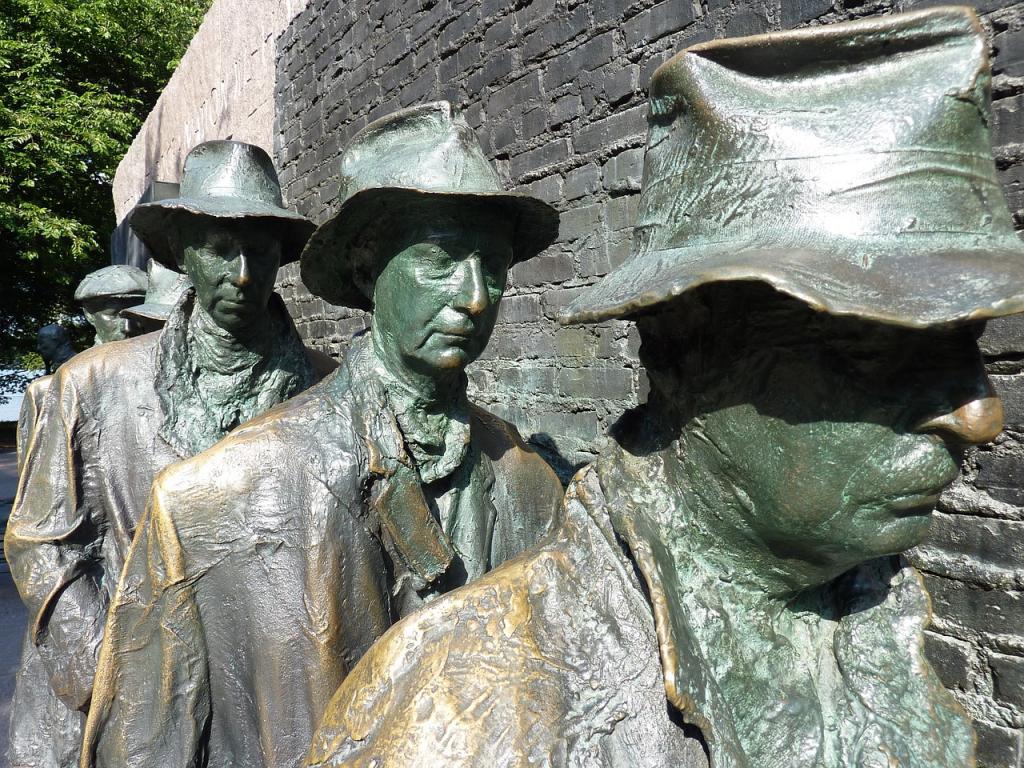
The bredline; from the FDR memorial https://pixabay.com/photos/bread-line-depression-fdr-2313469/
So I’m working my way through Amity Shlaes’ The Forgotten Man: A New History of the Great Depression, which is admittedly over a decade old now (published in 2007). A bit of a summary as well as its reception at the time is available at Wikipedia: her key argument is that not only was Hoover inept in how he reacted to the emerging depression (especially in implementing the Smoot-Hawley Tariff) but that FDR also, by his actions prolonged the Depression. His delight in “experimentation” meant that businesses worried about uncertainty and that climate of uncertainty prevented recovery.
The argument does make a certain amount of sense — after all, our history books give two contradictory messages: “FDR saved us from the Depression” and “only the war ended the Depression.” When we talk about stimulus programs now, they’re not meant merely to keep people adequately fed and housed until some external event ends the economic downturn; they are, we’re told, meant to boost the economy into recovery, so it seems to me worthwhile to question the conventional wisdom that New New Deals will save the day.
But I’m not an expert on the subject. So let’s start with Wikipedia’s general characterization of Depressions globally, since one of Shlaes’ first claims is that the decade-long downturn was not somehow “natural” or inevitable as evidenced by the fact that in other countries recovery was much faster.
In general, the Depression was a worldwide event, and the years up to 1932 – 1933 saw extreme hardship globally. The question is what happened next.
Australia: unemployment was high in 1932, but with a gradual recovery therafter. “Unemployment, which peaked at 32% in 1932, was 11% at the start of the Second World War compared to 17.2% in the United States.”
Canada: “The Canadian recovery from the Great Depression proceeded slowly. Economists Pedro Amaral and James MacGee find that the Canadian recovery has important differences with the United States. In the U.S. productivity recovered quickly while the labour force remained depressed throughout the decade. In Canada employment quickly recovered but productivity remained well below trend. Amaral and MacGee suggest that this decline is due to the sustained reduction in international trade during the 1930s.”
France: “The Great Depression in France started in about 1931 and lasted through the remainder of the decade. The crisis started in France a bit later than other countries. The 1920s economy had grown at the very strong rate of 4.43% per year, the 1930s rate fell to only 0.63%. The depression was relatively mild compared to other countries since unemployment peaked under 5%, the fall in production was at most 20% below the 1929 output and there was no banking crisis.”
Germany: “By cutting wages and taking control of labor unions, plus public works spending, unemployment fell significantly by 1935.”
Greece: “Despite the global depression, Greece managed to suffer comparatively little, averaging an average growth rate of 3.5% from 1932 to 1939. The dictatorial regime of Ioannis Metaxas took over the Greek government in 1936, and economic growth was strong in the years leading up to the Second World War.”
Iceland: “Due to the outbreak of the Spanish Civil War, which cut Iceland’s exports of saltfish by half, the Depression lasted in Iceland until the outbreak of World War II (when prices for fish exports soared).”
Italy: Mussolini came to power well before Hitler — in 1922. No reports of any effects on unemployment, only a financial crisis in 1932 and subsequent government intervention.
Japan: “the Great Depression did not strongly affect Japan.” Currency devaluation plus deficit spending. “By 1933, Japan was already out of the depression.”
Netherlands: prolonged depression, from 1931 to 1937. As of 1933, UK, US, and most European countries had abandoned the gold standard; in 1936, France and NL left the gold standard, boosting its economy.
Sweden: “the first country worldwide to recover completely from the Great Depression.”
UK: left the gold standard in 1931 after a financial crisis and “suffered relatively less than other major countries in the Great Depression.”
And here’s a chart from the French Wikipedia article, which shows the evolution of GDP in various countries:
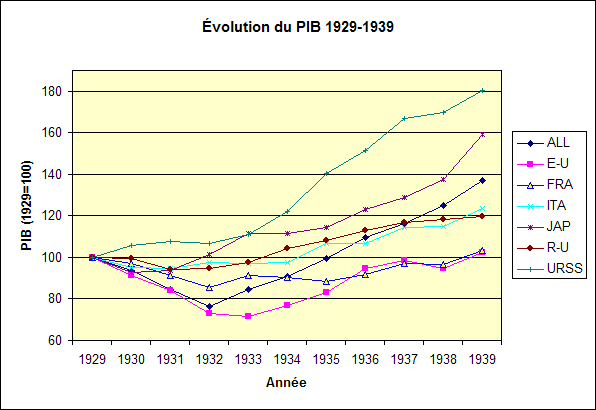
By Kimon Berlin, user:Gribeco – own work, data from Maddison “The World Economy”, CC BY 2.5, https://commons.wikimedia.org/w/index.php?curid=1170818
For the legend:
ALL = Allemagne, Germany
E – U = Etas Unis, US
FRA = France
ITA = Italy
Jap = Japan
R – U = United Kingdom
URSS = USSR
And PIB = GDP.
That the USSR grew steadly is a bit of a surprise given the manufactured famine, the Holodomor, and Stalin’s purges, but of course, this is relative to 1929, when that country was doing even worse.
Germany’s drop by 1932 was almost as bad as the US, but the recovery under Hitler was surprisingly rapid (and, yes, I’ve periodically wanted to read about that, from an economy history point of view).
France’s downturn was not as steep as the US but it likewise bumbled around for the remainder of the decade.
And the UK, as the other democracy on this chart (maybe Japan counts too, in terms of the way its economy operated at the time?), was effected substantially less grew more than the US.
But, of course, this is just one chart, and shows GDP rather than unemployment rate. A chart specifically for the UK reports that the unemployment rate was in the neighborhood of 8% – 10% during the 1920s, climbed to a peak of about 15% in 1932, then steadily declined to 12% in 1934, and 8% in 1937.
A 1998 paper, “Interwar Unemployment in International Perspective,” which is really quite long and I’ve only skimmed it, has some further tables. Among industrial workers (and I’m not sure how heavily caveatted the data is or should be), the US peaked at 37.6% in1933, dropped to 21.3% in 1937, and grew again to 27.9% in 1938 (the last year of data). In the UK, the peak was 22.1% in 1932, with a decline to 10.8% in 1937 and small increase to 12.9% in 1938. In France, the peak was in 1932, with 15.4%, dropping to 10.4% in 1936 and even further thereafter. In the Netherlands, consistent with the Wikipedia report, unemployment was high throughout the 1930s, dropping from a peak of 32.7% as late as 1936 to 19.9% in 1939. And so on. (p. 6).
In another table, average unemployment rates from 1921 to 1929, for the entire economy (not just industrial workers) stood at 18.2% for the US but only 9.8% for the UK, 8.7% in the Netherlands, and 13.3% for Canada. (No calculation for France was available in this data set.)
So, again, I’m hardly a trained economist, but this data set does seem to suggest that Shlaes’ argument has credence. Will I be convinced by the rest of the book? Stay tuned . . .
Previous Post

July 14, 2020
Yes, 2 + 2 still equals 4
Next Post
July 19, 2020 How Would Biden Govern? Looking at the "Unity Tast Force Recommendations"
Browse Our Archives
Select a Category Actuarial/Retirement Issues Politics Uncategorized
Select a Month September 2026 August 2026 July 2026 June 2026 April 2026 March 2026 February 2026 January 2026 December 2025 November 2025 October 2025 July 2025 June 2025 May 2025 April 2025 March 2025 February 2025 January 2025 December 2024 November 2024 October 2024 September 2024 August 2024 July 2024 June 2024 May 2024 April 2024 March 2024 February 2024 December 2023 November 2023 October 2023 September 2023 August 2023 July 2023 December 2022 September 2022 August 2022 July 2022 June 2022 May 2022 February 2022 January 2022 December 2021 August 2021 June 2021 April 2021 February 2021 January 2021 December 2020 November 2020 October 2020 September 2020 August 2020 July 2020 June 2020 May 2020 April 2020 March 2020 February 2020 January 2020 December 2019 November 2019 October 2019 September 2019 August 2019 July 2019 June 2019 May 2019 April 2019 March 2019 February 2019 January 2019 December 2018 November 2018 October 2018 September 2018 August 2018 July 2018 June 2018 May 2018 April 2018 March 2018 February 2018 January 2018 December 2017 November 2017 October 2017 September 2017 August 2017 July 2017 June 2017 May 2017 April 2017 March 2017 February 2017 January 2017 December 2016 November 2016 October 2016 September 2016 August 2016 July 2016 June 2016 May 2016 April 2016 March 2016 February 2016 January 2016 December 2015 November 2015 October 2015 September 2015 August 2015 July 2015 June 2015 May 2015 April 2015 March 2015 February 2015 January 2015 December 2014 November 2014 October 2014 September 2014 August 2014 July 2014 June 2014 May 2014 April 2014 March 2014 February 2014 January 2014 December 2013 November 2013 October 2013 September 2013 August 2013 July 2013
Follow Us!
TAKE THE
Religious Wisdom Quiz
Who confronted David about his sin with Bathsheba?
Select your answer to see how you score.
Samuel Joab Gad Nathan
Related posts from Jane the Actuary


Illinois’ Assisted Suicide Law is, yes, literally deadly

Revising the "Disability [Pride] Flag"

In which I comment on the Supreme Court...
TRENDING AT PATHEOS Catholic

Nearly every morning, I make the drive to Detroit with my high-school-age...

The Real AI Story Is Adoption Without Trust
Artificial intelligence has crossed a political threshold. It is no longer a...

A new article, written by Jeff Lindsay and Gale L. Pooley,...

Swimfan: Forgotten Aughts Pleasures
This is a recovery effort. In 2002, My Big Fat Greek Wedding...

Top Three Anti-Catholic Lies About Catholicism
This is my initial transcript for the video, "THE 3 WORST...

Pope Leo Celebrates Mass for Nurses & Docs...
I don't have any idea how he did it, but Pope Leo...
view all Catholic blogs
Ad-Free & Subscriber Log-In Subscription Support
- About Us
- 2026 Calendar
- Videos
- Podcasts
- Library of World Religions
- Faith In Media Tracker
- Advertise With Us
- Write for Us
- Privacy Policy
- Terms of Service
- Do Not Sell My Data
- Contact Us
- Radiant Digital
- Manage Newsletter Subscriptions
- Unsubscribe From Notifications
- Sitemap
Copyright 2008-2026, Patheos. All rights reserved.
Subscription Support Ad-Free & Subscriber Log-In
Follow Patheos