
BuddhistCatholicContemplativeEvangelicalGeneral ChristianHinduJewishLatter-day SaintMuslimNew VisionsProgressive Christian
Beliefs
- Buddhist
- Catholic
- Contemplative
- Evangelical
- General Christian
- Hindu
- Jewish
- Latter-day Saint
- More Voices
- Muslim
- New Visions
- Pagan
- Progressive Christian
Topics
- Religion News
- Food and Religion
- Sports and Religion
- Religious Art
- Religious Music and Entertainment
- Religious Events
- History and Religion
- Style and Religion
- Politics and Religion
- Women in Religion
- Recreation Outdoors and Religion
- Business Finance and Religion
- Careers Workplace and Religion
- Education and Religion
- Family Parenting and Religion
- Health Fitness and Religion
- Home and Religion
- Relationships and Religion
- Technology and Religion
- Travel and Religion
Columnists
- Buddhist Columnists
- Business Finance and Religion Columnists
- Careers Workplace and Religion Columnists
- Catholic Columnists
- Contemplative Columnists
- Education and Religion Columnists
- Evangelists Columnists
- Family Parenting and Religion Columnists
- General Christian Columnists
- Health Fitness and Religion Columnists
- Hindu Columnists
- History and Religion Columnists
- Home and Religion Columnists
- Jewish Columnists
- More Voices Columnists
- Latter Day Columnists
- Muslim Columnists
- New Visions Columnists
- Nonreligious Columnists
- Pagan Columnists
- Politics and Religion Columnists
- Progressive Columnists
- Recreation Outdoors and Religion Columnists
- Relationships and Religion Columnists
- Religion News Columnists
- Religious Art Columnists
- Religious Events Columnists
- Religious Music and Entertainment Columnists
- Sports and Religion Columnists
- Style and Religion Columnists
- Technology and Religion Columnists
- Travel and Religion Columnists
- Women in Religion Columnists
Resource Library
- 2026 Calendar
- Library of World Religions
- The 100 Most Holy Places on Earth
- Patheos Answers
- Podcasts
- Videos
- Faith Leaders Database
- Anglican Episcopalian
- Bahai
- Baptist
- Buddhism
- Christianity
- Confucianism
- Eastern Orthodoxy
- Hinduism
- Holiness and Pentecostal
- ISKCON
- Islam
- Judaism
- Lutheran
- Methodist
- The Church of Jesus Christ of Latter-day Saints
- New Age
- Paganism
- Presbytarian and Reformed
- Protestantism
- Religion Behind the Scenes
- Roman Catholic
- Scientology
- Shia Islam
- Sikhism
- Sufism
- Sunni Islam
- Taoism
- Zen
- See all religions
Research Tools
 Ad-Free & Subscriber Log-In Subscription Support
Ad-Free & Subscriber Log-In Subscription Support
Follow Patheos 

- Trending:
- Forgiveness
- |
- Marriage
- |
- Consciousness
- |
- Death Penalty
- |
- Election
- |
- Halloween

- Home
- Catholic
- Politics and Religion
- Actually, The Bostock Supreme Court Ruling Reaffirmed A Biological Definition of “Sex”
Actually, The Bostock Supreme Court Ruling Reaffirmed A Biological Definition of “Sex”
Last updated on: July 10, 2020 at 8:16 am by Jane the Actuary
Actually, The Bostock Supreme Court Ruling Reaffirmed A Biological Definition of “Sex” 2020-07-10T08:16:11-06:00 Jane the Actuary
Patheos Explore the world's faith through different perspectives on religion and spirituality! Patheos has the views of the prevalent religions and spiritualities of the world.
Hey, everyone — the article below might seem outdated, but I had been shopping it around for publication, got quizzical looks, and I finally concluded I don’t have the time or motivation to try to wordsmith it to make it more persuasive, if, indeed, that is possible. So please be patient with the length of it and share your reaction in the comments.
Everyone has made their pronouncements about the Bostock v. Clayton County, Georgia Supreme Court decision in which it found that discrimination against gay and transgender people violates the Civil Rights Act protections mandated by Congress in 1964. Conservatives are outraged that judges appointed with the expectation they’d follow “originalism” have become activists, instead. Progressives are celebratory.
Here’s how NBC News reported the story:
The Supreme Court ruled Monday that existing federal law forbids job discrimination on the basis of sexual orientation or transgender status, a major victory for advocates of gay rights and for the nascent transgender rights movement — and a surprising one from an increasingly conservative court. . . .
Gay rights advocates celebrated the ruling. . . .
Former Vice President Joe Biden, the presumptive Democratic presidential nominee, said the ruling was “a momentous step forward for our country,” adding that the court had “confirmed the simple but profoundly American idea that every human being should be treated with respect and dignity, that everyone should be able to live openly, proudly, as their true selves without fear.”
The New York Times further suggested that this decision was a harbringer of more to come:
“We’ve always known that our legal arguments are strong and should be accepted, but the reason it took decades for the courts to accept these arguments was because transgender people were so foreign to the courts,” said Shannon Minter, the legal director of the National Center for Lesbian Rights, who is representing transgender military members suing the Trump administration over its transgender ban on service.
That ban is just one of many policies that the administration has pursued against transgender people, including a regulation completed on Friday that lifted civil rights protections for transgender patients seeking health care, the revocation of Education Department guidance that had told schools to respect students’ gender identity in the use of bathrooms and a proposed rule forcing transgender homeless people into shelters according to their biology, not their identity.
“What the court did was send a strong rebuke to this administration’s attempt to scapegoat trans people and treat them with less than basic dignity,” Mr. Minter said. . . .
Transgender legal advocacy groups have already begun to mobilize. Transgender Legal Defense & Education Fund, which has lawsuits pending in North Carolina and Georgia, said the ruling would “immediately benefit” its challenges to state government decisions to withhold insurance coverage of transition-related health care. The organization said that it would immediately file briefs explaining how the decision affected the outcomes of those cases and “expects to bring new suits around the country.”
But would you believe me if I said that this was a ruling which actually affirms the existence of a biological definition of sex?
After all, the justices determined that to terminate a man who, for example, brings his male spouse to a company picnic, when a woman who brought her male spouse would be welcomed, was wrongly terminated on the basis of his sex because a similarly-situated woman wouldn’t have been fired. And they also determined that a man who prefers wearing a dress instead of a suit and tie, in a circumstance in which a woman wearing a dress would have been welcomed, was also wrongly terminated, because, again, there was a disparity in how he was treated, as a man, relative to how a woman was treated.
In other words, the ruling makes no judgment with respect to the core claim of transgenderism, that one’s sex is determined on the basis of one’s self-identity, and that a natal man who declares to be a woman, is such. It does not find in the constitution or the Civil Rights Act a requirement that one must use the pronoun of the transgender person’s choice, nor that those individuals be permitted to use the sex-segregated facilities (washrooms, locker rooms, etc.) of their choice, or compete athletically as the sex which they claim as their identity. It does not find a right to receive any particular form of hormone administration or surgery, neither with respect to the ability to compel hospitals to provide it nor to compel private employers or governmental entities to fund it. It is limited solely to prohibiting employers from discriminating based on how a given employee presents him/herself, when those ways are differentiated/prohibited solely due to the degree to which they do or don’t conform to sex-based norms. (That is, a suit-and-tie and a dress are both norms of professional dress, as opposed to wearing a tracksuit or cargo shorts.)
In fact, the ruling tends to reinforce the notion that a man-who-presents-as-a-woman nonetheless remains a man. The only way the Court could determine that this individual is protected under the Civil Rights Act is to frame the dispute in this manner, by defining transgenderism as a matter of a person of one biological sex presenting him/herself as if of the other sex.
Has the Court, as a result, set a precedent for future rulings, in future cases in which the plaintiff wants to compel the government, or a private entity, to recognize a transgender individual as that sex to which they have transitioned, wholly and completely? Insofar as a future court may care little for precedents which past rulings may have indirectly set, perhaps not, but it seems less likely, rather than more so, that we could find ourselves on this path.
Consider these excerpts from the decision, as written by Justice Neil Gorsuch:
The only statutorily protected characteristic at issue in today’s cases is “sex”—and that is also the primary term in Title VII whose meaning the parties dispute. Appealing to roughly contemporaneous dictionaries, the employers say that, as used here, the term “sex” in 1964 referred to “status as either male or female [as] determined by reproductive biology.” The employees counter by submitting that, even in 1964, the term bore a broader scope, capturing more than anatomy and reaching at least some norms concerning gender identity and sexual orientation. But because nothing in our approach to these cases turns on the outcome of the parties’ debate, and because the employees concede the point for argument’s sake, we proceed on the assumption that “sex” signified what the employers suggest, referring only to biological distinctions between male and female. (p. 5)
From the ordinary public meaning of the statute’s language at the time of the law’s adoption, a straightforward rule emerges: An employer violates Title VII when it intentionally fires an individual employee based in part on sex. (p. 9)
The statute’s message for our cases is equally simple and momentous: An individual’s homosexuality or transgender status is not relevant to employment decisions. That’s because it is impossible to discriminate against a person for being homosexual or transgender without discriminating against that individual based on sex. Consider, for example, an employer with two employees, both of whom are attracted to men. The two individuals are, to the employer’s mind, materially identical in all respects, except that one is a man and the other a woman. If the employer fires the male employee for no reason other than the fact he is attracted to men, the employer discriminates against him for traits or actions it tolerates in his female colleague. Put differently, the employer intentionally singles out an employee to fire based in part on the employee’s sex, and the affected employee’s sex is a but-for cause of his discharge. Or take an employer who fires a transgender person who was identified as a male at birth but who now identifies as a female. If the employer retains an otherwise identical employee who was identified as female at birth, the employer intentionally penalizes a person identified as male at birth for traits or actions that it tolerates in an employee identified as female at birth. Again, the individual employee’s sex plays an unmistakable and impermissible role in the discharge decision. (p 9 – 10).
This paragraph is, it seems to me, key. Justice Gorsuch does not make any claim of fact as to whether the individual in question is in fact a woman as the plaintiff identifies. The logic of the finding, in fact, hinges on a determination that this individual’s sex is that of a male. To find that this is a ruling of sex-based discrimination, one must read this penultimate sentence differently: “the employer intentionally penalizes a [man] for traits or actions [wearing dresses] that it tolerates in a [woman].” Without this re-reading, the entire argument falls apart. To read it otherwise, as “the employer intentionally penalizes a [woman who had been assigned male at birth] for traits and actions that it tolerates in a [woman whose gender identity was never in conflict with her gender marker as assigned by others],” means that Gorsuch’s argument, that transgender discrimination is sex discrimination, utterly fails, because that discrimination then becomes discrimination not between women and men but between two different categories of women.
Gorsuch continues by affirming that the ruling says nothing about locker rooms or rights of religious entities:
The employers worry that our decision will sweep beyond Title VII to other federal or state laws that prohibit sex discrimination. And, under Title VII itself, they say sex-segregated bathrooms, locker rooms, and dress codes will prove unsustainable after our decision today. But none of these other laws are before us; we have not had the benefit of adversarial testing about the meaning of their terms, and we do not prejudge any such question today. Under Title VII, too, we do not purport to address bathrooms, locker rooms, or anything else of the kind. The only question before us is whether an employer who fires someone simply for being homosexual or transgender has discharged or otherwise discriminated against that individual “because of such individual’s sex.” (p. 31)
Because RFRA operates as a kind of super statute, displacing the normal operation of other federal laws, it might supersede Title VII’s commands in appropriate cases. See §2000bb–3.
But how these doctrines protecting religious liberty interact with Title VII are questions for future cases too. Harris Funeral Homes did unsuccessfully pursue a RFRA-based defense in the proceedings below. In its certiorari petition, however, the company declined to seek review of that adverse decision, and no other religious liberty claim is now before us. So while other employers in other cases may raise free exercise arguments that merit careful consideration, none of the employers before us today represent in this Court that compliance with Title VII will infringe their own religious liberties in any way. (p. 32 – 33)
How might Gorsuch’s reasoning apply to these other cases? What might he have said about a case seeking to establish a right for transgender people to use the locker rooms corresponding to the sex with which they identify, or play on the corresponding athletic teams? Remember, Gorsuch has not determined that transgender female-identifying plaintiffs must be accorded legal recognition as women and the logic of his decision rests on the viewpoint that they remain men.
He did not create a new “right” out of whole cloth, in the fashion of Justice Kennedy’s Obergefell v. Hodges opinion, in which “liberty,” in the Fourteenth Amendment’s prohibition of the deprivation without due process of “life, liberty, or property,” was declared to include not only freedom from imprisonment but “certain personal choices central to individual dignity and autonomy, including intimate choices that define personal identity and beliefs.” Another court could indeed use this decision as precedent to declare that mandatory transgender recognition is another item “central to individual dignity,” but the Gorsuch decision has not provided any ammunition on this point.
Was Gorsuch right in his interpretation of the Civil Rights Act and the process for interpreting the relevant law and precedents? I am not a lawyer and I make no claim as to the appropriateness of the Court’s decision, in terms of its literalism. But neither do I think it’s a wholesale betrayal of traditionalists in favor of the LGBT agenda.
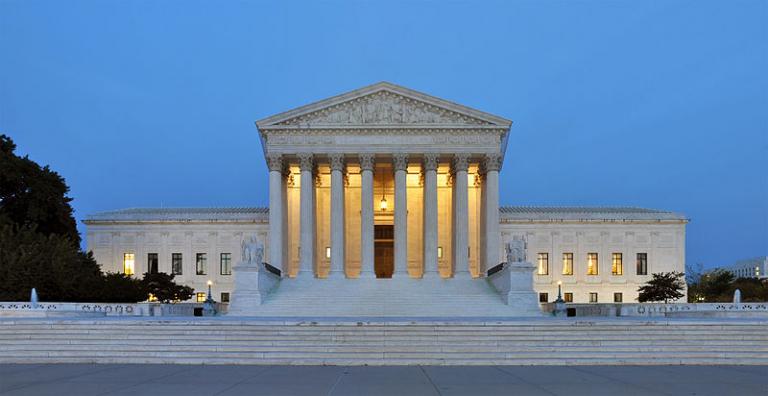
Image: https://commons.wikimedia.org/wiki/File:Panorama_of_United_States_Supreme_Court_Building_at_Dusk.jpg; Joe Ravi [CC BY-SA 3.0 (https://creativecommons.org/licenses/by-sa/3.0)], from Wikimedia Commons
Previous Post

July 5, 2020
Diversity, inclusion, and Olympia Fields
Next Post
July 14, 2020 Yes, 2 + 2 still equals 4
Browse Our Archives
Select a Category Actuarial/Retirement Issues Politics Uncategorized
Select a Month September 2026 August 2026 July 2026 June 2026 April 2026 March 2026 February 2026 January 2026 December 2025 November 2025 October 2025 July 2025 June 2025 May 2025 April 2025 March 2025 February 2025 January 2025 December 2024 November 2024 October 2024 September 2024 August 2024 July 2024 June 2024 May 2024 April 2024 March 2024 February 2024 December 2023 November 2023 October 2023 September 2023 August 2023 July 2023 December 2022 September 2022 August 2022 July 2022 June 2022 May 2022 February 2022 January 2022 December 2021 August 2021 June 2021 April 2021 February 2021 January 2021 December 2020 November 2020 October 2020 September 2020 August 2020 July 2020 June 2020 May 2020 April 2020 March 2020 February 2020 January 2020 December 2019 November 2019 October 2019 September 2019 August 2019 July 2019 June 2019 May 2019 April 2019 March 2019 February 2019 January 2019 December 2018 November 2018 October 2018 September 2018 August 2018 July 2018 June 2018 May 2018 April 2018 March 2018 February 2018 January 2018 December 2017 November 2017 October 2017 September 2017 August 2017 July 2017 June 2017 May 2017 April 2017 March 2017 February 2017 January 2017 December 2016 November 2016 October 2016 September 2016 August 2016 July 2016 June 2016 May 2016 April 2016 March 2016 February 2016 January 2016 December 2015 November 2015 October 2015 September 2015 August 2015 July 2015 June 2015 May 2015 April 2015 March 2015 February 2015 January 2015 December 2014 November 2014 October 2014 September 2014 August 2014 July 2014 June 2014 May 2014 April 2014 March 2014 February 2014 January 2014 December 2013 November 2013 October 2013 September 2013 August 2013 July 2013
Follow Us!
TAKE THE
Religious Wisdom Quiz
Who was the scribe and priest that led a second group back to Jerusalem?
Select your answer to see how you score.
Mordecai Ezra Nehemiah Zerubbabel
Related posts from Jane the Actuary

In which I comment on the Supreme Court...
"Jury refuses to protect 7 year old from...
Are teens being deceived into transgenderism?

Private spaces on the internet?
TRENDING AT PATHEOS Catholic

The Real AI Story Is Adoption Without Trust
Artificial intelligence has crossed a political threshold. It is no longer a...

A new article, written by Jeff Lindsay and Gale L. Pooley,...

Swimfan: Forgotten Aughts Pleasures
This is a recovery effort. In 2002, My Big Fat Greek Wedding...

Top Three Anti-Catholic Lies About Catholicism
This is my initial transcript for the video, "THE 3 WORST...

Pope Leo Celebrates Mass for Nurses & Docs...
I don't have any idea how he did it, but Pope Leo...

The Sermon on the Mount, Part I: Matthew...
The Sermon on the Mount, Part I (Matthew 4:12-5:12) St. Matthew moves...
view all Catholic blogs
Ad-Free & Subscriber Log-In Subscription Support
- About Us
- 2026 Calendar
- Videos
- Podcasts
- Library of World Religions
- Faith In Media Tracker
- Advertise With Us
- Write for Us
- Privacy Policy
- Terms of Service
- Do Not Sell My Data
- Contact Us
- Radiant Digital
- Manage Newsletter Subscriptions
- Unsubscribe From Notifications
- Sitemap
Copyright 2008-2026, Patheos. All rights reserved.
Subscription Support Ad-Free & Subscriber Log-In
Follow Patheos