
BuddhistCatholicContemplativeEvangelicalGeneral ChristianHinduJewishLatter-day SaintMuslimNew VisionsProgressive Christian
Beliefs
- Buddhist
- Catholic
- Contemplative
- Evangelical
- General Christian
- Hindu
- Jewish
- Latter-day Saint
- More Voices
- Muslim
- New Visions
- Pagan
- Progressive Christian
Topics
- Religion News
- Food and Religion
- Sports and Religion
- Religious Art
- Religious Music and Entertainment
- Religious Events
- History and Religion
- Style and Religion
- Politics and Religion
- Women in Religion
- Recreation Outdoors and Religion
- Business Finance and Religion
- Careers Workplace and Religion
- Education and Religion
- Family Parenting and Religion
- Health Fitness and Religion
- Home and Religion
- Relationships and Religion
- Technology and Religion
- Travel and Religion
Columnists
- Buddhist Columnists
- Business Finance and Religion Columnists
- Careers Workplace and Religion Columnists
- Catholic Columnists
- Contemplative Columnists
- Education and Religion Columnists
- Evangelists Columnists
- Family Parenting and Religion Columnists
- General Christian Columnists
- Health Fitness and Religion Columnists
- Hindu Columnists
- History and Religion Columnists
- Home and Religion Columnists
- Jewish Columnists
- More Voices Columnists
- Latter Day Columnists
- Muslim Columnists
- New Visions Columnists
- Nonreligious Columnists
- Pagan Columnists
- Politics and Religion Columnists
- Progressive Columnists
- Recreation Outdoors and Religion Columnists
- Relationships and Religion Columnists
- Religion News Columnists
- Religious Art Columnists
- Religious Events Columnists
- Religious Music and Entertainment Columnists
- Sports and Religion Columnists
- Style and Religion Columnists
- Technology and Religion Columnists
- Travel and Religion Columnists
- Women in Religion Columnists
Resource Library
- 2026 Calendar
- Library of World Religions
- The 100 Most Holy Places on Earth
- Patheos Answers
- Podcasts
- Videos
- Faith Leaders Database
- Anglican Episcopalian
- Bahai
- Baptist
- Buddhism
- Christianity
- Confucianism
- Eastern Orthodoxy
- Hinduism
- Holiness and Pentecostal
- ISKCON
- Islam
- Judaism
- Lutheran
- Methodist
- The Church of Jesus Christ of Latter-day Saints
- New Age
- Paganism
- Presbytarian and Reformed
- Protestantism
- Religion Behind the Scenes
- Roman Catholic
- Scientology
- Shia Islam
- Sikhism
- Sufism
- Sunni Islam
- Taoism
- Zen
- See all religions
Research Tools
 Ad-Free & Subscriber Log-In Subscription Support
Ad-Free & Subscriber Log-In Subscription Support
Follow Patheos 

- Trending:
- Forgiveness
- |
- Marriage
- |
- Consciousness
- |
- Death Penalty
- |
- Election
- |
- Halloween

- Home
- Catholic
- Politics and Religion
- Some notes on a Latin mass
Some notes on a Latin mass
Last updated on: February 21, 2020 at 2:38 pm by Jane the Actuary
Some notes on a Latin mass 2020-02-21T14:38:07-06:00 Jane the Actuary
Patheos Explore the world's faith through different perspectives on religion and spirituality! Patheos has the views of the prevalent religions and spiritualities of the world.
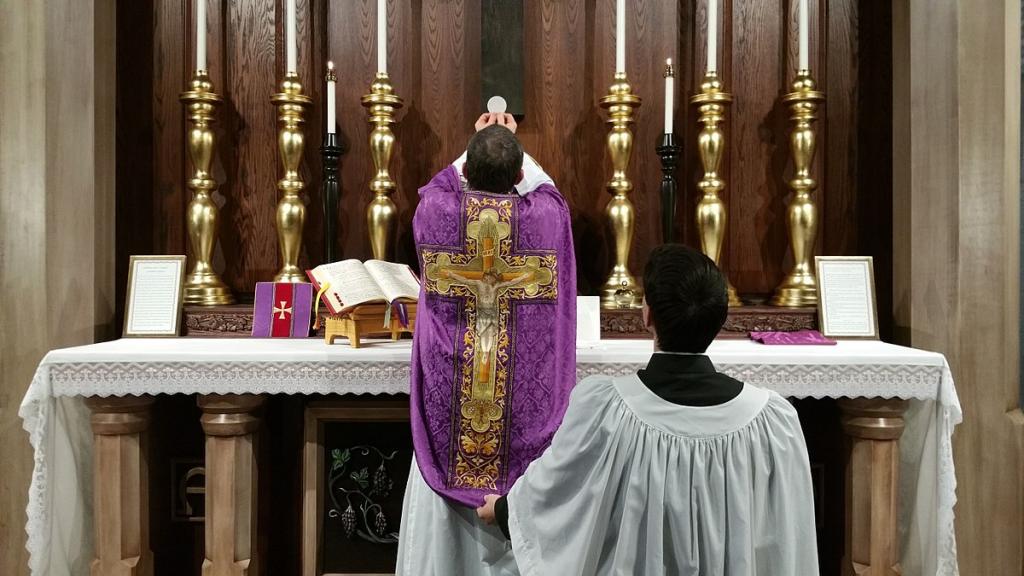
So in the Archdiocese of Chicago, this is Annual Catholic Appeal time. Not a fan, especially for that one week when, rather than a homily, we listen to a recording of the cardinal and are then instructed to fill out pledge cards in the pew, down to a literal script in which the priest says, “In Box 1, put your name. In Box 2, write your street address. Don’t forget your apartment number if you have one,” etc. So, since we were spending the day in Kenosha, I went to the Latin mass offered at one of the churches there.
Here’s my honest reaction:
I expected to be given a booklet with the mass in English and Latin, to follow along with, and I was.
I expected to hear the readings in English and have a homily delivered in English, and so it was.
I expected to see a diversity of ages, and that was true as well — with a preponderance of younger adults, and, interestingly enough, a fair number of small children but not really any grade school or older children, that I could tell, even though grade-school religious ed classes are held in-between the English and Latin mass on Sunday mornings, so there shouldn’t be any schedule conflicts. It was not a packed-to-the-gills church, however, though I didn’t really have an expectation for how many people there “should” have been.
What I did not expect was the silence of the mass.
Sure, maybe I should have, had I done a bit more looking beforehand.
After all, I knew that this sort of mass — the priest going about his business with the server saying the responses — was the norm in pre-Vatican II days. But I had assumed that this had been abandoned by those who prefer to worship with the Latin Mass just as much as with the modern, vernacular mass. Who wouldn’t prefer, given the option, to hear the priest and server? For that matter, in Dad’s old missal, there’s the instruction of how to know which responses are said by the worshippers in “the dialog mass,” and I had understood it to be the case that, before the mass was translated into English, before Vatican II, it had already evolved to the point of having this greater degree of participation.
Now, here’s the description of “The differences between Low Masses and Sung Masses” at a website for a parish which is exclusively Latin-mass:
Low Mass is celebrated by a priest assisted by one or more altar boys. The prayers are spoken (in Latin), and much of the Mass of the Faithful (after the offertory) is almost inaudible, in imitation of the ancient Jewish liturgies given by God to Moses, and emphasizing the fact that we are faced with a profound mystery.
During Low Mass, only the altar servers respond to the priest. The priest alone says the Pater Noster prayer (Our Father), and only he assumes the Orans prayer position (hands extended and held shoulder-width apart). . . .
Sung Mass includes the Asperges before Mass, in which the priest sprinkles the congregation with Holy Water as part of the opening liturgical ceremony. Sung Mass is so called because many of the prayers of the Mass are sung by the priest, choir, or schola. Sung Mass also usually employs the use of incense.
At Sung Mass, the faithful chant the Kyrie, Gloria, Credo, Sanctus and Agnus Dei with the Schola (choir). The congregation also responds to the Priest in chant during multiple points during the Mass.
So what I saw was something in-between: there was a choir singing the mass parts listed, but I didn’t hear so many of the congregants singing as for it to be clear to me that we were “supposed to” (though, let’s face it, with the small numbers, I couldn’t say for certain what the expectation was vs. what people chose to do). And there was incense but no sprinkling rite. And the “inaudible” portion seemed to include not just the post-offertory liturgy but the opening rites and pretty much everything except the readings, which were audible both in Latin and English.
Was this truly “in imitation of the ancient Jewish liturgies given by God to Moses”? Dunno. The Eastern Churches are similar — in fact, have an altar screen behind which the consecration and associated prayers take place. On the other hand, a Q & A at another Latin mass parish describes this as evolving from the High Medieval development of an increasing number of masses being said in monasteries and cathedrals, with the low voice resulting from speaking softly so as to not disturb the priest simultaneously saying mass in an adjacent side chapel.
And the dialog mass was an innovation of the early 20th century, along with the promotion of the printing of missals so that every worshipper could follow along with the mass. But, it turns out, the dialog mass has its opponents, those for whom the difference between the Latin mass and the modern vernacular mass is not merely a matter of the language in which it’s spoken seeming more sacred, or the prayers being more prayerful (because, after all, the novus ordo mass is more — or less — than a translation of the Latin Tridentine mass, and, in fact, for a several year stretch, the Tridentine mass was simply translated into English without the text being altered, prior to the prayers and the overall structure being simplified and shortened). Here’s some text from “The Dialogue Mass, a Tool
to Democratize Liturgy,” an article (part of a long series) which I happened upon in trying to find out what the dialog mass was all about:
It is important not to underestimate the seriousness of the proposal to make the Dialogue Mass the outcome of participation for all the faithful. A centuries-old custom of silent prayer that flowed from the faith and practice of generations of Catholics was about to be abolished, sacrificed on the altar of a destructive egalitarianism in which everyone’s “active participation” – whether clerical or lay – is treated as of equal status.
It was also a totalitarian measure in which the individual is sacrificed to the collective. The faithful, exhorted to join in the collective vocal responses, would no longer be free to choose whichever method of silent participation works best for them. Experience shows that, for those wishing to join their minds and hearts to the Holy Sacrifice being re-enacted on the altar, interior recollection can be distracted by the intrusive voices of others in the pews.
Henceforth, wherever the Dialogue Mass took root, the atmosphere of Catholic worship in the Roman rite would be forever changed as spoken responses drowned silent participation. What is more, silent participation has become a sort of lightning rod for the hatred of liturgical reformers. Indeed, it is now held to be an affront to democratic values in the “age of the laity” inaugurated by Vatican II.
Now, were all my fellow worshippers engaged in private devotions? No idea. Were they experienced enough with the Latin low mass that they knew where the were in the missal rather than trying to figure it out by watching the priest’s actions (left side, right side, center, back again to the left) as I was? Was the appeal of this form of worship, in the end, the silence, or was that of secondary importance?
All of which leaves me curious about this form of worship, even though practicalities dictate that I can’t dig into the issue further. And, after all, it was this form of worship that led Elizabeth Ann Seton to convert from Episcopalianism, writing in her journal:
Mrs. F. took me with her to mass as she calls it, and we say to church — I don’t know how to say the awful effect at being where they told me God was present in the blessed sacrament, and the tall pale meek heavenly looking man who did I don’t know what for I was the side of the alter, so that I could not look up without seeing his countenance on which many lights from the altar reflected, and gave such strange impressions to my soul that I could but cover my face with my ands and let the tears run — oh my the very little while we were there will never be forgotten though I saw nothing and no one, but this more than human person as he seemed to me.
And there I leave it for today, before I continue with the other items on my to-do list.
Image: https://en.wikipedia.org/wiki/File:Traditional_Latin_Mass_-_Elevation.jpg; CC BY 4.0, https://en.wikipedia.org/w/index.php?curid=55169741
Previous Post

February 20, 2020
RIP, Annual Catholic Appeal
Next Post
February 27, 2020 Lenten weight-loss update (and related thoughts)
Browse Our Archives
Select a Category Actuarial/Retirement Issues Politics Uncategorized
Select a Month September 2026 August 2026 July 2026 June 2026 April 2026 March 2026 February 2026 January 2026 December 2025 November 2025 October 2025 July 2025 June 2025 May 2025 April 2025 March 2025 February 2025 January 2025 December 2024 November 2024 October 2024 September 2024 August 2024 July 2024 June 2024 May 2024 April 2024 March 2024 February 2024 December 2023 November 2023 October 2023 September 2023 August 2023 July 2023 December 2022 September 2022 August 2022 July 2022 June 2022 May 2022 February 2022 January 2022 December 2021 August 2021 June 2021 April 2021 February 2021 January 2021 December 2020 November 2020 October 2020 September 2020 August 2020 July 2020 June 2020 May 2020 April 2020 March 2020 February 2020 January 2020 December 2019 November 2019 October 2019 September 2019 August 2019 July 2019 June 2019 May 2019 April 2019 March 2019 February 2019 January 2019 December 2018 November 2018 October 2018 September 2018 August 2018 July 2018 June 2018 May 2018 April 2018 March 2018 February 2018 January 2018 December 2017 November 2017 October 2017 September 2017 August 2017 July 2017 June 2017 May 2017 April 2017 March 2017 February 2017 January 2017 December 2016 November 2016 October 2016 September 2016 August 2016 July 2016 June 2016 May 2016 April 2016 March 2016 February 2016 January 2016 December 2015 November 2015 October 2015 September 2015 August 2015 July 2015 June 2015 May 2015 April 2015 March 2015 February 2015 January 2015 December 2014 November 2014 October 2014 September 2014 August 2014 July 2014 June 2014 May 2014 April 2014 March 2014 February 2014 January 2014 December 2013 November 2013 October 2013 September 2013 August 2013 July 2013
Follow Us!
TAKE THE
Religious Wisdom Quiz
What was the name of the blind beggar Jesus healed near Jericho?
Select your answer to see how you score.
Matthias Bartimaeus Cornelius Simon
Related posts from Jane the Actuary
On her feast day: Elizabeth Ann Seton and...
Is the cruelty the point? Cardinal Cupich's mean-spirited...


Illinois’ Assisted Suicide Law is, yes, literally deadly
TRENDING AT PATHEOS Catholic

When Halloween Unmasks Married Hearts
Written by Dr. David K. Ewen from Eternal Truth Bible College Behind...

Aristotle. He’s been called the father of logic, the father of the...

Methodist Central Hall and Westminster Abbey
Situated on the same square is Methodist Central Hall and Westminster Abbey. ...

57th Dove Awards Honor Dolly Parton, Crown New...
On gospel music’s biggest night, the 57th annual GMA Dove Awards honored...

The First Eucharistic Controversy: Christ’s Real Presence
For Catholics, the Eucharist is the source and summit of the Christian...

What a Stop Sign Can Teach Us About...
How to Make a Decision When You Can't Hear God Main point:...
view all Catholic blogs
Ad-Free & Subscriber Log-In Subscription Support
- About Us
- 2026 Calendar
- Videos
- Podcasts
- Library of World Religions
- Faith In Media Tracker
- Advertise With Us
- Write for Us
- Privacy Policy
- Terms of Service
- Do Not Sell My Data
- Contact Us
- Radiant Digital
- Manage Newsletter Subscriptions
- Unsubscribe From Notifications
- Sitemap
Copyright 2008-2026, Patheos. All rights reserved.
Subscription Support Ad-Free & Subscriber Log-In
Follow Patheos