
BuddhistCatholicContemplativeEvangelicalGeneral ChristianHinduJewishLatter-day SaintMuslimNew VisionsProgressive Christian
Beliefs
- Buddhist
- Catholic
- Contemplative
- Evangelical
- General Christian
- Hindu
- Jewish
- Latter-day Saint
- More Voices
- Muslim
- New Visions
- Pagan
- Progressive Christian
Topics
- Religion News
- Food and Religion
- Sports and Religion
- Religious Art
- Religious Music and Entertainment
- Religious Events
- History and Religion
- Style and Religion
- Politics and Religion
- Women in Religion
- Recreation Outdoors and Religion
- Business Finance and Religion
- Careers Workplace and Religion
- Education and Religion
- Family Parenting and Religion
- Health Fitness and Religion
- Home and Religion
- Relationships and Religion
- Technology and Religion
- Travel and Religion
Columnists
- Buddhist Columnists
- Business Finance and Religion Columnists
- Careers Workplace and Religion Columnists
- Catholic Columnists
- Contemplative Columnists
- Education and Religion Columnists
- Evangelists Columnists
- Family Parenting and Religion Columnists
- General Christian Columnists
- Health Fitness and Religion Columnists
- Hindu Columnists
- History and Religion Columnists
- Home and Religion Columnists
- Jewish Columnists
- More Voices Columnists
- Latter Day Columnists
- Muslim Columnists
- New Visions Columnists
- Nonreligious Columnists
- Pagan Columnists
- Politics and Religion Columnists
- Progressive Columnists
- Recreation Outdoors and Religion Columnists
- Relationships and Religion Columnists
- Religion News Columnists
- Religious Art Columnists
- Religious Events Columnists
- Religious Music and Entertainment Columnists
- Sports and Religion Columnists
- Style and Religion Columnists
- Technology and Religion Columnists
- Travel and Religion Columnists
- Women in Religion Columnists
Resource Library
- 2026 Calendar
- Library of World Religions
- The 100 Most Holy Places on Earth
- Patheos Answers
- Podcasts
- Videos
- Faith Leaders Database
- Anglican Episcopalian
- Bahai
- Baptist
- Buddhism
- Christianity
- Confucianism
- Eastern Orthodoxy
- Hinduism
- Holiness and Pentecostal
- ISKCON
- Islam
- Judaism
- Lutheran
- Methodist
- The Church of Jesus Christ of Latter-day Saints
- New Age
- Paganism
- Presbytarian and Reformed
- Protestantism
- Religion Behind the Scenes
- Roman Catholic
- Scientology
- Shia Islam
- Sikhism
- Sufism
- Sunni Islam
- Taoism
- Zen
- See all religions
Research Tools
 Ad-Free & Subscriber Log-In Subscription Support
Ad-Free & Subscriber Log-In Subscription Support
Follow Patheos 

- Trending:
- Forgiveness
- |
- Marriage
- |
- Consciousness
- |
- Death Penalty
- |
- Election
- |
- Halloween

- Home
- Catholic
- Politics and Religion
- Lenten weight-loss update (and related thoughts)
Lenten weight-loss update (and related thoughts)
Last updated on: February 27, 2020 at 9:48 am by Jane the Actuary
Lenten weight-loss update (and related thoughts) 2020-02-27T09:48:13-06:00 Jane the Actuary
Patheos Explore the world's faith through different perspectives on religion and spirituality! Patheos has the views of the prevalent religions and spiritualities of the world.
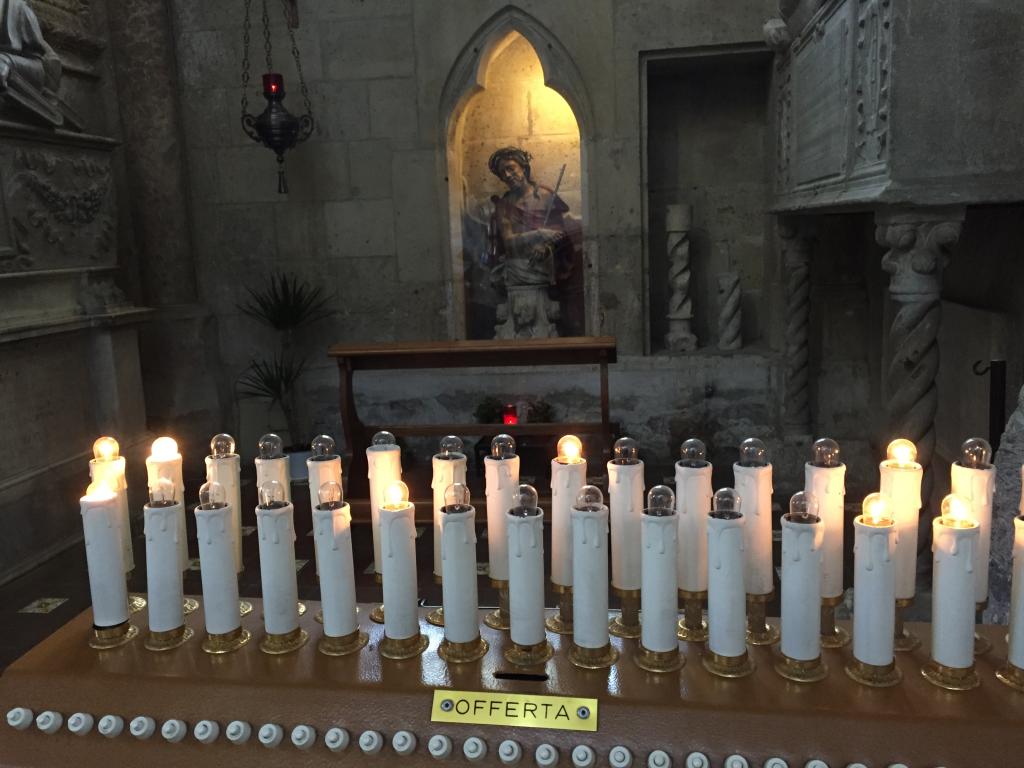
church in Italy; own work
It’s 8:30, the day after Ash Wednesday.
And I’m pleased to report some early success with Lenten weight loss: I’m down half a pound after yesterday’s, well, half-a**ed fast.
OK, so actually, there’s some context there: having gained weight during the summer and more weight during Halloween/Thanksgiving/Science Fair Season, I had already been dieting since New Year’s. (Yes, the norm is to gain weight in the winter, not the summer, but summer is not just the season of being more active, but of taking walks or going on bike rides to destinations such as Dunkin Donuts or an ice cream place. And my son’s science fair project had been about yeast, so he was baking lots of rolls.) And, while the dieting I pursued to take off baby weight in three instances, and at various other points in my adult life, had always meant a Weight Watchers-style points-counting, snack-reducing, generic reduction in “calories in,” and that had kept me at a reasonable weight, that was no longer working after I hit age 40 or so, at which point the only thing that really worked (and even then, my weight inched upwards) were bouts of what I initially called a half-a**ed South Beach Diet and, this time around, I’ve taken to calling a half-a**ed Keto diet — which means, in the first place, that I didn’t obsess over the low-fat requirements that South Beach called for and now I don’t obsess over the high-fat requirements of “true” Keto. And, turns out, the South Beach Diet author has a new book out, in which he pretty much says, “eh, fat’s not so bad, you should eat low-carb on a long-term basis, but you can still get weight-loss benefits without focusing on the “true Keto” fat vs. protein ratios and with, especially in the long-term, a higher ration of carbs. He says, true ketosis isn’t really necessary for anyone except for those with certain medical conditions.
Anyway, I haven’t actually lost all that much weight. In part, there’s a bit of a bait-and-switch going on: this and similar books promise that the key is cutting out carbs, but then they provide sample meal plans that turn out to pair no-carb eating with calorie reduction. So there was a bit of an ah-ha moment when I realized that I needed to cut down snacking rather than merely accustom myself to low-carb snacks. I had also set myself an initial goal: after I lose X pounds, I get to start enjoying low-carb treats. But I discovered that the snack bars I had been enjoying (Atkins branded, no less) were using a form of artificial sweetener (malitol) which is perhaps better than eating a full-sugar product, but not a “free lunch” after all.
So the weight-loss effort that I had hoped to have been finished with before Lent (for the pragmatic reason that I’m not a fan of seafood and constructing meatless meals which are also low-carb is no mean feat), is still ongoing. Therefore, I am “giving up carbs for Lent,” for what it’s worth.
I have also been attempting to get into a routine of exercising, and have been reasonably successful at the goal of going over to the cut-rate fitness center three times a week, after the kids have left for school. But at the same time, I’ve gotten into the practice of getting up later than I used to, and getting a late start on actually, well, working — whether that means writing or another freelancer-y project or something housewife-y — so I have another Lenten resolve, that of getting up when the alarm clock goes off, rather than hitting the snooze repeatedly.
Am I doing Lent “right”?
Many of you would likely say “no.” (OK, many of you aren’t actually Catholic, but among my Catholic readers, many of you would say “no.”)
Lent isn’t about self-improvement, after all. Getting up earlier than usual? That might be acceptable if paired with, say, Bible reading or rosary-praying. A change in diet? Maybe the version the college-me practiced would have been OK; then, my cutting out sweets wasn’t about weight loss because the moderate weight loss I experienced wasn’t really necessary and just moved me around slightly within the window of “somewhat on the slender side but not overly much so.” Granted, even then, it wasn’t done for spiritual reasons (heck, I wasn’t even Catholic), but more a matter of pushing myself to be self-disciplined about something.
But I tend to be of the opinion that it’s entirely acceptable to engage in a discipline even if you don’t have a spiritual motivation to go along with it. I likewise reject the idea that abstaining from meat on Fridays must be “spiritual” and entail “suffering” and/or “helping others by choosing a meatless meal that’s less tasty than the meat you’d usually eat, and less expensive than otherwise, to give the difference to the poor. Not eating meat on Lenten Fridays is only partly about penance; it’s also about doing a Thing that’s shared with the entire Catholic church, even if that particular practice doesn’t suit you individually.
And, of course, this is more than just a Lent issue. It’s a question I’ve raised on other occasions (though I’m not going to try to hunt down the links now): how important are spiritual practices to being a “good Christian”? If I believe (or assent to) the doctrines the Church teaches, if I attend mass weekly and otherwise do my best to avoid sin, if I tack onto that some reasonable efforts at volunteering, is it also necessary to add onto that a regular prayer life and/or other spiritual practices? Or are these more what you’d call “best practices” that are beneficial for those who do them? And, after all, I’d be happy to participate in the sorts of practices that have, in the past, been meaningful to me — a Vespers or other Liturgy of the Hours service, chant, other sorts of corporate prayer. But they don’t really exist in suburban Chicago. (And no, I don’t have the resources — that is, the Social Capital — to implement these at my local parish.) I attended a Stations of the Cross at my parish once, and the prayer booklet (from the 70s or so) was just really off-kilter and seemed at various points to have doctrinal error, though, I admit, that was so long ago I don’t recall the details. And a rosary or the notion of “spend some time talking to God” just doesn’t work for me — I spend my time instead, talking to myself about what I should be doing. Reading the Bible reflectively and prayerfully? Morning devotions? Tried it — I read for content and wasn’t able to shift into what I imagined reading in a prayerful manner should be.
And there’s, of course, another point of view as well — those who call for Lenten sacrifices to be directed at charitable works, that is, of the triad of “fasting, prayer, and almsgiving,” they deem as worthwhile the first two only insofar as it produces the third: use the proceeds from your reduced food purchases to give to others and use your prayer to motivate you to help others, or be a better person generally speaking (that is, pray to be better able to let go of grudges or be a better parent).
So this is the point where I solicit reader opinions. Is there a mandate to engage in prayer of one sort or another? Is it scriptural, or just a sort of conventional wisdom? What say you?
Previous Post

February 21, 2020
Some notes on a Latin mass
Next Post
March 1, 2020 Afghanistan, Vietnam, and the limits of power
Browse Our Archives
Select a Category Actuarial/Retirement Issues Politics Uncategorized
Select a Month September 2026 August 2026 July 2026 June 2026 April 2026 March 2026 February 2026 January 2026 December 2025 November 2025 October 2025 July 2025 June 2025 May 2025 April 2025 March 2025 February 2025 January 2025 December 2024 November 2024 October 2024 September 2024 August 2024 July 2024 June 2024 May 2024 April 2024 March 2024 February 2024 December 2023 November 2023 October 2023 September 2023 August 2023 July 2023 December 2022 September 2022 August 2022 July 2022 June 2022 May 2022 February 2022 January 2022 December 2021 August 2021 June 2021 April 2021 February 2021 January 2021 December 2020 November 2020 October 2020 September 2020 August 2020 July 2020 June 2020 May 2020 April 2020 March 2020 February 2020 January 2020 December 2019 November 2019 October 2019 September 2019 August 2019 July 2019 June 2019 May 2019 April 2019 March 2019 February 2019 January 2019 December 2018 November 2018 October 2018 September 2018 August 2018 July 2018 June 2018 May 2018 April 2018 March 2018 February 2018 January 2018 December 2017 November 2017 October 2017 September 2017 August 2017 July 2017 June 2017 May 2017 April 2017 March 2017 February 2017 January 2017 December 2016 November 2016 October 2016 September 2016 August 2016 July 2016 June 2016 May 2016 April 2016 March 2016 February 2016 January 2016 December 2015 November 2015 October 2015 September 2015 August 2015 July 2015 June 2015 May 2015 April 2015 March 2015 February 2015 January 2015 December 2014 November 2014 October 2014 September 2014 August 2014 July 2014 June 2014 May 2014 April 2014 March 2014 February 2014 January 2014 December 2013 November 2013 October 2013 September 2013 August 2013 July 2013
Follow Us!
TAKE THE
Religious Wisdom Quiz
What did God create on the first day?
Select your answer to see how you score.
Light Plants Water Animals
Related posts from Jane the Actuary
Can we -- should we -- pray for...

"Lent-to-date" weight loss: 2 pounds

Do you believe in [God's intervention/fate/karma] in the...

TRENDING AT PATHEOS Catholic

57th Dove Awards Honor Dolly Parton, Crown New...
On gospel music’s biggest night, the 57th annual GMA Dove Awards honored...

The First Eucharistic Controversy: Christ’s Real Presence
For Catholics, the Eucharist is the source and summit of the Christian...

What a Stop Sign Can Teach Us About...
How to Make a Decision When You Can't Hear God Main point:...

Archdiocese Hosts Military Marriage Retreat in Germany
RASTATT, Germany — The transient military lifestyle, with its frequent deployments and...

Nearly every morning, I make the drive to Detroit with my high-school-age...

The Real AI Story Is Adoption Without Trust
Artificial intelligence has crossed a political threshold. It is no longer a...
view all Catholic blogs
Ad-Free & Subscriber Log-In Subscription Support
- About Us
- 2026 Calendar
- Videos
- Podcasts
- Library of World Religions
- Faith In Media Tracker
- Advertise With Us
- Write for Us
- Privacy Policy
- Terms of Service
- Do Not Sell My Data
- Contact Us
- Radiant Digital
- Manage Newsletter Subscriptions
- Unsubscribe From Notifications
- Sitemap
Copyright 2008-2026, Patheos. All rights reserved.
Subscription Support Ad-Free & Subscriber Log-In
Follow Patheos