
BuddhistCatholicContemplativeEvangelicalGeneral ChristianHinduJewishLatter-day SaintMuslimNew VisionsProgressive Christian
Beliefs
- Buddhist
- Catholic
- Contemplative
- Evangelical
- General Christian
- Hindu
- Jewish
- Latter-day Saint
- More Voices
- Muslim
- New Visions
- Pagan
- Progressive Christian
Topics
- Religion News
- Food and Religion
- Sports and Religion
- Religious Art
- Religious Music and Entertainment
- Religious Events
- History and Religion
- Style and Religion
- Politics and Religion
- Women in Religion
- Recreation Outdoors and Religion
- Business Finance and Religion
- Careers Workplace and Religion
- Education and Religion
- Family Parenting and Religion
- Health Fitness and Religion
- Home and Religion
- Relationships and Religion
- Technology and Religion
- Travel and Religion
Columnists
- Buddhist Columnists
- Business Finance and Religion Columnists
- Careers Workplace and Religion Columnists
- Catholic Columnists
- Contemplative Columnists
- Education and Religion Columnists
- Evangelists Columnists
- Family Parenting and Religion Columnists
- General Christian Columnists
- Health Fitness and Religion Columnists
- Hindu Columnists
- History and Religion Columnists
- Home and Religion Columnists
- Jewish Columnists
- More Voices Columnists
- Latter Day Columnists
- Muslim Columnists
- New Visions Columnists
- Nonreligious Columnists
- Pagan Columnists
- Politics and Religion Columnists
- Progressive Columnists
- Recreation Outdoors and Religion Columnists
- Relationships and Religion Columnists
- Religion News Columnists
- Religious Art Columnists
- Religious Events Columnists
- Religious Music and Entertainment Columnists
- Sports and Religion Columnists
- Style and Religion Columnists
- Technology and Religion Columnists
- Travel and Religion Columnists
- Women in Religion Columnists
Resource Library
- 2026 Calendar
- Library of World Religions
- The 100 Most Holy Places on Earth
- Patheos Answers
- Podcasts
- Videos
- Faith Leaders Database
- Anglican Episcopalian
- Bahai
- Baptist
- Buddhism
- Christianity
- Confucianism
- Eastern Orthodoxy
- Hinduism
- Holiness and Pentecostal
- ISKCON
- Islam
- Judaism
- Lutheran
- Methodist
- The Church of Jesus Christ of Latter-day Saints
- New Age
- Paganism
- Presbytarian and Reformed
- Protestantism
- Religion Behind the Scenes
- Roman Catholic
- Scientology
- Shia Islam
- Sikhism
- Sufism
- Sunni Islam
- Taoism
- Zen
- See all religions
Research Tools
 Ad-Free & Subscriber Log-In Subscription Support
Ad-Free & Subscriber Log-In Subscription Support
Follow Patheos 

- Trending:
- Forgiveness
- |
- Marriage
- |
- Consciousness
- |
- Death Penalty
- |
- Election
- |
- Halloween

- Home
- Catholic
- Politics and Religion
- Does it matter if your ancestors owned slaves?
Does it matter if your ancestors owned slaves?
Last updated on: February 7, 2020 at 9:19 am by Jane the Actuary
Does it matter if your ancestors owned slaves? 2020-02-07T09:19:04-06:00 Jane the Actuary
Patheos Explore the world's faith through different perspectives on religion and spirituality! Patheos has the views of the prevalent religions and spiritualities of the world.
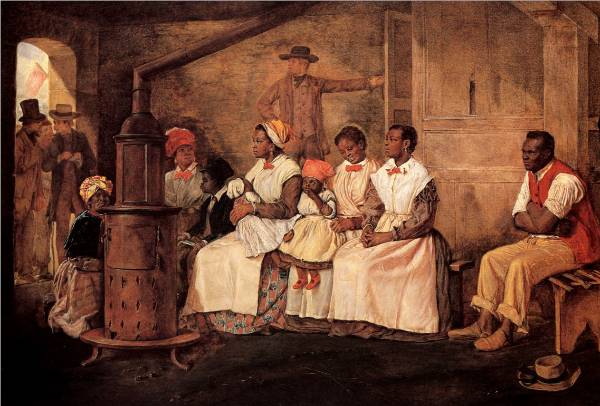
https://commons.wikimedia.org/wiki/File:Crowe-Slaves_Waiting_for_Sale_-_Richmond,_Virginia.jpg; Eyre Crowe [Public domain]
Yes, after a break of over two years, I am trying to get back to the family history project, if for no other reason than to save off information and cancel an ongoing subscription to Ancestry.com. In my last post on the subject, I wrote about the mystery of the Lutheran great-grandmother whose father and died-in-infancy sisters were buried in a Catholic cemetery. Now I’ve made another discovery, and it goes like this:
Richard Stapleton was a son of an Irish immigrant to Quebec, who then found his way to the American south, where he married a woman named Elmina, had a son, also Richard, then moved to St. Louis after his son was grown, where the younger Richard married my great-grandmother (where he promptly fathered two children, one of whom was my grandmother and the other died in infancy, before he himself died in a motorcycle crash) and the older Richard married her older (by two years) sister.
But who was Elmina?
There’a a marriage certificate for an Elmina Ussery who married a Richard Stapleton in roughly the right location, but a couple years after baby Richard’s birth.
Is this her? Why would the marriage date be after the boy’s birth, in a time and place when, well, this just wasn’t done? (And the family wasn’t poor — he was sent to a boarding school.) But what could make sense is this: Richard was an only child, and and when the older Richard remarried, they never had children even though his wife was literally young enough to be his daughter. Was he unable to father children, and was he really Richard’s stepfather? At any rate, the DNA matching algorithm for Ancestry comes up empty as to any possible Stapleton matches, and the ethnicity analysis reports that I have no Irish ancestry.
But could I gain more confidence that the Elmina in question is really Elmina Ussery in another way?
Turns out, Elmina Ussery is not a particularly common name, so it’s easy to find the family in census records: in 1880, she’s 13, the daughter of Isabel, and she works in a cotton factory, along with her widowed mother. In 1870, mom is a widowed seamstress. In 1860, as Isabel Sanders, she married Welcome Ussery, according to marriage records.
Is this enough to go on? I was able to learn more thanks to the magic of the public-to-members family trees, one of which included Welcome, Isabel, and the rest, and also went back several more generations in the past. Welcome’s father was John Ussery, and John’s father was Thomas Ussery, and John had a brother named Robert Jackson Ussery.
And this is where the Ancestry DNA matches come in: it’s possible to search for a particular surname in the family trees of members who have done DNA testing. And – bingo! I have DNA matches with several individuals who trace their ancestry to Thomas Usery.
So, yay, me, I can fill in a bit more of the family tree.
But there’s more.
Thomas Ussery was born in 1740.
Thomas Ussery is in the family tree of multiple dozens of members, and among the documents they have included in their trees is an application for a pension for Revolutionary War veterans. So that’s cool, I guess, that my ancestors are not merely homesteaders in Nebraska and downtrodden washerwomen in St. Louis, but that I would actually be eligible for DAR membership.
And then I clicked further back in the family trees. I still need to pull all of this together (one of the trees seems to skip a generation, with Thomas’s father born in 1660 and fathering Thomas at the age of 80), but another member traced the Usserys back to the late 1400s and the Sir Edward I Watson family of Rockingham Castle in England — in other words, actual English nobility.
But here’s the third discovery: Thomas Ussery left behind a will, in which he bequeaths to his children a total of 9 slaves, dividing them up among his children — and, in fact, he had bunches of children, not all of whom got a slave. Now, the details aren’t clear to me — another document shows an 840-acre farm, but only one of the slaves was slated to go to the son who inherited his property, which suggests that the slaves were used for general household duties rather than providing essential labor for the farm — unless, by the time of the will, that farm had already been divided up or he had stepped back from managing the farm in favor of his heir who himself already owned the slaves who ran the farm. And of the slaves, some are referred to as “girls,” others as “boys” and others as “men” — were these families being split up?
And, again, Thomas Ussery had bunches of children, and my presumed ancestor John was among the youngest, and inherited nothing, and his son Welcome is hardly recognizable as a descendant of English nobility — in 1850, he’s a schoolteacher whose wife (we presume she died before he married Isabel) could not read or write, and in 1860, he’s a bookkeeper living in a boardinghouse, and in 1880, his widow is so poor she must send her 13 year old daughter to the cotton factory.
So what does it mean to have a slave-owning ancestor? I’m inclined to think “nothing at all.” To the extent that the United States, as an entity, directly engaged in acts of slaveowning, then the United States as a corporate entity bears the fault, in much the same way as a corporation found to have engaged in fraud is at fault, not individual stockholders, and those same stockholders can’t say, “don’t punish the company because that would be unfair to those of us who bought stock after the fraud was perpetrated.”
And, of course, the whole issue is muddier than that, because the “United States” as an entity came into existence after slavery was already established by the colonial authorities, and the fact that the “United States” was in fact comprised of states pursuing their own interests, some never having any slaveowning economy, others emancipating their slaves voluntarily, and others having entrenched economic interests in slaveholding which resulted in the recurring conflict and crises and compromises with nonslave states, in which there was no “United States” pursuing policy as a single entity.
(Which, of course, suggests that the proper venue for any reparations claims is not the federal government, but individual state governments, some of which were very aggressive about protecting the institution of slavery.)
But of course, that’s the challenge in a country with immigration and diversity — what does it mean for a set of events in the past to be “our history” as Americans? Is it important for me, as the great-great-granddaughter of homesteaders, to reflect on the fact that they settled on land from which indigenous people were forced to leave? And, in that case, do individuals whose immigration is more recent get a “pass” — or do they bear an obligation to reflect on the misdeeds of their ancestors in their native country instead? But if that’s the case, how can we, as a country, be a people with a national identity, and with an appropriate sense of patriotism that says, “we’re all in this together and the well-being of all my fellow countrymen matters”?
And on the third hand — well, at the same time, it is cool to be able to find connections to old documents and events in history, but more as a matter of connection to those stories (which, again, are much more a matter of servants and washerwomen and farmers and lumberjacks than noble families) than any sense of achievement.
So anyway, those are my thoughts for today.
Previous Post

January 30, 2020
The polarization of America, part N: sex and politics and the GSS
Next Post
February 8, 2020 Confessions of a Never-Dem-er
Browse Our Archives
Select a Category Actuarial/Retirement Issues Politics Uncategorized
Select a Month September 2026 August 2026 July 2026 June 2026 April 2026 March 2026 February 2026 January 2026 December 2025 November 2025 October 2025 July 2025 June 2025 May 2025 April 2025 March 2025 February 2025 January 2025 December 2024 November 2024 October 2024 September 2024 August 2024 July 2024 June 2024 May 2024 April 2024 March 2024 February 2024 December 2023 November 2023 October 2023 September 2023 August 2023 July 2023 December 2022 September 2022 August 2022 July 2022 June 2022 May 2022 February 2022 January 2022 December 2021 August 2021 June 2021 April 2021 February 2021 January 2021 December 2020 November 2020 October 2020 September 2020 August 2020 July 2020 June 2020 May 2020 April 2020 March 2020 February 2020 January 2020 December 2019 November 2019 October 2019 September 2019 August 2019 July 2019 June 2019 May 2019 April 2019 March 2019 February 2019 January 2019 December 2018 November 2018 October 2018 September 2018 August 2018 July 2018 June 2018 May 2018 April 2018 March 2018 February 2018 January 2018 December 2017 November 2017 October 2017 September 2017 August 2017 July 2017 June 2017 May 2017 April 2017 March 2017 February 2017 January 2017 December 2016 November 2016 October 2016 September 2016 August 2016 July 2016 June 2016 May 2016 April 2016 March 2016 February 2016 January 2016 December 2015 November 2015 October 2015 September 2015 August 2015 July 2015 June 2015 May 2015 April 2015 March 2015 February 2015 January 2015 December 2014 November 2014 October 2014 September 2014 August 2014 July 2014 June 2014 May 2014 April 2014 March 2014 February 2014 January 2014 December 2013 November 2013 October 2013 September 2013 August 2013 July 2013
Follow Us!
TAKE THE
Religious Wisdom Quiz
Who predicted Jesus' betrayal price?
Select your answer to see how you score.
Zechariah Daniel Isaiah Jeremiah
Related posts from Jane the Actuary
About Amelia Wittkoetter (for Women's History Month)

Have you taken an ancestry-type DNA test?

My latest family history (non-)discoveries
TRENDING AT PATHEOS Catholic

Methodist Central Hall and Westminster Abbey
Situated on the same square is Methodist Central Hall and Westminster Abbey. ...

57th Dove Awards Honor Dolly Parton, Crown New...
On gospel music’s biggest night, the 57th annual GMA Dove Awards honored...

The First Eucharistic Controversy: Christ’s Real Presence
For Catholics, the Eucharist is the source and summit of the Christian...

What a Stop Sign Can Teach Us About...
How to Make a Decision When You Can't Hear God Main point:...

Archdiocese Hosts Military Marriage Retreat in Germany
RASTATT, Germany — The transient military lifestyle, with its frequent deployments and...

Nearly every morning, I make the drive to Detroit with my high-school-age...
view all Catholic blogs
Ad-Free & Subscriber Log-In Subscription Support
- About Us
- 2026 Calendar
- Videos
- Podcasts
- Library of World Religions
- Faith In Media Tracker
- Advertise With Us
- Write for Us
- Privacy Policy
- Terms of Service
- Do Not Sell My Data
- Contact Us
- Radiant Digital
- Manage Newsletter Subscriptions
- Unsubscribe From Notifications
- Sitemap
Copyright 2008-2026, Patheos. All rights reserved.
Subscription Support Ad-Free & Subscriber Log-In
Follow Patheos