
BuddhistCatholicContemplativeEvangelicalGeneral ChristianHinduJewishLatter-day SaintMuslimNew VisionsProgressive Christian
Beliefs
- Buddhist
- Catholic
- Contemplative
- Evangelical
- General Christian
- Hindu
- Jewish
- Latter-day Saint
- More Voices
- Muslim
- New Visions
- Pagan
- Progressive Christian
Topics
- Religion News
- Food and Religion
- Sports and Religion
- Religious Art
- Religious Music and Entertainment
- Religious Events
- History and Religion
- Style and Religion
- Politics and Religion
- Women in Religion
- Recreation Outdoors and Religion
- Business Finance and Religion
- Careers Workplace and Religion
- Education and Religion
- Family Parenting and Religion
- Health Fitness and Religion
- Home and Religion
- Relationships and Religion
- Technology and Religion
- Travel and Religion
Columnists
- Buddhist Columnists
- Business Finance and Religion Columnists
- Careers Workplace and Religion Columnists
- Catholic Columnists
- Contemplative Columnists
- Education and Religion Columnists
- Evangelists Columnists
- Family Parenting and Religion Columnists
- General Christian Columnists
- Health Fitness and Religion Columnists
- Hindu Columnists
- History and Religion Columnists
- Home and Religion Columnists
- Jewish Columnists
- More Voices Columnists
- Latter Day Columnists
- Muslim Columnists
- New Visions Columnists
- Nonreligious Columnists
- Pagan Columnists
- Politics and Religion Columnists
- Progressive Columnists
- Recreation Outdoors and Religion Columnists
- Relationships and Religion Columnists
- Religion News Columnists
- Religious Art Columnists
- Religious Events Columnists
- Religious Music and Entertainment Columnists
- Sports and Religion Columnists
- Style and Religion Columnists
- Technology and Religion Columnists
- Travel and Religion Columnists
- Women in Religion Columnists
Resource Library
- 2026 Calendar
- Library of World Religions
- The 100 Most Holy Places on Earth
- Patheos Answers
- Podcasts
- Videos
- Faith Leaders Database
- Anglican Episcopalian
- Bahai
- Baptist
- Buddhism
- Christianity
- Confucianism
- Eastern Orthodoxy
- Hinduism
- Holiness and Pentecostal
- ISKCON
- Islam
- Judaism
- Lutheran
- Methodist
- The Church of Jesus Christ of Latter-day Saints
- New Age
- Paganism
- Presbytarian and Reformed
- Protestantism
- Religion Behind the Scenes
- Roman Catholic
- Scientology
- Shia Islam
- Sikhism
- Sufism
- Sunni Islam
- Taoism
- Zen
- See all religions
Research Tools
 Ad-Free & Subscriber Log-In Subscription Support
Ad-Free & Subscriber Log-In Subscription Support
Follow Patheos 

- Trending:
- Forgiveness
- |
- Marriage
- |
- Consciousness
- |
- Death Penalty
- |
- Election
- |
- Halloween

- Home
- Catholic
- Politics and Religion
- We’re burying people all wrong!
We’re burying people all wrong!
Last updated on: November 20, 2019 at 10:24 am by Jane the Actuary
We’re burying people all wrong! 2019-11-20T10:24:41-06:00 Jane the Actuary
Patheos Explore the world's faith through different perspectives on religion and spirituality! Patheos has the views of the prevalent religions and spiritualities of the world.
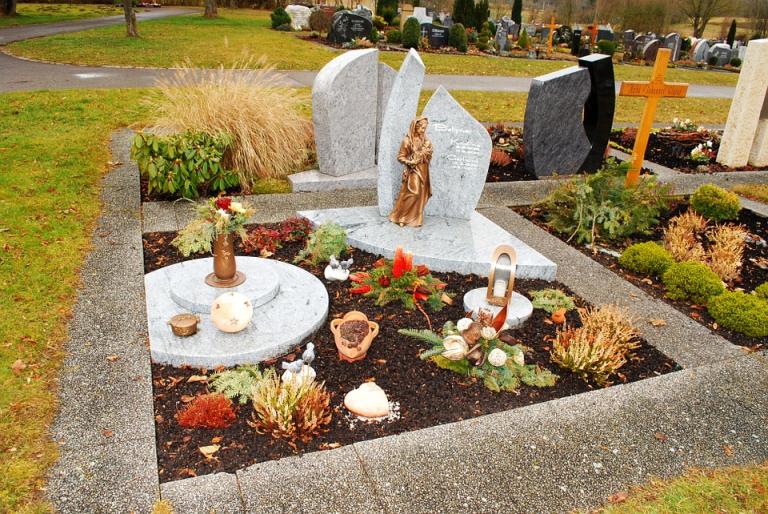
https://pixabay.com/en/german-grave-cemetery-headstone-275580/
So this morning, Pew published an article on consumer interest in “green burial” and the lack of available spaces, and the state regulations that get in the way of such options. And my first thought was, “hey, I wrote about that!” but then I couldn’t find the article, and ultimately figured out that it had been sitting in draft form for the past two years. (I had orginally hoped to publish it elsewhere, but couldn’t find any takers, and then I must have wanted to go through and check links or verify that there weren’t any new articles I should include.) But based on that Pew article, nothing much has really changed.
Bottom line: we should all be able to be buried in a way that allows our corpses to decompose, naturally. And here’s what I wrote two years ago:
***************************************
Not long ago, the AP produced an article on the main cemetery in Jerusalem, which is undergoing a dramatic “remodeling”; in the same way as dense cities grow upward with skyscrapers, so too, they’re building the reverse, a multi-story underground cemetery, in which one takes an elevator to visit the gravesite of one’s departed relative. This is not new, and “vertical cemeteries” already exist elsewhere — Brazil’s 32-story high Memorial Necropole Ecumenica is the tallest cemetery in the world — but what’s novel about the cemetery in Jerusalem is its tunnelling and mutiple underground levels.
The world over, people are coming up with innovative ways to bury the dead due to shortages of burial space. In Japan, futuristic cemeteries store cremains in storage lockers, and descendants can visit by calling up the loved one via key card. In Hong Kong, architects have proposed a “floating cemetery.” In China, the government is promoting shared burial plots, smaller gravesites, and scattering ashes.
And in Europe?
In Germany, grave plots are leased for periods of 15 – 25 years, at which point one’s family may choose to renew the lease or let it lapse; the expectation is that the body will have decomposed by this point, though, according to Der Spiegel, depending on soil conditions, it doesn’t always work out. Cemeteries in the Netherlands function similarly, with leases of 10 – 20 years. In France, burial plots can be reserved for as long as 99 years. In Greece, after three years, that is, without allowing enough time for decomposition, bodies are exhumed and bones placed in a communal ossuary.
But speaking from my own experience with respect to Germany, this actually works out rather nicely. In the United States, after all, for the most part, gravesites are simple markers, since the need to offer perpetual care results in the need to offer economical care, and since, for large numbers of burial plots, descendants are likewise long gone, or at least moved away. In Germany, each individual gravesite — which might be a site for a husband and wife, or multiple generations — has its own flower bed, marked by a border, and it’s up to the family to care for the grave, by planting and watering flowers. (In some cases, this tradition is slipping and the flower bed is replaced by a decorative rock covering and a flower pot, or by perennial ground cover.) As long as there’s someone to remember the departed loved one, the grave is tended and the lease is renewed. As an alternative to embalming, bodies are kept “presentable” if a funeral is delayed, by being cooled in the meantime, given that our technology has, after all, advanced from the Civil War era.
But this practice doesn’t work for all German residents; specifically, Turkish migrants to Germany, and even second and third generation ethnic Turks, are sending their deceaseds’ bodies back to Turkey to be buried, because
the German practice of limiting the duration of burial sites clashes with the Muslim tradition that the dead must be allowed eternal peace. In Berlin, the leases on graves span 20 years, after which they have to be renewed. Otherwise the site is cleared for reuse.
And, akin to the Muslims in Germany, we too in the United States think of a cemetery as not just a final but a perpetual “resting place.” We may not visit those graves, but we expect them to be there, forever. We expect to be able to find our grandparents, and great-grandparents, and great-grandparents’ graves, even when our own parents had long since moved away.
As a result, we have literal abandoned cemeteries, as well as near-abandoned cemeteries. For example, the Jewish cemetery which was the site of vandalism in Philadelphia in early 2017, was a closed cemetery, maintained by a neighboring active cemetery; the Jewish community itself had long since moved away from that neighborhood, and vandalism or, more generally, damage, was apparent long before the February vandalism was reported.
Why are our practices so different than the continental Europeans? In the U.K., to be sure, as reported by The Guardian, cemeteries are just now beginning to re-use graves, but up until the Burial Act of 1957, reusing graves was common, so that the early settlers should have had no cultural objection to grave re-use. But presumably in our colonial past, burial space was such a non-issue that there was no need to even consider reuse, until it had become forgotten about and the very idea became shocking.
Could we now move to a grave-reuse system? It would require a change in laws, which currently prohibit any disturbance of graves, except in the case of an heir adding another family member to the site. It would require a change in burial practices — the practice of embalming, and the consequent requirement of a concrete vault to protect the soil from the embalming chemicals, would have to be done away with, and practices more similar to a Jewish burial (no embalming, exposure of the casket to the ground, with no concrete vault, but, at most, a liner above the casket to keep the soil level) would need to be commonplace.
And, what’s more difficult, it would require a cultural change. Regardless of the reason for our custom of perpetual gravesites, it’s now imbued with meaning: individual gravesites, one per person, in perpetuity, speak to the importance of each individual. The perpetually-preserved gravesite has become a moral issue, and Americans view it as morally offensive to do otherwise. And our burial practices seek to mask and delay, however possible, the ultimate decay of the body, and imagine that, with concrete vaults, we are “protecting” the body.
The perpetuity of existing graves means increasing numbers of Americans, to save costs, and because they too find standard burial methods undesirable, elect cremation instead. But here, too, if they elect a columbarium, the cemetery/columbarium site still promises “perpetual care.” In contrast, in Germany, cremated remains are given the same respect in burial as traditionally-buried bodies, to the point where, until recently, cemetery burial was the only legal disposal option, but at the same time, they follow the same “lease” practices. In fact, in the United States, our culture around burial has left funeral homes struggling to store unclaimed cremains, because there is no culturally-normative practice for the handling of these ashes.
One might say that so-called “green burials” are the closest in the United States to a German-style system: no embalming and a burial process that intends to result in decomposition. In some cases, such as The Meadow in Virginia, families can choose between perpetual and “successive” (50-year) sites. In other such “natural” cemeteries, the gravesites are permanently protected with a conservation easement. But “green burials,” few in number in any case, swing too far in the opposite direction for most Americans — there is no headstone to mark the grave, and, with the few numbers of such cemeteries and the “conservation” nature of the land, they are distant enough as to make visiting the gravesite impractical.
More years ago than I care to admit, my high school composition teacher used as an example of “thinking outside the box” for persuasive speech topic, a boy in a prior class who spoke about the coming shortage of grave sites. Not long ago, Fortune reported on the increasing difficulty city-dwellers will have with finding burial space.
Many urban cemeteries in some of the biggest cities in the U.S. are experiencing a land shortage and face the prospect of running out of room for more bodies in the near future. . . .
According to the National Funeral Directors Association, cremation in the U.S. has reached an all-time high, with more than 50% of all funerals involving cremation as of 2016. The study projects that by 2035, nearly 80% of all burials will be cremations. . . .
“The day will come when it [will be] difficult to find space for someone to buy a burial plot,” [funeral home director Jack] Mitchell said. “For millennials, it’ll become a consideration more than now.”
And, much as it’s cool to find one’s great-grandmother’s tombstone and even have a bit of family history filled in (what happened to great-great-aunt Anne? Oh, she died young), it would be a deeply unfortunate bit of generational inequity if, in order to preserve centuries-old tombstones, the coming generations lose the ability for any sort of (nearby) burial as cemeteries fill.
So someday I want a flower garden on my tomb, and I want my grandchildren to stop by occasionally and pay their respects. But when they’ve passed on, too, or have moved away, and the only way I’m remembered is as a name on a family tree, then let the next generation take my spot.
Previous Post

November 13, 2019
L'Eglise, C'est -- Francis?
Next Post

December 3, 2019 It's Giving Tuesday. Let's talk about giving.
Browse Our Archives
Select a Category Actuarial/Retirement Issues Politics Uncategorized
Select a Month September 2026 August 2026 July 2026 June 2026 April 2026 March 2026 February 2026 January 2026 December 2025 November 2025 October 2025 July 2025 June 2025 May 2025 April 2025 March 2025 February 2025 January 2025 December 2024 November 2024 October 2024 September 2024 August 2024 July 2024 June 2024 May 2024 April 2024 March 2024 February 2024 December 2023 November 2023 October 2023 September 2023 August 2023 July 2023 December 2022 September 2022 August 2022 July 2022 June 2022 May 2022 February 2022 January 2022 December 2021 August 2021 June 2021 April 2021 February 2021 January 2021 December 2020 November 2020 October 2020 September 2020 August 2020 July 2020 June 2020 May 2020 April 2020 March 2020 February 2020 January 2020 December 2019 November 2019 October 2019 September 2019 August 2019 July 2019 June 2019 May 2019 April 2019 March 2019 February 2019 January 2019 December 2018 November 2018 October 2018 September 2018 August 2018 July 2018 June 2018 May 2018 April 2018 March 2018 February 2018 January 2018 December 2017 November 2017 October 2017 September 2017 August 2017 July 2017 June 2017 May 2017 April 2017 March 2017 February 2017 January 2017 December 2016 November 2016 October 2016 September 2016 August 2016 July 2016 June 2016 May 2016 April 2016 March 2016 February 2016 January 2016 December 2015 November 2015 October 2015 September 2015 August 2015 July 2015 June 2015 May 2015 April 2015 March 2015 February 2015 January 2015 December 2014 November 2014 October 2014 September 2014 August 2014 July 2014 June 2014 May 2014 April 2014 March 2014 February 2014 January 2014 December 2013 November 2013 October 2013 September 2013 August 2013 July 2013
Follow Us!
TAKE THE
Religious Wisdom Quiz
What root attitude does Paul say is the "root of all kinds of evil"?
Select your answer to see how you score.
Love of animals Love of music Love of money Love of wisdom
Related posts from Jane the Actuary

What's so "final" about your "final resting place"?

250,000 unjustly denied burial in Arlington National Cemetery!

TRENDING AT PATHEOS Catholic

57th Dove Awards Honor Dolly Parton, Crown New...
On gospel music’s biggest night, the 57th annual GMA Dove Awards honored...

The First Eucharistic Controversy: Christ’s Real Presence
For Catholics, the Eucharist is the source and summit of the Christian...

What a Stop Sign Can Teach Us About...
How to Make a Decision When You Can't Hear God Main point:...

Archdiocese Hosts Military Marriage Retreat in Germany
RASTATT, Germany — The transient military lifestyle, with its frequent deployments and...

Nearly every morning, I make the drive to Detroit with my high-school-age...

The Real AI Story Is Adoption Without Trust
Artificial intelligence has crossed a political threshold. It is no longer a...
view all Catholic blogs
Ad-Free & Subscriber Log-In Subscription Support
- About Us
- 2026 Calendar
- Videos
- Podcasts
- Library of World Religions
- Faith In Media Tracker
- Advertise With Us
- Write for Us
- Privacy Policy
- Terms of Service
- Do Not Sell My Data
- Contact Us
- Radiant Digital
- Manage Newsletter Subscriptions
- Unsubscribe From Notifications
- Sitemap
Copyright 2008-2026, Patheos. All rights reserved.
Subscription Support Ad-Free & Subscriber Log-In
Follow Patheos