
BuddhistCatholicContemplativeEvangelicalGeneral ChristianHinduJewishLatter-day SaintMuslimNew VisionsProgressive Christian
Beliefs
- Buddhist
- Catholic
- Contemplative
- Evangelical
- General Christian
- Hindu
- Jewish
- Latter-day Saint
- More Voices
- Muslim
- New Visions
- Pagan
- Progressive Christian
Topics
- Religion News
- Food and Religion
- Sports and Religion
- Religious Art
- Religious Music and Entertainment
- Religious Events
- History and Religion
- Style and Religion
- Politics and Religion
- Women in Religion
- Recreation Outdoors and Religion
- Business Finance and Religion
- Careers Workplace and Religion
- Education and Religion
- Family Parenting and Religion
- Health Fitness and Religion
- Home and Religion
- Relationships and Religion
- Technology and Religion
- Travel and Religion
Columnists
- Buddhist Columnists
- Business Finance and Religion Columnists
- Careers Workplace and Religion Columnists
- Catholic Columnists
- Contemplative Columnists
- Education and Religion Columnists
- Evangelists Columnists
- Family Parenting and Religion Columnists
- General Christian Columnists
- Health Fitness and Religion Columnists
- Hindu Columnists
- History and Religion Columnists
- Home and Religion Columnists
- Jewish Columnists
- More Voices Columnists
- Latter Day Columnists
- Muslim Columnists
- New Visions Columnists
- Nonreligious Columnists
- Pagan Columnists
- Politics and Religion Columnists
- Progressive Columnists
- Recreation Outdoors and Religion Columnists
- Relationships and Religion Columnists
- Religion News Columnists
- Religious Art Columnists
- Religious Events Columnists
- Religious Music and Entertainment Columnists
- Sports and Religion Columnists
- Style and Religion Columnists
- Technology and Religion Columnists
- Travel and Religion Columnists
- Women in Religion Columnists
Resource Library
- 2026 Calendar
- Library of World Religions
- The 100 Most Holy Places on Earth
- Patheos Answers
- Podcasts
- Videos
- Faith Leaders Database
- Anglican Episcopalian
- Bahai
- Baptist
- Buddhism
- Christianity
- Confucianism
- Eastern Orthodoxy
- Hinduism
- Holiness and Pentecostal
- ISKCON
- Islam
- Judaism
- Lutheran
- Methodist
- The Church of Jesus Christ of Latter-day Saints
- New Age
- Paganism
- Presbytarian and Reformed
- Protestantism
- Religion Behind the Scenes
- Roman Catholic
- Scientology
- Shia Islam
- Sikhism
- Sufism
- Sunni Islam
- Taoism
- Zen
- See all religions
Research Tools
 Ad-Free & Subscriber Log-In Subscription Support
Ad-Free & Subscriber Log-In Subscription Support
Follow Patheos 

- Trending:
- Forgiveness
- |
- Marriage
- |
- Consciousness
- |
- Death Penalty
- |
- Election
- |
- Halloween

- Home
- Catholic
- Politics and Religion
- Ugh. Just say no to (mandatory) national service
Ugh. Just say no to (mandatory) national service
Last updated on: October 17, 2019 at 9:16 am by Jane the Actuary
Ugh. Just say no to (mandatory) national service 2019-10-17T09:16:26-06:00 Jane the Actuary
Patheos Explore the world's faith through different perspectives on religion and spirituality! Patheos has the views of the prevalent religions and spiritualities of the world.
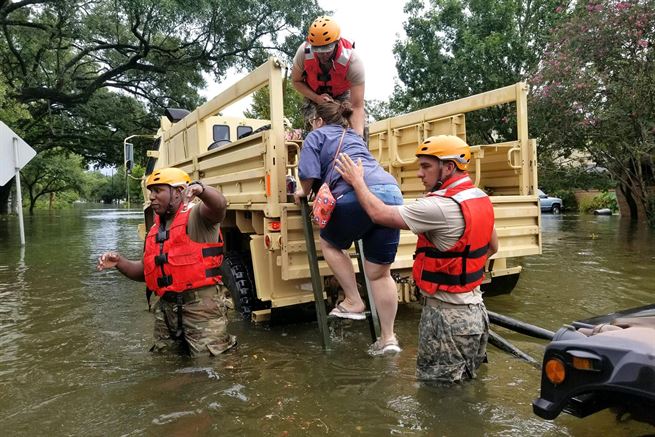
Texas National Guardsmen assist residents into a military vehicle during Hurricane Harvey flooding in Houston, Texas, Aug. 27, 2017. Army National Guard photo by Lt. Zachary West; https://www.defense.gov/Photos/Essay-View/CollectionId/16901/
So there’s a new report out at the Brookings Institute promoting “national service” and this concept really irks me to no end, so I wanted to spend a little bit of time griping about the concept, in general, and this particular report, specifically.
Advocates of national service promote the idea as a sort of 21st-century equivalent of the draft. In the idealized world (and as politicians like Buttigieg continue to idealize it), men (and women, now) who spend time in the military learn not just patriotism and civic duty but how to work together with people from all walks of life, of all races and creeds and education levels (though, let’s face it, the military has its own divides, namely, the divide between officers and enlisted men, and Pete Buttigieg’s service was as an officer). And since we don’t need or want a large military, the way to ensure that all young adults get this proper degree of inculcation in civic virtue is by mandating a nonmilitary equivalent (or creating a semi-mandatory version in which everyone participates because it is desirable or because there’s a stigma to declining to do so).
What’s more, advocates point to the draft, which Americans see as acceptable in extreme cases here, and recognize as a normal path elsewhere, to demonstrate that there’s nothing wrong per se with mandating national civilian service, that it isn’t “involuntary servitude” or a violation of the constitution or fundamental human rights. The paper even includes an appendix listing all country’s military service requirements. But that’s missing the point. Take Germany: they had had mandatory military service of two years throughout the Cold War, dropping down to 18 months as tensions eased, then down to 15 months, and eventually being eliminated entirely in 2011 (my husband, who was in the midst of his military service when the Wall came down, thought at the time he was fortunate to be required to serve only 18 months, until those who followed him needed three months less). And it is true that they had a parallel track of civilian service — but these positions were established only as an alternative for conscientious objectors, not as an institution of their own.
In fact, the closest we have to a norm of a “service year” is the Mormon tradition of serving missions. At the same time, we do have strong traditions of community service as a life-long endeavor that we would do well to rebuild. And as for teens/young adults learning to interact with people outside their social class, that had long been provided, for middle-class kids, via summer/afterschool jobs in which they worked alongside blue-collar folk for whom this was their full-time occupation.
But is “learning civic virtue” a substantial enough objective to warrant young adults spending a year engaging in compulsory manual labor away from home? And would such activities as weatherizing poor folks’ homes bring about this transformation – or would there be evening struggle sessions aimed at producing the desired effects if a day’s work on a labor crew didn’t?
And I’m also skeptical of those who do the math about the cost-benefit analysis of such a proposal merely in terms of the question of how much the government would have to spend compensating these young adults, either at wages sufficient to meet their living expenses or with additional perks that might not be reported in a scoring of costs but are real, and possibly quite substantial, anyway, such as college tuition and living expense benefits. It is already the case that young adults are taking much longer to get launched into adult life — into careers, marriage, family formation. Why would we add a further year or more? Yes, in some cases, young adults benefit from a “gap year” before college, because they need additional time to mature, to be ready to start their college years with a better sense of direction and purpose than if they’d just proceeded there from high school with no objective other than “this is what you do next.” But other students are already purpose-filled. Wouldn’t students be harmed if they had been aiming for technical fields, who had been taking math and science classes in high school and are ready to move on to the next class in the progression, but must now take a year away and re-learn material upon returning? (And that’s not just top students – I would assume that a kid on a track towards certification in something like automotive technology or welding or whatever could be impacted, too.) And even beyond this reintegration-into-schooling difficulty, for any such student who didn’t need a gap year, you’ve added a year onto their trajectory into full adult living at exactly a time when this is happening in too delayed a fashion as it is.
Finally, the fact that this is all under discussion for young adults, not for older adults, is an indicator that we think of these people’s lives as ours to control. Why would we mandate service for a 20 year old, but not a 65 year old? Why not say, in order to collect Social Security, you must serve your nation?
Of course, it’s preposterous. No one would suggest it – even though most such 65 year olds are empty-nesters, so they have no family responsibilities nor would they be delayed in establishing careers and families because they have already done so. But why would we then think that young adults’ lives are at our disposition?
Vent over.
Time to look at the Brookings report itself.
The report is organized into sections, and the first of these attempts to make the case for national service as a concept, before discussing polling, costs/benefits, constitutionality, etc.
Their rationale for national service begins with the Depression, and the Civilian Conservation Corps and the subsequent “national service” of men drafted into World War 2 and the women working on the home front.
In the unprecedented prosperity that followed the war, the Greatest Generation served more, joined organizations more, gave more in charitable contributions, attended church, school, and community activities more, and were active neighbors helping those in need more than the generations preceding or following them.
During those same post-war years in which our civic stocks rose, Americans voted more, entered public service in greater numbers, and enjoyed much lower levels of political polarization than we see now. National service was also understood as a way to express gratitude for a country that preserves our freedom.
I’m sorry, but I’m skeptical that it’s possible to recreate this level of civic involvement by keeping everything else about 2019 America unchanged and merely adding “universal service” into the mix.
And the report further observes that our social fabric has frayed. But rather than repairing those civic groups, religious congregations, and the like, the authors appear to imagine that national service can fix this. The report cites low numbers of available slots for the Peace Corps, and large numbers of young people being turned away (but ignores the fact that, so far as I understand, in order to provide meaningful benefits to the people the program is meant to serve, it requires Peace Corps participants to have some real, usable skills).
The report also claims thatr
With limited opportunities for full-time service, the rising generation seeks additional outlets for its patriotism or desire to give back, but is perennially stymied. For example, one survey estimated that, if asked and promised only minimal pay, more than a million Americans would serve each year.
The footnote to this claim did not provide sufficient detail to identify the source and see how the question was phrased or how their estimate was calculated. The closer this is phrased as the equivalent of a government jobs guarantee, vs. a civilian equivalent of military life (which the CCC was, in many ways, living in barracks and with the same sort of discipline expectations), the more I’d expect people to respond favorably.
The report then discusses polling, but without discussing results of actual polls, so much as their limitations and the need for “state of the art” surveys — but curiously, lists “specific services that federally-sponsored national service programs might address more and better if they had more workers and better funding”:
• Assisting military families and veterans in adjusting back into civilian life;
• Mentoring/tutoring students in low-performing schools to keep them on track;
• Helping communities prepare for and respond to emergencies and disasters;
• Cleaning up rivers, parks, blighted public areas, and coasts;
• Helping older Americans remain in their homes;
• Providing job training and career advice to low-income Americans;
• Incentivizing nonprofits, colleges, universities, and faith-based institutions to join a national service system by offering positions for Americans to serve for a year through their respective organizations;
• Amending the GI Bill to permit veterans to use a portion of their GI Benefits to support their performing a full year of civilian national service; and
• Amending the current Selective Service System so that every American receives information not only about opportunities to serve in the military but also in a civilian national service capacity.
Which is a curious sort of list as it appears to include both activities that nation-servers would be doing as well as benefits they would receive (and other actions that fit into neither category which makes this a catch-all list and which I’m including to avoid cherry-picking).
Are nation-servers expected to be the ones “providing job training” or are they, as young adults, intended to be the recipient of job training and career advice through a national service program which has as its real goal helping aimless youth? Would nation-servers be “assisting military families” or would a period of national service function as reintegration? Yes, I suppose you could have a new set of workers for clean-up of public/natural areas but I doubt someone who has signed on for or been drafted into a year of national service is going to be your best choice as a mentor and tutor and I am not particularly clear on how they can “help older Americans remain in their homes” — by installing ramps or other remodeling work to make a home wheelchair accessible? By providing eldercare?
The report then starts to lose me as it starts to get philosophical and says that a universal quasi-mandatory service requirement would be a natural evolution of the Selective Service system:
In conclusion, one the one hand, it takes no leap of imagination to envision the next chapters in the history of the U.S. Selective Service System, and the next innovations and amendments to System’s present administrative structure, mirroring the “21st Century National Service System” articulated in 2013 by the Franklin Project. But, on the other hand, this new system, and any mandatory service components, would have no twins and few close cousins around the globe. It would, however, reflect the American civic tradition, starting with the unprecedented and wholly novel creation of a government based on “reflection and choice” that is “neither a national nor a federal Constitution, but a composition of both.”
In the end, the more I read, the less persuaded I was. The very notion that every young adult should go through a formal program intended to inculcate desired civic virtues, however noble it may be intended, is a step too far for me, especially insofar as it intentionally seeks to replace the virtue cultivation of religion and other civic groups.
And I’ll end, as usual, with the invitation for readers to share their thoughts on the issue.
Previous Post

October 13, 2019
Three Days in DC

Browse Our Archives
Select a Category Actuarial/Retirement Issues Politics Uncategorized
Select a Month September 2026 August 2026 July 2026 June 2026 April 2026 March 2026 February 2026 January 2026 December 2025 November 2025 October 2025 July 2025 June 2025 May 2025 April 2025 March 2025 February 2025 January 2025 December 2024 November 2024 October 2024 September 2024 August 2024 July 2024 June 2024 May 2024 April 2024 March 2024 February 2024 December 2023 November 2023 October 2023 September 2023 August 2023 July 2023 December 2022 September 2022 August 2022 July 2022 June 2022 May 2022 February 2022 January 2022 December 2021 August 2021 June 2021 April 2021 February 2021 January 2021 December 2020 November 2020 October 2020 September 2020 August 2020 July 2020 June 2020 May 2020 April 2020 March 2020 February 2020 January 2020 December 2019 November 2019 October 2019 September 2019 August 2019 July 2019 June 2019 May 2019 April 2019 March 2019 February 2019 January 2019 December 2018 November 2018 October 2018 September 2018 August 2018 July 2018 June 2018 May 2018 April 2018 March 2018 February 2018 January 2018 December 2017 November 2017 October 2017 September 2017 August 2017 July 2017 June 2017 May 2017 April 2017 March 2017 February 2017 January 2017 December 2016 November 2016 October 2016 September 2016 August 2016 July 2016 June 2016 May 2016 April 2016 March 2016 February 2016 January 2016 December 2015 November 2015 October 2015 September 2015 August 2015 July 2015 June 2015 May 2015 April 2015 March 2015 February 2015 January 2015 December 2014 November 2014 October 2014 September 2014 August 2014 July 2014 June 2014 May 2014 April 2014 March 2014 February 2014 January 2014 December 2013 November 2013 October 2013 September 2013 August 2013 July 2013
Follow Us!
TAKE THE
Religious Wisdom Quiz
Who challenged Goliath to a duel before the army of Israel?
Select your answer to see how you score.
Abner Jonathan David Saul
Related posts from Jane the Actuary


Illinois’ Assisted Suicide Law is, yes, literally deadly

Revising the "Disability [Pride] Flag"

In which I comment on the Supreme Court...
TRENDING AT PATHEOS Catholic

Emotion in Early Christianity by Andrew Crislip
Andrew Crislip’s Emotion in Early Christianity examines an often overlooked dimension of...

16 Spiritual Touchstones for a More Grounded Life
After decades of spiritual study, here are 16 principles I try...

Catholic Evangelization: Sharing Your Faith Every Day
Welcome back to the Graceful Awakening mini-series called, “From Faith to Mission.” ...

The Pillar of the Boatmen: the Ancient Monument...
The Pillar of the Boatmen is a Romano-Gaulish sculpture that dates from...

In one sense walking into Westminster Abbey is like walking down the...

'Super Scam Me' Exposes AI Jon Bon Jovi...
Leslie Pickett believed she was in a relationship with Jon Bon Jovi....
view all Catholic blogs
Ad-Free & Subscriber Log-In Subscription Support
- About Us
- 2026 Calendar
- Videos
- Podcasts
- Library of World Religions
- Faith In Media Tracker
- Advertise With Us
- Write for Us
- Privacy Policy
- Terms of Service
- Do Not Sell My Data
- Contact Us
- Radiant Digital
- Manage Newsletter Subscriptions
- Unsubscribe From Notifications
- Sitemap
Copyright 2008-2026, Patheos. All rights reserved.
Subscription Support Ad-Free & Subscriber Log-In
Follow Patheos