
BuddhistCatholicContemplativeEvangelicalGeneral ChristianHinduJewishLatter-day SaintMuslimNew VisionsProgressive Christian
Beliefs
- Buddhist
- Catholic
- Contemplative
- Evangelical
- General Christian
- Hindu
- Jewish
- Latter-day Saint
- More Voices
- Muslim
- New Visions
- Pagan
- Progressive Christian
Topics
- Religion News
- Food and Religion
- Sports and Religion
- Religious Art
- Religious Music and Entertainment
- Religious Events
- History and Religion
- Style and Religion
- Politics and Religion
- Women in Religion
- Recreation Outdoors and Religion
- Business Finance and Religion
- Careers Workplace and Religion
- Education and Religion
- Family Parenting and Religion
- Health Fitness and Religion
- Home and Religion
- Relationships and Religion
- Technology and Religion
- Travel and Religion
Columnists
- Buddhist Columnists
- Business Finance and Religion Columnists
- Careers Workplace and Religion Columnists
- Catholic Columnists
- Contemplative Columnists
- Education and Religion Columnists
- Evangelists Columnists
- Family Parenting and Religion Columnists
- General Christian Columnists
- Health Fitness and Religion Columnists
- Hindu Columnists
- History and Religion Columnists
- Home and Religion Columnists
- Jewish Columnists
- More Voices Columnists
- Latter Day Columnists
- Muslim Columnists
- New Visions Columnists
- Nonreligious Columnists
- Pagan Columnists
- Politics and Religion Columnists
- Progressive Columnists
- Recreation Outdoors and Religion Columnists
- Relationships and Religion Columnists
- Religion News Columnists
- Religious Art Columnists
- Religious Events Columnists
- Religious Music and Entertainment Columnists
- Sports and Religion Columnists
- Style and Religion Columnists
- Technology and Religion Columnists
- Travel and Religion Columnists
- Women in Religion Columnists
Resource Library
- 2026 Calendar
- Library of World Religions
- The 100 Most Holy Places on Earth
- Patheos Answers
- Podcasts
- Videos
- Faith Leaders Database
- Anglican Episcopalian
- Bahai
- Baptist
- Buddhism
- Christianity
- Confucianism
- Eastern Orthodoxy
- Hinduism
- Holiness and Pentecostal
- ISKCON
- Islam
- Judaism
- Lutheran
- Methodist
- The Church of Jesus Christ of Latter-day Saints
- New Age
- Paganism
- Presbytarian and Reformed
- Protestantism
- Religion Behind the Scenes
- Roman Catholic
- Scientology
- Shia Islam
- Sikhism
- Sufism
- Sunni Islam
- Taoism
- Zen
- See all religions
Research Tools
 Ad-Free & Subscriber Log-In Subscription Support
Ad-Free & Subscriber Log-In Subscription Support
Follow Patheos 

- Trending:
- Forgiveness
- |
- Marriage
- |
- Consciousness
- |
- Death Penalty
- |
- Election
- |
- Halloween

- Home
- Catholic
- Politics and Religion
- Because I’m a nerd . . . looking at more STD data
Because I’m a nerd . . . looking at more STD data
Last updated on: October 26, 2019 at 7:17 am by Jane the Actuary
Because I’m a nerd . . . looking at more STD data 2019-10-25T23:24:17-06:00 Jane the Actuary
Patheos Explore the world's faith through different perspectives on religion and spirituality! Patheos has the views of the prevalent religions and spiritualities of the world.

So the other day, I wrote about STD rates climbing dramatically, but that post was based on the data I had had on hand that went back only to 2014. And as striking as it was, it didn’t make much sense to base any substantial comments on just five years’ worth of data. Were these fluctuations normal? Had the increases been going on for years and years? I was particularly suspicious of the various claims of cutbacks in government spending being to blame — isn’t that always the response by people whose desire is for more government money, and were there any particular cutbacks at exactly this point in time?
So I found the link to the CDC data source for more extensive historical data, and made a bunch of graphs and tables. Way too many of them, in terms of what constitutes a good use of my time, but there was a certain “sunk cost” element to it, and I really wanted to see if I could figure out anything from the data other than the vague answers that the experts and journalists give. So are you ready for a tedious number of charts and tables? (Well, tedious to me, in putting this together and into this blog post.)
Let’s start with the basic data – the relative prevalence of the three main STDs categorized together by the CDC.
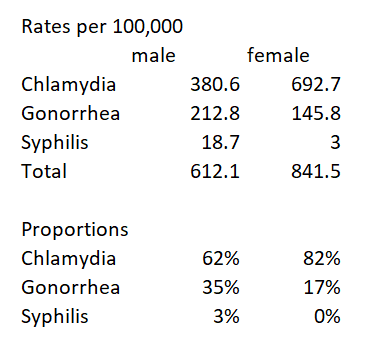
Yes, chlamydia is by far the most prevalent, and it’s a strange sort of disease, with 50% of women and 75% of men being asymptomatic (which I presume means that they don’t come in for a test because of symptoms but are identified through some sort of routine testing — and I’m not sure how they identify this for men, for whom it isn’t routine in the first place), but it impacting women’s future fertility if it isn’t treated in time (though I can’t tell from my initial reading how serious a risk this is, vs. a means of scaring women into being tested).
The CDC has data on prevalence going back to 1984. I’ve got two charts, one for chlamydia separately from the other two because the scales are so different, even looking at relative change since 1984 rather than rates per 100,000.
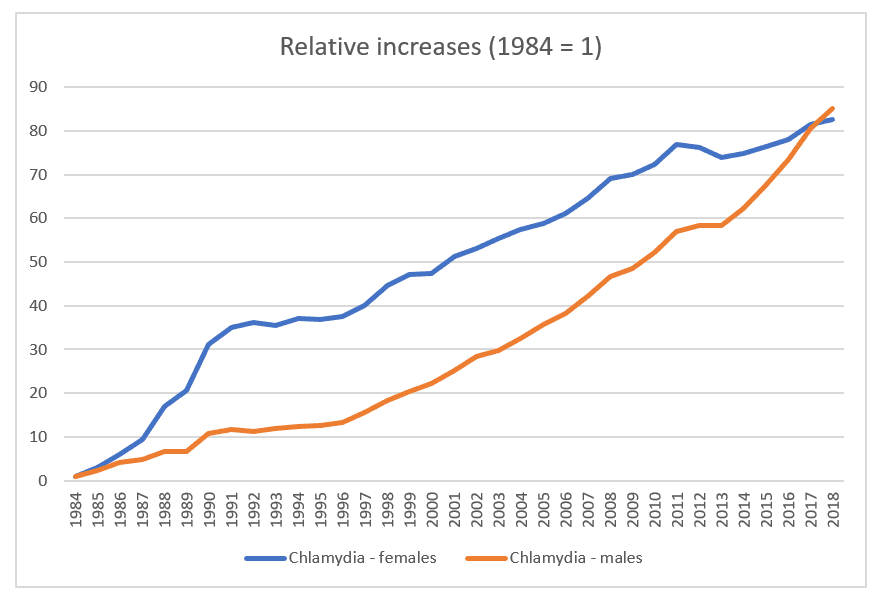
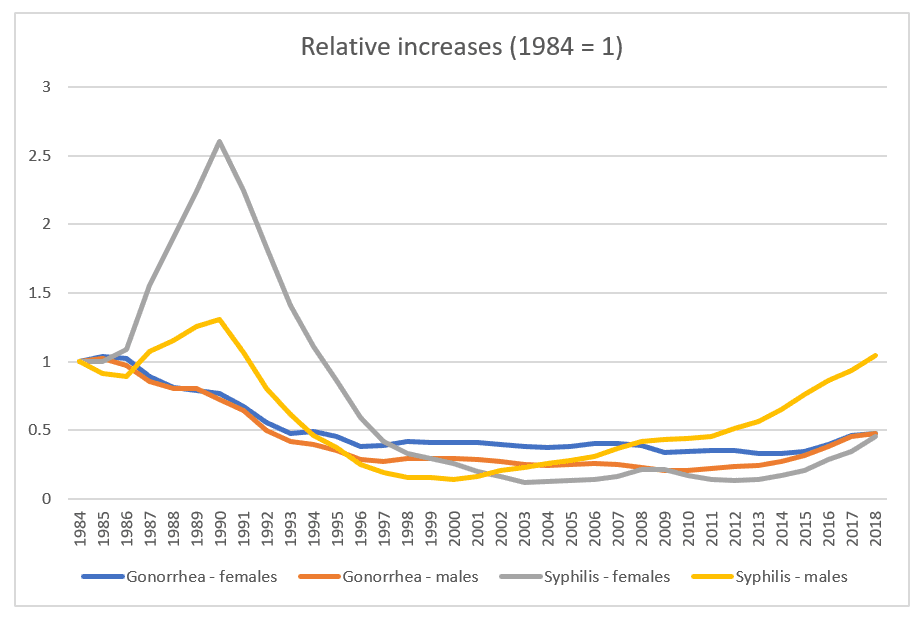
And these two graphs — well, it’s just peculiar.
The rates for chlamydia just exploded.
How much of that is because the number of cases increased so much, vs. this being the outcome of making STD testing a routine part of gynecological visits for all women under 25 and at-risk women over 25 (multiple partners or a new partner since previous testing)? And for that matter, if 75% of men are asymptomatic, and there is no norm for testing men except those who are deemed high-risk or partners of a woman who’s diagnosed, then how does their “real” prevalence compare to the new cases reported?
It’s also weird that the rates for women jumped so much in the 90s, then slowed comparatively, and leveled off starting at about the year 2010, while it was at that point that men’s rates climbed even more. And remember, these are not rates, but rates as a multiple of the 1984 rate, e.g., 80 times as prevalent in 2018 as in 1984.
At the same time, the scale for the second chart is wonky because of the strange spike in women’s syphilis diagnoses, but then both syphilis and gonorrhea dropped significantly and stayed at fairly level rates until 2014-ish, for gonorrhea and 2011 for syphilis.
Which means that if you put the rates and proportions for 1984 and 2018 side-by-side, the results are very wonky indeed.
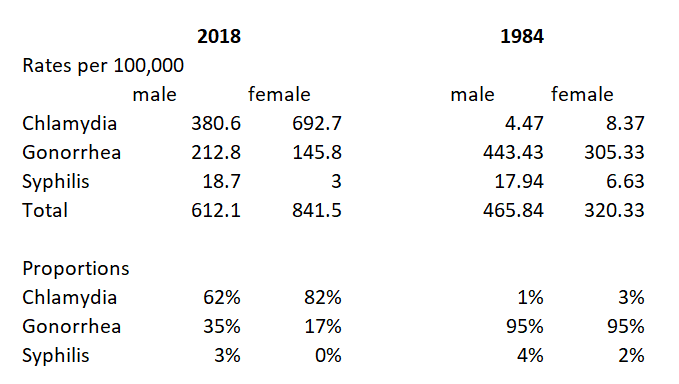
I am not an epidemiologist, but surely there is something more going with the chlamydia rates than merely “people need to be trained to use condoms.”
Anyway, that’s all whack enough, but let’s look at gonorrhea, or, more specifically, at the data for women. (I know that gay men make up a large number of gonorrhea cases, and I presume that much of that story has to do with fear — or lack thereof — of AIDS influencing condom use, so I don’t think they’re as useful to look at.)
To start with, here’s a summary of the statistics from my prior blog post:
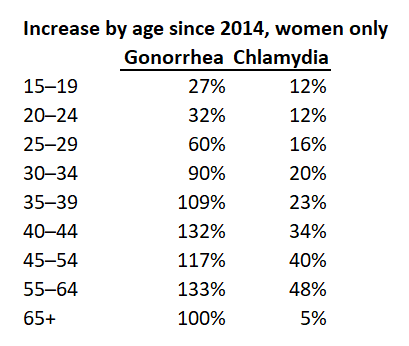
Which clearly shows the leveling off of rates for chlamydia, and the significant increase for gonorrhea — and, what’s more, the fact that for both STDs, it is at the older ages that the increase has been most dramatic, even though it is at younger ages that the most number of cases exist in absolute numbers.
Now, going back before 2014 (in terms of data that’s easily accessible) requires sacrificing the age breakdowns above age 40, because the pre-2014 data is only grouped as women 40+, and in any case age breakdowns only start in 1996.
So here are the relevant charts, which I left untouched rather than hacking off part of the Y axis.
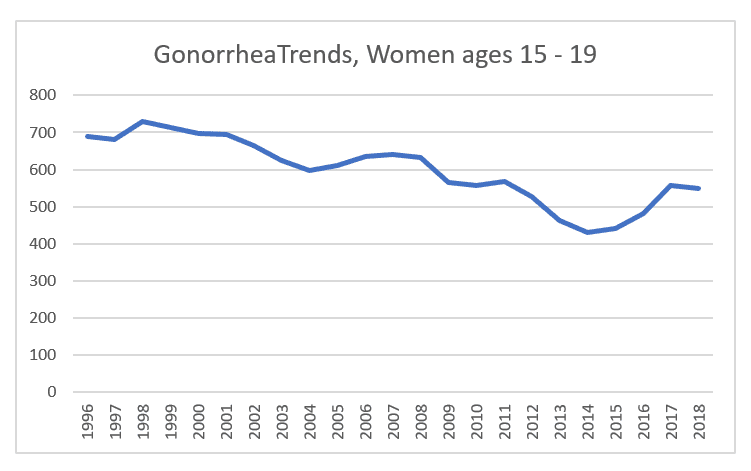
Ages 15 – 19: a slow but steady drop from 700 cases per 100,000 to a low of 430 in 2014, before bouncing up again to 550 in 2018.
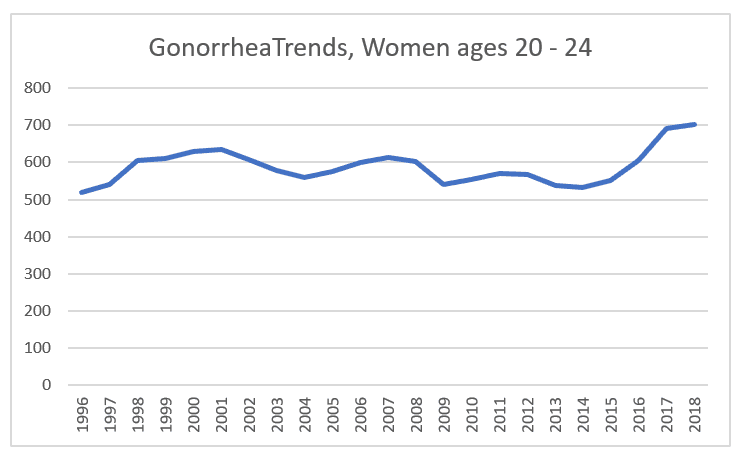
Ages 20 – 24 stayed relatively steady, in my view. A statistician would no doubt opine on the significance of these fluctuations, but I don’t see anything dramatic until the increase that starts in 2015.
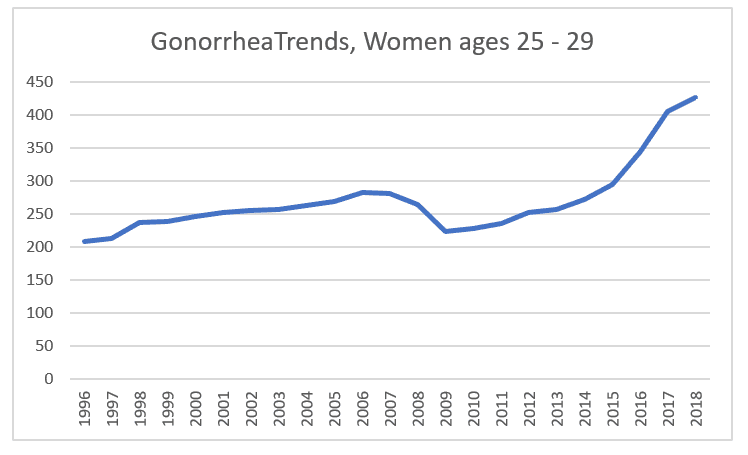
Same thing, more or less. Do you count the increase from 1996 to 2006 as significant, or as more-or-less level? What accounts for the recessionary-timed dip? More caution? If it were something that could be treated at home, vs. requiring antibiotics, I’d say that this age group, living on their own and impacted by the recession, were self-medicating to avoid copays, but I don’t see how this could be the case.
At any rate, the rates return to their pre-recession high in 2014, and increase from there.
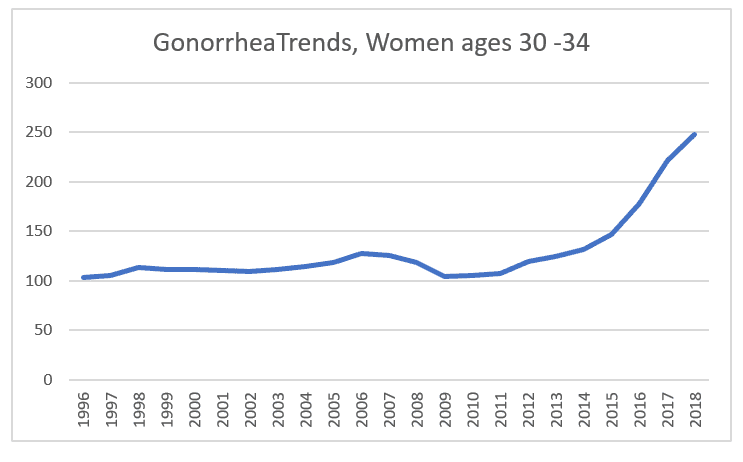
Another recession dip, though less pronounced, a recovery to pre-recession levels in 2013, and increases since then, with dramatic increase in 2016 and 2017, of 21% and 24% per year respectively.
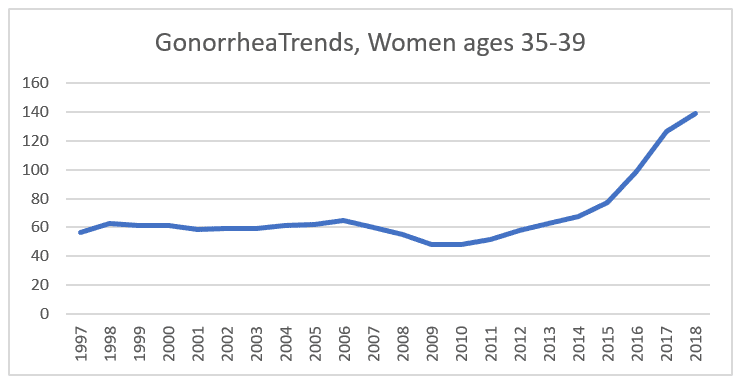
And here, too, the nearly level rate from 1997 to 2006 is interesting, followed by the recession dip and recovery in 2013, then moderate followed by dramatic increases, again in 2016 and 2017 (27% and 28%).
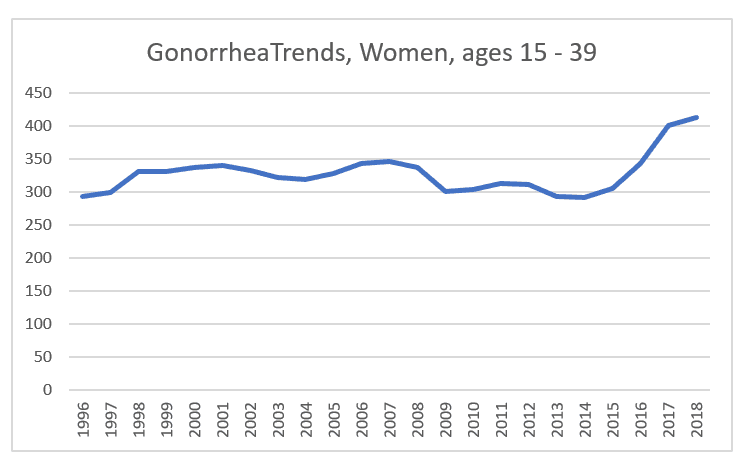
And this one puts all these trends together, causing an apparent more or less level rate from 1996 to 2014 (especially in comparison to the significant drop in the prior decade), then a rise of 4% in 2015, 12% in 2016, 17% in 2017, and 3% in 2018.
So, again, I only have guesses as to what accounts for this:
I don’t believe that it’s the usual scapegoat of “we need more services for young adults” — after all, pregnancy rates for teens and young 20-somethings have been falling dramatically, and, again, any explanation would seem to me to need to start from the very large increases for older women.
It also doesn’t make sense to say, “this is the result of delayed or no marriage for older women” when the trend is really so, so recent.
Is this the effect of Tinder (first released in 2012, massively popular in 2014) and similar apps?
Is this an effect of heavy promotion of LARCs (IUDs, implants, etc.) and the no-copay provision of Obamacare, since they are more popular among older women? Has this caused women to shift away from condoms?
Is there some element of the economic recovery finally kicking in? Do women, even if not consciously thinking about this, feel freer about taking risks when they’re doing better economically? Conceivably, the economic anxiety impacted older women harder so their response to a stronger economy might have been greater? (Note that these are not cohorts — the women in the 25 – 29 age category at the time of the recession, with the most dramatic recession dip, are now in the 35 – 39 category with the most dramatic spike.)
Is this truly a matter of empidemiology, that is, something more elementarily biological, in which the bacterium itself (which has been reported to be increasingly resisitent to antibiotics) has become more virulent?
Or is this simply a matter of the fact that testing is a “preventive care” item under Obamacare? Was there a widespread push to increase testing rates, even if it was behind the scenes, at conferences and in training sessions, so that doctors could make a little extra profit if they went beyond testing the under-25s to placing their over-25 patients into the “at-risk” category to run the tests? (After all, every doctor now screens you for depression, and I’m sure charges the insurer a bit extra for it.) To be sure, that would not explain how this could occur at the same time as chlamydia rates flattened, comparatively, but, again, these are guesses.
So now it’s really time to close out of this data file, and move on to something else. And, again, reader speculation invited!
Image: Colorized scanning electron micrograph of Neisseria gonorrhoeae bacteria, which causes gonorrhea. Credit: NIAID; https://commons.wikimedia.org/wiki/File:Neisseria_gonorrhoeae_Bacteria_(16221300454).jpg
Previous Post

October 25, 2019
A few (more) words on the Amazon Synod
Next Post

October 26, 2019 STDs, part 3: Let's talk about risk, baby
Browse Our Archives
Select a Category Actuarial/Retirement Issues Politics Uncategorized
Select a Month September 2026 August 2026 July 2026 June 2026 April 2026 March 2026 February 2026 January 2026 December 2025 November 2025 October 2025 July 2025 June 2025 May 2025 April 2025 March 2025 February 2025 January 2025 December 2024 November 2024 October 2024 September 2024 August 2024 July 2024 June 2024 May 2024 April 2024 March 2024 February 2024 December 2023 November 2023 October 2023 September 2023 August 2023 July 2023 December 2022 September 2022 August 2022 July 2022 June 2022 May 2022 February 2022 January 2022 December 2021 August 2021 June 2021 April 2021 February 2021 January 2021 December 2020 November 2020 October 2020 September 2020 August 2020 July 2020 June 2020 May 2020 April 2020 March 2020 February 2020 January 2020 December 2019 November 2019 October 2019 September 2019 August 2019 July 2019 June 2019 May 2019 April 2019 March 2019 February 2019 January 2019 December 2018 November 2018 October 2018 September 2018 August 2018 July 2018 June 2018 May 2018 April 2018 March 2018 February 2018 January 2018 December 2017 November 2017 October 2017 September 2017 August 2017 July 2017 June 2017 May 2017 April 2017 March 2017 February 2017 January 2017 December 2016 November 2016 October 2016 September 2016 August 2016 July 2016 June 2016 May 2016 April 2016 March 2016 February 2016 January 2016 December 2015 November 2015 October 2015 September 2015 August 2015 July 2015 June 2015 May 2015 April 2015 March 2015 February 2015 January 2015 December 2014 November 2014 October 2014 September 2014 August 2014 July 2014 June 2014 May 2014 April 2014 March 2014 February 2014 January 2014 December 2013 November 2013 October 2013 September 2013 August 2013 July 2013
Follow Us!
TAKE THE
Religious Wisdom Quiz
What was Barnabas' original name?
Select your answer to see how you score.
Timothy Silas Mark Joseph
Related posts from Jane the Actuary

STDs, part 3: Let's talk about risk, baby
Why are STD rates at all-time highs?


Illinois’ Assisted Suicide Law is, yes, literally deadly
TRENDING AT PATHEOS Catholic

The Image: On the Horror of Capitalism and...
The Image Then went the Pharisees, and took counsel how they might...

We are approaching the date of our new American national holiday: October...

Letters on Living the Faith by C.S. Lewis
Most of us met C.S. Lewis as a public intellectual. Mere Christianity....

When Halloween Unmasks Married Hearts
Written by Dr. David K. Ewen from Eternal Truth Bible College Behind...

Aristotle. He’s been called the father of logic, the father of the...

Methodist Central Hall and Westminster Abbey
Situated on the same square is Methodist Central Hall and Westminster Abbey. ...
view all Catholic blogs
Ad-Free & Subscriber Log-In Subscription Support
- About Us
- 2026 Calendar
- Videos
- Podcasts
- Library of World Religions
- Faith In Media Tracker
- Advertise With Us
- Write for Us
- Privacy Policy
- Terms of Service
- Do Not Sell My Data
- Contact Us
- Radiant Digital
- Manage Newsletter Subscriptions
- Unsubscribe From Notifications
- Sitemap
Copyright 2008-2026, Patheos. All rights reserved.
Subscription Support Ad-Free & Subscriber Log-In
Follow Patheos