
BuddhistCatholicContemplativeEvangelicalGeneral ChristianHinduJewishLatter-day SaintMuslimNew VisionsProgressive Christian
Beliefs
- Buddhist
- Catholic
- Contemplative
- Evangelical
- General Christian
- Hindu
- Jewish
- Latter-day Saint
- More Voices
- Muslim
- New Visions
- Pagan
- Progressive Christian
Topics
- Religion News
- Food and Religion
- Sports and Religion
- Religious Art
- Religious Music and Entertainment
- Religious Events
- History and Religion
- Style and Religion
- Politics and Religion
- Women in Religion
- Recreation Outdoors and Religion
- Business Finance and Religion
- Careers Workplace and Religion
- Education and Religion
- Family Parenting and Religion
- Health Fitness and Religion
- Home and Religion
- Relationships and Religion
- Technology and Religion
- Travel and Religion
Columnists
- Buddhist Columnists
- Business Finance and Religion Columnists
- Careers Workplace and Religion Columnists
- Catholic Columnists
- Contemplative Columnists
- Education and Religion Columnists
- Evangelists Columnists
- Family Parenting and Religion Columnists
- General Christian Columnists
- Health Fitness and Religion Columnists
- Hindu Columnists
- History and Religion Columnists
- Home and Religion Columnists
- Jewish Columnists
- More Voices Columnists
- Latter Day Columnists
- Muslim Columnists
- New Visions Columnists
- Nonreligious Columnists
- Pagan Columnists
- Politics and Religion Columnists
- Progressive Columnists
- Recreation Outdoors and Religion Columnists
- Relationships and Religion Columnists
- Religion News Columnists
- Religious Art Columnists
- Religious Events Columnists
- Religious Music and Entertainment Columnists
- Sports and Religion Columnists
- Style and Religion Columnists
- Technology and Religion Columnists
- Travel and Religion Columnists
- Women in Religion Columnists
Resource Library
- 2026 Calendar
- Library of World Religions
- The 100 Most Holy Places on Earth
- Patheos Answers
- Podcasts
- Videos
- Faith Leaders Database
- Anglican Episcopalian
- Bahai
- Baptist
- Buddhism
- Christianity
- Confucianism
- Eastern Orthodoxy
- Hinduism
- Holiness and Pentecostal
- ISKCON
- Islam
- Judaism
- Lutheran
- Methodist
- The Church of Jesus Christ of Latter-day Saints
- New Age
- Paganism
- Presbytarian and Reformed
- Protestantism
- Religion Behind the Scenes
- Roman Catholic
- Scientology
- Shia Islam
- Sikhism
- Sufism
- Sunni Islam
- Taoism
- Zen
- See all religions
Research Tools
 Ad-Free & Subscriber Log-In Subscription Support
Ad-Free & Subscriber Log-In Subscription Support
Follow Patheos 

- Trending:
- Forgiveness
- |
- Marriage
- |
- Consciousness
- |
- Death Penalty
- |
- Election
- |
- Halloween

- Home
- Catholic
- Politics and Religion
- The Great Guardianship/Financial Aid Scandal of 2019 (or not)
The Great Guardianship/Financial Aid Scandal of 2019 (or not)
Last updated on: July 30, 2019 at 12:08 pm by Jane the Actuary
The Great Guardianship/Financial Aid Scandal of 2019 (or not) 2019-07-30T12:08:51-06:00 Jane the Actuary
Patheos Explore the world's faith through different perspectives on religion and spirituality! Patheos has the views of the prevalent religions and spiritualities of the world.
Here’s a “scandal” reported by ProPublica Illinois yesterday:
“Parents Are Giving Up Custody of Their Kids to Get Need-Based College Financial Aid,” with the subtitle/excerpt, “First, parents turn over guardianship of their teenagers to a friend or relative. Then the student declares financial independence to qualify for tuition aid and scholarships.”
Some excerpts:
Dozens of suburban Chicago families, perhaps many more, have been exploiting a legal loophole to win their children need-based college financial aid and scholarships they would not otherwise receive, court records and interviews show. . . .
Parents are giving up legal custody of their children during their junior or senior year in high school to someone else — a friend, aunt, cousin or grandparent. The guardianship status then allows the students to declare themselves financially independent of their families so they can qualify for federal, state and university aid, a ProPublica Illinois investigation found. . . .
While ProPublica Illinois uncovered this practice in north suburban Lake County, where almost four dozen such guardianships were filed in the past 18 months, similar petitions have been filed in at least five other counties and the practice may be happening throughout the country. ProPublica Illinois is still investigating. . . .
When filling out the application for financial aid, called the Free Application for Federal Student Aid, or FAFSA, students have to prove formal separation from their parents to qualify as an independent. One of the few ways to do that is through a legal guardianship change. Students cannot just declare financial independence — even in cases where parents are able to pay but refuse to do so, Borst said.
According to the U.S. Department of Education website, “a student in legal guardianship does not need to report parent information on the FAFSA form because he or she is considered an independent student.” Independent students are evaluated for financial aid based on their own income and resources and not that of their parents.
And here’s my reaction: good for them!
OK, maybe that’s going to far. But I have a hard time getting upset – I find the manipulation of finances that many families engage in to qualify their elder for Medicaid nursing home coverage, to be no different, and, unless I’m mistaken, that’s generally accepted as a “thing you have to do,” however unethical it is. (ElderLawAnswers.com provides a handy article, “How to Use a Trust in Medicaid Planning” about how to preserve an estate for children while still qualifying for Medicaid.)
The article does not report (and does not have access) to information on the family’s finances, though the students in question are attending public universities. They’re not seeking out the Harvards and Sarah Lawrences and other jaw-droppingly-expensive private colleges.
But the reality is this:
Prior to 1992, if your parents, despite a middle-class income, were unwilling to pay for your tuition or were unwilling to go into debt if they hadn’t saved for this purpose, you had a reasonable alternative: support yourself independently for two years (living in your own place and earning enough to pay for your expenses), then apply for financial aid as an “independent student.”
At that point, new rules were implemented. Any student under the age of 24 is deemed dependent on his/her parents, and their income must be included in the FAFSA, the financial aid form, with exceedingly narrow exceptions, including marriage, homelessness, literally uncontactable parents, jailed parents, or in case of abuse. A student whose parents refuse to complete the FAFSA has no financial aid options except unsubsidized loans (and, I recall, when I wrote the above-linked blogpost, the only advice for students in such a situation was, “beg and plead and tell them that it’s their moral responsibility to do so, and even if they won’t pay your tuition, they should at least disclose their income on the form”).
What’s more, the financial aid formulas calculate an Expected Family Contribution with a formula which ratchets up to expecting that families spend nearly 50% of “disposable income” on college tuition. (What follows is from a 2013 blogpost, so it’s possible that there’s been a significant change, but unlikely.) Specifically, after-tax income of $30,000 for a family of 5 is “protected,” the next $30,000 has applicable rates of from 22% to 40%, and starting at $60,000 (more or less; probably a bit higher due to inflation), 47% of the family income is expected to be usable for paying college tuition. In addition, parents are expected to be able to spend 1/8 of their non-pension assets, each year, on tuition. (This is not the same as liquidating your assets after 8 years of kids in college; it’s 1/8 of your current assets, then 1/8th of what’s left next year, and so on.)
Do parents really do this? Do they really cut back their finances by such incredible sums? I have a hard time believing it. It’s merely a way of allocating financial aid, and funneling middle-class kids into (unsubsidized) student loans/parental loans, because, when you do further reading, you immediately land on the advice that, gosh, if you can’t actually afford to pay the money that’s been deemed to be your EFC, then you’re invited to click the link to learn more about PLUS (parent) loans. Oh, and on top of that, in many schools indirectly and in some schools quite out-in-the-open, part of what those parents are paying for, are subsidies for their children’s classmates (see here and here).
Now, I do not mean to make the case that “this proves we need free tuition.” We need more and better ways to reduce the cost of college, and to reduce the perceived necessity of a 4 year degree (plus, increasingly, master’s degrees), enabling more young adults to enter the workforce after trade school, apprenticeships, 2 year degrees, or other forms of learning, plus better education at the high school level so that baseline communication/thinking skills are already in place, and the prescription of “do exactly what we’re doing now, except with the federal government funding everything,” is preposterous.
But such a system, with Expected Family Contributions that have no bearing to reality, certainly communicates that the EFC is not meant to be “real” at all, but is all simply part of a bigger game in how federal and “institutional” (that is, both segregated funds from donors and money from the general university budget) aid is allocated.
It’s also already widely known that universities play games in other ways. They engage in data-mining in order to identify which students should and shouldn’t be offered financial aid/merit scholarships. (I wrote about this back in 2014 and had the distinct impression, maybe from subsequent reading, that their data-mining extends even to the degree of assessing on which students a merit scholarship would be “wasted” because they’d have come anyway; various articles discussed strategies around “don’t list your first-choice college first, but play a little hard-to-get.”) The University of Chicago sent multiple postcards to my son who, really, was a fine student but not so stellar as to be University of Chicago material (sorry, kid, no offense), and we concluded that they were trying to manipulate their statistics: the more applications =more rejections = more prestige.
So, given this, it’s really hard to blame parents who view what they’re doing as simply “playing the game” as aggressively as the universities themselves.
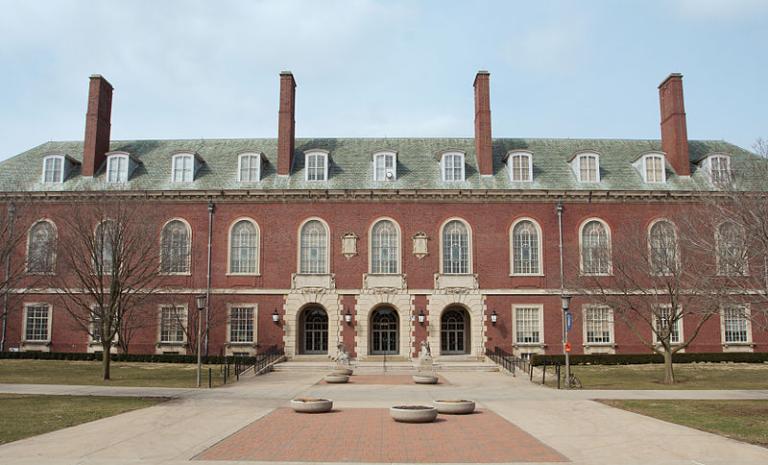
Image: University of Illinois at Urbana-Champaign, Main Library. https://commons.wikimedia.org/wiki/File%3AMainLibrary_Urbana_Illinois_4582.jpg; By Dori (Own work) [GFDL (http://www.gnu.org/copyleft/fdl.html) or CC BY-SA 3.0 us (http://creativecommons.org/licenses/by-sa/3.0/us/deed.en)], via Wikimedia Commons
Previous Post

July 26, 2019
What captures your imagination?
Next Post
July 30, 2019 Snopes, The Bee, and fact-checking as a power play
Browse Our Archives
Select a Category Actuarial/Retirement Issues Politics Uncategorized
Select a Month September 2026 August 2026 July 2026 June 2026 April 2026 March 2026 February 2026 January 2026 December 2025 November 2025 October 2025 July 2025 June 2025 May 2025 April 2025 March 2025 February 2025 January 2025 December 2024 November 2024 October 2024 September 2024 August 2024 July 2024 June 2024 May 2024 April 2024 March 2024 February 2024 December 2023 November 2023 October 2023 September 2023 August 2023 July 2023 December 2022 September 2022 August 2022 July 2022 June 2022 May 2022 February 2022 January 2022 December 2021 August 2021 June 2021 April 2021 February 2021 January 2021 December 2020 November 2020 October 2020 September 2020 August 2020 July 2020 June 2020 May 2020 April 2020 March 2020 February 2020 January 2020 December 2019 November 2019 October 2019 September 2019 August 2019 July 2019 June 2019 May 2019 April 2019 March 2019 February 2019 January 2019 December 2018 November 2018 October 2018 September 2018 August 2018 July 2018 June 2018 May 2018 April 2018 March 2018 February 2018 January 2018 December 2017 November 2017 October 2017 September 2017 August 2017 July 2017 June 2017 May 2017 April 2017 March 2017 February 2017 January 2017 December 2016 November 2016 October 2016 September 2016 August 2016 July 2016 June 2016 May 2016 April 2016 March 2016 February 2016 January 2016 December 2015 November 2015 October 2015 September 2015 August 2015 July 2015 June 2015 May 2015 April 2015 March 2015 February 2015 January 2015 December 2014 November 2014 October 2014 September 2014 August 2014 July 2014 June 2014 May 2014 April 2014 March 2014 February 2014 January 2014 December 2013 November 2013 October 2013 September 2013 August 2013 July 2013
Follow Us!
TAKE THE
Religious Wisdom Quiz
Which prophet predicted God would pour out His Spirit on all people?
Select your answer to see how you score.
Hosea Joel Amos Micah
Related posts from Jane the Actuary

Oh, heck, let's criticize "free college" in detail
How much is a grad student worth?

Affirmative-Action Rhodes Scholarships?
Grad student Chicken Littles -- sort of right,...
TRENDING AT PATHEOS Catholic

Looking at the Largest Orthodox Cathedral on Earth
There is often a considerable amount of anger and, shall we...

The Problem with False Prophets
Miller’s Station UMC| 10/18/26| Anchor Verse: Jeremiah 23: 1, 9-23 I...

Emotion in Early Christianity by Andrew Crislip
Andrew Crislip’s Emotion in Early Christianity examines an often overlooked dimension of...

16 Spiritual Touchstones for a More Grounded Life
After decades of spiritual study, here are 16 principles I try...

Catholic Evangelization: Sharing Your Faith Every Day
Welcome back to the Graceful Awakening mini-series called, “From Faith to Mission.” ...

The Pillar of the Boatmen: the Ancient Monument...
The Pillar of the Boatmen is a Romano-Gaulish sculpture that dates from...
view all Catholic blogs
Ad-Free & Subscriber Log-In Subscription Support
- About Us
- 2026 Calendar
- Videos
- Podcasts
- Library of World Religions
- Faith In Media Tracker
- Advertise With Us
- Write for Us
- Privacy Policy
- Terms of Service
- Do Not Sell My Data
- Contact Us
- Radiant Digital
- Manage Newsletter Subscriptions
- Unsubscribe From Notifications
- Sitemap
Copyright 2008-2026, Patheos. All rights reserved.
Subscription Support Ad-Free & Subscriber Log-In
Follow Patheos