
BuddhistCatholicContemplativeEvangelicalGeneral ChristianHinduJewishLatter-day SaintMuslimNew VisionsProgressive Christian
Beliefs
- Buddhist
- Catholic
- Contemplative
- Evangelical
- General Christian
- Hindu
- Jewish
- Latter-day Saint
- More Voices
- Muslim
- New Visions
- Pagan
- Progressive Christian
Topics
- Religion News
- Food and Religion
- Sports and Religion
- Religious Art
- Religious Music and Entertainment
- Religious Events
- History and Religion
- Style and Religion
- Politics and Religion
- Women in Religion
- Recreation Outdoors and Religion
- Business Finance and Religion
- Careers Workplace and Religion
- Education and Religion
- Family Parenting and Religion
- Health Fitness and Religion
- Home and Religion
- Relationships and Religion
- Technology and Religion
- Travel and Religion
Columnists
- Buddhist Columnists
- Business Finance and Religion Columnists
- Careers Workplace and Religion Columnists
- Catholic Columnists
- Contemplative Columnists
- Education and Religion Columnists
- Evangelists Columnists
- Family Parenting and Religion Columnists
- General Christian Columnists
- Health Fitness and Religion Columnists
- Hindu Columnists
- History and Religion Columnists
- Home and Religion Columnists
- Jewish Columnists
- More Voices Columnists
- Latter Day Columnists
- Muslim Columnists
- New Visions Columnists
- Nonreligious Columnists
- Pagan Columnists
- Politics and Religion Columnists
- Progressive Columnists
- Recreation Outdoors and Religion Columnists
- Relationships and Religion Columnists
- Religion News Columnists
- Religious Art Columnists
- Religious Events Columnists
- Religious Music and Entertainment Columnists
- Sports and Religion Columnists
- Style and Religion Columnists
- Technology and Religion Columnists
- Travel and Religion Columnists
- Women in Religion Columnists
Resource Library
- 2026 Calendar
- Library of World Religions
- The 100 Most Holy Places on Earth
- Patheos Answers
- Podcasts
- Videos
- Faith Leaders Database
- Anglican Episcopalian
- Bahai
- Baptist
- Buddhism
- Christianity
- Confucianism
- Eastern Orthodoxy
- Hinduism
- Holiness and Pentecostal
- ISKCON
- Islam
- Judaism
- Lutheran
- Methodist
- The Church of Jesus Christ of Latter-day Saints
- New Age
- Paganism
- Presbytarian and Reformed
- Protestantism
- Religion Behind the Scenes
- Roman Catholic
- Scientology
- Shia Islam
- Sikhism
- Sufism
- Sunni Islam
- Taoism
- Zen
- See all religions
Research Tools
 Ad-Free & Subscriber Log-In Subscription Support
Ad-Free & Subscriber Log-In Subscription Support
Follow Patheos 

- Trending:
- Forgiveness
- |
- Marriage
- |
- Consciousness
- |
- Death Penalty
- |
- Election
- |
- Halloween

- Home
- Catholic
- Politics and Religion
- What will the French do in the Notre Dame restoration?
What will the French do in the Notre Dame restoration?
Last updated on: May 2, 2019 at 12:55 pm by Jane the Actuary
What will the French do in the Notre Dame restoration? 2019-05-02T12:55:15-06:00 Jane the Actuary
Patheos Explore the world's faith through different perspectives on religion and spirituality! Patheos has the views of the prevalent religions and spiritualities of the world.
Answer: whatever the heck they want to do.
I know that many of us outside observers, and Christians in particular, have been worrying about proposals that the French government (which indeed does own the cathedral, as it does all cathedrals and any church built before 1905, and how that impacts the restoration is anyone’s guess) transform the fire-damaged cathedral into some sort of multicultural museum or meditation space, for instance the soundly derided Rolling Stone article claiming that
any rebuilding should be a reflection not of an old France, or the France that never was — a non-secular, white European France — but a reflection of the France of today, a France that is currently in the making
or the proposal to replace the fallen spire with a minaret, or suggestions by British architects that view the restoration as a work of art with, if needed, a “smaller church inside the ruins,” or the latest proposal, reported in the Daily Mail, of a rooftop greenhouse.
But none of us, neither those making these proposals nor the audience objecting to them, are actually French (well, except for the latest of these, by the French firm Studio NAB), and, while I’ll be the first to admit that I have a weak grasp of French culture, one thing that’s pretty clear to me is that it is not simply Anglo-American culture with lots of extra consonants at the end of their words. (The very fact that they persist in using “four-twenties and nineteen” is itself an indicator of this.) So long as we have no grounds to believe they’re going to do a Taliban (or Wahabi)-style destruction of the building, the rest of us do need to suck it up and let the French work it out, and, while I’d feel a heck of a lot more comfortable if the Catholic Church in France actually held title to the building, it’s also the case that, a proposed international competition notwithstanding, the French government seems to have no more interest in directly funding (and controlling) the restoration now than it did the work underway at the time of the fire.
And here’s a key point that we observers are forgetting:
Medieval cathedrals are houses of worship, yes.
But they were also, even when they were constructed, monuments to the glory of their cities’ economic prosperity, and a celebration of the new technology the people of those cities had attained that began in what is called the “Renaissance of the Twelfth Century,” a period of economic development, revitalized trade, the development of the university, translations of Greek and Arabic texts in science, philosophy, and mathematics, and consequently the growth of cities and the beginning of the period of Gothic cathedral-building, with developments in building technology such as the flying arch allowing for greater use of windows, particularly stained glass windows, which we now take for granted but were extraordinary at the time. Notre Dame de Paris (built from 1163 – 1345), Chatres Cathedral (1194 – 1220), Reims Cathedral (1211 – 1345), and Metz Cathedral (1220 – 1550) were all on this author’s checklist during grad school travels.
Were they primarily about devotion to God? Civic showpieces? How do you differentiate when the archbishop of a medieval city governs the city, and when kings and nobility use cathedral-building to demonstrate their piety?
Here’s a useful example: the Italian cities of Siena and Florence, both wealthy and powerful at the time, had a rivalry that, well, rivals that of any American college football match-up. Siena’s Duomo (cathedral) was begun in 1196, and it’s a feast for the eyes, both inside and out, with less emphasis on stained glass than the Gothic cathedrals of France, but more interior artwork and more color in the exterior stonework.
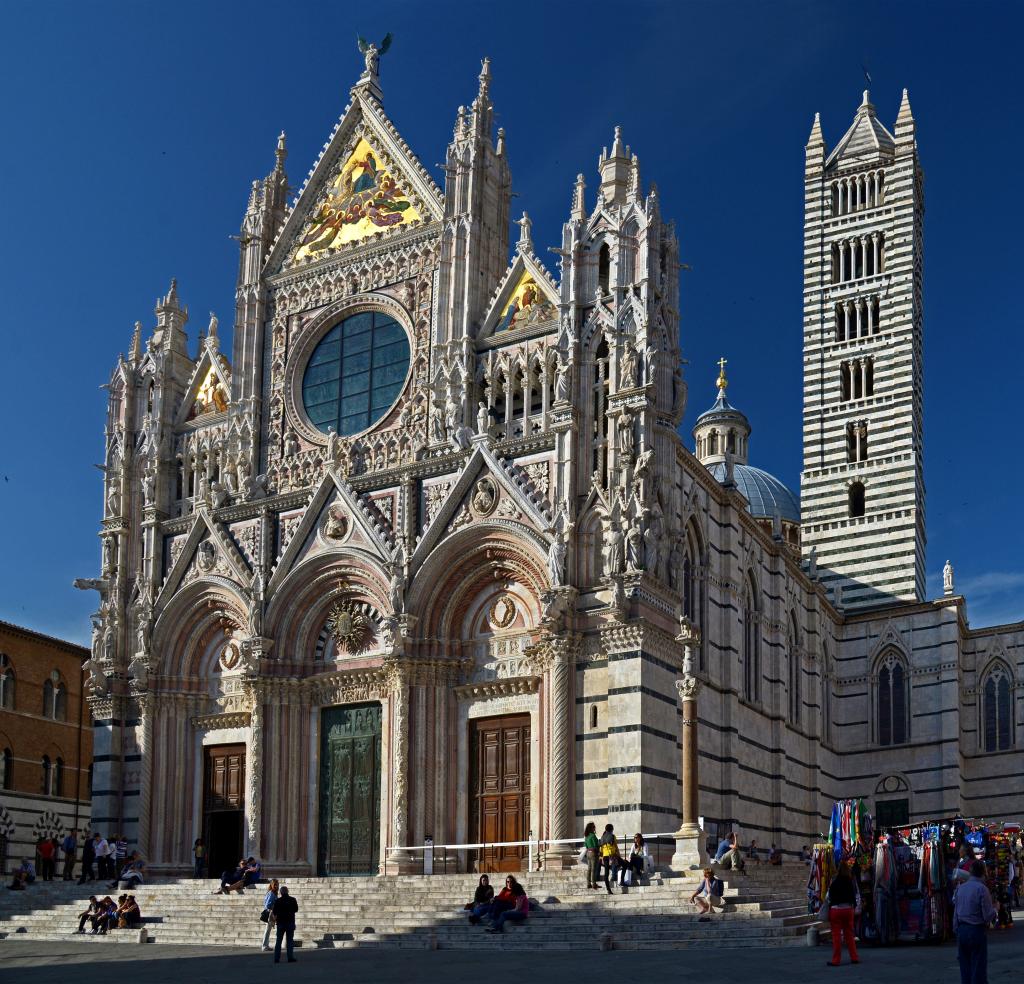
https://commons.wikimedia.org/wiki/File:Siena_Cathedral._Italy.jpg; Ввласенко [CC BY-SA 3.0 (https://creativecommons.org/licenses/by-sa/3.0)]
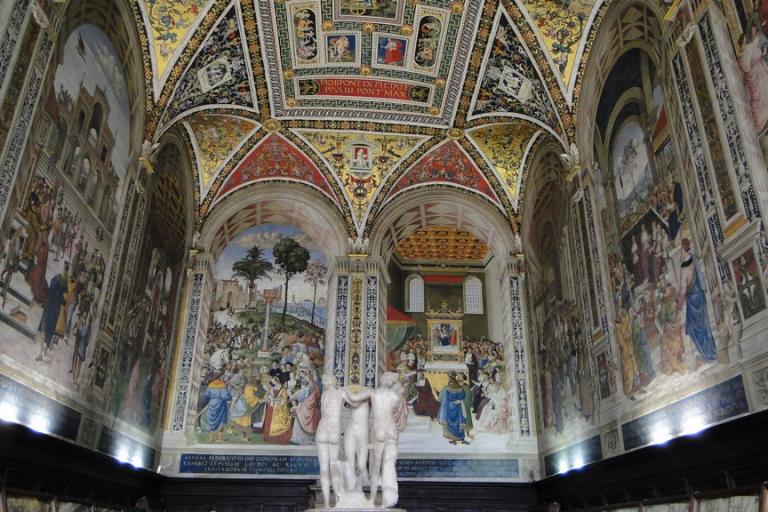
https://commons.wikimedia.org/wiki/File:Siena_Cathedral.jpg; Leon Petrosyan [CC BY-SA 3.0 (https://creativecommons.org/licenses/by-sa/3.0)]
Not to be outdone, the city fathers of Florence started building a replacement to their existing fifth-century cathedral in 1296, bequeathing to us the Duomo with its famous dome. And the city fathers of Siena, in turn, wouldn’t stand for being outdone in cathedral-building, and began to plan an addition in 1339, which would have doubled the size of the already-massive building; construction was halted with the coming of the Black Death in 1348 and never resumed, as the city lost much of its wealth along with its population, and tourists can now view the unfinished building presiding over a parking lot.
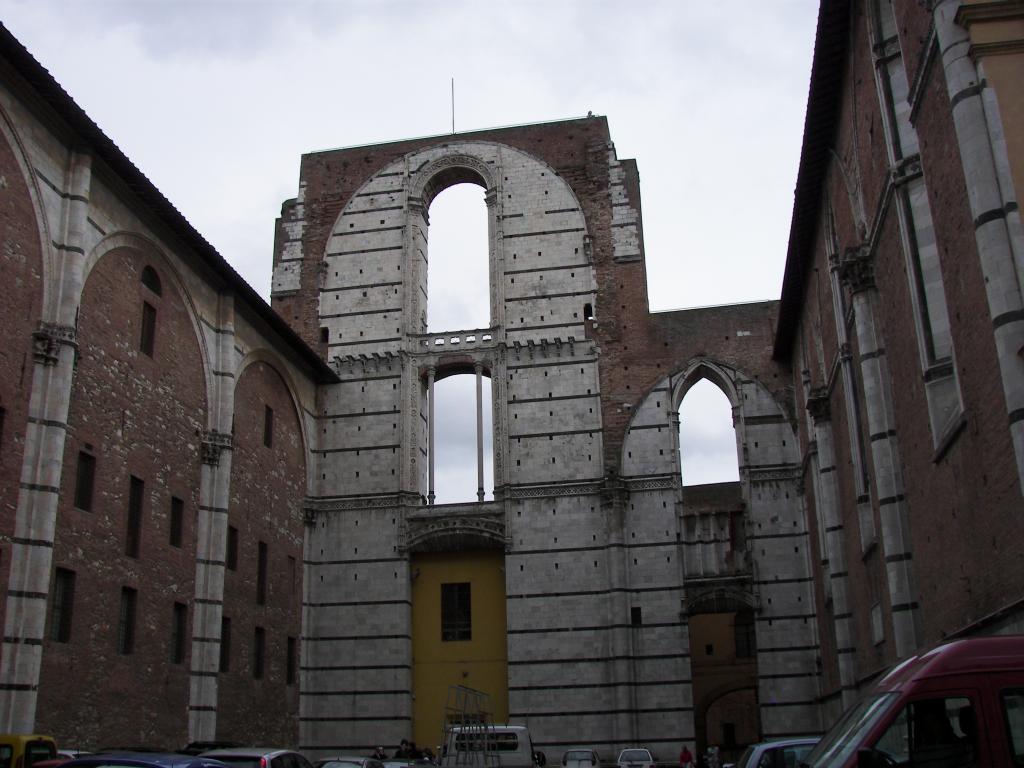
https://commons.wikimedia.org/wiki/File:Unfinished_nave_of_Siena_Cathedral.jpg; Wknight94 [CC BY-SA 3.0 (http://creativecommons.org/licenses/by-sa/3.0/)]
https://commons.wikimedia.org/wiki/File:Unfinished_nave_of_Siena_Cathedral.jpg
Or consider the cathedral in Augsburg, Germany.
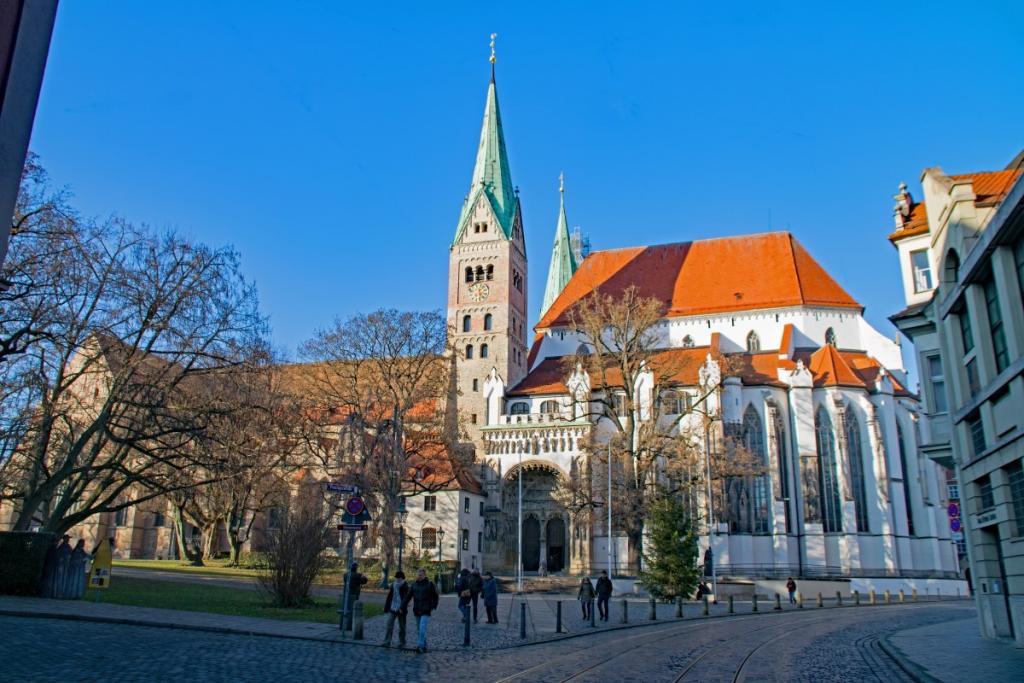
https://pxhere.com/en/photo/1201889
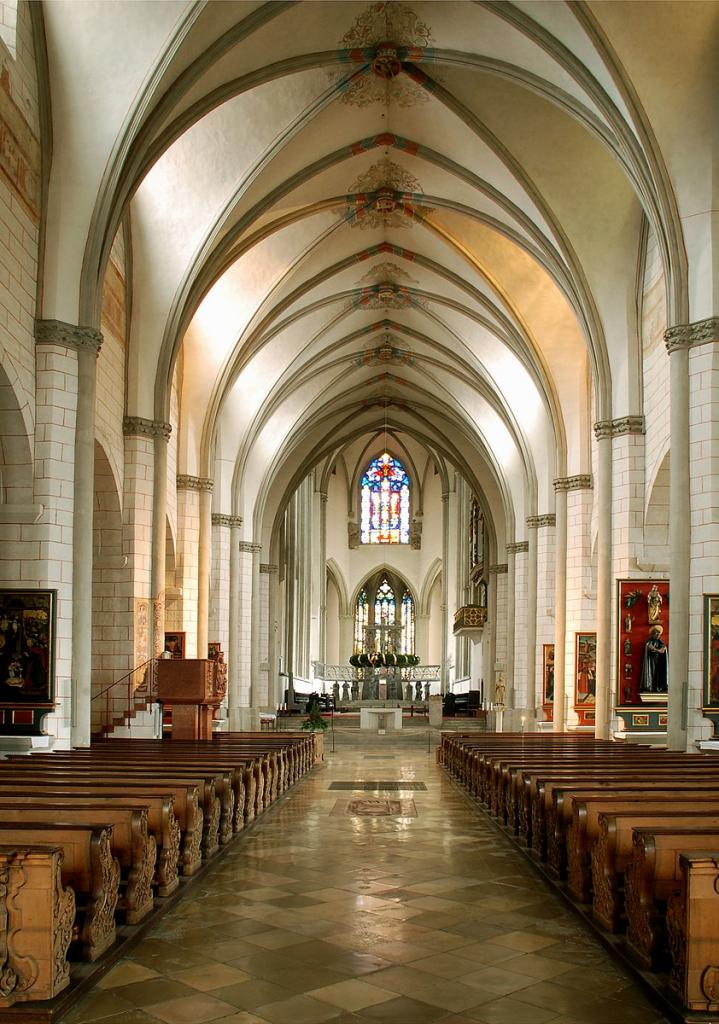
https://de.wikipedia.org/wiki/Datei:Der_Dom_zu_Augsburg.JPG; Otto Schemmel, CC 2.0
Never heard of it? Not a prime destination? Neither the exterior nor the interior will knock your socks off, and it’s of secondary interest to tourists relative to the Basilica of Saints Ulrich and Afra, with its typically Bavarian onion dome.
The cathedral itself was initially built in Romanesque style from 1043 to 1054. As Wikipedia then says,
From 1331 to 1431 numerous Gothic elements were added, including the eastern choir.
During the Protestant Reformation, the church lost most of its religious artworks, although some were later restored. The interior, which was turned into a Baroque one during the 17th century, was partially restored to its late medieval appearance in the 19th century, with the addition of some neo-Gothic elements.
Or, as the website Sacred-Destinations.com reports,
The interior is not very harmonious due to its combination of styles and various additions, but is interesting in its details.
The German Wikipidia site further details the history of the building’s expansions, with numerous phases to the Gothic additions during the 1300s and 1400s, not following a single strategic plan but with multiple changes over time. Rather than leaving well enough alone, the city and the bishops of Augsburg were engaged in the cathedral version of “keeping up with the Joneses,” and in particular with the cathedral in Cologne, under construction at the time (though ironically the latter building, though the largest Gothic church in Northern Europe, was not completed until the 19th century).
I’m sure that experts in art history can list yet more examples, but my point is this:
We simply can’t take our modern notions of Separation of Church and State and expect them to make any sense in terms of understanding a cathedral like Notre Dame. Like so many buildings, it is a tourist destination. It is a way of looking at pretty things – windows, sculpture, soaring facades. It is a place for contemplation (though maybe necessarily in a side chapel tucked away from the crowds as in these Strasbourg cathedral photos). And it is a house of worship, which welcomes worshippers from across the globe and tries its best to encourage spiritual contemplation even among those whose intention was merely to marvel at art and architecture — and, yes, I still have my worship aid with the readings in multiple languages tucked away in the basement with other mementoes.
But I think (or at least hope) that the French get this, even if Americans don’t.
Next Post

May 2, 2019 So . . . let's talk Game of Thrones
Browse Our Archives
Select a Category Actuarial/Retirement Issues Politics Uncategorized
Select a Month September 2026 August 2026 July 2026 June 2026 April 2026 March 2026 February 2026 January 2026 December 2025 November 2025 October 2025 July 2025 June 2025 May 2025 April 2025 March 2025 February 2025 January 2025 December 2024 November 2024 October 2024 September 2024 August 2024 July 2024 June 2024 May 2024 April 2024 March 2024 February 2024 December 2023 November 2023 October 2023 September 2023 August 2023 July 2023 December 2022 September 2022 August 2022 July 2022 June 2022 May 2022 February 2022 January 2022 December 2021 August 2021 June 2021 April 2021 February 2021 January 2021 December 2020 November 2020 October 2020 September 2020 August 2020 July 2020 June 2020 May 2020 April 2020 March 2020 February 2020 January 2020 December 2019 November 2019 October 2019 September 2019 August 2019 July 2019 June 2019 May 2019 April 2019 March 2019 February 2019 January 2019 December 2018 November 2018 October 2018 September 2018 August 2018 July 2018 June 2018 May 2018 April 2018 March 2018 February 2018 January 2018 December 2017 November 2017 October 2017 September 2017 August 2017 July 2017 June 2017 May 2017 April 2017 March 2017 February 2017 January 2017 December 2016 November 2016 October 2016 September 2016 August 2016 July 2016 June 2016 May 2016 April 2016 March 2016 February 2016 January 2016 December 2015 November 2015 October 2015 September 2015 August 2015 July 2015 June 2015 May 2015 April 2015 March 2015 February 2015 January 2015 December 2014 November 2014 October 2014 September 2014 August 2014 July 2014 June 2014 May 2014 April 2014 March 2014 February 2014 January 2014 December 2013 November 2013 October 2013 September 2013 August 2013 July 2013
Follow Us!
TAKE THE
Religious Wisdom Quiz
Who was the first high priest of Israel?
Select your answer to see how you score.
Levi Joshua Moses Aaron
Related posts from Jane the Actuary
A rant about medieval hospitals

What's the opposite of Islamism?

Cheese-eating surrender monkeys? Apparently, not so much
TRENDING AT PATHEOS Catholic

In one sense walking into Westminster Abbey is like walking down the...

'Super Scam Me' Exposes AI Jon Bon Jovi...
Leslie Pickett believed she was in a relationship with Jon Bon Jovi....

The Brazilian Remake of Kendricks' 'Flywheel' Opens in...
“Flywheel,” the story that launched the Kendrick Brothers’ filmmaking career is getting...

The Dangers of Gradual Accommodation (Winking at Sin)
Recently, the “law of gradualness” resurfaced during the opening of a weeklong,...

The Iron Gates and the Lion of the...
Yesterday, I didn't finish my report about, well, yesterday. So I'll...

The Image: On the Horror of Capitalism and...
The Image Then went the Pharisees, and took counsel how they might...
view all Catholic blogs
Ad-Free & Subscriber Log-In Subscription Support
- About Us
- 2026 Calendar
- Videos
- Podcasts
- Library of World Religions
- Faith In Media Tracker
- Advertise With Us
- Write for Us
- Privacy Policy
- Terms of Service
- Do Not Sell My Data
- Contact Us
- Radiant Digital
- Manage Newsletter Subscriptions
- Unsubscribe From Notifications
- Sitemap
Copyright 2008-2026, Patheos. All rights reserved.
Subscription Support Ad-Free & Subscriber Log-In
Follow Patheos