
BuddhistCatholicContemplativeEvangelicalGeneral ChristianHinduJewishLatter-day SaintMuslimNew VisionsProgressive Christian
Beliefs
- Buddhist
- Catholic
- Contemplative
- Evangelical
- General Christian
- Hindu
- Jewish
- Latter-day Saint
- More Voices
- Muslim
- New Visions
- Pagan
- Progressive Christian
Topics
- Religion News
- Food and Religion
- Sports and Religion
- Religious Art
- Religious Music and Entertainment
- Religious Events
- History and Religion
- Style and Religion
- Politics and Religion
- Women in Religion
- Recreation Outdoors and Religion
- Business Finance and Religion
- Careers Workplace and Religion
- Education and Religion
- Family Parenting and Religion
- Health Fitness and Religion
- Home and Religion
- Relationships and Religion
- Technology and Religion
- Travel and Religion
Columnists
- Buddhist Columnists
- Business Finance and Religion Columnists
- Careers Workplace and Religion Columnists
- Catholic Columnists
- Contemplative Columnists
- Education and Religion Columnists
- Evangelists Columnists
- Family Parenting and Religion Columnists
- General Christian Columnists
- Health Fitness and Religion Columnists
- Hindu Columnists
- History and Religion Columnists
- Home and Religion Columnists
- Jewish Columnists
- More Voices Columnists
- Latter Day Columnists
- Muslim Columnists
- New Visions Columnists
- Nonreligious Columnists
- Pagan Columnists
- Politics and Religion Columnists
- Progressive Columnists
- Recreation Outdoors and Religion Columnists
- Relationships and Religion Columnists
- Religion News Columnists
- Religious Art Columnists
- Religious Events Columnists
- Religious Music and Entertainment Columnists
- Sports and Religion Columnists
- Style and Religion Columnists
- Technology and Religion Columnists
- Travel and Religion Columnists
- Women in Religion Columnists
Resource Library
- 2026 Calendar
- Library of World Religions
- The 100 Most Holy Places on Earth
- Patheos Answers
- Podcasts
- Videos
- Faith Leaders Database
- Anglican Episcopalian
- Bahai
- Baptist
- Buddhism
- Christianity
- Confucianism
- Eastern Orthodoxy
- Hinduism
- Holiness and Pentecostal
- ISKCON
- Islam
- Judaism
- Lutheran
- Methodist
- The Church of Jesus Christ of Latter-day Saints
- New Age
- Paganism
- Presbytarian and Reformed
- Protestantism
- Religion Behind the Scenes
- Roman Catholic
- Scientology
- Shia Islam
- Sikhism
- Sufism
- Sunni Islam
- Taoism
- Zen
- See all religions
Research Tools
 Ad-Free & Subscriber Log-In Subscription Support
Ad-Free & Subscriber Log-In Subscription Support
Follow Patheos 

- Trending:
- Forgiveness
- |
- Marriage
- |
- Consciousness
- |
- Death Penalty
- |
- Election
- |
- Halloween

- Home
- Catholic
- Politics and Religion
- Fixing CFM
Fixing CFM
Last updated on: April 9, 2019 at 10:58 am by Jane the Actuary
Fixing CFM 2019-04-09T10:58:17-06:00 Jane the Actuary
Patheos Explore the world's faith through different perspectives on religion and spirituality! Patheos has the views of the prevalent religions and spiritualities of the world.
What is CFM?
CFM stands for Christian Family Movement, though it’s specifically a Catholic group. I can’t find a history of the group on the CFM website, but Wikipedia has an entry which explains that they were founded in the 1940s. The idealized CFM group is a group of families at a parish who meet regularly to discuss Christian teaching and social topics, then engage in group “actions” in response. In many respects, it’s a form of “small groups” that existed before “small groups” became popular, though with couples rather than a men’s group or a women’s group. At my parish, it has become “how we do small groups,” has historically been the largest way that people get involved in the parish and get to know other people, and has not changed in years and years except for shrinking: groups meet in members’ homes once a month on Friday nights, and on a monthly or bimonthly basis there are activities with all groups combined — though it used to be, seems to me, a dozen group and now there are half that many, and likewise, there used to be significantly more all-group activities than now as a result. Oh, and the attendance at the groups is much shrunken, as if increasing numbers of nominal members think they’re doing a good deed by joining but aren’t actually interested in attending meetings. In particular, the groups are getting greyer, with relatively fewer younger couples participating, and I’ve been trying to think through what can be done to either “fix CFM” or replace it, and have had some conversations to that effect.
Now, I know your response is to say, “Jane, you should step up, if things have gone off the rails.”
But I know the reality of what I can and can’t do. I can think through and try to tackle a problem. I can put together an excel file calculating pension liabilities. I can remember to submit a donut order (most of the time) and scrape together enough people to serve Sunday morning donuts. I am terrible at organization, in a way that, yes, increasingly worries me, because I am now realizing that I have to fix this about myself before old age sets in, and instead I seem to be getting more scatter-brained. I am also introverted and really not a fan of social gatherings, or at least the part of them that consists of mingling and trying to find people to talk to when everyone else already knows each other and is engaged in conversations with each other and I identify with people On The Spectrum, as they say, though I am not one myself (yes, it takes more than “not fitting in” to have an actual autism diagnosis).
So the best I can do, at least for the moment, is try to think through what could be done.
Why has participation in CFM declined? I would put it at some combination of the following:
Declining numbers of parishioners in general. I don’t have counts, but Sunday attendance and weekly collections are both way down, as are the number of kids in the parish school as well as those who participate in religious ed. Why that is, is probably a combination of overall trends, as well as general weaknesses in the parish leadership, both professional and volunteer. Even though the parishes in town are supposed to be working together, it’s my understanding that the parish just to the north of us is, well, kicking our butts. Used to be, they were very progressive (small church building which when they grew with suburbanization they supplemented and eventually mostly replaced with mass-in-the-gym, entirely contemporary music, laypeople giving homilies labelled “reflections,” changes in the liturgical text, etc.) so we had a comparative advantage in being more traditional, but now they have a new pastor, they have perpetual adoration, they are actually expanding their church building so as to actually worship in a church,
Organizational weaknesses. There have been good intentions to promote CFM that have fallen by the wayside. The all-group events have been disorganized, both in terms of the events themselves and the planning and communication around them. “Actions” — that is, service projects, collections of goods for donation, and what-not, have diminished substantially relative to what was the case early on in our years in the group, mostly, I assume, due to lack of people able and willing to take on the coordination. It’s tempting to say, “hey, [person holding this role], you shouldn’t have taken on this job if you weren’t willing to do the work!” but I suspect that at least in some cases, they’d respond with not, “hey, I just wanted all the recognition that comes with taking on this job without putting in any effort” but “I know I’m not a great fit but at least I stepped up when no one else would.” And, really, if the group is half the size, your talent pool has shrunk, too.
Declining interest in CFM as it functions now among those families who continue to attend mass or would otherwise be receptive. This is where I’m asking myself more general questions, like:
What do people really want from CFM?
What would make it a meaningful experience for them?
How many people do it because they get a lot out of it, vs. participating out of a sense of obligation?
What logistical barriers are there, and how many people would like to participate if logistical barriers could be removed?
To start with the last of these first, whenever over the past several years I have raised concerns about barriers to participation, I get nowhere. It’s a combination of “that’s how we’ve always done it” paired with “this is the Right Way to do it and people should be willing to make this sacrifice.” Some examples: as practiced at our parish, CFM groups intentionally mix together people of all ages and life stages (as opposed, say, to a Young Moms’ group or a senior group or whatever), but, as far as I can tell, this just doesn’t seem to work any longer, because there are so few young couples that they feel out of place. I suggested some years ago that some consideration be given to offering a “young couples only” group for those who would feel more comfortable with this format and it was totally rebuffed. Another time, I suggested that if Friday nights just don’t work for parishioners who would otherwise be interested in participating, that people could be offered the choice of an alternate time, say, for instance, Sundays after the late-morning mass, perhaps paired with pizza and a babysitter/babysitting room. Nope. Maybe the group I was talking to didn’t understand that my suggestion was for an alternative time for those interested, rather than wholly changing all the groups, but I was left with the impression that there was a general unwillingness coming from an attitude that “part of what makes use as CFM participants so great is that we sacrifice our Friday nights when we’d otherwise rather be going out or staying in and curled up on the couch after a long week, so we can’t change that.” It reminds me a bit of when the Society of Actuaries changed the structure of its exams a while back (after I had finished the exams already) and there was some resistance along the lines of “I struggled and took years more than it was supposed to take, to pass the exams, so the next generation shouldn’t have it any easier.” (FYI: I took years longer than it should have, but I had babies and morning sickness in the way.)
The booklets which are used to structure the meeting (which are published by the national organization) also have simply changed in style. The general structure is a combination of scripture and “social inquiry”-type readings with discussion questions, which is fine and actually fairly suitable for this sort of group insofar as it enables discussion without requiring that any one member of the group be an expert as might be the case, say, for a Bible study in which a leader is expected to be able to provide guidance. (Maybe this isn’t really the case and Bible studies the world over use discussion guides which circumvent this just as well.) But the chapters are just not as well written as they used to be, and maybe that’s simply a matter of having lost a few members with that skill set having left for whatever reason and the new volunteer writers and editors lacking that skill. The latest batch of authors like to use the “what word or phrase spoke to you?” type of discussion-starter, which I always cringe at. The “action” part also used to list suggestions for activities one might do as an individual, couple, or family, but lately these have been much more specific and prescriptive for the entire group, which just isn’t in keeping with the way it works at our parish at all. (Maybe it should be, and maybe the groups should, as individual groups, concretely plan outreach activities, but that’s not what happens.)
Now, there are a lot of elements to CFM that are valuable, but I think what people appreciate most is the way it offers a means of getting “hooked into” the parish, and there are other structures to accomplish that. To be honest, I’d also prefer something that involved less small talk, even if it’s a couples’ euchre group or the like (and even an idealized CFM group might be something I’d want to take a break from as I’m becoming less and less willing to repeatedly be on the fringes of someone else’s conversation or to offer the same statements of how my son is liking college). If the parish tradition of “we do CFM” prevents the parish from offering experiences to (prospective) participants that are meaningful to them, that’s a problem, yet my core assumption is that it would be an absolute non-starter to say “we need to jettison CFM” because so many of the people who control decisionmaking take such pride in its history at our parish.
So that’s my sort of long and rambling effort to sort through the issue, and, as usual, comments are great but I do this sort of thing because it helps me to think through it even though I don’t have any next-steps figured out.
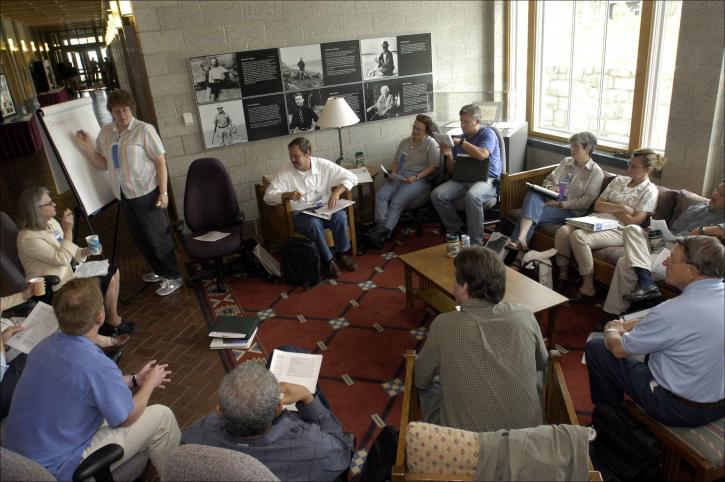
Image: https://pixnio.com/people/people-in-small-discussion-group-meeting
This is not actually a CFM meeting. We don’t use whiteboards, we don’t meet in lounge areas of larger buildings, we sit as couples and generally have snacks and wine glasses. But it’s close enough.
Previous Post

April 8, 2019
Can we have nice things after all? Nathan Pyle edition
Next Post
April 13, 2019 In which things get worse (a mom-and-dad update)
Browse Our Archives
Select a Category Actuarial/Retirement Issues Politics Uncategorized
Select a Month September 2026 August 2026 July 2026 June 2026 April 2026 March 2026 February 2026 January 2026 December 2025 November 2025 October 2025 July 2025 June 2025 May 2025 April 2025 March 2025 February 2025 January 2025 December 2024 November 2024 October 2024 September 2024 August 2024 July 2024 June 2024 May 2024 April 2024 March 2024 February 2024 December 2023 November 2023 October 2023 September 2023 August 2023 July 2023 December 2022 September 2022 August 2022 July 2022 June 2022 May 2022 February 2022 January 2022 December 2021 August 2021 June 2021 April 2021 February 2021 January 2021 December 2020 November 2020 October 2020 September 2020 August 2020 July 2020 June 2020 May 2020 April 2020 March 2020 February 2020 January 2020 December 2019 November 2019 October 2019 September 2019 August 2019 July 2019 June 2019 May 2019 April 2019 March 2019 February 2019 January 2019 December 2018 November 2018 October 2018 September 2018 August 2018 July 2018 June 2018 May 2018 April 2018 March 2018 February 2018 January 2018 December 2017 November 2017 October 2017 September 2017 August 2017 July 2017 June 2017 May 2017 April 2017 March 2017 February 2017 January 2017 December 2016 November 2016 October 2016 September 2016 August 2016 July 2016 June 2016 May 2016 April 2016 March 2016 February 2016 January 2016 December 2015 November 2015 October 2015 September 2015 August 2015 July 2015 June 2015 May 2015 April 2015 March 2015 February 2015 January 2015 December 2014 November 2014 October 2014 September 2014 August 2014 July 2014 June 2014 May 2014 April 2014 March 2014 February 2014 January 2014 December 2013 November 2013 October 2013 September 2013 August 2013 July 2013
Follow Us!
TAKE THE
Religious Wisdom Quiz
I wanted a vineyard so badly that my wife arranged the owner's death through false witnesses. Who am I?
Select your answer to see how you score.
Jezebel Ahab Naboth David
Related posts from Jane the Actuary
What do we do when coronavirus lockdowns destroy...

Are you happy with your local parish? and...
TRENDING AT PATHEOS Catholic

The Iron Gates and the Lion of the...
Yesterday, I didn't finish my report about, well, yesterday. So I'll...

Dolly Parton’s Last Song Wins Dove Award with...
Bluegrass band The Grascals, speaking on the red carpet at the 57th...

The Image: On the Horror of Capitalism and...
The Image Then went the Pharisees, and took counsel how they might...

We are approaching the date of our new American national holiday: October...

Letters on Living the Faith by C.S. Lewis
Most of us met C.S. Lewis as a public intellectual. Mere Christianity....

When Halloween Unmasks Married Hearts
Written by Dr. David K. Ewen from Eternal Truth Bible College Behind...
view all Catholic blogs
Ad-Free & Subscriber Log-In Subscription Support
- About Us
- 2026 Calendar
- Videos
- Podcasts
- Library of World Religions
- Faith In Media Tracker
- Advertise With Us
- Write for Us
- Privacy Policy
- Terms of Service
- Do Not Sell My Data
- Contact Us
- Radiant Digital
- Manage Newsletter Subscriptions
- Unsubscribe From Notifications
- Sitemap
Copyright 2008-2026, Patheos. All rights reserved.
Subscription Support Ad-Free & Subscriber Log-In
Follow Patheos