
BuddhistCatholicContemplativeEvangelicalGeneral ChristianHinduJewishLatter-day SaintMuslimNew VisionsProgressive Christian
Beliefs
- Buddhist
- Catholic
- Contemplative
- Evangelical
- General Christian
- Hindu
- Jewish
- Latter-day Saint
- More Voices
- Muslim
- New Visions
- Pagan
- Progressive Christian
Topics
- Religion News
- Food and Religion
- Sports and Religion
- Religious Art
- Religious Music and Entertainment
- Religious Events
- History and Religion
- Style and Religion
- Politics and Religion
- Women in Religion
- Recreation Outdoors and Religion
- Business Finance and Religion
- Careers Workplace and Religion
- Education and Religion
- Family Parenting and Religion
- Health Fitness and Religion
- Home and Religion
- Relationships and Religion
- Technology and Religion
- Travel and Religion
Columnists
- Buddhist Columnists
- Business Finance and Religion Columnists
- Careers Workplace and Religion Columnists
- Catholic Columnists
- Contemplative Columnists
- Education and Religion Columnists
- Evangelists Columnists
- Family Parenting and Religion Columnists
- General Christian Columnists
- Health Fitness and Religion Columnists
- Hindu Columnists
- History and Religion Columnists
- Home and Religion Columnists
- Jewish Columnists
- More Voices Columnists
- Latter Day Columnists
- Muslim Columnists
- New Visions Columnists
- Nonreligious Columnists
- Pagan Columnists
- Politics and Religion Columnists
- Progressive Columnists
- Recreation Outdoors and Religion Columnists
- Relationships and Religion Columnists
- Religion News Columnists
- Religious Art Columnists
- Religious Events Columnists
- Religious Music and Entertainment Columnists
- Sports and Religion Columnists
- Style and Religion Columnists
- Technology and Religion Columnists
- Travel and Religion Columnists
- Women in Religion Columnists
Resource Library
- 2026 Calendar
- Library of World Religions
- The 100 Most Holy Places on Earth
- Patheos Answers
- Podcasts
- Videos
- Faith Leaders Database
- Anglican Episcopalian
- Bahai
- Baptist
- Buddhism
- Christianity
- Confucianism
- Eastern Orthodoxy
- Hinduism
- Holiness and Pentecostal
- ISKCON
- Islam
- Judaism
- Lutheran
- Methodist
- The Church of Jesus Christ of Latter-day Saints
- New Age
- Paganism
- Presbytarian and Reformed
- Protestantism
- Religion Behind the Scenes
- Roman Catholic
- Scientology
- Shia Islam
- Sikhism
- Sufism
- Sunni Islam
- Taoism
- Zen
- See all religions
Research Tools
 Ad-Free & Subscriber Log-In Subscription Support
Ad-Free & Subscriber Log-In Subscription Support
Follow Patheos 

- Trending:
- Forgiveness
- |
- Marriage
- |
- Consciousness
- |
- Death Penalty
- |
- Election
- |
- Halloween

- Home
- Catholic
- Politics and Religion
- Can we have nice things after all? Nathan Pyle edition
Can we have nice things after all? Nathan Pyle edition
Last updated on: April 8, 2019 at 7:17 pm by Jane the Actuary
Can we have nice things after all? Nathan Pyle edition 2019-04-08T19:17:32-06:00 Jane the Actuary
Patheos Explore the world's faith through different perspectives on religion and spirituality! Patheos has the views of the prevalent religions and spiritualities of the world.
Did Arthur Brooks plan for his book Love Your Enemies to be released a few short weeks before the latest Two Minutes’ Hate? Unlikely. But it’s certainly fortuitous, though it was a bit discombobulating to be reading the final chapters of Brooks’ book calling for reconciliation with political opponents while idly checking my facebook feed and learning that there’s a new hatestorm brewing against Nathan Pyle, the author of a emergingly-popular internet comic strip in which aliens talk about everyday actions, because of a newly-discovered tweet from 2017, to wit:
https://twitter.com/nathanwpyle/status/825066260153167873
(yes, I was, in fact reading at a fast clip; the book is due back at the library).
Some of the reactions from twitter and facebook were mild announcements that the account was being unfollowed. Others called him an “anti-choice activist” and proclaimed that he wanted to enslave women:
I am deeply disappointed to learn that Nathan Pyle is an ardent anti-choice activist. I will not be sharing any more of his comics.
— Erica Friedman is on Bluesky: okazu.bsky.social (@OkazuYuri) April 8, 2019
Just found out Nathan Pyle is a #forcedbirther which is a shame because I was really enjoying #StrangePlanet . Oh well, glad I found out before ordering any merch. Unsubscribe. https://t.co/BsbcvxcjUZ
— Cassie (@CaSSiSiA) April 8, 2019
https://twitter.com/timeisascam/status/1115325202441723904
(I’m told that people are being even more, er, expressive in their facebook comments.)
How do you digest that, in light of Brooks’ call for a little more kumbaya?
To back up a bit:
The essence of Brooks’ book is that we should all just take a step back, and focus on calming the heck down. Even if we feel like those on the other side of the political divide hold us in contempt, we need to practice, as the title says, loving our enemies, rather than mirroring this same contempt back at them.
(His background, by the way, is that of a think-tanker, now president at AEI so I am predisposed to say nice things about him anyway, and prior to that an academic, and before that a French hornist at a symphony orchestra. And he seems to be an all-around Smart Person.)
There are a couple key observations to his book:
First, a chapter called “How Can I Love My Enemies if They Are Immoral?” calls on readers to recognize that their political opponents do indeed have moral principles, but just express them differently. He cites a scholar who distills morality into five “foundations”: fairness, care for others, respect for authority, loyalty to one’s group, and purity or sanctity, and suggests that while progressive reject the last three, we share the first two, but understand them differently. Now, I’m skeptical of the claim that progressives reject “loyalty to one’s group” as a virtue; seems more that they disagree on who “the group” consists of. And they are not interested in sexual purity but demand other sorts of purity and I’m not going to venture into assessing whether there’s some underlying similarity.
He also shares the story of Robert George and Cornel West, two professors at Princeton who are polar opposites politically but very close on a personal basis. He provides an anecdote of a researcher in the 1930s who found that a Chinese couple traveling the US had no difficulty being accepted at hotels and restaurants the management of which later said, via an anonymous survey that they would not accept Chinese customers — that is, because it is personal contact and personal relationships which make a difference, not exchanges in the ether of the internet, or statistical data. And he writes that, when he gives talks — which he attempts to do frequently, even to potentially hostile audiences — he does so with an attitude of outreach rather than confrontation. Oh, and he emphasizes that “winning arguments” is really nothing of the sort — that is, if you “own” someone or “school” someone with your superior intellect, you haven’t actually persuaded someone if the end result is that they feel you’ve treated them with contempt.
Finally, he gives “five rules” in his conclusion, including a call to “escape the bubble” by exposing yourself to other perspectives, to actively try to “treat others with love and respect, even when it’s difficult” and to “disagree better.”
So what does this have to do with Nathan Pyle?
It is difficult to process this sort of name-calling, and it’s circular. These people said really nasty things about me. Maybe not directly, but indirectly, they piled on hate for someone who shares my beliefs, in the same way as the Covington High School boys were deemed guilty because of their presence at a March for Life. How can I work with people who hate me and are mean to me? And in that respect, isn’t Brooks’ book just preaching to the choir? The haters aren’t interested in changing their ways — they are perfectly happy riling people up on the internet.
But at the same time, on the bright side, “Nathan Pyle” isn’t trending. There are tweets pushing back against this reaction (though some of them say, unfortunately, “give him the benefit of the doubt; maybe he’s reformed since then”). And with respect to the haters, the boycotters, the “cancel culture,” I am not going to change anyone’s mind. But Brooks’ call is something more long-term. It’s a serenity-prayer sort of thing, I suppose: if you’re not going to change minds by yelling back, what can you do? Maybe in your own small corner of the world, in the way you interact with people on a day-to-day basis online and in person, you can decrease the chances that someone will react that way in the first place.
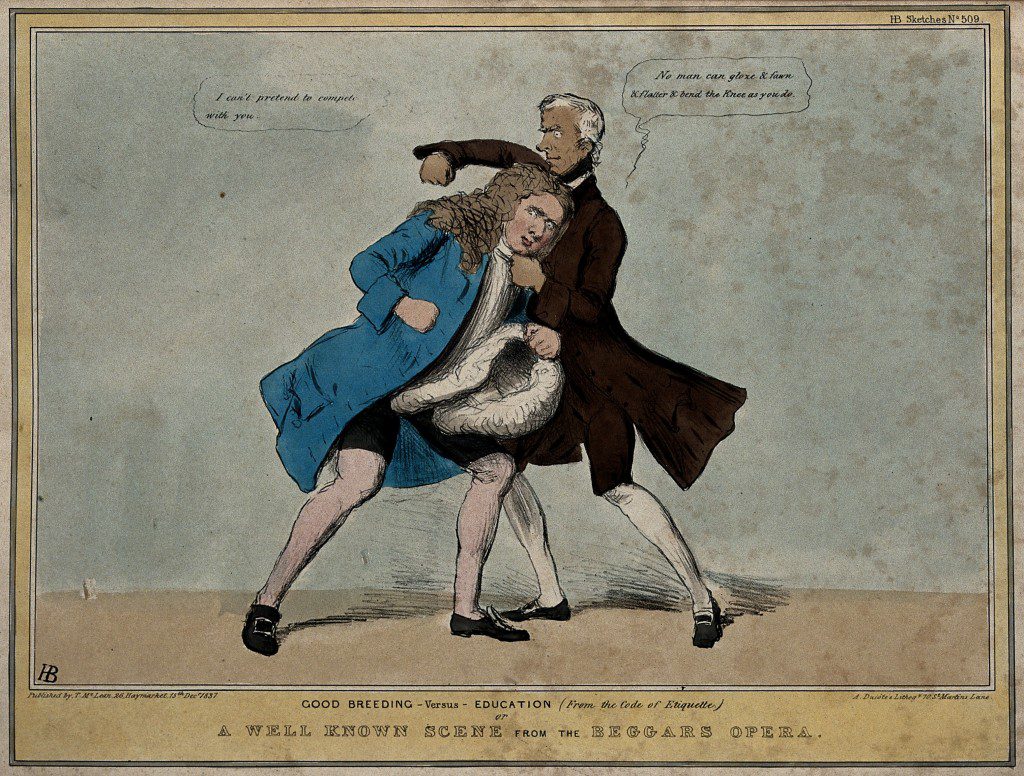
Image: V0050236 A fist-fight between Lord Brougham and Lord Melbourne as Pea
Credit: Wellcome Library, London. Wellcome Images
[email protected]
http://wellcomeimages.org
A fist-fight between Lord Brougham and Lord Melbourne as Peachum and Lockit. Coloured lithograph by H.B. (John Doyle), 1837.
1837 By: John DoylePublished: 22 October 1836
Copyrighted work available under Creative Commons Attribution only licence CC BY 4.0 http://creativecommons.org/licenses/by/4.0/
Previous Post

April 8, 2019
Wheelchairgate and "can't" vs. "won't"
Next Post
April 9, 2019 Fixing CFM
Browse Our Archives
Select a Category Actuarial/Retirement Issues Politics Uncategorized
Select a Month September 2026 August 2026 July 2026 June 2026 April 2026 March 2026 February 2026 January 2026 December 2025 November 2025 October 2025 July 2025 June 2025 May 2025 April 2025 March 2025 February 2025 January 2025 December 2024 November 2024 October 2024 September 2024 August 2024 July 2024 June 2024 May 2024 April 2024 March 2024 February 2024 December 2023 November 2023 October 2023 September 2023 August 2023 July 2023 December 2022 September 2022 August 2022 July 2022 June 2022 May 2022 February 2022 January 2022 December 2021 August 2021 June 2021 April 2021 February 2021 January 2021 December 2020 November 2020 October 2020 September 2020 August 2020 July 2020 June 2020 May 2020 April 2020 March 2020 February 2020 January 2020 December 2019 November 2019 October 2019 September 2019 August 2019 July 2019 June 2019 May 2019 April 2019 March 2019 February 2019 January 2019 December 2018 November 2018 October 2018 September 2018 August 2018 July 2018 June 2018 May 2018 April 2018 March 2018 February 2018 January 2018 December 2017 November 2017 October 2017 September 2017 August 2017 July 2017 June 2017 May 2017 April 2017 March 2017 February 2017 January 2017 December 2016 November 2016 October 2016 September 2016 August 2016 July 2016 June 2016 May 2016 April 2016 March 2016 February 2016 January 2016 December 2015 November 2015 October 2015 September 2015 August 2015 July 2015 June 2015 May 2015 April 2015 March 2015 February 2015 January 2015 December 2014 November 2014 October 2014 September 2014 August 2014 July 2014 June 2014 May 2014 April 2014 March 2014 February 2014 January 2014 December 2013 November 2013 October 2013 September 2013 August 2013 July 2013
Follow Us!
TAKE THE
Religious Wisdom Quiz
Who was the youngest king of Judah?
Select your answer to see how you score.
Jehoshaphat Asa Hezekiah Josiah
Related posts from Jane the Actuary

"Jury refuses to protect 7 year old from...
Guest post: When Liberal Catholicism Becomes Toxic, or,...
Outrage. Clicks. Readers, I have questions.
It's MLK Day. Who should I hate?
TRENDING AT PATHEOS Catholic

Dolly Parton’s Last Song Wins Dove Award with...
Bluegrass band The Grascals, speaking on the red carpet at the 57th...

The Image: On the Horror of Capitalism and...
The Image Then went the Pharisees, and took counsel how they might...

We are approaching the date of our new American national holiday: October...

Letters on Living the Faith by C.S. Lewis
Most of us met C.S. Lewis as a public intellectual. Mere Christianity....

When Halloween Unmasks Married Hearts
Written by Dr. David K. Ewen from Eternal Truth Bible College Behind...

Aristotle. He’s been called the father of logic, the father of the...
view all Catholic blogs
Ad-Free & Subscriber Log-In Subscription Support
- About Us
- 2026 Calendar
- Videos
- Podcasts
- Library of World Religions
- Faith In Media Tracker
- Advertise With Us
- Write for Us
- Privacy Policy
- Terms of Service
- Do Not Sell My Data
- Contact Us
- Radiant Digital
- Manage Newsletter Subscriptions
- Unsubscribe From Notifications
- Sitemap
Copyright 2008-2026, Patheos. All rights reserved.
Subscription Support Ad-Free & Subscriber Log-In
Follow Patheos